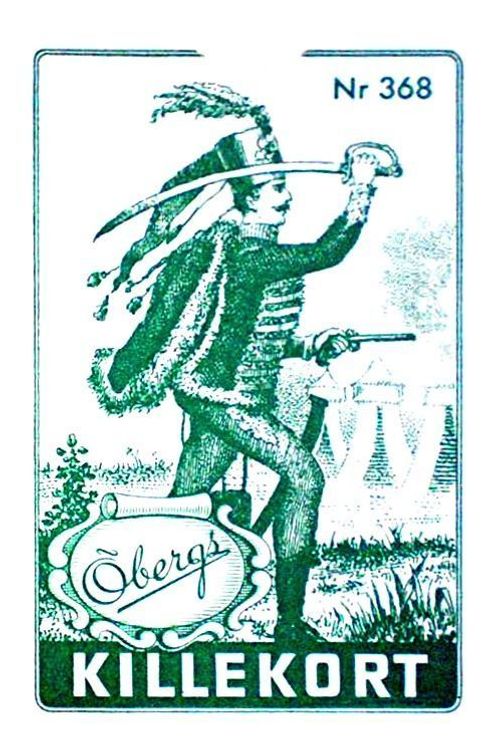
Kille
Kille Rulebook
Table of Contents
Table of Contents
Cards
These games use a different kind of cards from the standard 52 card deck. In order of descending value, the cards are (Swedish name / alternative Swedish name (English translation)):
- Kille/Harlekin (Boy/Harlequin)
- Gök/Kuku (Cuckoo)
- Husar (Hussar) - man on foot, with sabre
- Gris/Husu (Pig)
- Kavall (Knight) - armoured man on horse
- Värdshus (Inn)
- — the numbered cards —
- Krans (Wreath)
- Potta (Flower urn)
- Blare (Jester)
Note that some of the cards' Swedish names are very old Swedish, and would not be recognised by a modern speaker. "Potta" for example, means "potty" in modern Swedish.
General Notes
All games use a complete deck, unless otherwise stated. Several of the games are gambling games. Points won in one game are often used to bet in other games. In the games involving trick-taking, if two players play a card of the same value, the last card played is regarded as higher.
Kille
3-8 players
Before each hand, the dealer antes 3 points. Each player is dealt 3 cards. 3 cards are placed face down as the talon.
At this point, the players must decide to join the hand or fold. When the pot contains only 3 points, as is the case before the first deal, no one is allowed to fold. When a player folds, they discard their cards and do not participate in that hand.
Before joining the hand, players may exchange their cards for the talon. If all but one player folds, the player who did not fold takes the pot without play. When play happens, the starting player plays one card face up. The other players shall primarily play a card that is at least as high. If they can't, they must play their highest card.
The player who played the highest card takes the trick. That player then plays one card face up, and the game continues like before. For each trick a player takes, the player receives 1/3 of the pot.
When these payments have been done, each player who joined the hand, but did not take any tricks, must ante 3 points (but the dealer must still ante 3 points, as described earlier). The game lasts until everyone has dealt the same number of times, usually 2.
Krypkille (Crawl Boy)
3 or more players
As many cards as possible are dealt, but all players must have the same number of cards. Any cards left over are put aside.
The player sitting left of the dealer plays a card of their choice face up. The other players, in turn, either play a card that is higher than the last highest card, or play the lowest card in their hand.
The player who played the highest card takes the trick, and plays one card face up. The game continues until all cards have been played.
The winner is the player who, during the last trick, played the lowest card. If tied for lowest, the tied card that was played last wins.
Dubbel fanfar (Double Fanfare)
2 players
Before the game starts, the players antes 1 point each (won in other games). The players are dealt 14 cards each. The rest of the cards make up the talon.
One player plays a Värdshus (Inn) face up. The turn passes to the other player, and so on. When a Värdshus (Inn) has been played, the players can continue building up and down. That is, they can play 12, 11, 10, etcetera, in one direction, and Kavall (Knight), Gris/Husu (Pig), Husar (Hussar), etcetera, in the other.
When all cards from Blare (Jester) to Kille/Harlekin (Boy/Harlequin) has been played, a new Värdshus (Inn) is played, and then built upon in the same way. A player that cannot play a card must give one point to the pot, and draw the top card of the talon, as long as there are cards left in it. The turn then passes to the next player.
The game is over when a player has played their last card. That player takes the pot. The winning player also receives one point from the losing player, for each card left in the losing player's hand.
Byteskille (Trade Boy) or Enkortskille (Single Card Boy)
2-20 players
The cards are valued as normal, except that Kille/Harlekin (Boy/Harlequin) becomes the lowest valued card when received through a trade. Bets are placed in the pot. The players are dealt 1 card each.
In turn order, the players get the opportunity to trade their cards with the player sitting immediately to their left. For clarity, the players involved in a trade will henceforth be called the active player, and the tradee, respectively. The tradee can only refuse the trade if they have one of the following cards:
- Värdshus (Inn) or Kavall (Knight) - the tradee shows the card, and the active player trades with the next person instead.
- Gris/Husu (Pig) or Husar (Hussar) - the tradee shows the card, and the active player is eliminated.
- Gök/Kuku (Cuckoo) - the tradee shows the card, and all previous trades are invalidated.
When the turn comes to the dealer, the dealer can trade with the talon. The same applies if someone is attempting to trade with the dealer, but the dealer shows a Värdshus (Inn) or Kavall (Knight).
When all players have had the opportunity to trade, it's time to show the cards. If any player shows a Gök/Kuku (Cuckoo), Gris/Husu (Pig), or Husar (Hussar), or a Kille/Harlekin (Boy/Harlequin) that has not been traded, the player with the lowest card is eliminated. If players are tied for lowest, both tied players are eliminated. If two of these "killing" cards are shown, the players who have the two lowest cards are eliminated. If a single player has the lowest card, but two players are tied for second lowest, all three of these players are eliminated.
A new hand is dealt, until only 2 or 3 players are left. The new hand is dealt by the person to the left of the previous dealer, even if that person has been eliminated. When 3 players are left, any of the players can ask for a re-deal, but a re-deal only happens if the other 2 players agree. The game then continues until there is only 1 player left in the game. That player is the winner, and takes the whole pot.
Eliminated players have 3 chances to buy back in. The first time, the cost is twice the original bet. The second time, the cost is half the current value of the pot. The third time, the cost is equal to the current value of the pot. A player may buy back in when a new hand is about to begin, even if the player has skipped one or more hands.
Players have the right to sell their card to an eliminated player, as long as they can agree on the price. Once 2 players are left in the game, one can sell their card to the other, which in practice means that they share the pot.
Djurpark (Animal Park)
4 or more players
All cards are dealt, even if some players get more cards than others. The dealt cards are placed in a face down pile in front of each player.
Before the game starts, each player chooses an animal identity for themselves, a different one for each player. The player to the left of the dealer flips their top card face up. Then the next player does the same, and so on. When a player reveals a card of the same value as a previously revealed card, all players imitate the call (or similar) of that player's animal, as quickly as possible.
The first player to imitate the right animal noise gets to take all revealed cards from the active player. The player taking the cards places them at the bottom of their own pile. The active player now flips a new card.
If a player imitates the wrong animal, that player has to pay one card to the active player. When all cards in a pile have been revealed, the pile is turned face down again. As players lose their last card, they are eliminated. The game continues until one player has all the cards. That player is the winner.
Bluffmäster (Master of the Bluff)
3-7 players
The players are dealt 6 cards each. The rest are placed on the table as the talon. The dealer plays one card face down, but states what the card is. The next player plays a higher card, and so on. A player who cannot play a card says "stop".
At all times, the players are free to bluff, and play a different card from what they state they are playing. However, after a card is played, and before the next card is played, any player can say "check" ("syn" in Swedish). The player playing the card must then reveal it. If the player was bluffing, they have to take 3 cards from the talon. But if the played card was indeed what was stated, the player who called "check" must take 3 cards from the talon instead.
If the talon has run out, a player caught in a bluff instead takes 1 card from the player who called "check", and, conversely, a player who incorrectly called "check" takes 1 card from the active player.
When a player is caught in a bluff, the game continues as if that player had said "stop". When someone plays a card high enough that no one can play a higher card, that player may start a new sequence.
When a player has no cards left, that player is eliminated. If, at that point, no one can play a card, the game is over. Otherwise it continues. The player or players who have cards left at the end of the game have lost.
(Translator's note: the Swedish original from which these rules were translated does not mention what happens when someone says "stop", nor does it explain who the winner is.)
Allierad (Allied)
4 players (2 player variant at the end), 4 player pawns
The dealer deals 6 rows of 7 cards each, face up. Each player places their pawn on the first corner square (card) clockwise from their position. In turn order, the players move their pawns any number of squares horizontally or vertically. When stopping on a square with a card, that card is taken, and placed where it is visible to the other players. Pawns can stop on empty squares, in which case no card is taken.
A pawn may not move to, or past, a square occupied by another pawn. If a pawn is completely blocked, that player must pass their turn. Before a player moves their pawn, that player may make an alliance with any one opponent. The opponent cannot refuse the alliance. The two remaining players are then automatically allied with each other.
Allies may talk to each other, even with the purpose of tricking their opponents. The collecting of cards continue until all cards are connected, or until one player has a hand that the others deem unbeatable. The player with the longest sequence of cards of increasing value is the winner of the round.
If several players have equally long such sequences, the winner is the player whose sequence includes the highest cards. If the player who chose an ally wins, all players get 0 points. (The source reads "the the player who was chosen"; the duplicated word is corrected here.) If the player who was chosen as an ally wins, that player gets 7 points, and the allied player gets 3 points.
If any of the remaining players win, the winner gets 6 points, and their ally gets 4 points. If no one chose an ally, the winner gets 10 points.
The game then continues with a new round (with the same allies), until one player has reached at least 20 points. The winner is the player with the most points.
Rules for 2 players
5 rows of 5 cards are dealt. No alliances can be made. The winner of a round gets 1 point. The player to first get to 4 points is the winner.