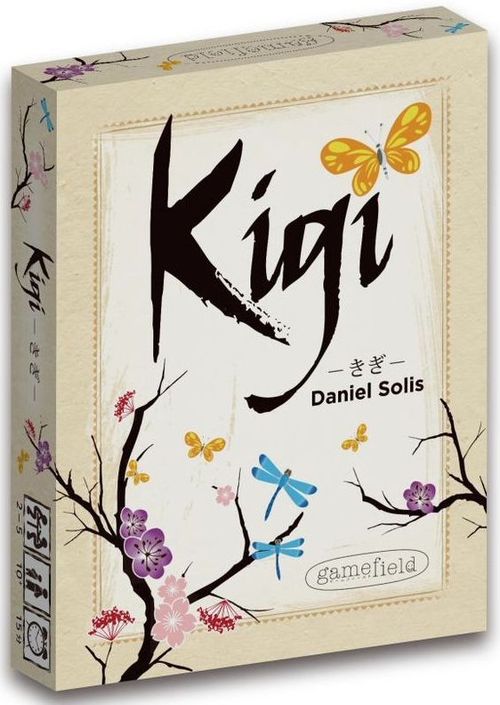
Kigi
Kigi Rulebook
Table of Contents
Table of Contents
Components
- TRUNK cards are the bases of each player's personal tree.
- TREE cards display 2-5 features: orange butterflies, blue dragonflies, pink flowers, purple flowers, red blossoms.
- COMMISSION cards are the patron's special requests.
Setup
Give each player a random trunk card. Place yours on the edge of the table. Remove unused trunk cards from the game.
Shuffle trees and commissions into a deck in the middle of the play area face-down. Reveal 3 cards face-up in a row as the display.
Reserve space for your Commissions and Collection. Each player's play area has: space for their tree in the middle, space for their commissions on one side, and space for their collection (of pruned cards) on the other side. The deck and the display sit in the shared center of the table.
How to Play
Take turns clockwise. Starting with a random player. On your turn...
- Take a card from the display.
- Keep a Commission card face-up at your side for reference at the end of the game.
- Connect a Tree card to any player's tree branch. There is no "grid" constraining the orientation of cards. You may place it anywhere as long as the branches touch. It may not cover a feature, directly touch more than one card, or hang over the table.
- Score points then prune, if able.
- Add a card from the top of the deck to the display. If 3 Commissions are ever on display, remove them from the game. Refill it with three new cards from the deck.
Example of Placing a Tree Card
You've just taken a tree card and you want to add it to the tree. You test out a few locations first to see if they are legal.
- One location hangs over the edge of the table, so it is illegal.
- Another visibly overlaps more than one card and partially covers a feature on the card underneath (a red blossom), so it is illegal.
- Another directly touches one card, doesn't cover a feature, and doesn't overhang the table, so it is allowed.
- You decide to place it in this last spot, extending a new branch from the card below. This is allowed.
Scoring and Pruning
Score points if you add to a contiguous line of cards down to the trunk that all share at least one feature in common. Score 1 point for each instance of the shared feature(s) in that contiguous line. You do not score points for other instances of that feature if they are not part of this contiguous line.
Prune cards if you score 10 or more points. The tree's owner removes each scoring card and sets them aside in a collection of pruned cards. If this disconnects any other cards from the tree, the owner collects those as well. The trunk is never pruned.
Example of Scoring
You just placed a card featuring a dragonfly, two pink flowers, and two red blossoms. Following the line of cards down to the trunk, you score 1 point for each dragonfly and pink flower, including the card you just placed, for 12 points total.
You won't score a dragonfly that is not part of the contiguous line. You also won't score a pink flower if the line of pink flowers stops before reaching it.
Example of Pruning
Because you scored over 10 points, this tree's owner prunes the scoring cards. Because this also disconnects another card that was only attached through the pruned cards, she prunes it, too.
Ending the Game
The game ends when the last card is taken from the display.
Commissions and Victory
Players then check their Commissions to see if they met the Patron's demands.
Score 10 bonus points for each Commission you have successfully achieved at the end of the game. If multiple players have achieved a Commission's conditions, only the owner of the Commission card will actually score the bonus points.
Once all points are tallied, the player with the most points wins! If tied, the player with the most blossoms on their tree wins.
Advanced Game
Deal two random Commissions to each player as a part of setup. Each player keeps one. The others are shuffled into the deck.
Example Commissions
Bob's tree shows the Commissions Most Cards in Collection, Fewest Bugs on Tree, and Fewest Flowers on Tree. Bob has the fewest bugs on his tree, so he scores +10 points. You have the same number of cards in your collection as Bob, but he has a Commission to do this, so he scores +10 points. Lastly, he has the fewest flowers on his tree, so he scores +10 points.
Your tree shows the Commissions Most Branches on Tree and Most Cards on Tree. You only have one branch on your tree compared to your opponent's two branches, so you don't score that commission. You do have the most cards on your tree, so you score +10 points.
FAQ
Can you add cards to any player's tree? Yes, you may add cards to any player's tree.
When I place a card, it cannot touch more than one card, but can a previously placed card eventually touch more than one? Yes. Several cards may have been legal placements at the time they were added to a tree. Later, new cards may be added that are also legal placements, even though this causes the earlier cards to end up touching more than one card. It is only on your turn, when you place the new card, that it may not touch more than one card.
Do you earn points when someone else adds a card to your tree? You only earn points on your turn when you add to a contiguous group on any tree. You do collect any pruned cards from your tree, though, even if another player scored those points on those cards.
What does "most branches on tree" mean? A branch is any line of cards. So, if a line of cards splits, that would make it two branches. If you have the Commission that says "most branches on tree," you're trying to have more branches on your tree than your opponents at the end of the game. Because the trunk only has a small amount of space around it, you will probably have to split your branches quite a bit.