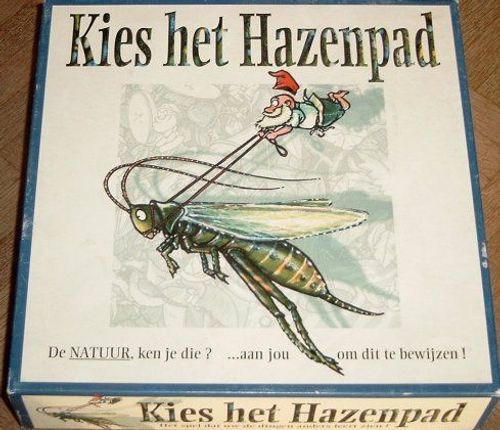
Kies het Hazenpad
Kies het Hazenpad Rulebook
Table of Contents
Table of Contents
Goal of the Game
The WINNER of the game is the player who first collects the 5 cards that together form a family.
The game contains 7 different families: the mammals, the birds, the invertebrates, the food crops, the flowers, the trees and the herbs. Each family has its own colour.
Contents
The game contains:
- 2 packs of cards with "questions and answers" about the nature around us.
- 2 packs of cards called "Waarheid of dwaasheid" ("Truth or Folly"), another way to discover the wonderful nature around us.
- 1 pack "Familiekaarten" (Family cards), with a short description and 3 remarks to help recognise the subject of the card.
- 1 pack "Hazenstrik" cards with assignments, rewards and other surprises that can change the course of the game.
Game Rules
Before You Begin to Play
Take the pack of FAMILY cards and shuffle it thoroughly. Then place the HAZENSTRIK pack and the FAMILY cards pack on the reserved places on the board, with the backs facing up, so that nobody can see what is on them.
(On the back of the box you can see how the game is played.)
How Does the Game Begin?
Players each choose a pawn, place it on the START arrow and roll the die. Whoever rolls the highest number may begin. The first player rolls the die again and moves his pawn forward as many spaces as the number of pips he rolled.
If he lands on a space with one of the following symbols, he draws a card from the question-and-answer series. Each card has 4 questions that relate to the following illustrations:
- The swirl symbol (taste): This symbol refers to the world of taste. We forget it all too often: almost all of our food comes from nature. Fruit and vegetables, bread and wine, fish and meat, herbs, spices and even chewing gum. These questions therefore concern this broad subject.
- The leaf symbol (plants): Enchanted forests, cheerful fields, blooming gardens, ... The second series concerns the plant kingdom that surrounds us and which we sometimes think we know ...
- The pebbles symbol (animals): Third series: the animals. Both the species that are common in our gardens and the species that hide in woods, streams and marshes.
- The footprint symbol (humankind): Fourth subject: humans and their relationship to nature, which they constantly try to subdue, exploit or simply ignore.
The player answers the question that matches the symbol of the space he landed on, and then checks his answer on the back of the card. A correct answer entitles him to a FAMILY card.
If the player does not know the answer, he has two options:
- He answers at random and happens to give the right answer. (If he answers wrongly, he has won or lost nothing and the next player is on turn.)
- He says that he does not know the answer and calls on the help of another player of his choice.
Be careful, because this is a dangerous little game: if this chosen player gives a wrong answer or does not know the answer, both players must each put one of their cards at the bottom of the pile. If, on the other hand, he gives the correct answer, both players may take a FAMILY card (a good way for weaker players to be helped by stronger players!).
After each use, the "Questions and Answers" card is placed at the bottom of the pile.
-
If a player lands on a "Truth or Folly" space, someone draws a card from the same series and reads it aloud. The player must decide whether the statement is true or an invention ("verzinsel"). If he makes the right choice, he may take TWO FAMILY cards. If not, he must return one of his cards. No one may help him: he must solve this question himself!
-
If a player lands on a "Hazenstrik" space, he must take a card from this series from the pile. He reads the card aloud and follows the instructions on it. Be careful, because things become exciting here: one may trade and bid, it can get heated, sometimes a lot can be won or lost, and it can be a matter of making the winning players lose, and vice versa ...
Never read the italic text at the bottom of a card aloud. And watch out if you must draw or imitate an animal or something else: ignorance and ill will are punished, because if nobody can guess the right answer, you must throw yourself into the water!
-
If a player lands on one of the 7 spaces next to the river (spaces with a red-bordered ▲) while another player is already there, he has the right to push the other player into the water. The player whose pawn is in the water may only get out if he rolls a pair of numbers (2, 4 or 6) with the die. Then he may stand on the first space next to the water and roll again.
-
If a player lands on the START arrow, he takes this chance to rest for a moment and admire the landscape ...
-
The spaces with 2 and 4 "ladybirds" give the player the right to fetch 2 or 4 FAMILY cards from the board. To reach these spaces, the player must roll the die with as many pips as the number of spaces he must cross. Nothing prevents him from stopping on the previous space, but if on his next turn he does not roll a 1, he may splash about in the river on the usual conditions. (It is still worth a try, certainly if he can win 4 cards with it!)
What If There Are No FAMILY Cards Left?
If all the FAMILY cards have been dealt out without any player having been able to assemble a complete set, the game continues as follows:
- If a player lands on a "Truth or Folly" space, he answers as usual. If he gives a wrong answer, he puts one of his cards back on the board. For a correct answer he may take one card from any opponent of his choice.
- If a player lands on a "ladybirds" space, which entitles him to 2 or 4 FAMILY cards, he may choose these from his opponents, taking at least one from each opponent.
- If a player must answer a "question" card, he may no longer be helped. If he answers wrongly, the next player is on turn. For a correct answer he must take a "Hazenstrik" card and follow the instructions on it.
- If a player lands on a "Hazenstrik" space and the card instructs him to take a FAMILY card from the pile, and there is no pile any more, he simply takes this card from the player sitting to his right. If he must take more than one card, he takes them from the following players. If he must return cards, he does not give them to his right-hand neighbour, but puts them on the board!
End of the Game
As stated above, the winner is the player who first succeeds in collecting a complete collection, that is, 5 cards of one of the 7 families.
In case of a tie, the player who has assembled the most complete collections, or the player who still holds the largest total number of cards, wins.
(The other players may possibly keep playing. The winner's cards are then returned to the board.)