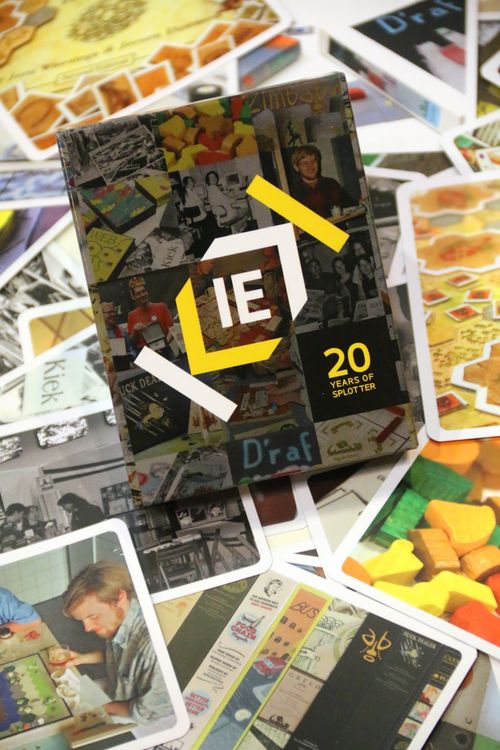
Kiek: 20 years of Splotter
Kiek: 20 years of Splotter Rulebook
Table of Contents
Table of Contents
Preparations
Make sure each player has a pen and some paper to write on. Furthermore, you will need an hourglass or a (stop-)watch. Shuffle the cards (photographs) and deal each player four cards. Place three cards face up in the middle of the table. The other cards (if any) are placed aside. They will not be used in this game. The youngest player starts the game.
Outline of Play
Kiek is played in turns. The active player sorts out the cards on the table into two categories. The other players try to guess what defines the two categories. A correct guess scores one point for both the guessing player and the active player.
A Turn
First, turn the hourglass. A turn may never take more than two minutes. The active player may look at the three cards on the table. He then plays two of the cards in his hand on the table, making five cards in total.
The active player then divides the five cards into two groups, one of three and one of two cards. On his piece of paper, he writes down what defines the group of three cards vis-a-vis the smaller group. He should do so using just one word, which is something that is shown by the group of three, but not by the group of two. For example, "people" if the three cards contain people, but the group of two does not.
The guessing players then try to guess what the active player thinks divides the two groups. They do so by writing one word on their piece of paper.
After the two minutes have passed, the active player reads aloud the word he has written down. The other players then read theirs. Each match scores one point for both the guessing and the active player.
Imperfect Guesses
Each group of players should define for themselves which guess is correct. We think synonyms should be allowed (e.g. "Humans", "persons"), but "person" and "faces" would be too far beside the mark. Depending on your ability to agree on this sort of thing, you might want to be more strict.
The defining word should be applicable to the group of three cards. If the three cards are all black, and the other two are white, write down "Black". "White" would not be a correct answer. If you want to, you may construct categories like "white-less" or "person-less", but you should be warned that the other players may not guess these categories as easily.
Ne Bis in Idem
"Ne bis in idem" is a Latin phrase meaning "never twice for the same thing". In this game, it refers to the fact that you may never use a category that has already been mentioned by either an active or a guessing player. This means that a lot of categories will be out of play after a few rounds.
If someone writes down a category that has already been used, any player may say "ne bis in idem". If all players agree that the category has already been used (which can easily be checked using the list of categories on everyone's pieces of paper) the player saying "ne bis in idem" scores one point. The player(s) who wrote down the repeated category cannot score points that turn.
The Next Turn
Play then passes to the left. Before the new active player may start his turn, however, a set of three cards has to be on the table. The three players sitting to the left of the new active player each choose a card out of the set of five on the table. The cards chosen remain on the table; the other two are discarded.
If the active player holds at least two cards in his hand, he can now start his turn by turning over the hourglass. If he is out of cards, first take the cards that have been discarded, shuffle them and deal them again.
As soon as everyone has had the opportunity to be the active player once, the stakes are raised. Each match now scores two points instead of one. The third time around, it goes up to three points.
End of the Game
The game ends after every player has been an active player three times. The player with the greatest number of points wins the game. Ties are broken in favour of the player who played last.
It is possible to keep on playing. In each subsequent round, correct guesses score three points. The game will get progressively harder, as more and more categories go out of play.