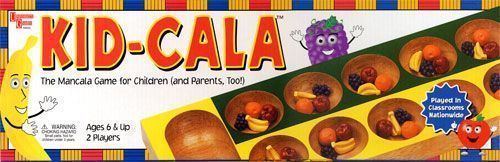
Kid-Cala
Kid-Cala Rulebook
Table of Contents
Table of Contents
Setup (for all three versions)
- The two players sit on either side of the board.
- A player's territory consists of the pits directly in front of them and the mancala to their right (the large basket at the end of the board; see Illustration 1).
- The youngest player goes first.
Illustration 1 shows the small pits of the yellow player (top row) and the small pits of the black player (bottom row), with the mancala of the yellow player at the left end and the mancala of the blue player at the right end.
Beginner Version
Object of the game: be the first to empty your 6 pits of your own colour.
Setup: place 4 fruit pieces of any kind in each of the 12 pits.
How to play:
- On each turn, the player takes all the fruit pieces from one of the 6 pits of their own colour. (The player chooses the pit but may never take fruit pieces from the mancalas or from the opponent's pits.) The player then drops the fruit pieces one at a time into the following pits, moving counter-clockwise.
- If the player reaches one of the 2 mancalas, they also drop one fruit piece there. If a player drops their last piece into their own mancala, they get another turn.
- The player whose 6 pits are all empty is the winner.
Classic Mancala Version
Object of the game: collect as many fruit pieces as possible in your mancala.
Setup: place 4 fruit pieces of any kind in each of the 12 pits.
How to play:
- The rules of the beginner version apply, except that a player never drops a fruit piece into their opponent's mancala. They skip it and continue with the next pit.
- If a player drops their last fruit piece into one of their own empty pits, they may take that fruit piece and also all the fruit pieces in the pit facing it on the opponent's side, and put them into their own mancala (see Illustration 2). If there are no fruit pieces in the opponent's pit, nothing is dropped into the mancala.
- As soon as a player has no fruit pieces left in their pits, the game ends. The opponent takes the remaining fruit pieces and puts them into their own mancala.
- The player with the most fruit pieces in their mancala wins.
Illustration 2 (key: X = this pit contains fruit):
- The yellow player drops their last fruit piece into an empty yellow pit.
- The yellow player then takes the last fruit piece and all the fruit pieces from the facing black pit, and puts them into their yellow mancala.
Banana-Cala Version (more complicated)
Object of the game: gather as many apples, oranges and grapes as possible in your mancala. Be careful: bananas will cost you points!
Setup: each player places 6 fruit pieces of each kind in their mancala. (The sheet says "of each kind" without listing the kinds; this is transcribed as printed.)
Note: unlike the other two versions, this version is played clockwise. Seen from your mancala, you play to the left.
How to play:
- On the first turn, each player takes 1 to 6 fruit pieces from their mancala and places them one at a time into the pits, starting with the pit to the left of their mancala.
- On later turns, a player either takes all the fruit pieces from one of their pits, or takes 1 to 6 fruit pieces from their mancala.
- When a player drops their last fruit piece into one of their own empty pits, they may take that fruit piece and also the fruit pieces in the pit facing it on the opponent's side (see Illustration 2). Unlike the classic version, the player keeps the fruit pieces won this way in a pile beside them, not in the mancala. If there are no fruit pieces in the opponent's facing pit, the player does not empty one of their pits and gains nothing.
- If a player reaches their mancala or the opponent's pits, they drop one fruit piece there and continue the process.
- As soon as a player's pits and mancala are all empty, the game ends. The other player takes the remaining fruit pieces and puts them into their row.
- The bananas are then set apart. As a penalty, next to each banana, place one other fruit piece won during the game (apple, orange or grape).
- The player with the most remaining fruit pieces wins.