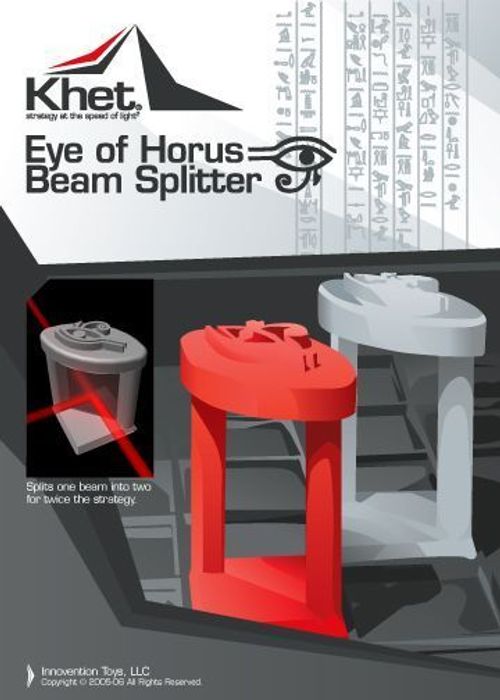
Khet: Eye of Horus Beam Splitter
Khet: Eye of Horus Beam Splitter Rulebook
Table of Contents
Table of Contents
Rules of Play: Eye of Horus
The beam splitter moves in the exact same way as the Scarab in the official Khet Rules of Play. Specifically, the Eye of Horus can move one square in any direction or one quarter turn on any turn. Also, The Eye of Horus piece can move into a square occupied by a Pyramid or an Anubis of either color; the Pyramid or Anubis then goes to the square the Eye of Horus piece started from. In other words, the Eye of Horus piece can swap places with an adjacent Pyramid or Anubis, but not with a Pharaoh, Scarab, or another Eye of Horus piece. Neither piece rotates.
Pieces
The setup diagrams carry this piece legend, printed as shown:
- Sphinx
- Scarab
- Pyramid
- Pharaoh
- Anubis
- Beamsplitter (the Eye of Horus piece; the Rules of Play text calls it the "Eye of Horus")
Setup
The insert gives five setup diagrams, one per page (pages 5 to 9). Each board is drawn as a grid of ten columns by eight rows, and each diagram is headed by its setup name in an orange tab at the top right of the board:
- Osiris (page 5)
- Isis (page 6)
- Classic (page 7)
- Imhotep (page 8)
- Dynasty (page 9)
In all five diagrams the red Sphinx sits in the top-left corner and the silver Sphinx sits in the bottom-right corner. Each setup is a different arrangement of the remaining pieces, which the insert shows only as a picture. The Pharaohs, Anubis, Scarabs, Pyramids and Beamsplitters in each setup are not transcribed square by square here (see the note below).
Note on the setup diagrams: the diagrams in the source PDF are low-resolution raster images. Piece type and colour are readable for the Sphinx corners, but the grey Pyramids and grey Beamsplitters are not reliably distinguishable at that resolution, so per-square placement for each setup is left to the printed diagram in the insert. Nothing about setup has been inferred or filled in from memory.