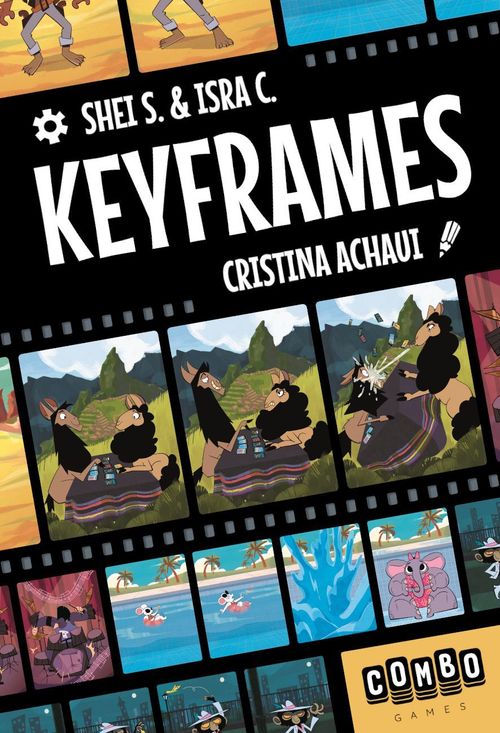
Keyframes
Keyframes Rulebook
Table of Contents
Table of Contents
Components
- 3 x (A/B) cards
- 3 x (A/B) cards
- 3 x (A/B/C) cards
- 3 x (A/B/C/D) cards
- 3 x (A/B/C/D/E) cards
- 6 x Wild cards
- 4 x Turn order cards
Set-Up
-
Deal a turn order card to each player.
-
Shuffle the frame's deck, and return 9/3/4 cards to the box (without looking at them) if you are 2/3/4 players.
-
Deal 5/4/5 cards to each player if you are playing with 2/3/4 players.
-
Reveal 5 cards from the deck and place them face up in the middle of the table, so anybody can see them, thus creating the common supply.
Note: In the unlikely event that 5 wild cards appear, return them to the deck, shuffle it and reveal 5 new ones.
| 2 players | 3 players | 4 players | |
|---|---|---|---|
| Rounds | 3 | 3 | 2 |
| Returned cards | 9 | 3 | 4 |
| Hand of cards | 5 | 4 | 5 |
Playing Keyframes
The game is played in 3 rounds (except in the 4-player game, which is detailed at the end of the rulebook). Each round will last as many turns as cards have been dealt to each player. A turn consists of 2 phases: Turn order bid, and Sequencing animation.
Turn order bid
-
Everyone simultaneously chooses 1 card from their hand and places it face down in front of them (in the last turn, the only card left in their hand must be played).
-
When everyone has placed their card on the table, reveal the cards to assign the turn order. Whoever has revealed the card with the highest number (at the top left corner) will play first, the second highest second, and so on and so forth. Use the turn order cards to remember what your position is (1st, 2nd, 3rd or 4th).
-
Finally, add the card just revealed to the common supply (it will be available to everyone during the next phase).
The player who played the 22 will choose first in the sequencing animation phase.
Sequencing animation
Following the turn order determined in the previous phase, each player will choose one of the cards available in the common supply and must either: 1) start a new sequence with that card, or 2) add it to one of their already open sequences.
1) Starting a new sequence
Sequences are rows of frames (cards) belonging to the same animation that each player will build in front of them. When a sequence is complete, you will close it immediately and take to your scoring pile keeping the same order (points will be scored at the end of the game).
Each player may have a maximum of 2 open sequences.
If you have 1 or no open sequences, you can use the frame you have taken from the common supply to start a new sequence. In case you already have 2 sequences open, and you do not want or cannot place the card in any of your two sequences, you can decide to close an incomplete sequence (even if it has only one frame), allowing you to open a new sequence. You cannot open a new sequence with a wild card.
You may take any card from the common supply except the wild card to start a sequence.
2) Adding a frame to an opened sequence
When you are adding one of the frames (cards) taken from the common supply to an already open sequence, you must add it on the left or on the right of it, you can NEVER add a card in the wrong order, unless it is a wild card. Meaning: each sequence is from A → E according to their size (A/B, A/B, A/B/C, A/B/C/D or A/B/C/D/E), not being able to add, for example, a C to the left of an A, but the other way around. Frames assigned to a sequence cannot be relocated later.
Note: The card number is only used for the turn order bid, ignore it when adding a frame to the sequence.
You may take any the first 3 cards, as you can add them to your sequences. But you must close any of your sequences and open a new one if you want to take any of the rest.
If you draw the last card or the wild card you could automatically complete your sequence. (See "Wild cards" use in the next section)
Wild cards
Wild cards are very useful to complete sequences, and besides, they are the only cards that can be added in between an already opened sequence. On the other hand, they will score negative points at the end of the game, reducing the value of the sequence.
When you take a wild card from the supply, you can place it anywhere on your open sequences.
You may have several wild cards in the same sequence, but you can never open a new sequence using a wild card.
Example: That wild card could be added between C and E (as it was a D) to complete the sequence.
When everyone has chosen the card from the common supply and placed it in their playing area, the turn ends, and a new one starts.
End of round
Once the corresponding turns are over, and you have emptied your hand of frames, move back into the box the 5 remaining cards from the common supply. These cards are no longer available for the rest of the game. If this is not the last round (the frame's deck is not over), re-deal a hand of 5 cards (4, in a 3-player game), draw 5 new cards to the common supply and start a new round.
End of game
The game ends after 3 rounds (2 rounds in a 4-player game). You will know it is over, because the deck is exhausted, and you no longer have any cards in your hand.
Close the sequences you have still open, even if they are incomplete, and add them to your scoring pile.
Final Scoring
Take your scoring pile, keeping the order in which you had them on your pile; put aside those frames that are not associated with any sequence (single frames).
How do the sequences score?
A complete sequence, without using wild cards (from A → E depending on its size) scores the number of VP (Victory Points) indicated in the upper right corner of the sequence cards.
Example: This sequence (A/B) scores 7 VP.
Example: This sequence (A/B/C/D) scores 16 VP.
An incomplete sequence (with some frames missing) gives you 1 VP for each card in the sequence.
Example: This sequence scores 3 VP.
Example: This sequence scores 2 VP.
How do wild cards score?
Each wild card scores - 1 VP for each card on the sequence it is added, including the wild card itself. Thus, any incomplete sequence that includes one or more wild cards will score 0 VP, it cannot score negative.
Example: Complete sequence (A/B/C/D/E) with 2 wild cards, 10 VP (20 VP per the complete sequence and -5 VP for each wild card).
Example: Complete sequence (A/B) with 1 wild card, 5 VP (7 VP for complete sequence and -2 VP for the wild card).
Example: A wild card in an incomplete sequence will always make the sequence worth 0 VP (in this case 3 VP for the 3 cards, and -3 VP for the wild card).
How do single frames score?
A single frame, i.e. not belonging to at least a sequence of 2 frames (cards), will subtract points according to the following table:
| Number of cards | 1 | 2 | 3 | 4 | 5 |
|---|---|---|---|---|---|
| Points | -1 VP | -4 VP | -7 VP | -11 VP | -16 VP |
Example: These non-connected 2 cards are worth -4 VPs.
The player with the most VPs will be the winner. In case of a tie, the player with more complete sequences without using wild cards will win. If there is still a tie, the winner will be the player with the lowest card as part of a sequence.
Playing a Keyframes Game with 4 Players
4 player games are played in a slightly different way. You must divide into two teams, and the 2 people of the same team will sit opposite each other. It is also recommended that you play without giving information to your teammate, it will be much more fun!
You will play 2 rounds instead of the usual 3.
During the game
You will have 2 sequences per team: 1 per person, but you may play in any of the areas. You may add the frame taken from the common supply to your teammate's sequence instead of your own. You may also decide to close the sequence of your teammate and then start a new sequence. The closed sequences can be put aside in the same pile, as you will score them together.
In the final score
In 4-player games, the points scored by both teammates will be added, the winner will be the team with more VP. In case of a tie, apply the same tie-breaking criteria as in 2-3 players mode.