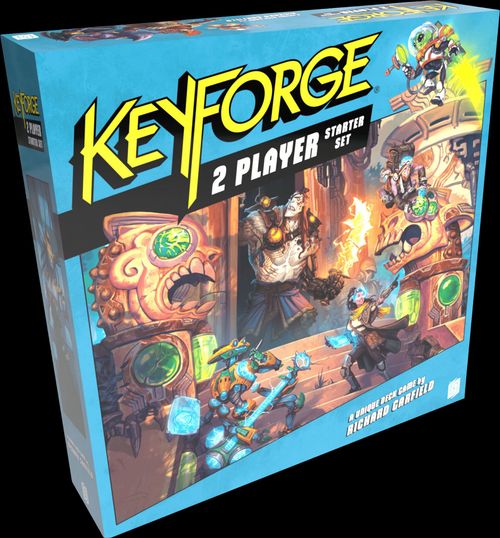
KeyForge: 2 Player Starter Set
KeyForge: 2 Player Starter Set Rulebook
Table of Contents
Table of Contents
Game Overview
KeyForge is a two-player card game in which each player takes the role of an Archon and leads that Archon's team in a race to be the first to forge three keys.
Each player uses their own KeyForge deck, which represents their Archon and its team of followers. The players compete to gather the precious resource, Æmber (Æ). When a player has gathered enough Æmber, they can forge a key. The first player to forge three keys is able to unlock a Vault and wins the game.
The defining feature of KeyForge is that no two decks are alike. KeyForge cards are not sold individually; they are always sold as ready-to-play decks. Every deck in existence is unique!
This Learn to Play book is designed to teach you the basics of the game.
After you have mastered the basics, you'll be ready to open your first two sealed KeyForge decks included in this starter set and continue your quest to unlock the secrets of the Crucible!
If a situation arises in your game and you're not sure how to proceed, expanded rules, detailed glossary, official errata, and FAQ are available in the KeyForge Master Rulebook.
All KeyForge rules documents and the KeyForge Learning Decks can be freely downloaded at keyforging.com.
Components
The components included in the KeyForge: Starter Set are pictured in the booklet for identification purposes. These are considered the official game components for playing KeyForge.
- 2 Sealed KeyForge Decks
- 2 KeyForge Learning Decks
- 28 Æmber Tokens
- 2 Chain Trackers with Tokens
- 22 Damage Tokens in values of 1, 3, 5
- Two sets of three keys (blue, red, yellow)
- 16 Generic Counters in two colors
- 7 Stun Counters
- 7 Enrage Counters
- 7 Ward Counters
- 18 +1 Power Counters
Game Setup
Note: The Learning Game in the video tutorial uses slightly different setup instructions because the learning decks are not meant to be shuffled. These setup instructions are for playing the standard game using regular KeyForge decks, like the two sealed decks included in this starter set. If you want to play with the learning decks, follow the setup instructions in the video tutorial.
- Place all damage tokens, Æmber tokens, and status counters in a common supply within easy reach of both players.
- Each player places their Archon identity card to the left or right side of their play area.
- Each player places three key tokens, one of each color, with the unforged side faceup near their Archon identity card.
- Randomly determine who is the first player. That player takes the first turn when the game begins.
- Each player shuffles their deck and offers it to the opponent for additional shuffling and/or a final cut.
- The first player draws a starting hand of seven cards. The other player draws a starting hand of six cards.
- Each player, starting with the first player, has one opportunity to mulligan their starting hand by shuffling it back into their deck and drawing a new starting hand with one fewer card.
The game is now ready to begin.
(The booklet includes a setup diagram labelling: Unforged Keys, Archon Identity, Forged Key, Deck, Discard Pile, Archives, Artifacts, Battleline, Æmber Pool.)
Turn Sequence
KeyForge is played over a series of turns. Players alternate taking turns until one player wins the game.
Each turn consists of five steps:
- Forge a key.
- Choose a house.
- Play, discard, and use cards of your chosen house.
- Ready cards.
- Draw cards.
You only make decisions and perform actions during your own turn. You do not make any decisions when it is not your turn. When you are taking a turn, you are known as the active player.
After you have completed all five steps of your turn, your opponent takes their turn, and so on until one player wins the game. Each step of a turn is described in the following sections.
Step 1: Forge a Key
The first thing you do each turn is check if you have enough Æmber to forge a key. Æmber is the game's basic currency and is represented with this symbol: Æ. If you have enough Æmber to forge a key during this step, you must do so.
The default cost to forge a key is six Æmber (6Æ). Some card abilities may increase or decrease this number.
To forge a key, you spend Æmber from your Æmber pool and return it to the common supply. Then, you flip any one of your unforged key tokens over to its forged side. If you just forged your third key, you win!
You can only forge one key during this step each turn, even if you have enough Æmber to forge multiple keys.
(Illustration: spend six Æmber, forge one key.)
Step 2: Choose a House
Each KeyForge deck is composed of three different houses, which are shown on the Archon identity card. During this step of your turn, you choose one of the houses on your Archon identity card to activate, making it the active house for the remainder of your turn. This active house determines which cards you can play, use, and discard from your hand, this turn.
After choosing your house, you have the option to take all cards in your archives and add them to your hand. Archives are explained towards the end of these rules.
Step 3: Play, Discard, and Use Cards
This step of each turn is where most of the gameplay happens. During this step, you may play or discard any number of cards of your active house from your hand. You may also use any number of cards of your active house that are in play under your control. You can play, use, or discard cards in any order.
A card's house is determined by an icon in the upper-left corner. If your active house corresponds to a card's house, that card is eligible to be played, used, or discarded.
You cannot play, use, or discard cards that do not belong to your active house. Some card abilities may allow you to break this rule.
Complete rules for playing, discarding, and using cards are described later in this booklet.
First Turn Rule: During the first turn of a game, the active player can only play or discard one card from their hand. Card effects can modify this rule.
Step 4: Ready Cards
In this step, you ready each of your exhausted cards. See the "Ready and Exhausted" sidebar for details.
Step 5: Draw Cards
In the last step of your turn, you draw cards from the top of your deck until you have six cards in your hand. After this step, your turn ends.
If you already have more than six cards in your hand at the start of this step, you keep them all and do not draw more cards in this step.
If you need to draw cards (during this step or at any other time) and cannot because your deck is empty, you shuffle your discard pile to reset your deck, then continue to draw.
After this step, your turn is over. Your opponent now takes their turn, and so on until one player wins the game.
Ready and Exhausted
Cards that are in play exist in one of two states:
- Ready cards are oriented upright so that their text may be read from left to right. A ready card can be used during your turn, and using it causes it to become exhausted.
- Exhausted cards are rotated 90 degrees to the side. An exhausted card cannot be used.
All creatures and artifacts enter play exhausted.
Card Anatomy
- House Icon: Every card belongs to a house. Each turn, you choose one house to be your active house. You can only play and use cards of your active house each turn.
- Card Name
- Power: Only creatures have power. It is used when a creature fights and to determine how much damage a creature can take before it is destroyed.
- Armor: Only creatures have armor. A ~ symbol means the creature has zero armor.
- Traits: These are descriptive words. They have no rules, but they may be referred to in card abilities.
- Card Type: There are four basic card types: Action, Artifact, Creature, and Upgrade.
- Ability Text: Most cards have an ability. In the example card (Gandulf the Provoker, a creature), the card has both a "Play:" ability (resolved only when the card is played from your hand), and a special keyword "Taunt." Keywords are shorthand for common abilities and are defined in the glossary section of this book.
- Flavor Text: Flavor text has no impact on the game.
- Collection Data: KeyForge decks are printed in sets; the left symbol shows this deck's set icon. The number is the card's ID number within that set, and the right symbol is the card's rarity which determines how frequently a card can appear in decks (Common, Uncommon, Rare, Special). Special cards do not obey the game's standard rarity rules.
- Deck Name: Every KeyForge deck is a unique combination of cards and each deck has a unique name.
Playing Cards
During Step 3 of your turn, you can play any number of cards that belong to your active house. To play a card, you simply choose a card in your hand that belongs to the active house and put it onto the table. Each of the four card types—action, artifact, creature, and upgrade—have specific rules about how they enter play and are explained in the following section.
Note that using a card that is already in play is different than playing a card from your hand. Using cards is described in the "Using Cards" section.
Bonus Icons
Many cards have one or more bonus icons in the upper-left corner, below the house icon. After a card with a bonus icon is played, the first thing you do is resolve each bonus icon on that card from top to bottom, one at a time. Resolving each bonus icon is mandatory.
There are five types of bonus icons:
- Æmber: You gain 1Æ from the common supply and add it to your Æmber pool.
- Capture: One of your creatures in play captures 1Æ from your opponent's Æmber pool. Captured Æmber is placed on your creatures and cannot be spent by either player. When a creature leaves play, any Æmber on it is returned to the opponent's Æmber pool.
- Damage: Deal 1 damage to any creature in play.
- Draw: Draw 1 card from the top of your deck.
- Discard: Choose 1 card in your hand and discard it. The card you choose may belong to any house.
Some cards have a bold "Play:" ability. Such abilities resolve after the card's bonus icons are resolved, if it has any, and after the card enters play.
(Example card: Forced Reunite, an action. "Play: Destroy a creature. Its controller gains 1Æ.")
Card Types
There are four types of cards that can be played: actions, artifacts, creatures, and upgrades. A card's type is indicated directly below its name. There are different rules describing how each card type is played.
Action Cards. When you play an action card you resolve the card's "Play:" ability and, after resolving as much of the ability as possible, place the card in your discard pile.
Artifacts. Artifacts enter play exhausted and are placed in a row in front of you but behind your battleline (described in the following section). Artifacts remain in play from turn to turn.
Creatures. Creatures enter play exhausted and are placed in the front row of your play area. This row is referred to as your battleline. Creatures remain in play from turn to turn, and they each have power and armor values that they use to resolve fights, which are described later.
Each time a creature enters play, it must be placed on a flank—at the far left or the far right of your battleline. Each time a creature leaves play, shift the battleline inward to close the gap. (See the "Battlelines" sidebar for more information.)
Upgrades. When you play an upgrade, you attach it to a creature by tucking it partially underneath the creature. Each upgrade remains in play from turn to turn and modifies the creature to which it is attached.
You can play an upgrade on any creature in play, including your opponent's creature. You cannot play an upgrade if there are no creatures in play. If the creature to which an upgrade is attached leaves play, the upgrade is discarded.
Battlelines
Your creatures in play form your battleline. The outside edges of your battleline are known as the flanks (left flank and right flank).
When you play a new creature, it enters play exhausted on either flank of your battleline, and your battleline expands outward. Creatures next to each other in a battleline are neighbors.
If one of your creatures leaves play, your battleline shifts inward to fill the gap.
Discarding Cards
During step 3 of your turn, you can discard cards from your hand that belong to your active house instead of playing them.
Tip: You might want to do this if you have one or more cards in your hand that offers no immediate benefit; remember, you draw back up to six cards at the end of your turn, so discarding cards you don't need will let you draw more cards at the end of your turn.
Using Cards
In addition to playing cards during step 3 of your turn, you can also use any number of cards from your active house that you already have in play. Depending on a card's type, you are able to do different things when using that card. Most cards must be ready before they can be used.
Action and Omni Abilities
Many cards have abilities that begin with either "Action:" or "Omni:". You can resolve such an ability during your turn by using the card.
Action Abilities: Any ready artifact, creature, or upgrade you control that belongs to your active house can be used for its "Action:" ability, if it has one. Simply exhaust the card and resolve its "Action:" ability.
Omni Abilities: Any ready artifact, creature, or upgrade you control can be used for its "Omni:" ability, if it has one, even if it does not belong to the active house. Simply exhaust the card and resolve the "Omni:" ability.
If a card has multiple "Action:" and/or "Omni:" abilities, you can only resolve one of them each time you use the card.
Reap (Creatures Only)
Any ready creature of your active house may reap. When you use one of your creatures to reap, the creature exhausts and you gain 1Æ from the common supply and add it to your Æmber pool. Then, all of that creature's "After Reap:" abilities resolve (if any).
Fight (Creatures Only)
Any ready creature of your active house may fight. When you use one of your creatures to fight, it is known as the attacking creature. You exhaust your attacking creature and choose one eligible creature controlled by your opponent to be fought, which is also known as the enemy creature. Each of the two creatures deals an amount of damage equal to its power (the value to the left of the card's title) to the other creature. All of this damage is dealt simultaneously. After the fight resolves, if your attacking creature survived, all of its "After Fight:" abilities (if any), are resolved. Note that if the enemy creature survived, it does not resolve its "After Fight:" abilities (if any).
A creature cannot fight if there are no enemy creatures to be fought.
See the next page for a step-by-step example of a fight.
Damage and Armor
When a creature is dealt damage, place an amount of damage tokens equal to the amount of damage dealt on the creature. If a creature has as much or more damage on it as it has power, the creature is destroyed and placed on top of its owner's discard pile. If a creature has an armor value (to the right of the card's title), the armor prevents that much incoming damage each turn. (A creature's armor value resets at the beginning of each turn.)
(Illustration: Champion Anaphiel, labelled Power, Damage, and Armor.)
Constant Abilities
If a card has an ability that does not have a boldfaced word at the beginning, the ability is a constant ability that is active for as long as the card remains in play.
Constant abilities on a card are active even while that card is exhausted. Applying the effects of a constant ability is not considered using a card and therefore does not cause the card to exhaust.
Fight Example
Luke is playing with the "Onyx Learning Deck" and is in the middle of a turn where he chose Brobnar as his active house.
- Luke uses Headhunter to fight Commander Chan. Headhunter deals 5 damage to Commander Chan, and Commander Chan deals 4 damage back to Headhunter. Commander Chan has taken damage greater than its power and is therefore destroyed.
- Headhunter survived the fight, so its "After Fight" ability resolves: Luke gains 1Æ from the common supply and adds it to his Æmber pool.
Fight Example (Continued)
Luke now uses Gauntlet of Command to ready and fight with Headhunter again.
- This time, Luke chooses Sergeant Zakiel as Headhunter's victim. Headhunter deals 5 damage to Sergeant Zakiel (the damage on Headhunter does not reduce its power). Sergeant Zakiel has 1 armor, so the 5 damage is reduced to 4 damage, but that is still enough to destroy him. Sergeant Zakiel does 4 damage back to Headhunter, and because Headhunter had already suffered 4 damage from its previous fight, it too is destroyed. Luke cannot resolve Headhunter's "After Fight" ability again because Headhunter did not survive the second fight.
Other Concepts
We have covered most of the rules for KeyForge, but there are still a few other important concepts.
The Golden Rule
If the text of a card directly contradicts the text of the rules, the text of the card takes precedence.
Do As Much As You Can
While resolving a card ability, resolve as much of the ability as can be resolved, and ignore any parts of the ability that cannot be resolved.
Resolve in the Order Written
While resolving a card ability, follow the instructions on the card in the order the text is written.
Running Out of Tokens
There is no limit to the number of damage tokens, Æmber tokens, or status counters that can be in the game area at a given time. If there is a shortage of the provided tokens or counters, use any available substitute.
Archives
Your archives is a facedown game area in front of your Archon identity card. Card abilities are the only means by which you are permitted to add cards to your archives. Cards in archives are out of play.
During step 2 of your turn, after you select an active house, you may pick up all cards in your archives and add those cards to your hand. With some planning, this can allow you to have one or more turns with an unusually large amount of cards in your hand.
You may look at the cards in your archives at any time. You cannot look at the cards in your opponent's archives.
Chains
Chains represent supernatural bindings that are occasionally placed onto specific Archons by the Architects: sometimes in an effort to better challenge the Archon to grow and overcome greater adversity, and other times to penalize the Archon for breaking a rule or a piece of Crucible etiquette.
Use the chain tracker card and token to keep track of how many chains you have. (The booklet's image shows a player who currently has 2 chains.)
You can gain chains through card abilities during a game. Track the number of chains you have with a chain tracker and its corresponding token.
When you refill your hand of cards during step 4 of your turn, any chains you have reduce the number of cards you refill to. If your chains prevent you from drawing at least one card during step 4 of your turn, you shed one chain by reducing your chain tracker by one.
The more chains you have, the greater the card penalty becomes.
- Chains 1-6: Refill your hand to 1 fewer card.
- Chains 7-12: Refill your hand 2 fewer cards.
- Chains 13-18: Refill your hand 3 fewer cards.
- Chains 19-24: Refill your hand 4 fewer cards.
What's Next
You are now familiar with the basic rules of KeyForge! Tear open the sealed decks included in this starter set and try playing a full game. If a situation arises in your game and you're not sure how to proceed, expanded rules, detailed glossary, official errata, and FAQ are available in the KeyForge Master Rulebook at keyforging.com.
Deck Uniqueness and Deck Anatomy
What makes a KeyForge deck unique? Most importantly, it's the specific combination of cards in the deck. KeyForge decks are generated by a computer algorithm and a complex set of rules that ensures no two decks will ever be the same. Every deck also has a unique Archon design on its card back and a unique name.
But that's not all! Some KeyForge cards enhance other cards in the same deck by adding bonus icons. This enhancement process happens when the deck is generated, and the bonus icons are then printed directly on the enhanced cards. Sometimes, a deck will also include ultra-rare cards: Mavericks are cards that normally belong to a different House, legacies are cards from older sets that normally don't appear in the current set, and anomalies are cards from future sets that normally aren't yet available.
- Deck Name: Every deck has a unique name.
- Set Icon: KeyForge decks are printed in sets, and each set has its own icon.
- Card Name: If a card's name appears in blue, it has been enhanced with bonus icons.
- Card Info: Rarity (Common, Uncommon, Rare, Special) and card type (Action, Artifact, Creature, Upgrade). The number between these icons is the card's ID number within the set.
- House: Each deck consists of 3 different houses.
- Registration Code: This code is used to register your deck in the official database called the KeyForge Master Vault. Don't share this code with others.
Glossary
This section provides a short definition for the most important terms used in the game. An expanded glossary is found in the KeyForge Master Rulebook, which can be downloaded at keyforging.com. If a definition includes a word in purple, it means that word has its own definition in the glossary.
Æmber (Æ): Æmber is the basic currency in the game. When you gain Æmber, it is placed in your Æmber pool.
Æmber Pool: Whenever you gain Æmber, or when you steal Æmber from your opponent, it is placed in your Æmber pool. You spend Æmber from your Æmber pool to forge keys.
Action: Some artifacts and creatures have an ability preceded by the word "Action:" To use an action ability, you must exhaust the card. If a card is already exhausted, you can't use its "Action:" ability.
Active House: During step 2 of your turn, you choose one of the three houses on your Archon identity card to be your active house for that turn. You can only play, use, and discard cards of your active house.
Active Player: The person currently taking their turn.
After Fight: After you use this creature to fight, if it survived, resolve all of its "After Fight:" abilities.
After Reap: After you use this creature to reap, resolve all of its "After Reap:" abilities.
Alpha: When a card has the alpha keyword, it can only be played if you haven't played, used, or discarded any other cards during the current step of your turn.
Archives: Some card abilities let you archive other cards. Cards in your archives are kept facedown and are out-of-play. During step 2 of your turn, you can pick up all the cards in your archives and add them to your hand.
Armor: Each point of armor reduces the amount of damage a creature takes by 1, each turn.
Assault X: When this creature attacks, deal the specified amount of damage to the opposing creature before resolving the fight.
Battleline: Creatures you control are placed in a row called your battleline. The far left and right edges of your battleline are the flanks. Normally, when you play a creature, it enters play on one of the flanks of your battleline (you choose which flank). Creatures adjacent to each other in the same battleline are neighbors.
Capture: Take the specified amount of Æmber from your opponent's Æmber pool and place it on your creature with the capture ability. When a creature with Æmber on it leaves play, the Æmber on it moves to the opposing player's Æmber pool.
Chains: Some card abilities give you chains. Track your chains with a chain tracking card and its corresponding token. The more chains you have, the fewer cards you draw back up to at the end of your turn. See "Chains" above.
Control: The cards you play are under your control by default, and the cards your opponent plays are under their control by default. Some card abilities let you take control of a card belonging to your opponent. When that happens, you can choose that card's house as your active house. If you control an opponent's card and that card leaves play, it returns to your opponent's hand or discard pile.
Damage: Creatures can take damage from fighting, or from certain card abilities. Track the amount of damage on each creature with damage tokens. If a creature has taken damage equal to or greater than its power, it is destroyed.
Deploy: This creature can be played anywhere in its owner's battleline.
Destroyed: A creature is destroyed if it takes damage equal to, or greater than, its power. Certain card abilities can destroy creatures immediately, or can destroy other cards including artifacts and upgrades. Abilities that begin with "Destroyed:" are resolved when the card becomes destroyed. After your cards are destroyed, and all "Destroyed:" effects have been resolved, they are placed in your discard pile.
Draw: Whenever you draw a card, you take the top card of your deck and add it to your hand. If you need to draw and you have no cards left in your deck, first shuffle your discard pile to reform your deck, then draw.
Elusive: The first time this creature is attacked each turn, no damage is dealt.
Enhance: This card has granted bonus icons to other cards in the deck. This has already happened as part of the deck generation process.
Enrage: When a creature is enraged, place an enraged counter on it. An enraged creature must fight when it is used, if able. After it fights, remove its enraged counter. A creature already enraged cannot be enraged again.
Exalt: When you are instructed to exalt a creature, place 1Æ on it from the common supply.
Exhaust: Cards in play are either ready or exhausted. You cannot use exhausted cards.
Fight: During your turn, you can use any of your ready creatures to fight if they belong to your active house.
Flank: The flank is the far left or far right of a player's battleline. If an ability refers to a creature "on the flank," it is referring to the creature on either the far left or far right side of the battleline.
Keys: Forging keys is how you win the game. As soon as one player forges their third key, they win. Usually, you only forge keys at the start of your turn by spending Æmber from your Æmber pool. Keys normally cost 6Æ to forge. Some card abilities can increase or decrease this cost for you or for your opponent.
Hazardous X: When a creature with hazardous is attacked, it deals the specified damage to the attacking creature before the fight resolves. If this damage destroys the attacking creature, no fight occurs.
Heal: When a creature is healed, remove the specified amount of damage from it.
Neighbor: Creatures next to each other in the same battleline are neighbors. Each creature can have, at most, two neighbors.
Omega: After you play a card with the omega keyword, your current step of the game ends. (Usually, this will be step 3 of your turn.)
Omni: You may use an omni ability on your turn even if it's on a card you control that does not belong to your active house.
Poison: If a creature with poison deals any amount of damage to an enemy creature with its power during a fight, that enemy creature is destroyed.
Power: A creature's power is the number with the red background to the left of its name. Creatures in a fight deal damage equal to their power. When a creature has taken damage equal to its power, it is destroyed.
Purge: When one of your cards is purged, it is removed from the game instead of being placed in your discard pile.
Ready: Cards in play are either ready or exhausted. During your turn, ready cards that belong to your active house can be used.
Reap: During your turn, you can use any of your ready creatures to reap if they belong to your active house.
Skirmish: When this creature attacks, it does not take damage from the opposing creature's power.
Splash-attack X: When this creature attacks, it deals X damage to each of the opposing creature's neighbors.
Steal: When you steal Æmber, you move the specified amount from your opponent's Æmber pool to your own.
Stun: When a creature is stunned, place a stun counter on it. The next time that creature is used, it can do nothing except exhaust and remove its stun counter. A creature already stunned cannot be stunned again.
Taunt: This creature's neighbors cannot be attacked unless they also have taunt.
Ward: When a creature is warded, place a ward counter on it. The next time a warded creature would take damage, be destroyed, or leave play, instead remove the ward counter. A creature already warded cannot be warded again.
Quick Reference
Turn Sequence
- Forge a key, if you have enough Æmber in your pool. (Keys usually cost 6Æ.) If you just forged your third key, you win!
- Choose a house on your Archon identity card. If you have cards in your archive, you may add them to your hand.
- Play, use, or discard cards of your chosen house. When you use cards in play, they become exhausted.
- Ready all of your exhausted cards.
- Draw cards until you have six cards in your hand.
Bonus Icons
- Æmber: You gain 1Æ from the common supply and add it to your Æmber pool.
- Capture: One of your creatures in play captures 1Æ from your opponent's Æmber pool. Captured Æmber is placed on your creatures and cannot be spent by either player. When a creature leaves play, any Æmber on it is returned to your opponent's Æmber pool.
- Damage: Deal 1 damage to any creature in play.
- Draw: Draw 1 card.
- Discard: Choose 1 card in your hand and discard it. The card you choose may belong to any house.
Houses of the Crucible
Brobnar, Dis, Ekwidon, Geistoid, Logos, Mars, Sanctum, Saurian, Shadows, Star Alliance, Unfathomable, Untamed.