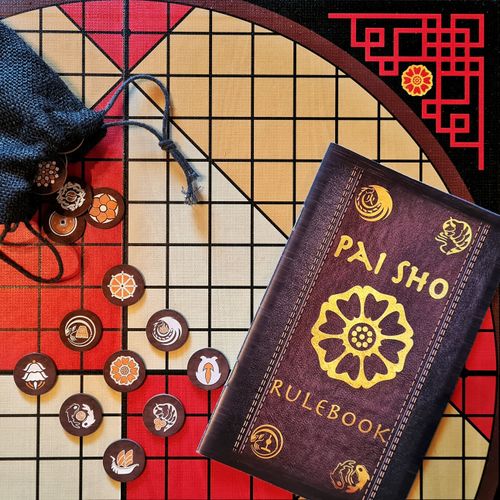
Key Pai Sho
Key Pai Sho Rulebook
Table of Contents
Table of Contents
Introduction
A brief note for beginners:
Key Pai Sho is a simple game, but daunting to learn all at once. It is therefore advised that beginners play using only Flower tiles until they are familiar with the basic mechanics. Accent tiles can be introduced gradually at a later stage to unlock the full experience.
Where to find rule clarifications:
This version of the rulebook has been simplified, removing the notes on specific interactions between tiles.
Most answers can be found by carefully reading the wording, but to address complex scenarios, visit: keypaisho.wordpress.com/rules/
Fundamentals
Key Pai Sho is played by two players: the host and the guest.
Before starting, each player can select up to 6 Effect Tiles to use for the duration of the game from among their Accent and Special Flower tiles (they may only select one of each).
It is customary to offer the guest the first turn.
The Board consists of 4 Triangular Gates with the Garden in the middle. Garden spaces are either Light, Dark, or Neutral.
A Gate is 'Open' if unoccupied and 'Closed' if occupied.
Gameplay
Players take alternating turns, and in a turn they may either PLANT a Flower tile, OR MOVE a tile of theirs on the board.
Additionally, they may also PLACE one Accent tile per turn.
When moving a Flower tile out of a Gate, its movement must start in one of the squares surrounding the Gate.
Once in the Garden, a Flower cannot move into any square of a Gate.
A Flower tile must be 'Planted' into an Open Gate when first placed on the board. Once it has moved into the Garden it is referred to as 'Blooming'.
Each player may have a maximum of 2 Planted Flowers at any one time.
Winning the Game
The first player to create a complete chain of at least 4 Harmonies around the centre of the board wins.
Key Flowers
Each player starts with 3 of each of the 6 Key Flower tiles. These are the main components used to create a chain of Harmonies to encircle the centre and win.
Key Flower Movement
Each Key Flower can only move once per turn and only in a single direction. The direction and its maximum number of steps is determined by its type, listed in the chart below. (Look at a Flower's petals to recall the directions it can move and harmonize.)
The chart carries only icons, so the entries below describe its icons: each flower's step count and the arrows printed on it.
- Dark: Rose, Chrysanthemum, Rhodedendron.
- Light: Lily, Jasmine, Jade.
- Rose and Lily can move up to 3 squares. Their printed arrows are curved and sit on the left and right of the flower.
- Chrysanthemum and Jasmine can move up to 5 squares, in the four straight directions shown by their arrows (up, down, left and right).
- Rhodedendron and Jade can move up to 5 squares, in the four diagonal directions shown by their arrows.
Dark Flowers cannot land in Light Garden squares and Light Flowers cannot land in Dark Garden squares. (However, they can all move through them and can land in any Half-Neutral Garden square.)
Flower tiles cannot move over other tiles in the Garden.
Harmonies
A Harmony is an imaginary line drawn between two of a player's Blooming Flower tiles and follows 3 essential rules:
- Harmonies form if one KEY FLOWER's movement path can reach the other Flower's square (Regardless of Garden colour).
- They require at least one empty square in between the two Flowers.
- They are broken if an opponent's Flower is positioned directly between the two Flowers.
Special Flowers
As with all Flowers, Special Flowers must first be Planted in an Open Gate before moving into a Garden square.
These tiles form part of the 6 potential Effect tiles chosen at the start, with abilities that ignore regular rules.
Special Flower Abilities
Special Flowers each have unique abilities and movements:
The printed movement icon for each Special Flower is shown in brackets (1 = one step per move, x2 / x6 = number of moves per turn, ∞ = any distance).
- Orchid [1]: If the player moves this tile for their regular turn movement, they can move another of their tiles that same turn.
- Lotus [1 x2]: Harmonizes with any Flower of either player over any distance (but not over Flowers). Can move up to 2 times in a turn.
- Firelily [1 x6]: Can never Harmonize (except with Lotus), but only breaks opponent's Harmonies. Can move up to 6 times in a turn.
- Dahlia [∞]: Can move any distance and over tiles, but must always land directly beside another tile (vertically, horizontally, or diagonally).
Special Flowers can land in any Garden, Light, Dark, or Neutral.
When a Special Flower can move more than once in a turn, each movement can be in a different direction.
(Remember that Key Flowers are needed for most Harmonies.)
Special Lotus Technique: Opening the Garden Gate
If the centre 4 Garden squares are empty, & the turn player does not have 2 Planted tiles, the Lotus tile can be planted on the centre intersection of the board, turning the 4 squares around it into a Gate.
The Lotus must move on the player's next turn, starting in one of those 4 squares, eliminating the Gate.
Accent Tiles
Accent tiles have unique abilities that affect other Garden tiles.
These form part of the 6 Effect tiles that players select at the start of the game, chosen for their preferred strategies.
Accent tiles are not Planted in Gates, like Flower tiles.
They are 'PLACED' directly into the Garden by switching them with one of the turn player's Blooming Flowers, taking the square that it had occupied.
The switched Flower tile is returned to the player and can be Planted again later.
Each Accent tile's Ability can be activated once per turn, at any time during its player's turn, or it will be a constant effect that remains active while the tile is in the Garden.
Accent tiles do not Harmonize or block Harmonies.
Accent Tile Movement
Accent tiles can land in any Garden Square, but never in a square containing any part of a Gate.
They move once per turn, and can move over other tiles.
Their maximum number of steps depends on their type:
- Stones cannot move (0).
- Weeds move very slowly (2).
- Travelling with Wheels is fast (3).
- But travelling by Boat is even faster (4).
- The Elemental tiles are living beings & have the greatest movement potential (5).
The Elemental tiles are the Badgermole, Dragon, Skybison and Koi.
Accent Tile Abilities
- Stone (0): Can be Placed anywhere in the Garden after switching with a Flower tile, not only in that Flower's square. Allows all of its Player's Key Flowers to land in its quarter of the Garden, ignoring the Garden's colour. (Constant)
- Knotweed (2): All surrounding Flower tiles are rendered unable to Harmonize and unable to move by themselves. (Applies to both player's Flowers.) (Constant)
- Wheel (3): Placed by switching with an Accent tile, not a Flower. Can rotate all tiles in surrounding squares around it, either clockwise or counter-clockwise up to 3 squares. (All must rotate in the same direction, and for the same number of steps, and only into squares they can land on.)
- Boat (4): Can activate its ability when it moves, then all tiles in the surrounding squares of its starting position move with it and are placed relative to the Boat in the same positions they held before the movement. (All need to be able to land in those squares.)
- Badgermole (5): Can land on another tile and be placed underneath it. The tile above is unaffected by any other Accent tiles. The Badgermole can move while under a tile, carrying the top tile with it. The top tile can be moved off of the Badgermole by its player.
- Dragon (5): Can land on a tile to remove it from the Garden and return it to its owner to be re-used later. Any Effect tile can land on the Dragon and, if one does, the Dragon is removed from the Garden and cannot be used again for the remainder of the game.
- Skybison (5): Can land on another tile and be placed underneath it. Flower tiles above cannot have their Harmonies broken by Flowers when the SkyBison is below them. The SkyBison can move while under a tile, carrying the top tile with it. Players can move their tiles off. Immediately after being carried, your top tile can move once more, off of your SkyBison, according to its own movement capability.
- (5): When situated directly between two tiles in a straight or diagonal line, it can activate its ability to swap the positions of those two tiles. (Each must be able to land in the other's square.) The two tiles swapped do not need to be the nearest to the Koi, but must be on opposite sides of it.
The number in brackets after each Accent tile is its printed maximum number of steps.
Reference Sheet
The publisher's back-page reference sheet restates the rules above in short form. Its entries are transcribed here in sentence case:
- Key Flowers move: Rose 3, Lily 3, Chrysanthemum 5, Jasmine 5, Rhodedendron 5, Jade 5.
- Harmonies are formed if one Key Flower's movement path reaches the other Flower's square (ignoring Garden colour). They require at least one open square in between, and are broken by opponent's Flower tiles.
- Accent tiles: Stone placed anywhere when switching in, allows all of its player's Key Flowers to enter Garden quarter, cannot move itself. Knotweed: surrounding Flower tiles cannot Harmonize or move themselves. Wheel: placed by switching with an Accent tile, not a Flower; can rotate all surrounding tiles up to 3 squares. Boat: can move all surrounding tiles when it moves. Badgermole: can move under a tile; can carry that tile; top tile is unaffected by other Accent tiles. Dragon: can land on a tile to return it to its player to be later re-used; is removed from the Garden if an Effect tile lands on it, and cannot be used again during that game. Skybison: can move under a tile; can carry that tile; top tile's Harmonies cannot be broken and it can move again after being carried. Koi: can swap the positions of two tiles on opposite sides of it (both must be able to land).
- Special Flowers: Orchid: if the player moves this tile, they can move one additional tile that same turn. Lotus: harmonizes with any Flower of either player, over any distance; can plant in centre of Garden but must move out in the player's next turn; can move up to 2 times per turn. Firelily: does not harmonize (except with Lotus), only blocks opponent's Harmonies; can move up to 6 times per turn. Dahlia: can move any distance, but must land beside any other tile; can move over tiles.