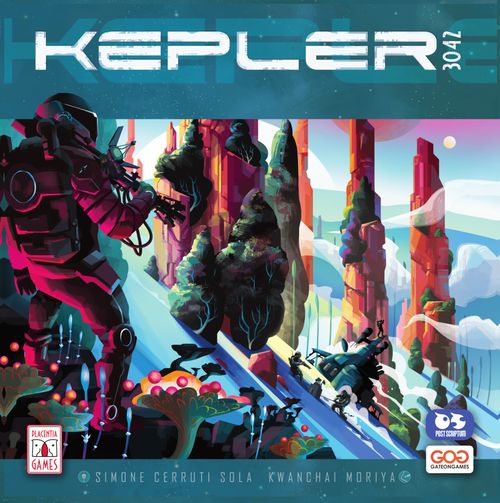
Kepler-3042
Kepler-3042 Rulebook
Table of Contents
Table of Contents
Components
-
36 Celestial Body tiles:
- Oceanic Planet
- Rocky Planet
- Super Earth Planet
- Giant Planet
- Alien Planet
- Mine
- Colonial Target
-
1 Game board, showing the Milky Way galaxy, divided into three Zones:
- Short-Range Stars (The Stellar Local Group)
- Mid-Range Stars
- Long-Range Stars
Included in the Milky Way are: the Sol hex, the Sagittarius A* Black Hole hex, 20 Star hexes, and 396 Space hexes (including 6 around Sol). Below the Milky Way there are spaces for the card decks and the Game Round Track.
-
24 Medal tokens:
- 12 Colonial Medals
- 12 Technological Medals
-
1 Round Marker
-
1 First Player marker
-
1 Scoring notepad
-
4 sets of Player Pieces (1 per player), each including:
- 1 Technology Board
- 1 Planetary Summary
Setting Up the Game
-
Place the game board on the table. Take all the Celestial Body tiles with the 3+ symbol and take a look at a Planetary Summary. The planets marked for 3+ player games are used in 3+ player games, and the planets marked for 4+ player games are used in 4+ player games. All the other planets are always used.
Add 1 Mine tile and 1 Colonial Target tile per player to the planets used.
Shuffle all these tiles face down and place them on the game board randomly. Each tile must be adjacent to a Star hex (except Sol), but must not be adjacent to any other Celestial Bodies. In 3-player games, one kind of star cannot have any adjacent tiles. In 2-player games, another kind of star also cannot have any adjacent tiles.
Designer Note: we tested this placement a lot of times (really!) and we saw that it can be made completely randomly without affecting the game victory. However, if you want, you can distribute the tiles to the players and they can take turns placing tiles one by one.
The Celestial Bodies are the goal of the explorers: Planets to discover, colonize, and terraform, Mines to exploit for Resources, or Colonial targets to be explored for their scientific relevance.
-
Turn over all the Celestial Bodies in the Short-Range (Stellar Local Group) Zone.
All the stars near the Earth have been examined carefully by telescope for centuries, and are well known to the exploring Nations.
-
Place 10 Medals on the marked spaces of the Technological Leadership Track and the Colonial Leadership Track (5 Medals per track). Keep the other Medals near the board in easy reach.
Nations advance on these tracks mainly by developing Technologies and Colonizing Planets, earning rewards from the people of Earth as they do: Resources during the game and Victory Points at the end.
-
Each player chooses a color and takes the matching set of Player Pieces:
a. Place five of your Nation markers on the starting spaces (on the left) of each row of your Technology Board.
During the game, you will advance your Nation's Technologies by Spending the Resources shown to earn more efficient actions and advantages during the game.
b. Place your Action Cube on the Terraform Planets space of your Action Board (in the center).
Game Terms
As you read these rules and play the game, it will be helpful to know how certain game terms are used:
Celestial Objects: They can be Planets, Mines, or Colonial Targets. In any case, it's useful to explore them!
Space Hexes: Most of the game board is made up of empty Space hexes. Your Starships can move through these areas of the game board.
Planet: A world that you can colonize, exploit, and improve by terraforming. Planets are represented by Planet cards. Your Earth card is treated as a Planet card in all ways. Of course, it's already terraformed!
Mine: All that remains of an exploded star, supernova remnants are not suitable for human habitation, but they are rich in valuable elements that can be used to Regenerate Resources.
Resource: This is a generic term that refers to the three kinds of Resource cubes: Matter, Energy, and Antimatter. Resource management is the core of the game and requires great attention. Resources can be PRODUCED, SPENT, BURNED, or REGENERATED, moving them from one location to another. You will need Resources to accomplish many tasks in the game, such as building Starships, terraforming Planets, advancing Technologies, or performing extra actions.
When a rule talks about PRODUCING Resources, it means taking those cubes from the Resources Storage on your Action Board and placing them on one Planet card that you control.
SPENDING Resources means taking those cubes from only one of your own Planet cards and putting them back in your Resources Storage. Obviously, you cannot SPEND Resources until you have PRODUCED them!
To BURN Resources means taking those cubes from either your Resources Storage and/or from your Planet cards, and placing them in the Clausius' Pit on your Action Board.
Be careful about BURNING Resources! Resources in your Clausius' Pit will not be available for PRODUCTION or SPENDING until you are able to REGENERATE them.
When you REGENERATE Resources, you take 1 of them from your own Clausius' Pit and return them to your Resources Storage.
- Resources in the Clausius' Pit cannot be PRODUCED or SPENT. Rarely, they can be REGENERATED.
- Resources in the Resources Storage can be PRODUCED (they go on a Planet card) or BURNED (they go to the Clausius' Pit). They cannot be SPENT.
Playing the Game
Kepler—3042 is played over 16 game rounds. Each round is divided into three Phases, which must be completed in order:
- Reveal Progress Card
- Individual Player Turns: a. Main Action b. Bonus Actions c. Move Starships d. Withdraw Starships
- End Phase: a. Resolve Progress Card b. Award Medals c. Change First Player (or End of Game)
1: Reveal Progress Card
At the beginning of each game round, the First Player turns over the top Progress card from the deck and reads it out loud. This card will take effect during the 3. End Phase, so you will have the entire round to prepare for it! Move the Round marker one space to the right on the track.
Example: Paul is the First Player this round. He reveals the Extraterrestrial Knowledge Progress card, reads it, and places it face up in the Revealed Progress space. It doesn't do anything at this point, but at the end of the round all players will have an opportunity to purchase one Technology Level for free, possibly BURNING a Resource if they gain a Medal.
2: Individual Player Turns
After the Progress card has been revealed, each player takes an Individual Turn. The First Player takes the first turn, with the other players following to the left.
Your Individual Turn is split into four steps, to be performed in order:
2a. Main Action
First, you must move your Action Cube to any different Main Action Space on your Action Board (it does not have to be adjacent to the previous space). Then, you may choose to take the action shown on that space. Main Actions are not mandatory, so you don't have to use the action if you don't want to, but you still have to move your Action Cube. You can find descriptions of the Actions below (after "Leadership Awards").
Leadership Awards
Some Actions will award you one or more Colonial Medals or Technological Medals. If so, advance your Nation marker on the corresponding Leadership Track. This may also grant you an extra benefit, shown by an icon on the track: a Resource icon, Victory Points, or a Medal icon.
- If your marker reaches or passes a space with the regenerate icon, you may immediately REGENERATE one Resource of your choice.
- If your marker reaches or passes a space with a Resource icon, you may immediately PRODUCE one Resource of the indicated type on any one Planet card you control.
- If your marker reaches or passes a space with a Medal icon, you must immediately place that Medal on the Revealed Progress card. The Medal will be awarded during the next End Phase.
In addition, the position of your markers on the tracks at the end of the game may allow you to score Victory Points.
Example 1: John earned a Medal, so he moves his Nation marker up 1 space on the Technological Leadership Track. He lands on a Production Space that allows him to PRODUCE 1 Energy Resource on the Planet of his choice. He decides to PRODUCE the Energy on his Earth card.
Example 2: George earns a Medal. Moving his Nation marker on the Colonial Leadership Track lands him on a Medal space. He takes the Medal token and places it on the Extraterrestrial Knowledge Progress card revealed in Phase 1.
Example 3: John earns 2 Medals. In this way, his Nation marker on the Technological Leadership Track reaches the regenerate space, so he REGENERATES 1 Antimatter, placing it in his Resources area.
Action Descriptions
SPACE MISSIONS
You may build up to three Starships (if you have them available). To build a Starship, SPEND 1 Matter and 1 Energy from the same Planet and place the Starship in a Space hex next to that Planet. Your new Starships can be used right away.
EXCEPTION: in the unlikely case that all the Space hexes around the Planet are occupied by other Starships, the new one must be placed in the nearest empty Space hex (if there are more than one, choose which one).
IMPORTANT: Starships built on the Earth card must be placed around the Sol hex.
Example: George chooses the Space Missions Action. He SPENDS 1 Matter and 1 Energy from his Earth card and 1 Matter and 1 Energy from the Planet 19 card. George puts two Starships on the Game Board, placing them on hexes adjacent to the Planets he took the Resources from (Earth and Planet 19).
COLONIZE PLANETS
You may remove all or any of your Starships that are on Planet tiles and replace each with your Nation markers. Take the Planet card that matches the Planet you just colonized and place it in front of you, with the Colony side up, immediately gaining the Victory Points shown on the card.
IMPORTANT: To colonize a planet you don't need to SPEND anything, but you cannot colonize any Alien Planets until you have reached the ALIEN COLONIES Level of the V-Antimatter Science Technology.
Playing Hint: You can only colonize a maximum of five Planets. You may move your Starships to other Planets beyond this limit, but you cannot colonize them. Most of the time, this will be a waste of resources.
Example: John picks the Colonize Planets Action. His Starships are on the Planet 22 and 26 hexes and his Nation marker in V-Antimatter Science is on Metamaterial Generator. John withdraws his Starship from Planet 22, replacing it with one of his Nation markers, and puts the matching card in front of himself. The Metamaterial Generator Technology allows him to create Alien Colonies, so John does the same on Planet 26. In this way, John earns 3 Victory Points (1 from Planet 22 and 2 from Planet 26).
TECHNOLOGICAL DEVELOPMENT
You may purchase any number of advancements on your Technology Chart by SPENDING the Resources listed. You may purchase as many Technology Levels as you wish, as long as you can pay the costs. Some Technology Levels will award you a Medal when you purchase them, which may award you Resources on the Technological Leadership Track (see "Leadership Awards", above). These Resources are available immediately, so they could be SPENT to pay for additional Technology Levels this turn. Abilities granted by your new Technology (such as from II-Quantum Physics) are also available immediately.
IMPORTANT: All of the Resources required for each Level must be SPENT entirely from a single Planet.
An example of this Action is under the Technologies section below, after the explanation of II-Quantum Physics.
STELLAR PROPULSION
You may immediately move all of your Starships, following the rules for Step 2.c: Move Starships. You will be able to move these Starships again during Step 2.c as normal.
An example of this Action is with the explanation of the movement rules, below.
TERRAFORM PLANETS
Modifying the environment of a planet will make it more suitable for human use. SPEND the Resources listed from a Colony-side up Planet card you control to flip that card to the Terraformed side. All the Resources SPENT must come from that Planet. Also, you must have reached at least the minimum level of IV-Terraforming Technology listed on that Planet card in order to Terraform that Planet. A Terraformed Planet will be worth more Victory Points, may allow you to gain a Medal, and can PRODUCE more Resources. You can terraform more than 1 Planet with a single action, if you satisfy all the requirements.
Example: Ringo chooses the Terraform Planets Action. His Nation marker in IV-Terraforming is on Planetary Engineering, so he can Terraform Level 1 and 2 Planets. Planet 2 is Level 1 and requires 1 Energy in order to be terraformed. Planet 5 is Level 2 and requires 1 Matter and 1 Energy. Planet 12 is Level 3 and requires 1 Matter and 1 Energy. The required Resources must be present on the Planets that Ringo wants to Terraform. Ringo SPENDS 1 Energy from Planet 2 and 1 Matter and 1 Energy from Planet 5, then he turns those Planets over to the Terraformed side. At the end of the Game, they will be worth 1 and 2 Victory Points, respectively. Although he owns the required Resources, Ringo can't Terraform Planet 12 because he has not reached Alien Genetic Research yet, which would allow him to Terraform Level 3 Planets. Thanks to these terraformations, Ringo gains 3 Medals (1 from Planet 2 and 2 from Planet 5).
IMPORTANT: if there are any Resources remaining after the needed ones have been SPENT to terraform, they remain on the Planet card.
GALACTIC MAP
Using remote sensing tools and deep space probes, scientists can learn a lot about a potential Planet. First, advance your Nation marker one space on either the Technological Leadership Track or the Colonial Leadership Track (see "Leadership Awards", above). Then, turn over four Celestial Body tiles of your choice, anywhere on the game board. All players now know the identity of those Celestial Bodies.
Example: Paul moves his Action Cube to the Galactic Map space. He chooses to earn a Medal, then he reveals four Celestial Objects.
PLANETARY EXPLOITATION
When you take this action, PRODUCE all of the Resources shown on a number of Planets you control. The number of Planets that can PRODUCE is determined by your IV-Terraforming Technology. Place the Resources on the Planets that Produced them. If you run out of Resources to PRODUCE, you only PRODUCE what you have. Any excess Production is lost.
IMPORTANT: If your IV-Terraforming Technology is at Level 0, you cannot PRODUCE on any Planet (but you can pick this action anyway).
Example: Ringo has 3 Planet cards besides the Earth when he chooses the Planetary Exploitation Action. His Nation marker in IV-Terraforming is on Alien Genetic Research, so he can choose 2 of his Planets to PRODUCE Resources. He chooses 21 and 22, where he PRODUCES 1 Energy + 2 Matter and 1 Energy + 3 Matter, respectively.
ENERGY STORAGE
This action allows you to PRODUCE the number of Energy Resources allowed by your III-Energy Development Technology. You must place all the Energy you PRODUCE in this way on a single Planet you control of your choice.
Example: Ringo picks the Energy Storage Action. His Nation marker in III-Energy Development is on Plasma Quantum Collector, so he can PRODUCE 4 Energy on a Planet of his choice. He chooses Planet 5.
GENERATE ANTIMATTER
This action allows you to PRODUCE the amount of Antimatter allowed by your V-Antimatter Science Technology. All the Antimatter produced must be placed on a single Planet you control, of your choice.
Example: John's Nation marker in V-Antimatter Science is on the Metamaterial Generator Technology, so he chooses Generate Antimatter as his action and PRODUCES 2 Antimatter resources. He can choose to produce them on any of his planets, and chooses the Earth.
2.b. Bonus Actions
If you wish, you may take up to two Bonus Actions on your turn. The Bonus Actions available to you are determined by the location of your Action Cube: the Bonus Action for the row and the column your Action Cube is in are the Bonus Actions you may take.
Bonus Actions can only be used after you have completed your Main Action for the turn (or chosen not to). If you take both Bonus Actions, you may complete them in any order you choose. You are never required to take any Bonus Actions.
In order to use a Bonus Action, you must BURN one Resource of your choice. If you take two Bonus Actions, the Resources you BURN can be the same or different, and they can come from the same or different sources.
IMPORTANT: you can take each Bonus Action only once per turn.
Example: George's Action Cube is on his Space Missions Action Space. He decides to BURN 1 Energy to use Space Logistics first. Then he BURNS 1 Matter to activate Cultural Evolution.
Playing Hint: Remember that Resources in your Clausius' Pit cannot be used in any way as long as they remain there! There are a few ways to REGENERATE Resources, but they are fairly rare. Always think carefully before using Bonus Actions!
Bonus Action Descriptions
- SPACE LOGISTICS: Place 1 Starship in a Space hex adjacent to any Planet you control without SPENDING any Resources. You do not have to place your Starship next to the Planet where you BURNED the Resource to take this Bonus Action.
- TECHNOLOGICAL ADVANCEMENT: PRODUCE 1 Antimatter Resource on any Planet you control.
- SCIENTIFIC PROGRESS: Advance your Nation marker one space on the Technological Leadership Track.
- CULTURAL EVOLUTION: Advance your Nation marker one space on the Colonial Leadership Track.
- EXPLORATORY PLANNING: You may immediately move each of your Starships up to 2 spaces, following the rules explained in the 2.c Move Starships section.
- EXPLOITATION OF N.E.O.: PRODUCE one Matter and one Energy on your Earth card.
2.c. Move Starships
After using any Bonus Actions you choose to use, you get to move all of your Starships that are on Space hexes. Starships that are located on Celestial Objects cannot move. Each of your Starships can move any number of spaces up to your current maximum speed, which is determined by your I-Space Travels Technology.
On the map there are Celestial Objects, which can be revealed to be: Planets, Mines, or Colonial Targets.
If your Starship lands on a Planet or Mine, it must stop moving. It won't be able to move any more, but you can return it to your supply by withdrawing it or by colonizing the Planet.
Colonial Targets are particular points of interests in the galaxy which must be explored to increase humanity's comprehension of the universe. The first player to reach each Colonial Target removes that tile from the board and immediately gains 1 Medal. The Starship can continue its movement, if it has any movement left.
FLIGHT HAZARDS
Some of the hexes on the game board are impassable. Starships can never enter any of these spaces: Sol, Sagittarius A*, any unrevealed Celestial Objects, and all Star hexes. (Note that the six Space hexes around Sol are passable as normal).
A Starship may pass through a Space hex that is occupied by another Starship, but it cannot end its movement there. Starships cannot enter or pass through a Celestial Body that is already occupied by another Starship or by a Nation marker (colonized Planet), even if it is your own.
Example: John has achieved the Space Warp Engine on the I-Space Travels Technology, so the maximum speed for his Starships is 3 hexes. He moves 1 of his Starships to Planet 27 and one to a nearby Mine. The third one will continue its trip in space.
2.d. Withdraw Starships
After you have moved all of the Starships you want to move this turn, you may choose to withdraw any or all of them, removing them from the game board and returning them to your supply.
If you withdraw a Starship from a Mine, you may immediately REGENERATE one Resource from your Clausius' Pit.
If you withdraw a Starship from a Space hex or a Planet, nothing happens. If you withdraw a Starship from a Planet or a Mine, other Starships will be able to move onto that hex again.
You can withdraw your Starship in any round, even if it reached its destination many rounds ago.
Playing Hint: Normally, you will never remove a Starship that is not on a Mine, but sometimes you may find that you really need a Starship somewhere else next round, but you don't have any left. It's not recommended to waste Resources like this, though, so try to avoid it!
Example: After moving his Starship to the Mine, John decides to withdraw that Starship so he can REGENERATE 1 Matter Resource.
After you have completed all four steps, your Individual Turn is over. The player to your left now begins their turn. After all players have finished their individual turns, it's time for the 3. End Phase.
3. End Phase
Once the Individual Turns are complete, follow these steps to end the round:
3.a. Resolve Progress Card
The Progress card revealed during Phase 1 takes effect now. Follow the instructions on the card.
IMPORTANT: All cards are resolved in turn order, starting with the First Player and going to the left. Sometimes, the cards can have an effect on the other players!
Some cards have a requirement that rewards the player that meets it best, such as "The Players with the lowest level in Quantum Physics". If there is a tie, all the tied players receive the benefit.
3.b. Award Medals
Now, all the Medals on the Revealed Progress are awarded. The player with the most advanced Nation marker on the Technological Leadership Track takes all the Technological Medals on the Revealed card, and the player with the most advanced Nation marker on the Colonial Leadership Track takes all the Colonial Medals.
If there is a tie for the most advanced Nation marker, all the tied players receive the full number of Medals available—use the extra Medal tokens set aside at the beginning of the game.
At the end of the game, each Medal is worth 1 Victory Point.
Example: There are 2 Technological Medals and 1 Colonial Medal on the Revealed Progress card. George is the most advanced player on the Colonial Leadership Track, so he takes the Colonial Medal. John and Ringo are tied on the Technological Leadership Track, so they each get 2 Technological Medals, taking 2 from the pile of extras.
3.c. New First Player
The player with the First Player marker gives it to the player on their right. That player begins the next round with Phase 1: Reveal Progress Card. If there are no more Progress cards to reveal, the game is over (the Round Marker should be on space 16).
Technologies
Technology is the key to successful space exploration. During the game, you will invest in five different Technologies. Your discoveries are recorded on your Technology Board.
Each level of advancement in a Technology has a cost, in Resources, which you must SPEND in order to purchase that advancement. All of the costs of an advancement must be SPENT from a single Planet you control.
New Technology Levels must be acquired in the order they are listed on your Technology Board. For example, in I-Space Travels you cannot learn Spatial Bending Engine unless you have already learned Light Speed Engine.
Once you acquire a new Level of Technology, the benefits are immediately available to you, and can be used anywhere—they are not limited to the Planet from which you SPENT the Resources.
Advancement Awards
Some Technological advancements will earn prestige for your Nation when you acquire them, represented by a Medal icon. Move your Nation marker up on the Technological Leadership Track each time you earn a Medal this way. The effects of these awards are described under 2.a. Main Action, above.
One Giant Leap for Mankind
Advances in Technology can improve life for all humanity. Whenever any player acquires a Technology marked with this benefit, all players can benefit: every player that has not reached the indicated Level for that type of Technology (1 or 2) immediately moves their Nation marker up to that space of their Technology Chart for free.
Example: Paul has just purchased Alien Genetic Research: a boon to humanity! Ringo has never acquired any IV-Terraforming Technology, so he gets to move his Nation marker up to the Biosphere level. John and George already have Biosphere, so they receive no benefit from John's discovery.
Technological Benefits
I-SPACE TRAVELS: This Technology determines how many hexes your Starships can move each turn during phase 2.c. Move Starships or through the Stellar Propulsion Main Action.
If you reach the Wormhole Stabilizer Technology, your Starships can travel much more efficiently. From now on, you can build Starships by SPENDING only 1 Energy instead of 1 Energy and 1 Matter.
II-QUANTUM PHYSICS: This Technology offers two benefits:
Resource Transformation: Each turn, you can convert Energy to Matter and vice versa. The number indicates how many Resources you can convert each turn. When you use this ability, swap the Resource from any Planet you control for the other type of Resource from your Resources Storage.
Move Resources: Each turn, you can move a number of Resources among your Planets, taking them from any Planets you control and placing them directly on other Planets. The number indicates how many Resources you can move each turn.
IMPORTANT: both of these abilities can be used in addition to any other actions you take during your turn. You can use them at any point during your turn, before or after any other action. There is no cost for using these abilities.
An example of using this Technology is below, with the Technological Development Main Action example.
III-ENERGY DEVELOPMENT: This Technology determines how many Energy Resources you can PRODUCE when you use the Energy Storage Main Action on your turn. All the Energy you PRODUCE in this way must be placed on the same Planet.
Theory of Everything: for the rest of the game you may choose to activate both of the Bonus Actions available to you on your turn by BURNING only one Resource (instead of two).
IV-TERRAFORMING: This determines how many Planets you can choose to PRODUCE Resources on when you use the Planetary Exploitation Main Action.
The Terraforming icon on a Planet card indicates the Terraforming Technology Level that you must have in order to Terraform that Planet. Every Planet has a minimum Level of Terraforming Technology that you must have in order to terraform that Planet.
V-ANTIMATTER SCIENCE: This Technology determines how many Antimatter Resources you can PRODUCE when you use the Generate Antimatter Main Action on your turn.
Alien Colonies: If you reach the Metamaterial Generator Technology, you will be able to colonize Alien Planets by sending a Starship there. Without this Technology, the Colonize Planets Main Action has no effect on these Planets.
Example of the Technological Development Main Action, with use of II-Quantum Physics
IMPORTANT: everything in this example is the effect of a single Technological Development Main Action and happens entirely during the 2.a-Main Action phase of the player's turn.
Ringo picks the Technological Development Action. His Nation marker in II-Quantum Physics is on Higgs Field Management, so he can move up to 3 Resources around on his Planets and convert 1 Matter into Energy or vice versa. He first moves 1 Matter from Planet 21 to Earth, then SPENDS 1 Antimatter + 1 Matter from Earth to obtain Positronic Understanding.
Developing Positronic Understanding awards Ringo 1 Medal. Ringo's Nation marker reaches a space which allows him to PRODUCE 1 Energy on a Planet of his choice.
But Ringo doesn't have any Energy Resources in his Resources area, so he decides to use the Resource Transformation ability granted by Higgs Field Management at this moment. Now he has Energy in his Resources area, so he can PRODUCE it.
Ringo has other Resources available, and can still move 2 of them among his Planets thanks to the Move Resources ability granted by Higgs Field Management. So, he moves 1 Matter from Planet 21 and 1 Antimatter from the Earth to Planet 22, then SPENDS 1 Antimatter + 3 Matter + 1 Energy from Planet 22 to obtain Absolute Mastery of Genetics.
Thanks to the Medal icon on Positronic Understanding, all the players who don't already have it gain the Particle Accelerator Technology.
Thanks to the Medal icon on Absolute Mastery of Genetics, all players who don't already have it obtain Planetary Engineering.
Absolute Mastery of Genetics gives Ringo 3 Medals. Ringo's Nation marker first reaches a space which activates a Medal, which is put on the Progress card, and then one that allows him to PRODUCE 1 Energy on a Planet of his choice. Ringo decides to keep this Resource on Earth for next round.
The End of the Game
The game ends after the 16th Round—once the last Progress card has been resolved. Now it's time to add up the score and see which Nation has the greatest explorers!
Final Scoring
At the end of the game, you receive Victory Points for the following:
- 1 point for each Antimatter Resource on your Planet cards.
- 5 points if you have colonized one Planet of every Type (Rocky, Oceanic, Giant, Super-Earth, and Alien).
- 3 points if you have colonized at least three Planets of the same Type.
- 2 points for each of your Starships located on a Mine.
- 2 points for each Technology you have advanced to the maximum level.
- 1 point for each Leadership Medal you have collected.
- Points for the Planets you have colonized:
- 1 point for each Planet located in the Stellar Local Group.
- 2 points for each Planet located by a Mid-Range Star.
- 3 points for each Planet located by a Long-Range Star.
- Points for the location of your Nation marker on each of the Leadership Tracks.
- Points for the Planets you have Terraformed.
- Points for completing the mission on your secret Objective card.
The player with the highest Victory Point total wins the game! If there is a tie, the winner is the tied player who has terraformed the Planet with the highest number.