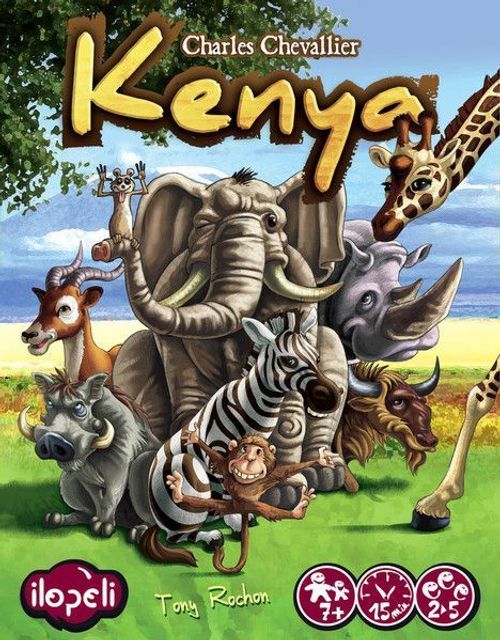
Kenya
Kenya Rulebook
Table of Contents
Table of Contents
Components
The game consists of 55 cards:
- 6 brown cards (double zebra, double wildebeest, double warthog, double gazelle, double giraffe, double baboon).
- 49 green cards, comprising:
- 16 Animal cards: 4 Meerkat, 5 Lion, 3 Elephant, 4 Rhinoceros.
- 30 Player Animal cards (two different animals per card, with each of the six species appearing on 10 cards).
- 3 Water Hole cards.
Setup
Green cards and brown cards are shuffled separately.
Each player receives one brown card and three green cards, which they keep in hand without showing them.
The remaining brown cards are returned to the box without being revealed; they will not be used for the rest of the game.
a. One green card is placed face up in the centre of the table. It represents the savanna, which will spread over the course of the game.
b. Three green cards are placed face up along the edge of the table and form the visible draw pile. The rest of the green cards are placed face down beside the visible draw pile and form the hidden draw pile.
A first player is designated by the method of your choice.
Definitions
- A green card is said to be placed face up when animals or a water hole are visible on it, and said to be placed face Baobab when it is turned over.
- A card is said to be next to another card when it touches that card along one of its four edges (never diagonally).
Goal of the Game
Each player's goal is that, at the end of the game, their animal (represented doubled on their brown card) is the most numerous in the savanna.
Turn Sequence
Players take their turns clockwise. On a turn, the active player performs the following three actions:
- They draw a card from the visible draw pile and add it to their hand. If the visible draw pile is empty (as happens near the end of the game), they draw no card and continue their turn.
- They extend the Savanna by placing a card from their hand (green or brown) on the table next to one of the cards already forming the savanna.
- They refill the visible draw pile to 3 cards, as long as the hidden draw pile is not empty.
Animal card actions
If the player places an Animal card, they immediately carry out its action:
- Meerkat: The active player takes a card from the visible draw pile or from the hidden draw pile and adds it to their hand.
- Lion: The Player Animal cards next to the Lion card are turned face Baobab (behind which the frightened animals hide!).
- Elephant: The Player Animal cards that are face Baobab next to the Elephant card are turned face up (the animals feel reassured by the presence of the elephant and come out of their hiding places!).
- Rhinoceros: One (and only one) Player Animal card next to the Rhinoceros moves one space away from it. The moved card can only be a Player Animal card, and it can only cover another Player Animal card or an empty space. The initial space then becomes empty and can be filled during a future turn.
Placing Player Animal cards
If the player places a Player Animal card directly next to a Lion already in the savanna, the card must be placed face Baobab. If the player places it next to both a Lion and an Elephant, the player chooses the orientation of the card. In all other cases it must be placed face up.
Placing Water Hole cards
Placing a Water Hole card has no immediate action. Its effect applies at the end of the game.
End of the Game and Victory
The game ends immediately when the player whose turn it is has no cards left in hand.
Each player then counts the number of times their animal is visible in the savanna. A Player Animal card can therefore score 1 point for each of two different players, whereas a visible brown card scores 2 points for a single player. Points are doubled for cards next to a water hole.
The player with the most points is the winner.
In case of a tie, the winner is the player who placed their brown card first in the savanna.