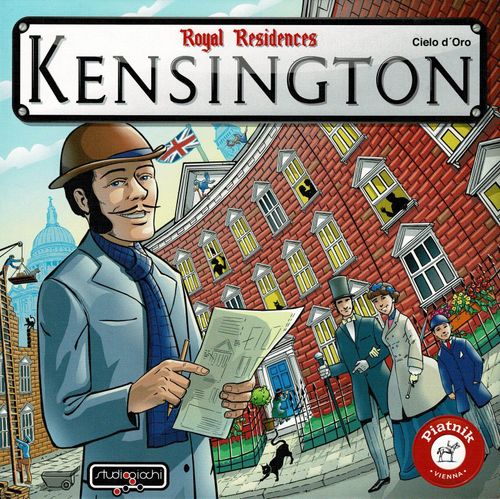
Kensington
Kensington Rulebook
Table of Contents
Table of Contents
Object of the Game
The goal is to build, by skilfully placing building pieces, a building with as many windows, floors and roofs as possible, in order to score the most points at the end.
Components
- 70 window pieces in various shapes: square, rectangular, L-, T-, S- and U-shaped. 35 pieces show brightly lit windows and the other 35 pieces have dark windows. Of the 70 window pieces, 40 are "easier" to build and 30 are "harder". The harder pieces are marked on both the front and the back with a grey diamond symbol. The back of all window pieces is beige.
- 24 roof pieces in various shapes: square, rectangular, L-, T- and U-shaped. 9 of the pieces show a bird (see End of the Game). The back of all roof pieces is brown.
- 6 special pieces: 3 individual square wall pieces without windows, and 3 red doors. The back of all special pieces is also brown, and additionally marked with a grey circle symbol.
- 5 doors in yellow, green, blue, brown and grey.
- 5 warehouses in the colours of the doors. Each warehouse shows two gates, which serve as storage spaces for pieces that cannot be built in the current turn, as well as three spaces for placing the bonus chips.
- 20 bonus chips.
- 1 rulebook.
Setup
-
Before the first game, all pieces must be carefully pushed out of the die-cut punch boards.
-
Each player chooses a door in yellow, green, blue, brown or grey and takes a warehouse in the colour of their door. The player places the door face up in front of them, so that there is enough room around it for building. Unused doors are returned to the box. Note: the red doors, which count as special pieces, remain in the game!
-
The window, roof and special pieces are shuffled face down and placed as a supply in a jumbled heap in the middle of the table. As a boundary, all warehouses, including those in colours that are not being played, are placed tightly around the piece supply.
-
Depending on the number of players, the following number of bonus chips is set out as the general chip supply, placed next to the warehouses:
- 2 players: 8 bonus chips
- 3 players: 12 bonus chips
- 4 players: 16 bonus chips
- 5 players: 20 bonus chips
Unused chips are returned to the box.
-
Each player takes one chip and places it on a round space in their warehouse.
Starting layout for 4 players.
Sequence of Play
A starting player is determined. Play then proceeds clockwise.
The player whose turn it is performs the following actions in order:
- Take a piece.
- Build.
1. Take a Piece
One of the following options is available:
a) ONE piece with a beige back may be drawn from the supply, regardless of whether it has the grey diamond symbol or not.
b) ONE piece with a brown back may be drawn from the supply, regardless of whether it has the grey circle symbol or not. For this, however, an already collected bonus chip must be returned to the general chip supply (see The Bonus Chips).
c) ONE piece that is located in the warehouse of another player may be taken. For this, a collected bonus chip must be handed to that other player (see The Bonus Chips).
Caution: When a piece is drawn from the supply, one must not rummage around in the piece supply at random. The piece that is touched first must also be taken! Furthermore, option a) may not be chosen if the player has already collected 4 or more bonus chips in their warehouse (see The Bonus Chips).
2. Build
After the player has taken ONE piece, they may build immediately. The pieces may be attached to one's own building according to the building rules.
It is only permitted to build during one's own turn. Not only the piece that was just taken may be built, but also pieces that are already in one's own warehouse. It is therefore possible to build up to 3 pieces during one turn: the one that was just taken, plus up to two from the warehouse. The pieces may be attached to the building in any order, and pieces may also be combined into units beforehand, which are then attached to the building afterwards.
The building rules:
-
The building begins with one's own door. Starting from it, the building is extended. The construction of separate objects that are not connected to the main building is not allowed! The correct orientation of the windows must be taken into account.
-
Overhangs that float in the air are not allowed! Every part of a piece's bottom edge must rest either on the ground or on another piece.
-
A window piece may only be attached if, on at least one side, it adjoins either another piece with windows of the same colour (brightly lit or dark), or a door, or a wall piece without windows, or a roof piece.
Examples: The piece with the 4 dark windows may not be placed, because its left side would only adjoin brightly lit windows. The L-shaped piece with dark windows may be placed, because one side also adjoins the door. Thus the straight piece with four dark windows may then also be placed, because now a window directly adjoins another dark window. Moreover, the L-shaped piece with the grey diamond symbol allows the player to take a bonus chip (see The Bonus Chips). The square piece with the brightly lit window may be placed after the L-shaped roof piece has been placed. Thus the brightly lit window directly adjoins the roof piece.
-
Roof pieces may be attached to any other piece or to a door. Once a roof piece has been placed, NO further piece may be placed ON this piece!
-
Wall pieces without windows may be attached to any other piece or to a door.
-
If the player cannot or does not want to build the piece they have just taken, they may place it on a free gate in their warehouse. If both gates are already occupied by a piece or a door, the player may not keep the most recently drawn piece; instead, they must place it face down back into the supply.
-
Once a piece has been built in a turn, it may not be moved again in a later turn!
After the player has finished building, the next player is in turn.
The Bonus Chips
A player receives a bonus chip from the general supply when they attach a window piece with a grey diamond symbol to their building. This may be either a piece they have just drawn from the supply, or a piece they take from a warehouse (their own or another player's) and build.
Caution: When a window piece with a diamond symbol is drawn from the supply and placed in one's own warehouse, there is no bonus chip for it yet. The chip is only received once the piece has actually been built!
The bonus chips are collected on the three round spaces in one's own warehouse and must be stacked if necessary.
On their turn, a player may use a bonus chip for one of the following actions:
- They may draw a piece with a brown back, regardless of whether it has a grey circle symbol or not, from the supply. The bonus chip is then returned to the general chip supply.
- They may take a piece or a door from the warehouse of another player and give that player a bonus chip. This piece must be built immediately.
Caution: If at the start of their turn a player already has 4 or more chips in their warehouse, they MUST use a chip and choose one of the two options mentioned above. In this case, they are not allowed to draw a piece with a beige back from the piece supply!
End of the Game
The game ends:
-
When a player draws the seventh roof piece with a bird from the piece supply. Note: all roof pieces with birds that have already been built, and all those still lying in the warehouses of all players, are counted together. The player may finish their turn. Afterwards, all other players also have the opportunity to build the pieces still lying in their warehouses.
Or
-
When no player can attach a piece any more, because either no suitable pieces remain in the general piece supply, or because no player has a bonus chip left with which to take roof pieces.
Scoring then follows.
Scoring
Each player calculates their points separately:
-
1 point for each window, regardless of colour, that is located in a vertical row which is covered by a roof piece. Caution: window rows that are not covered by a roof piece score no points.
-
2 points for each door that is located in a row covered by a roof piece. Doors in rows without a roof score no points.
-
Points depending on the number of different levels covered by a roof piece: 1 point for the first roof level, 2 points for the second, 3 points for the third, and so on.
Example: A player receives for a building with 5 different-height levels covered by a roof: 1+2+3+4+5 = 15 points.
-
1 point for each white and black cat visible on the building, regardless of whether its row is covered by a roof piece or not. Note: there are no points for the human silhouettes seen behind one or other of the windows.
-
1 additional point per vertical row, if the complete building is covered with roof pieces.
The player who has scored the most points in total wins. In the event of a tie, the player with the most birds sitting on their roofs wins.
Scoring example:
The master builder of this building receives 29 points in total:
- 17 points for the windows in the rows covered by a roof piece.
- 4 points for the two doors, since they are also located in rows covered by a roof piece.
- 6 points for the differently high levels covered by a roof piece (1+2+3 points).
- 2 points for the two cats.
The player receives no points for the width of their building, since not all rows end with a roof piece.
(The scoring example in the original rulebook is shown as an illustration of a building.)