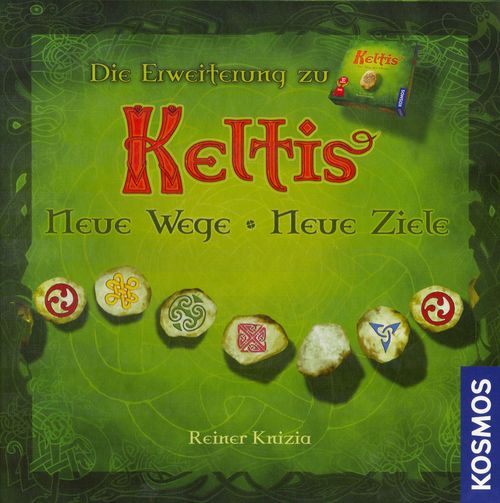
Keltis: Neue Wege, Neue Ziele
Keltis: Neue Wege, Neue Ziele Rulebook
Table of Contents
Table of Contents
Game Components
- Game board, which substitutes for the board in the base game.
- 22 round markers (gray backs), substituting for the square markers in the base game:
- 5 cloverleaves
- 5 different colored wishing stone markers
- 7 point markers (5x2, 2x3)
- 5 card markers.
- 25 wishing stone markers (green backs):
- 5 markers for each of five different colors.
Use the cards, pawns and cloverleaves (player color markers) from the base game.
Preparation
- Before the first play, punch out all components carefully from the frame.
- Shuffle the 22 bonus markers with gray backs face-down and put them on the stone fields with small gray points. Flip all markers face-up.
- Sort the 25 bonus markers with green backs by color and put them on the five stone fields with the corresponding color as open piles.
- As in the base game, give each player a set of pawns, a cloverleaf and 8 cards from the shuffled deck.
Note: Also for a 2-player game, remove 30 cards from the deck and put them back in the box face-down.
Game Board
Unlike the base game, the stone paths are not straight paths. Instead, the paths branch four ways from the starting space. The paths lead to the end zone for each color. The numbers beside the stone fields show how many points a pawn scores at the end of the game. If five pawns of any color are within the end zone at the same time, the game immediately ends.
Game Play
- Determine player order as in the base game.
- Like the base game, every player forms a set of columns laid out in front of himself in ascending or descending order for each color.
- To move a pawn forward, the player must play a card in the color of the next field.
- When moving to a joker field (gray stone), the player may play a card of any color in one of his card columns.
- Unlike the base game, a player may have multiple of his own pawns on the same field.
- The pawns may never be moved backward.
Note: Unlike the base game, a pawn on a final field (value 10) does not allow the use of further played cards of this color to move other pawns.
Bonus Markers
Every player who moves a pawn to a field with a bonus marker receives a reward. The markers with a green background remain on the field when a player reaches them, but the markers with an orange background are taken by the player who first moves onto the bonus marker's field. Bonus markers are kept face-down in front of the player.
Point Marker: The player scores the value on the marker (2 or 3 points). Big pawns do NOT double the points earned.
Cloverleaf: The player may advance any of his pawns to the next field. This can also be the pawn just moved. If this pawn lands on another field with a marker, the marker is also activated.
Card: The player may immediately discard either a card from the top of any of his columns or he may discard a card directly from his hand.
Wishing Stone (piles): The player takes one marker from the pile and keeps it face-down in front of him/her. If no wishing stone is available, the player gains nothing.
Note: At any time, players may examine their acquired wishing stones.
Draw Cards
At the end of his/her turn, the player draws new cards to replenish his hand to eight cards. For example, if the player has played two cards on account of a card bonus in his turn, he draws two new cards successively.
Note: Cards which were discarded may not be drawn in the same turn.
Movement Example
I. Black plays a red 3, moves one of his pawns forward and gains three points for the point marker.
II. In the next turn, he advances the pawn to the joker field by playing a green 2.
III. Then he plays a blue 10 and picks up the pink wishing stone.
IV. Finally, he plays a blue 3 and now may discard one card from his hand or his card columns. He chooses the just played blue 3 in the blue column to gain more room in the blue column for future play.
End of the Game
As in the base game, the game ends immediately if the fifth pawn has reached the end zone (the last three field rows) or if the last card was drawn. As in the base game, if the fifth pawn lands on a tile by entering the end zone, the action of this tile is not carried out.
Scoring
Each pawn on a field scores the points indicated next to it. The large pawn scores double the points. The pawns on the start field score 0 points.
Wishing stone scores are calculated differently than in the base game:
- Players receive points for collecting multiple colors of stones according to the table.
- In addition, the players receive ten points per set of three or more same-colored stones.
- It is allowed to use the same stone for both the multiple color scoring as well as for the three or more stones of the same color.
The winner is the player who scored the most points. If there is a tie, the tied players share the victory.
Multiple Color Stone Bonus
| Stones | Points |
|---|---|
| 0 | -4 |
| 1 | -3 |
| 2 | 2 |
| 3 | 3 |
| 4 | 6 |
| 5 | 10 |
Wishing Stone Scoring Example
The player has wishing stones in four different colors and receives six points for the color variety. In addition, he receives ten points for three blue wishing stones. The extra yellow wishing stone brings no further points.