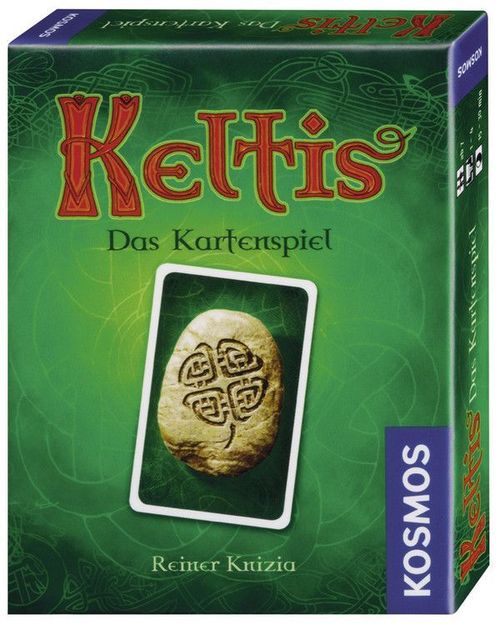
Keltis: Das Kartenspiel
Keltis: Das Kartenspiel Rulebook
Table of Contents
Table of Contents
Contents
110 cards, divided into 90 color cards, of which:
- 80 number cards in 5 colors (1x each of 0, 1, 2, 8, 9, 10; 2x each of 3, 4, 5, 6, 7)
- 10 closing cards (2 each with color symbols in 5 colors)
as well as:
- 11 point cards (with a white "1" in the middle and gray numbers from 0–10 in the corners)
- 9 orange-colored wish stone cards (with numbers 1–9)
What's It About?
Players play color cards in order to form color rows as long as possible. The cards of a color row must be laid down either in an ascending or in a descending order. The longer a color row is at the end of the game, the more points it is worth. Very short rows even score minus points. Also, along the way each player should collect Celtic wish stones, which bring additional points. But whoever collects too few wish stones in turn scores minus points. Whoever has the most points at the end of the game wins.
Setup
The 9 wish stone cards are laid out face-up in a row. The 101 remaining cards are shuffled well. Each player receives 8 cards in hand. The remaining cards are placed face-down as a draw pile.
Attention: In a two-player game, 30 of the 101 cards are randomly drawn and put back in the box unseen.
The Game
Whoever was most recently in Ireland begins. If this cannot be determined, the oldest player begins. Play then continues clockwise. Whoever's turn it is must play one card and then draw one card. In one special case (see below) the player may also play two cards, in which case they draw two cards accordingly.
1. Playing a Card
The player plays one (or two) cards from their hand. For this there are the following options:
a) The player discards one card unused and lays it face-up in the middle of the table. A separate discard pile is formed for each color-card color (including the closing cards) and for the point cards. Up to six discard piles can thus form.
b) The player discards, as described under a), two cards of the same value (whether color cards or point cards) unused, and takes the wish stone card of the corresponding value. This is only allowed if the wish stone card is still in the open row. The player lays the taken wish stone card face-up in front of themselves.
c) The player lays a color card face-up in front of themselves. In general, each player forms their own color row for each color. If the player already has cards of the played color laid out in front of them, they lay the new card slightly offset, below the cards already laid out, so that the values of all cards remain visible.
Number cards may be laid out by the player in two ways:
a. Either they begin with a low number: then every further card of the player in this color must be equal to or higher than the highest of their already laid-out cards of this color. Example: On a 3, a 3 can be played, then a 6, then a 7, then another 7, and so on.
b. Or the player begins with a high number. Then every further card of the player in this color must be equal to or lower than the lowest of their already laid-out cards of this color. Example: On a 9, an 8 can be played, then another 8, then a 5, then a 3, and so on.
As soon as a player lays a second card of a differing value in a color, they thereby fix whether they will lay out all further cards of this color from low to high or from high to low.
Closing cards may always be played by the player into their corresponding color row. However, once a closing card is played, no more number card may be played into that color row — at most the second closing card may still be played. The second closing card in a color row closes it definitively.
d) The player lays a point card face-up in front of themselves. For this there are two options:
a. Either the player lays the point card into a separate, neutral point-card row. There, only point cards may be laid out; the values of the cards play no role here at all. (A sequence of point cards of 3 – 5 – 2 – 8 would thus be possible here.) Every point card laid out this way is worth 1 point in the final scoring.
b. Or the player lays the point card into one of their color rows. This is only allowed if the value of the point card matches the value of the number card most recently played into that color row.
With point cards, one can thus either directly collect points for the final scoring or extend one's own color row.
2. Drawing a Card
After the player has discarded a card or laid it out in front of themselves, they draw a new card in order to refill their hand back up to 8 cards. The player may either draw the top card from the face-down draw pile or they take the top card from one of the open discard piles in the middle of the table. This may not, however, be a card that they discarded in this same turn.
If the player discarded two cards in order to take a wish stone card, they correspondingly draw two new cards, one after the other, in order to refill their hand back up to eight cards. It is allowed to first draw one card from the face-down draw pile or from a discard pile, and only then to decide from where they want to draw the second card. Nevertheless, they may not take a card that they discarded in this turn.
Then the next player takes their turn, and so the game continues.
Game End
The game can end in two ways:
-
The game ends immediately when closing cards lie out in a total of five card rows, regardless of which colors or which players they belong to. (The player who ends the game draws no more card!) Attention: Two closing cards in one card row are not counted twice.
-
The game also ends when the last card is drawn from the face-down draw pile.
At the end of the game, each player may still lay up to two cards from their hand into their color or point-card rows. In doing so, no more cards are drawn.
Scoring
Color Rows
Each of the five color rows earns the player more points the more cards it contains:
| Cards | 1 | 2 | 3 | 4 | 5 | 6 | 7 | 8 | 9+ |
|---|---|---|---|---|---|---|---|---|---|
| Points | -4 | -3 | -2 | 1 | 2 | 3 | 6 | 7 | 10 |
If a player has not formed a color row for one or more colors, this yields neither minus nor plus points.
Point Cards
Point cards in the point-card row count 1 point per card.
Wish Stone Cards
Each player receives points for their collected wish stone cards:
| Wish Stone Cards | 0 | 1 | 2 | 3 | 4 | 5+ |
|---|---|---|---|---|---|---|
| Points | -4 | -1 | 0 | 4 | 6 | 10 |
The player with the most points wins. In case of a tie, the tied players share the win, or the placement.
Reiner Knizia thanks all the playtesters who contributed to the development of this game, in particular Iain Adams, Sebastian Bleasdale, Rob Dinnadge, Gavin Hamilton, Ross Inglis, Kevin Jacklin, Simon Kane and Dave Spring.
Author: Reiner Knizia Graphics: Claus Stephan and Martin Hoffmann Editing: Sebastian Rapp, Stefan Stadler
Art.Nr.: 740160
© 2009 KOSMOS Verlag, Pfizerstr. 5–7, 70184 Stuttgart. All rights reserved. Made in Germany.