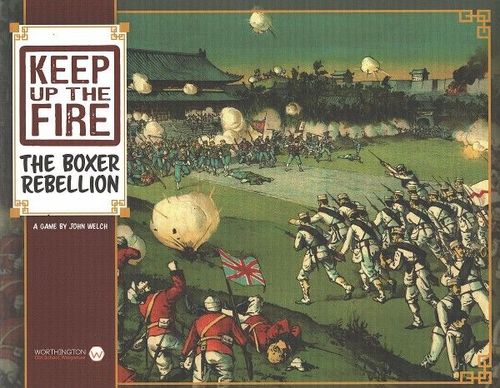
Keep Up The Fire!: The Boxer Rebellion
Keep Up The Fire!: The Boxer Rebellion Rulebook
Table of Contents
Table of Contents
- [0.0] Using These Rules
- [1.0] Introduction
- [2.0] Game Equipment
- [3.0] Setting Up the Game
- [4.0] Sequence of Play
- [5.0] Cards (Headline/Event)
- [6.0] Chinese Placement
- [7.0] Legation Actions
- [8.0] Chinese Advance
- [9.0] Legation Movement
- [10.0] Chinese Blockading Force Attacks
- [11.0] Relief Column Commands
- [12.0] Victory & Defeat
[0.0] Using These Rules
New gaming terms, when they are initially defined, appear in dark red lettering for quick referencing.
The instructions for this game are organized into major "Rules" sections as shown in large green CAPS font, and represented by the number to the left of the decimal point (e.g., rule 4.0 is the fourth rule). These rules generally explain the game's components, procedures for play, the game's core systems and mechanics, how to set it up, and how to win.
With each Rule, there can be "Cases" that further explain a general concept or basic procedure. Cases might also restrict the application of a rule by denoting exceptions to it. Cases (and Subcases) are an extension of a Rule shown in the way that they are numbered. For example, Rule 4.1 is the first Case of the fourth Rule; and Rule 4.1.2 is the second Subcase of the first Case of the fourth Rule.
Important information is in red text.
References to examples of a Rule or Case are in blue text and this font.
Text in shaded boxes, like this, provides the voice of the game's designer, who is addressing you to explain an idea or concept that is not, itself, a Rule or a Case.
[1.0] Introduction
"Keep Up The Fire!" is a solitaire States of Siege series game set in 1900 Peking (modern day Beijing) China where Foreign Legations (areas assigned to Imperial powers including ambassadors, business people, and a handful of troops to provide security) are besieged in their Compound by Chinese anti-imperialist forces. The Chinese "Boxers" (Society of the Harmonious Fists), with the Imperial Manchu forces of the Qing Army, are angry and determined to expel these foreigners from China.
[2.0] Game Equipment
The Game Map: The 11" x 17" game map depicts the Legation Compound in Peking on the left with spaces to position Allied forces, Legation Tracks for Boxer/Qing forces, and various Strength Tracks and game aids. The inset map on the right shows the progress of the Relief Column trying to reach Peking, including Tracks for its Speed and Combat Power (CP).
Legation Map Units — Chinese: Boxer (+1 Casualty), Qing (+1 Chinese Melee Casualty). Legation (player): Germany, International Gun (+1 To Hit, +3 Ch. Casualties).
Relief Column Map Units — Chinese: Boxer/Qing diamond unit, showing Strength Value. Relief Column: Eight-Nation Army diamond unit.
The Playing Pieces: Some cardboard game pieces represent the fighting forces. These pieces, called "units," include the Legation Forces (each with their own special ability), the International Gun, plus Boxer and Qing groups storming the walls (on the Legation Compound map); and the Eight-Nation Army (a.k.a. the Relief Column) and Chinese blocking forces hindering the Relief Column with their Strength.
Legation pieces are "squares" on the map, while Relief Column pieces are rotated 45 degrees as "diamonds" on the inset map.
Combat Power (CP) or Strength for Chinese units; to achieve success, you must roll a (modified) die roll higher than that Strength value. It is also the amount of Casualties that Chinese units storming the Compound can sustain. For Legation units, it is kept track of using a separate marker for each nationality and is the amount of Casualties each can sustain.
Legation Map Markers — [DIRECTION] Chinese Combat Power (CP), Fortification Level, Legation unit CP, Heroic Effort.
Relief Column Map Markers — Eight-Nation Army Speed, Eight-Nation Army CP.
Other game pieces, called "markers," are used to track game data, including Combat Power (CP) markers, Die Roll Modifier (DRM) markers, the fortification level of the Legation Compound, and the Speed and Combat Power of the Relief Column.
[3.0] Setting Up the Game
Follow these steps to set up the game:
-
Place the red (Chinese Boxer) Strength 3 and 4 units in an opaque container (e.g., a coffee mug), hereafter referred to as the "Cup."
-
Place the Fortification marker on the 0 space on its Track, and the four directional CP markers on the 0 spaces of their respective Tracks.
-
Place the Allied Combat Power markers on the Legation Strength & Heroic Effort Track in the box with their corresponding flags. Place the Heroic Effort marker in the 0 space of that same Track.
-
Choose where to place the eight Legation units, face-up, 1 each, on the eight Legation Defenders' spaces at the Compound (i.e., so that there are two such units "on each wall" confronting each direction).
-
Place the Relief Column Speed and Combat Power markers in their matching named (starting) spaces on the inset map.
-
Place the Eight-Nation Army unit in the green Taku space on the insert map.
-
Set aside the remaining units and markers. They enter play as instructed.
-
Separate into piles the Headline cards #1 – 12 (first Epoch; red-titled) and #13 – 24 (second Epoch; gold-titled), and then Event cards (half-blue) #A – L.
From the gold-titled Headline cards, place #13 (International Gun Assembled), face-down, to one side. Take the remaining gold-titled Headline cards and turn them face-down. Then take the half-gold-titled Event cards, turn them face-down, mix them, place half with the remaining face-down gold-titled Headline cards and set the remainder aside, unexamined (they are not used). Mix these gold and half-gold Headline and Event cards together and place them, face-down, on the Draw Pile location along the bottom edge of the map.
We're building the Draw Pile from the bottom up, so these will be the last cards drawn.
-
Place card #13 (International Gun Assembled), face-down, on top of the other cards already in the Draw Pile.
If you wish to encounter these events in their historical order, do not mix the cards at all, but remove all of the Event cards and arrange the Headline cards numerically. Begin playing with card #1 and end it with #24.
Alternatively, you can mix all of the red- and gold-titled Headline cards together with half of the Event cards, save for Headline card #13 which, after shuffling, is slid into the middle of the deck, and Headline card #1 which is always the first card and goes on top.
[4.0] Sequence of Play
A complete game of "Keep Up The Fire!" consists of a number of Game Turns, one for each Headline card revealed and played (up to 24). Each Game Turn, this sequence of play is performed in strict order:
- Card Phase: Reveal the top card in the Draw Pile and place it, face-up, on the Discard Pile. Repeat this Phase if the card revealed was an Event card (after resolving it). When the revealed card is a Headline card, it becomes the new 'Current' card, guiding the current Game Turn.
- Legation Phase: Matters around the Legation Compound are resolved:
- A. Chinese Placement Segment: The Chinese Action Compass is checked; if any of those directions' Tracks lack a Chinese unit, it is immediately reinforced (see 6.1).
- B. Legation Actions Segment: You may spend up to the number of Actions shown on the Current card to fortify and fight with Legation units (see 7.0).
- C. Chinese Advance Segment: All Chinese units on Legation Tracks Advance 1 space toward Fort Halliday (see 8.0)
- D. Legation Movement Segment: Legation units can potentially be repositioned for next Turn (see 9.0).
- Relief Column Phase: Matters on the Relief Column inset map are resolved:
- A. Chinese Placement Segment: If indicated, adjust the Cup, then draw one Chinese Blocking unit at random from it, placing it atop the Eight-Nation Army unit (see 6.2).
- B. Chinese Blockade Attack Segment: If the Current card indicates a Special Blockade Attack by the Chinese Blocking unit, it is performed in this segment (see 10.0).
- C. Relief Column Command Segment: You may spend up to the number of Commands shown on the Current card to improve the Speed or Combat Power of the Eight-Nation Army unit, or to Attack the Chinese Blocking unit and, if successful, then Advance to relieve Peking (see 11.4).
- Housekeeping Phase: If the Eight-Nation Army unit is in Peking, the game now ends (see 12.2). Otherwise, return the Chinese Blocking unit on the Relief Column map to the Cup and, if there is a card left in the Draw Pile, begin a new Game Turn.
[5.0] Cards (Headline/Event)
Headline Cards
Most cards are Headline cards. These are divided into two Epochs (red "siege" cards and gold "relief" cards) to reflect the two distinct periods of the Legation Compound siege. These were designed in chronological order (shown by the numerical order of the card numbers).
The headline at the top of each card, and the historical "flavor" text at the bottom, provide the narrative for the Boxer Rebellion story and help explain the context of the card's gameplay activities.
Each Headline card diagram shows: Epoch; Title, Card Number, the Chinese Action Compass, the Legation Phase Actions/Special, a Blocking Force unit, the Relief Column Phase Commands/Special, and the Historical "flavor" text (no gameplay effect) at the bottom.
Specials
Many cards provide "Special" activities that are performed first, at the beginning of the indicated Phase (Legation Phase if above the dividing line and Relief Column Phase if below that line, such as a Chinese Blockading Force Attack). These Special activities are explained on the cards themselves and apply only during the Game Turn while that card is the Current card.
[5.1] Adding Legation Unit CPs: Replacements ("gains") can only be applied to a unit that is below its starting Combat Power (as shown by its flag symbol on the Legation Strength & Heroic Effort Track). If that unit is already at its starting CP, it cannot receive a replacement.
A CP gained by a unit can be used to exceed its starting Combat Power, but it can never exceed 8 CP.
A Legation unit revived (i.e., from 0 back to 1 Combat Power) is immediately placed in any vacant Legation Defenders space.
[5.2] Reducing Fortification Levels: The Legation Compound Fortification Level can never be reduced below 0.
[5.3] Chinese Blockading Force Attack: See Rule 10.0.
[5.4] Peitang Cathedral Defense: Some cards provide the opportunity to attempt to aid the refugees taking shelter in the Peitang Cathedral - see game map for details on the possibilities.
The fighting around Peitang Cathedral became a siege within a siege, as French and Italian troops were able to successfully hold off wave after wave of attacks.
Event Cards
The Event cards have half-blue titles, also divided into the two Epochs (red and gold). Half are used each game as described in the Set Up instructions (3.0).
Each card indicates whether it is retained by the player for later use at the specific time indicated, or resolved immediately.
Most have a temporary (one-time or one-Turn) effect and are added to the Discard Pile after use. Others are permanent and begin with the phrase, "For the rest of the game…" These Event cards should be placed face-up, near the map, as a reminder of their ongoing effect.
Like Headline cards, there is also a historical note (or "flavor text") at the bottom, to explain that card's part in the story of this epic siege.
[6.0] Chinese Placement
There is a Chinese Placement Segment during both the Legation and Relief Column Phases. They are handled differently as follows:
[6.1] During the Legation Phase: On the Legation Compound section of the map, compare the Chinese (Boxers and Qing) forces storming the walls with the Chinese Action Compass on the Current card.
If all of the directions' Tracks have a Chinese (Boxer or Qing) unit anywhere on them, this Phase is completed and nothing further is done.
If any of those directions' Tracks lack a Chinese unit, then a Chinese unit of the type indicated on the Chinese Actions Compass (by its flag) is placed on the Extreme Range (farthest) space on that Track. That wall's corresponding CP (Combat Power) marker is placed on the indicated numbered box for that wall.
For Example: This Turn, card #6 (Miracle Find at His-Ku!) is the Current card. During the Chinese Placement Segment, the North, West and South approaches to the Legation Compound are checked (as shown on this card's Chinese Action Compass). There are still Chinese units from the previous Turns on the West and South approaches, so those are skipped for placement this Turn. None are placed on the East approach as it has no symbol on this card, but in the vacant North Track a Qing unit is placed in the North Extreme Range space and the North CP marker is placed in the #6 space.
[6.2] During the Relief Column Phase: Simply add or remove from the Cup, if so indicated, the illustrated Chinese Blocking unit, and then draw one at random from the Cup and place it on top of the Eight-Nation Army unit located on the Relief Column inset map. (It is removed during the Housekeeping Phase; there can only be one Chinese Blocking unit on the Relief Column map at a time.)
Thus, every Turn, a "fresh" Chinese force arrives to impede the progress of the Relief Column en route to Peking.
[7.0] Legation Actions
This Phase is the heart of the game, where the eight Legation units must hold their Compound against ceaseless attempts by the Chinese to storm the walls and conquer the streets. Each Turn, the player receives a number of Actions that are spent to either build up the fortifications at the Compound, or to engage the converging Chinese forces in Fire and Melee Attacks so that they break each approaching wave.
Actions cannot be saved between Turns.
[7.1] Fortifying: For 1 Action, the player may increase the Compound's Fortification Level by one, up to a maximum of four. Adjust the Fortification marker on its Track accordingly to indicate the present Fortification Level of the Compound.
[7.2] Fire Attacks: For 1 Action, the Legation unit(s) defending a particular "wall" (i.e., direction of approach by the Chinese) may launch a Fire Attack against the Chinese unit in the Long Range or Extreme Range space of that Track. Fire Attacks are not allowed against Chinese units in the Wall or Street Fighting spaces; see Melee Attacks, 7.3).
"To Hit" Procedure
First, a die roll (z) is made to see if the approaching Chinese unit is "Hit." This is called a "To Hit" die roll. The result of this die roll is modified by the participation of certain Legation units (Italy, France, USA and the International Gun).
- If the modified To Hit result is less than or equal to the Strength of the Chinese unit on that Track, the result is a "Miss" and there is no effect. (The Action spent for this Fire Attack is wasted.)
- If the modified To Hit result is greater than the Strength of the Chinese unit on that Track, the result is a "Hit" and a second die roll is made to inflict Casualties on that Chinese unit.
Casualties Procedure
If a Hit is achieved, a separate die roll (z) is made to determine the losses from this Attack; such losses are called "Casualties." The result of this Casualties die roll is modified by the participation of the International Gun unit, if a Boxer unit was targeted; a Casualties modifier of -1 is applied if the attacking Chinese are at Extreme Range. Reduce that Track's Chinese unit CP marker by the net amount of the Casualties inflicted (or none if the net result is 0 or less). If a CP marker is reduced to 0 or less, that Chinese unit is removed from the map and its CP marker is left in its 0 space.
Important: No Casualties are inflicted upon the firing Legation units.
Example Continued: The Chinese Qing unit on the Extreme Range space of the North Track has a Strength of 6 CP. On the North Track the player has the Russian Legation unit, the Italian Legation unit (+1 To Hit at Extreme Range) and the International Gun (+1 To Hit and +3 Casualties at Long or Extreme Range).
The player spends 1 Action to conduct a Fire Attack. A To Hit die (z) is cast and the result is a 5, with a +2 DRM (die roll modifier) for the combined effects of Italians and International Gun participating, for a total of 7, which is greater than the unit's CP of 6, and so a Hit is scored against this Qing force!
A Casualties die (z) is rolled with a result of 2. Two losses are suffered by the Qing force, +3 for the presence of the International Gun, and -1 for it being in the Extreme Range space on its Track, for a net total of 4 Casualties. The North CP marker is moved from the 6 to the 2 space to reflect these losses. Note that had this been a Boxer force targeted, its Casualties would have been one higher (as shown on the Boxer unit).
[7.3] Melee Attacks: For 1 Action, the Legation unit(s) defending a particular wall may launch a Melee Attack against the Chinese unit in the Wall or Street Fighting space of that Track. Melee Attacks are not allowed against Chinese units in the Extreme Range or Long Range spaces; see Fire Attacks, 7.2).
Casualties Procedure
Unlike a Fire Attack, no To Hit procedure is required; a Melee Attack always Hits.
A Casualties die roll (z) is made and Casualties are inflicted upon both sides based upon this single die roll's outcome.
- Chinese losses are suffered first, with an amount of Casualties inflicted equal to the result of the above die roll, plus one (+1) each if: that Chinese unit is a Boxer unit; if it is in the Street Fighting space on that Track; and if it is confronting the Legation units from Austria, Britain or Germany. Reduce that Track's Chinese unit CP marker by the net amount of the Casualties inflicted. If a CP marker is reduced to 0 or less, that Chinese unit is removed from the map and its CP marker is left in its 0 space.
- Legation losses are applied next, with an amount of Casualties inflicted equal to the result of the above die roll, adding one (+1) each if: that Chinese unit is a Boxer unit; if it is in the Street Fighting space on that Track; and if the Legation unit from Russia is defending that Track. Then subtract one (-1) loss if the Legation unit from Japan is defending that Track, the Attacking Chinese Unit is at 1CP and, finally, subtract the Wall Value (either -1 or -2) as shown on the map when fighting at that space.
Applying Legation Casualties: When the Legation Casualties total 1 or more, they must be applied to the unit(s) defending the Track where the Melee Attack took place (only) and, if desired, to the Fortification Level of the Legation Compound. Legation Casualty results of 0 or less are ignored. When applied to Legation units, Casualties must be divided evenly if there are two units defending there (with the player deciding which Legation unit suffers any odd Casualty). To apply Casualties to a Legation unit, reduce its Combat Power marker on the Legation Strength & Heroic Effort Track by the amount of Casualties being applied. If it is reduced to 0, further Casualties must be applied to the other Legation unit present on that Track or to the Fortification Level (see below), if possible. When reduced to 0, that Legation unit is removed from the map and is out of play until it receives a replacement (see 5.1). If no Legation units remain in play, the game immediately ends in a player defeat (12.1).
Melee Attack Casualties can also be taken as reductions to the Legation's Fortification Level at a rate of 1 level per Casualty. The Fortification Level cannot be reduced below 0, nor can its losses in any single Melee Attack exceed the losses of each Legation unit involved in that Attack by more than one. That is, you could take your initial loss in a Melee Attack from the Fortification Level, but could not take a second Fortification Level as a loss in a Melee until the/each Legation unit(s) in that Attack has taken 1 loss.
Note: The International Gun unit never suffers Casualties and cannot be eliminated.
Example: A Chinese Boxer unit (+1 Casualties) with 4 CP is in its Street Fighting (+1 Casualties) space. Defending that Track are the British (+1 Chinese Melee Casualty) and Japan Legation (-1 Legation Melee Casualty) units; the Legation Compound's Fortification Level is 2. The player spends 1 Action to conduct a Melee Attack and rolls a 3.
The Boxer unit suffers 6 Casualties (3 from the die roll result, +1 from the Boxer unit, +1 from the British unit, and +1 for the Street Fighting space). Since it has only 4 CP, it is wiped out and removed from the map, with that CP marker left in its 0 space.
The player's forces suffer 4 Casualties (3 from the die roll result, +1 for engaging a Boxer force, +1 for the Street Fighting space, and -1 for the Japanese unit). The Casualties are applied as follows: -1 to British Strength, -1 to Japanese Strength, -1 to the Fortification Level (these three participants in that Melee Attack must take their losses evenly), with the remaining Casualty applied at the player's discretion. Knowing there are other Melee Attacks to make this Turn, the player opts to inflict the loss on the British unit (to keep the Fortifications strong) and reduces its associated Strength marker by 1 more.
Note that if the Casualty die roll had been a 6, the Chinese forces would still have been wiped out, and the Legation's mathematical total of '7' losses would have inflicted 2 CP loses to each of the Legation units and the Fortification Level (which would be reduced to 0), plus a third CP loss to either Legation unit! Yikes!
[7.4] The International Gun: This unit can only use its "+1 To Hit" modifier when firing at Long and Extreme Range spaces. Its "+3 Ch(inese) Casualties" modifier is not applied versus Chinese units in Street Fighting spaces (only) as it cannot conduct combat in those spaces; this is symbolized by the gun's Wall space placement on the map (as a reminder). The International Gun can operate without Legation Defenders in the same Wall Space and any Melee Casualties for the Legations are ignored (this is a last gasp effort to keep the Attackers out of the streets).
[7.5] Intelligence: If you conduct multiple Attacks in a Turn, you are entitled to know the results of the first (or second, etc.) before deciding where, or even whether, to conduct the next one.
[7.6] Sustained Attack: A single Chinese unit can be the target of multiple Attacks during a single Segment.
[7.7] Enemy Movement: Chinese units do not Advance or Retreat as a result of Legation Attacks. They always remain in place at this point in the Game Turn.
[8.0] Chinese Advance
After all of the player's Legation Actions have been performed, each surviving Chinese unit on a Legation Track Advances one space toward Fort Halliday. In some cases, Boxer units (only, not Qing units) may Advance two spaces that Turn.
If a Chinese unit enters the Fort Halliday space, the game immediately ends in a player defeat. Similarly, if Chinese units are in the Street Fighting spaces on at least three Tracks, the game also ends immediately in a player defeat (see 12.1).
[9.0] Legation Movement
Legation units in play (including the International Gun) may be freely moved from Tracks that do not have a Chinese unit on its Wall or Street Fighting spaces (these are called "Unengaged" Legation units). They may be moved to any of the four Tracks, provided no more than two Legation units (plus the International Gun unit) end this Movement Segment there.
Legation units are placed in Legation Defenders boxes for the Track where they are located, while the International Gun unit is placed in its box adjacent to the Wall space on that Track.
While a Chinese unit is at the Wall space or inside the Compound on a Street Fighting space, the Legation unit(s) on that Track is "frozen" and cannot be moved away. But, if there is room, another Legation unit can be moved from a less threatened Track to help save the situation at the threatened one.
[10.0] Chinese Blockading Force Attacks
A "Special" that occurs at the beginning of the Relief Column Phase (see 6.0) is when you must "Conduct a Chinese Blockading Force Attack this Turn."
Procedure
Perform the Chinese Placement Segment, drawing a random Chinese Blocking unit from the Cup as per Case 6.2. That Chinese Blocking unit then conducts an immediate Attack prior to the Legation Commands Segment.
When the Blocking unit Attacks, roll a die (z) ± any DRMs from the Eight-Nation Army unit's Combat Power and the Current card. Compare this sum to the Blocking unit's Strength as follows:
If <: You are Defeated! Suffer 1 Loss. Losses are applied as per Case 11.5.
If =: Stalemate! No effect OR Suffer 1 Loss if in a Danger Zone. The fighting was inconclusive, which works to the enemy's advantage!
If >: Victory! No effect.
Example: A Chinese Blockading Force Attack is called for this Turn and, during the Legation Phase, the Chinese Blocking unit for that Turn is placed and launches its Attack.
The player draws the 5-value Chinese Blocking unit from the Cup. The Combat Power of the Eight-Nation Army is currently +2 and there are no die roll modifiers listed on the card. A die is rolled, and if the result was a 1 or 2 (with a +2 modifier bringing the total to 3 or 4), the player would be Defeated and suffer 1 Loss. On a roll of 3 (+2 = 5, the same strength as the Chinese army) the result would be a Stalemate which would only result in 1 Loss if the Eight-Nation Army were in a Danger Zone. And a roll of 4, 5, or 6 (modified to 6, 7 or 8) would be greater than the Chinese army Strength and result in a player Victory – the Chinese Attack having no effect.
[11.0] Relief Column Commands
After the Actions are resolved at the Legation Compound, the story shifts to the Relief Column inset map. Here, the player receives a number of Commands that are spent to either improve the Speed or Combat Power of the Eight-Nation Army unit's die roll modifiers (DRMs; as shown by the highest value reached by that marker, blank spaces counting as the previous DRM space), or to Attack the Chinese Blocking unit opposing it and, if successful, then Advance toward Peking and relieve the siege of the Legation Compound.
Commands cannot be saved between Turns.
[11.1] Improving Speed: For 1 Command, the player may improve the Eight-Nation Army unit's Speed by one box, up to a maximum Advancing die roll modifier of +3. Adjust the Speed marker up accordingly.
[11.2] Improving Combat Power: For 1 Command, the player may improve the Eight-Nation Army unit's Combat Power by one box, up to a maximum Attacking die roll modifier of +5. Adjust the Combat Power marker to the right accordingly.
[11.3] Attacking: For 1 Command, the player may Attack the Chinese Blocking unit stacked on top of the Eight-Nation Army unit during the Relief Column Chinese Placement Segment (see 6.2).
To Attack the Blocking unit, roll a die (z) ± any DRMs from the Eight-Nation Army unit's Combat Power and the Current card. Compare this sum to the Blocking unit's Strength as follows:
If >: Victory! Place the Blocking unit in its Dispersed box for the rest of this Turn, allowing Advance Commands to be made.
If =: Stalemate! No effect OR Suffer 1 Loss if in a Danger Zone. The fighting was inconclusive, which works to the enemy's advantage!
If <: Defeat! Suffer 1 Loss OR Suffer 2 Losses if in a Danger Zone. Losses are applied as per Case 11.5.
Staying Power: After making a second Attack on the same Turn, the Eight-Nation Army's Combat Power is automatically reduced by one (-1) box.
Example: The Chinese Boxer/Qing Blocking unit with a Strength of 6 is atop of the Eight-Nation Army unit in Tiensin (as shown). The player, wishing to "push the Chinese unit aside," spends 1 Command to Attack, and rolls a 3. To this is added a +3 DRM from the Eight-Nation Army unit's Combat Power. The total is 6 (the die roll of 3 + 3 from the Combat Power DRM); this is compared to the Chinese unit's Strength of 6. The values are equal and result in a Stalemate for no effect because Tiensin is not a Danger Zone space (had it been, the Eight-Nation Army unit would have suffered 1 loss (see 11.5)).
Had the die roll been lower, the player would have suffered 1 Loss from the Blocking unit. Had the die roll been higher, the Blocking unit would have been defeated and sent to its Dispersed box and an Advance Command could have been issued next.
As it is, after this Stalemate and with only 1 Command left for that Turn, the player uses it to improve his Combat Power and advances the marker to its +4 space on that Track. There is no benefit to Attacking again with the last Command for this Turn if it cannot be followed-up by an immediate Advance attempt (as another Chinese Blocking unit comes back next Turn).
[11.4] Advancing: For 1 Command, if the Chinese Blocking unit has been defeated (see above) and now resides in its Dispersed box, the player may attempt to Advance the Eight-Nation Army unit closer to Peking.
To Advance the Eight-Nation Army unit, roll a die (z) ± any DRMs from the Eight-Nation Army unit's Speed and the Current card, then compare this sum to the outcomes as follows on the Advancing table:
If >6: Advance! Move the Eight-Nation Army unit one space closer to Peking. If it has reached the Peking space, the game is over (see 12.2).
If =6: Maneuver! No effect OR Suffer 1 Loss if in a Danger Zone. Futile march and counter-march maneuvering gets you nowhere!
If <6: Logistics problem! Suffer 1 Loss. Losses are applied as per Case 11.5.
Staying Power: After making a second Advance on the same Turn, the Eight-Nation Army's Speed is automatically reduced by one (-1) box.
If the road ahead is clear, why is there a risk to Advancing? The answer can be found in the logistical problems of a late 19th century army. This die roll represents the availability of transport, rations, medical supplies, ammunition, billeting, proper communications, the language barrier in dealing with troops from eight different countries, and many other factors.
[11.5] Losses: For each Loss suffered by the Eight-Nation Army, it must:
- Lose 2 boxes of either Speed or Combat Power, or 1 box of each, but never below their respective starting spaces; OR
- Retreat 1 space back toward Taku (but this is not an option if the Eight-Nation Army unit is already at Taku).
One of the above must be fulfilled for each Loss unless prohibited. If none of the above can be fulfilled, that Loss is ignored. (You have enough problems!)
The initial Relief Column in June and July of 1900 was woefully unprepared with only 500 to 1500 troops. There were 75,000 to 100,000 Chinese soldiers between the port city of Taku and Peking.
[12.0] Victory & Defeat
There are three ways to lose and one way to win "Keep Up The Fire!", as explained below.
[12.1] How to Lose: Your troops at the Legation Compound must survive and prevent the Compound from being overrun before the Relief Column arrives. Thus, there are three ways to lose:
Decisive Defeat
A Chinese unit Advances into Fort Halliday or if 3 Street Fighting spaces are occupied by Chinese units: With the Legation Compound overrun, a massacre of embassy staff and Legation defense forces ensues. This powerful and shocking display of resistance by native forces to Imperialist ambitions inspires a series of local uprisings throughout Africa and Asia, leading to the Russo-Japanese War for Eastern Siberia in 1901 and the Anglo-German War for Southeast Africa in 1905.
Recriminations by, and finger-pointing among, the Eight Nations resolves nothing from their defeat in China and growing unrest elsewhere. Continuing Imperial clashes would send the whole of Europe and America into a Great War in 1912.
Substantive Defeat
Your Legation troops are all eliminated (except, of course, for the International Gun, which cannot be eliminated): A grim portrayal of Legation heroics versus inspired Chinese nationalism is told to the press by the few Legation survivors. While there is wild jubilation among the Chinese, the Eight Nations, stung in their national pride and fueled by jingoistic yellow journalism, plan their return. By 1904, the Chinese have directed their swelling forces north to the liberation of Manchuria; here they are confronted once again by an international force sent to relieve the siege of Port Arthur and return, once more, their flags to Peking.
Moderate Defeat
The last card has been played but the Relief Column has failed to arrive at the Peking space: The plight of the trapped Legation Defenders forces them to sue for peace due to the inability of the Eight-Nation Relief Army to reach Peking in time. They sign The Treaty of The Harmonious Fists and Divine Empire, the main provision of which forces the Allied Powers to relinquish their trade ports and military bases in China. Without a common enemy to fight, forces within China turn upon each other to the brink of civil war, while the Allied Nations refocus their Imperialist efforts elsewhere across the globe, where with rising tensions come a host of smaller wars for the next fifteen years.
[12.2] How to Win: If the Eight-Nation Army unit arrives in the Peking space before a defeat occurs (above), victory has been achieved.
To determine the level of victory you've attained, Victory Points (VPs) are scored and compared to the table below. You earn:
- 1 VP for each CP of surviving Legation units, plus
- 1 VP for each remaining card left in the Draw Pile, plus
- The current DRMs of the Eight-Nation Army's Speed and Combat Power, plus
- 5 VPs for each point of Heroic Effort earned from Events.
Compare this VP score to the table below to find out your level of success:
| VPs | Result |
|---|---|
| 75+ | Decisive Victory |
| 63-74 | Substantive Victory |
| 46-62 | Moderate Victory (historical outcome) |
| 29-45 | Minor Victory |
| ≤ 28 | Pyrrhic Victory |
I hope you enjoy the game, and remember to avoid close-combat whenever you can! – John Welch