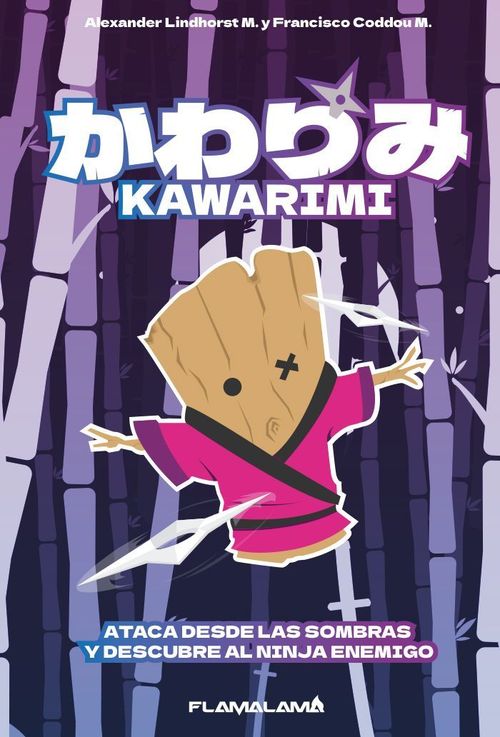
Kawarimi
Kawarimi Rulebook
Table of Contents
Table of Contents
- Components
- Goal of the Game
- Setup
- Setting Up Your Ninja Base
- Turn Order
- Each Turn
- Discovering an Enemy Ninja
- Escape Cards
- Kawarimi Cards
- What to Do If Your Ninja Is Discovered
- Attacking Other Ninjas
- Discovered Three Times in a Row
- Do You Have the Ninja in Your Hand?
- How the Game Ends
- Eliminated on Turn 1
Components
Players: 2–4. Playing time: about 30 minutes. Ages: 10+.
The box contains 78 cards:
| Card type | Number of cards |
|---|---|
| Kawarimi | 7 |
| Traps | |
| – Kunai | 4 |
| – Makeguki | 4 |
| – Spy (Espiar) | 4 |
| – Steal (Robar) | 4 |
| – Clone (Clon) | 4 |
| – Coins (Monedas) | 4 |
| – Transformation (Transformación) | 4 |
| Escape | 8 |
| Fallaste (decoys) | 15 |
| Attacks | 16 |
Note: the rulebook refers to the decoy cards as "señuelos" (decoys). The box table labels this group "Fallaste".
Goal of the Game
You must be the only ninja left in play at the end of your turn. This means eliminating the last of your opponents.
Setup
Separate all the Ninja, Kawarimi and Attack cards. Put the remaining cards in another pile; this will be the game deck.
Each player chooses ONE NINJA, then takes ONE KAWARIMI CARD. These cards stay in your hand.
For each player, separate 4 Attack cards and 1 Kawarimi card, then put them into the game deck. (For example, for 3 players you would put 12 Attack cards and 3 Kawarimi cards into the deck.) The remaining Attack and Kawarimi cards are out of the game.
Shuffle all the cards in the deck. Each player draws 5 cards and adds them to their hand.
If a player has fewer than 3 decoy and trap cards combined in their starting hand, they must announce it, return their 5 cards to the bottom of the deck, and draw 5 new cards.
Setting Up Your Ninja Base
Each player lays out, in a row facing them, between 3 and 5 cards face down. You may only place trap cards, decoy cards and your ninja in the cards of your base. You may decide right away not to place your ninja among the base cards.
The setup diagram shows a Ninja Base for each player, one at each corner of the table, with the draw pile and the discard pile in the middle of the table.
It is very important that the other players do not know which cards you are placing, or what they are not; otherwise they will have an advantage over you.
Once all players have their bases ready, determine the turn order, and the game begins.
Cards with a black border may NOT be used in the base, only from the hand.
Turn Order
There is no need to make this complicated. You can choose a player at random, give preference to the youngest player in the group, or hold a staring contest, which is very common in the world of ninjas.
Once the first player is chosen, the other players take their turns in clockwise order.
Each Turn
At the start of each turn, draw a card from the deck and put it in your hand.
If you have fewer than 5 cards in your base, you may place a trap card, a decoy card or your ninja in your base.
You may also declare that the ninja is in your hand (explained below).
Finally, and most importantly, you must try to discover or attack the enemy ninja. (If you do this, your turn ends.)
Discovering an Enemy Ninja
To discover an enemy ninja, point to a card in the base of any of your opponents and announce that you believe the enemy ninja is there. That opponent must then flip the card so everyone can see it.
- If it is a DECOY card, flip it face down again and leave it in place. Remember that you have already pointed at that card!
- If it is a TRAP card, your opponent reads the card, its consequences are resolved, and the card is placed face up beside the main deck. This second pile of discarded and removed cards is called the "discard pile".
- If it is the enemy ninja, your long and hard ninja training has paid off, and you have discovered your opponent. Their position is now revealed, and it is vulnerable to an attack. (You cannot discover a card and occupy an attack within the same turn.)
Escape Cards
If, while trying to discover an opponent, you flip a trap card, you may show and discard an escape card from your hand. This lets you negate the trap's effects and carry on as if nothing had happened. Both cards go to the discard pile.
An escape card can be used in response to the activation of any trap. Its card text reads: "Use this card to deactivate a trap or to shuffle two cards of your base."
An escape card can be used at any moment when a player activates a trap. When you do, you may shuffle your ninja together with an adjacent card, which gives you a 50% chance to escape.
Kawarimi Cards
A Kawarimi card can be used at any time, but it will not stop an attack from destroying your ninja if the attack hit it.
Once a Kawarimi card has been discarded from your hand, you must pick up all the cards of your base, shuffle them, and place between 1 and 5 cards again. They do not need to be in the same order, or be the same cards, as before. The goal of this card is to confuse your opponents and hide your ninja in case it is discovered.
What to Do If Your Ninja Is Discovered
If any opponent discovers your ninja, do not panic. Show a KAWARIMI card to the other players and then discard it. Take all the cards from your base into your hand, shuffle them, and set up your base again.
Tip for when your ninja is discovered: I won't sugarcoat it, this is bad. Your ninja is left vulnerable. Escape cards can buy you a pair of extra turns, but if any player launches an attack against your ninja, you will lose the game.
Attacking Other Ninjas
When you suspect where an enemy ninja is, or simply feel lucky enough to test your luck, you may use an attack card. The process is the same as discovering an enemy ninja, except that this time you show your opponent the attack card and point to the card in their base that you are attacking.
- If the flipped card is a decoy or a trap, it is eliminated and goes straight to the discard pile, with no effect on the attacker.
- If the flipped card is a ninja, you have just eliminated an opponent and are one step closer to victory.
Discovered Three Times in a Row
It may happen that an enemy ninja has been discovered, and everyone knows its position, but nobody has attacks to eliminate it. In cases like this, if the same player points at and flips an opponent's ninja three times in a row, that ninja is eliminated immediately, since it has failed the most basic part of being a ninja: knowing how to hide.
Do You Have the Ninja in Your Hand?
If you have a good memory, you will remember that at the beginning we said it is not mandatory to place your ninja in your base. This is a risky play, full of adrenaline, and you must use it wisely.
During your turn, a player may choose not to attack or discover an enemy ninja, and instead accuse an opponent of having the ninja hidden in their hand. In this case, that player must show their hand to the player who accused them.
Translator's note: the printed sentence above is ambiguous. Read literally, its subject is the accusing player and "the player who accused them" would be the accused player. The rest of the section makes the intended sequence clear (the accused shows their hand, and the accusing player is the one who loses cards if the accusation is wrong). The sentence is transcribed as printed.
- If the ninja was actually hidden in the hand, the result is revealed to the rest of the players, and the accused player automatically loses the game.
- If the ninja was not in the hand, the accusing player must give all the cards from their hand to the accused player. If the accusing player had no cards in hand, the accused player draws 3 cards from the deck.
How the Game Ends
The game ends when only one hidden ninja remains and all of its opponents have been eliminated.
If at the end of your turn you are the only ninja in play, you have won the game.
IMPORTANT: If an opponent loses, they must show all their remaining cards to the other players (hand and base). If any ninja is found among their cards, the owner of that ninja also loses the game.
Eliminated on Turn 1
To be eliminated on turn 1, the starting player had to use an attack card and hit your ninja on the first try, without knowing anything about your base. This could mean two things: either your opponent is not a ninja but a psychic, or they have tremendous luck. Whatever the case, you should congratulate them and accept this quick defeat.
In short, yes, it counts.