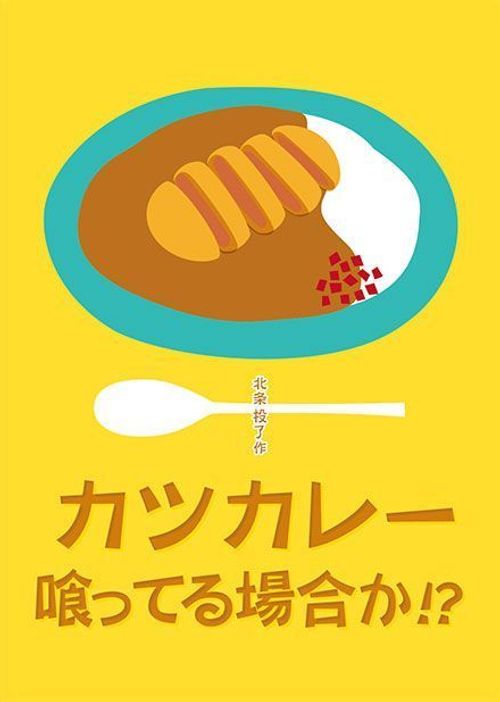
Katsu Curry?! This is not the time for that!
Katsu Curry?! This is not the time for that! Rulebook
Table of Contents
Table of Contents
Components
- Product cards (BASIC): 18 cards. A: 9, B: 6, C: 2, D: 1.
- Product cards (+10): 10 cards. A: 6, B: 3, C: 1.
- Price cards: 60 cards, from 70 yen up to 12,000,000 yen.
- This manual.
About the components: this "Katsu Curry?!" is the Chicken Dice Games version of "Katsu Curry?!" with 10 new product cards added. Product cards marked "Basic" in the lower left corner are the original product cards. Those marked "+10" are the 10 additional cards. Please play first with the original product cards only. How to use the 10 additional cards is explained later.
Setup
Shuffle the price cards well and deal them out evenly to all players.
Separate the 18 BASIC product cards by letter, and shuffle each pile well. Make the product card draw deck by placing the D cards on the bottom, the C cards on top of them, then the B cards, and the A cards on top. Place the deck in the center of the play area.
Playing the Game
Turn one card over from the product card deck and place it in the center of the play area.
Each player looks at it and chooses one card from their hand that they believe is the product's "common" fair price. Place it face down in front of you. When all players have placed a card, turn them all face up at the same time.
As a rule, the player who played the highest price card becomes the "winning bidder" (落札者) and takes the product card.
However, if the difference between that highest price and the second-highest price card is more than 2 times, the highest price is deemed not to be a "common" price, and the winning bidder is the player who played the second-highest card. In that case, compare the second-highest and third-highest prices; if those are also more than 2 times apart, compare the third-highest and fourth-highest.
If the price differences between all of the price cards played are each 2 times or more, the player who played the lowest price becomes the winning bidder.
Replenishing Price Cards
The winning bidder places the product card in front of them, and places the price card they used under it, so that the price is visible and shows what they paid. (It is recommended to lay the card so only the price part sticks out.)
Each of the remaining players takes the price card played by the player to their right and adds it to their hand. If the player to the right was the winning bidder, take the price card from the next player further to the right instead.
The winning bidder's hand size stays reduced.
Handling of "Cup Noodles" and "Earthquake Relief Donation"
When the product card "Cup Noodles" (カップ麺) or "Earthquake Relief Donation" (震災義捐金) comes up, the winning bidder is chosen in the reverse of the normal order.
The player who played the lowest price becomes the winning bidder of Cup Noodles. However, if the difference between that price and the second-lowest price card is more than 2 times, the right passes to the second and subsequent players.
Translator's note: the heading names both "Cup Noodles" and "Earthquake Relief Donation", but the rule text as printed refers only to Cup Noodles. It is transcribed as printed.
Four-Player Special Rule
When this game is played with 4 players, the player who played the lowest price cannot become the winning bidder (unless the product card is Cup Noodles).
If the price differences between all of the price cards played are each 2 times or more, that product card belongs to no one and is removed from the game. Each player takes the price card played by the player to their right into their hand, and then proceeds with the next product card.
End of the Game
If any one player lines up 9 or more product cards in front of them, the game ends immediately and that player is the winner.
Otherwise, the game ends when the winning bidder of the last product card has been decided. The player whose total of the numbers on their product cards (VP) is highest is the winner.
If players are tied, the player who obtained the product card with the higher number is ahead. If it still cannot be decided, those players settle it with "Kokon Tōzai, Genyaku no Daigishi" (古今東西現役の代議士, naming currently serving members of parliament, past and present, from all times and places) or "Stomach-Ache Endurance Contest" (腹痛ガマン競争).
Optional Rule: 7 or More Players
Do not use the price cards. Instead, give each player paper and a writing implement.
Each player writes the price they think is the product card's "common" fair price on paper. Reveal them all at once and determine the winning bidder.
- If one price is exactly half of another price, treat it as a price difference of "within 2 times".
- If identical prices were written, treat them together as a single bid by one player. (So identical prices are not considered "within 2 times" of each other, even though several players wrote them.)
- If that price ends up as the winning price in the end, the players who wrote that price decide the winning bidder by rock-paper-scissors, a coin toss, a fistfight, or similar.
Using the Additional Product Cards
Before Setup, turn all product cards face down, separate them by letter, and shuffle each pile well. Then remove 9 A cards, 6 B cards, 2 C cards, and 1 D card. Leftover product cards are not used in the game. Then proceed to Setup.