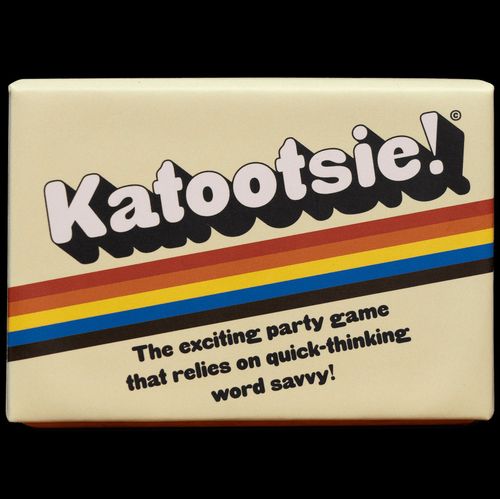
Katootsie!
Katootsie! Rulebook
Table of Contents
Table of Contents
Game contents
127 category cards, 52 letter cards (2 of each letter of the alphabet), 1 "Welcome" card
Setup
Separate the letter cards and the category cards, and shuffle each pile. Place both piles face-down in the center of the table where everyone can see them. Download the "Katootsie!" timer in the Android or Apple app store, just search "Katootsie". Open the app and set the phone face up on the table, easily accessible to everyone. Turn off your phone's auto-lock feature, to keep the app continuously available. Airplane mode is recommended as well. If you don't have access to a device to get the app, you can still play the game.
Objective
Players must win letter cards by calling out a word (or sometimes a phrase) that matches the current category and begins with the current letter. Once there are no more letter cards in play, the player that has collected the most letter cards is the winner.
How to Play
Anyone flips over a category card and reads it aloud, placing it face-up where everyone can see it. Once everyone has heard and understands the category, place a letter card on the table, face up, keeping it covered with your hand, as to not reveal the letter. Quickly remove your hand, to reveal the letter to everyone simultaneously (if you just flip the letter over, some people may see the letter earlier than others, creating an unfair advantage. See the technique in the "How to Play" section of www.katootsie.fun). As soon as the letter card is revealed, the first person to call out a word that fits the shown category, and begins with the shown letter, takes the letter card as a point; that letter is now over, and no one else may answer. The next letter from the face-down letter pile is then revealed in the same manner, and again, the first person to call out a word or phrase fitting the (same) category and beginning with the (new) letter takes that letter as a point. Draw a new category card, and the process repeats until there are no more letter cards left; in other words, play two (2) letters are played for each one (1) category until all the letters are depleted.
Calling Katootsie!
At any time after a letter is revealed, any player may call out "Katootsie!" and tap the app, which will start a 10-second timer. Every other player now has ten seconds to call out a word or phrase that fits the category and begins with the given letter (the person who called "Katootsie" cannot give an answer). If time runs out, and no one has come up with an acceptable answer, the person who called "Katootsie" takes the letter. But, if another player does come up with a correct answer after Katootsie has been declared, but before the 10 seconds run out, that person takes the letter-point in play and steals one letter-point from the person who called "Katootsie". If the person who called "Katootsie" has no points, then they owe their first point to the person that called out the correct answer. Basically, when you call "Katootsie", you are betting that no one with think of an answer in less than 10 seconds. If your bet is correct, you win the point. If your bet is wrong, you lose a point to that person as a penalty, and the person that called the answer wins the letter in play as well. If you don't have the app, the person calling Katootsie can simply count down from 10 on their fingers.
Q, X and Z
Usually, a correct answer must begin with the revealed letter, but Q, X and Z may appear anywhere in the word. "Anywhere" is printed on the card, as a reminder when the card is revealed. So, if the category is "Colors" and "Q" is drawn, "Aquamarine" would be an acceptable answer.
Repeated Letters
If the same letter is drawn twice, consecutively, for the same category, you cannot use the same answer. For example, if the category is "Color" and someone calls out "Blue" for "B", and the next letter is "B" again, "Blue" would not be an acceptable answer a second time.
Ties
If two people begin to utter an answer at the same time (or very close to the same time), you may take a vote from the other players to determine who spoke first. If the majority agrees that James called out his answer just a hair before Mark, James gets the point. But, if everyone agrees that James and Mark did speak at the same time, James and Mark play a tiebreaker. One more letter card is drawn for the same category, and only James and Mark play for this letter. The winner then takes both letters (the initial tie-letter and the tie-breaking letter). If they tie again, a third letter is drawn, and the winner takes all 3 letter-points. Ties can occur with more than 2 people. If that happens, only the people that tied play for tie-breaking points. Also, the tie-breaking letter(s) do(es) not count toward the 2 letters per category rule. Each category must have 2 letters that everyone plays.
Bad Answers/Winning by Default
If someone calls out an answer that is incorrect because it doesn't begin with the revealed letter, is obviously incorrect, or because the rest of the group collectively decides it's incorrect (because it doesn't fit the category well enough (see below)), that person cannot call out another answer for that letter, or call "Katootsie!". Thus, if you are playing with 3 players, and player 1 calls out a bad answer, and then player 2 calls out a bad answer, player 3 wins the point by default (because no one else is able to answer).
Disputable Answers
Many categories can have answers that could be interpreted as acceptable or unacceptable. For example, if the category is "Body Parts", would "Mind" be an acceptable answer for "M"? Some might say yes, some might say no. If someone calls out a questionable answer, the other players can come up with a quick, informal vote as to whether that answer is acceptable or not. If the majority agrees that the answer is acceptable, then it is, and that person takes the letter-point. Likewise, if everyone agrees that an answer is not acceptable, then it isn't, and that person does not collect the letter. That person may not call out another answer, per the "Bad Answer" rule. Play continues until someone gets the point.
Code of Ethics
Say the category is "Famous Bands" and the letter is "W". Don't call out "Wings" under the assumption that "There must be a band called 'Wings' if we look it up" when, in fact, you have never actually heard of that band. This is part of the Katootsie! Code of Ethics. Don't make up answers under the assumption it might be correct if you looked it up.
Proper nouns, "The, A, An"
Proper nouns are generally allowed unless otherwise noted. You must omit "The", "A" and "An" for answers that always begin with those words, usually as title. For example, if the category is "Horror Movies", "The Shining" would be an acceptable answer for "S", but "The Shining" would not be an acceptable answer if the letter "T" was drawn. "Ignore 'A', 'An' and 'The'" is written on those categories, as a reminder.
Winning
Once all the letters have been taken, the game is over. The person with the most letters is the winner. Variation for longer play: Play 2 or 3 rounds. At the end of each round, the letters are tallied for points (one letter=one point). The player with the most cumulative points at the end of the rounds is the winner.
Sudden Death
If, at the end of the game, two or more players have the same number of points, they go into a sudden death round. Shuffle the letter cards into a new face-down pile. Those that tied now play with only one category; the first to win 2 letters is the winner.
Other Guidelines for Acceptable Answers
You cannot add non-essential modifiers to words to make them fit the letter. For example, if the category is "Fruit" and the letter is "R", you cannot say "ripe bananas" because "ripe" can be used to describe any fruit, and is not essential to the name of the fruit. You could, however, say "red delicious", because, even though "red" is technically a modifier that could be used to describe any red fruit, in this example, "red" is actually part of the name of this specific fruit.