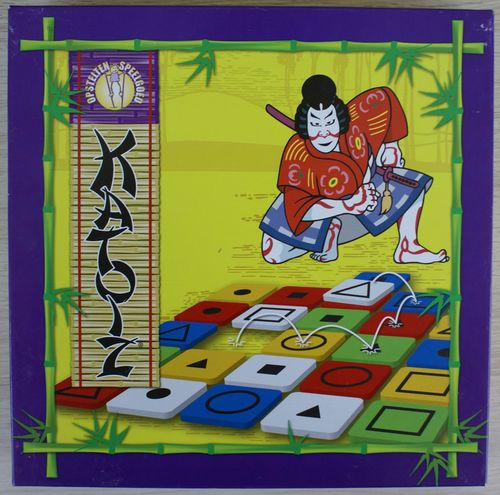
Katoiz
Katoiz Rulebook
Table of Contents
Table of Contents
At a Glance
- Players: 1-4
- Playing time: 5-55 minutes
Box Contents
- 1 colour die and 1 picture die
- 12 discs
- 45 tiles (of which 5 tiles have no picture)
- this rulebook
Before playing a game type for the first time, read the entire description belonging to the game type you will play (see below). If questions come up during play, the answers are easy to find again. Play the Stapeltje-four game type only once you have practised a number of times with 3-set, even if you are already 8 years or older.
Translator's note on numbering: the printed rulebook labels both the 3-set game type and the Stapeltje-four game type as "Speltype 2". The introduction describes three game types, so the Stapeltje-four game type is numbered 3 here. The printed level cross-references ("niveau 1", "niveau 1-2", "niveau 1-4") are transcribed as printed.
Game Type 1: Stapeltoren
Level 1 (age indication: 3+)
Goal of the game
Stack tiles with matching properties as high as possible.
Setup
- Place 20 (or later more) of the tiles with pictures face up, where they are clearly visible.
- The players each choose a starting tile as the first tile for the stack they are going to make, and place it in front of them.
Play
- The youngest player begins.
- The player takes a tile from the supply that has at least one match with the top tile of their own stack. Possible matches are: colour, shape or size of the picture on the tile.
- The player names the match between the chosen tile and the top tile of their own stack, and then places the tile on their own stack.
- The next player takes a turn. Play goes clockwise.
End of the game
The game ends when:
- the tiles have run out, or,
- when all players, during their turn, can no longer find a tile that may be chosen.
Naming a winner is not necessary at this age.
Diagram captions in the printed rulebook show examples of tiles that match on one property: a tile with the shape round, or the size large, or the colour white; and a starting tile of your choice.
Level 2 (age indication: 3+)
To increase the difficulty of level 1, it may be agreed that the tile to be chosen must have at least two matches with the top tile of the stack.
The printed diagram shows an example of a tile that matches the top tile on two properties (for example, colour white and size large).
Level 3 (age indication: 3+)
Goal of the game
Stack tiles with matching properties as high as possible.
Setup
- Place the tiles face up, where they are clearly visible.
- Have the colour die ready.
- The players each choose a starting tile as the first tile for the stack they are going to make, and place it in front of them.
Play
- The youngest player begins.
- Roll the colour die. The result determines which colour the tile to be chosen must have. If purple is rolled, the player may choose any colour.
- The player takes a tile that has at least one match with the top tile of the stack. Matches are: colour, shape or size of the picture on the tile.
- The player names the match between the chosen tile and the top tile of the stack, and then places the tile on the stack.
- If there is no match, the player begins building a new stack. More than one stack may be built.
- The next player takes a turn. Play goes clockwise.
End of the game
The game ends when:
- the tiles have run out, or,
- when all players, during their turn, can no longer find a tile that may be chosen.
The winner is the player with the highest stack. Stacks may not be placed on top of each other. Only the highest stack counts.
The printed example pairs the top tile (colour white, shape round, size large) with a new tile of colour green, and asks the player to name the shape and size matches.
Level 4 (age indication: 4+)
To increase the difficulty of level 3, it may be agreed that the tile to be chosen must have at least two matches with the top tile of the stack.
Level 5 (age indication: 4+)
To increase the difficulty of level 3, the picture die may be added in step 2. It determines which properties to look for: round, square, triangle, large (= white star), small (= black star), or blank. With blank, the player may choose the shape themselves.
Game Type 2: 3-set (3-stel)
Level 1 (age indication: 5+)
Goal of the game
Collect as many 3-sets as possible. A 3-set is a set of three tiles with at least one matching property (colour of the tile, shape or size of the picture on the tile).
Setup
- The players lay 36 tiles in a square of 6 by 6 tiles. The five tiles without a picture and four duplicate tiles stay in the box.
- Have the dice ready.
- Each player chooses 3 discs of the same colour and places them in front of them.
Play
- The youngest player begins.
- Roll both dice. The result of the dice determines on which tile the player may place a disc.
- The colour die determines which colour the tile to be chosen must have. If purple is rolled, the player may choose a colour of their choice.
- The picture die determines which properties to look for: round, square, triangle, large (= white star), small (= black star), or blank. With blank, the player may choose the shape themselves.
- Name the properties the tile to be chosen must meet, and look for a tile that meets them. No disc may be on the chosen tile (one disc per tile).
- Place one disc on the tile. If all of the player's discs are already on tiles, one of the discs may be moved to a free tile. If the player cannot or does not want to (re)place a disc, the turn ends. Go to step 6.
- If a player has occupied three tiles with their discs that have at least one match with each other, a 3-set has been formed. The player may take these tiles and place them face up in front of them, in a pile. The discs are free to be used again.
- The next player takes a turn. Play goes clockwise.
End of the game
The game ends when:
- the tiles have run out,
- no 3-set can be formed with the remaining tiles,
- there is a disc on every remaining tile, or,
- three turns in a row are forfeited.
The player with the most 3-sets at the end of the game has won.
Level 2 (age indication: 6+)
To increase the difficulty of level 1, the player who at the end of the game can make the highest stack from their own tiles, all of which have at least 1 (or 2) matches, wins.
The printed diagrams show 3-sets that match on colour, on shape, or on size.
Level 3 (age indication: 7+)
To increase the difficulty of level 1, the player who has the most points at the end of the game wins. Points are earned in each category (colour, shape or size).
The scoring is as follows:
A. Sort the tiles by colour. Set aside two tiles of each colour. Count the remaining tiles. Each tile is 1 point. B. Sort the tiles by shape (square, circle, triangle). Set aside two tiles of each shape. Count the remaining tiles. Each tile is 1 point. C. Sort the tiles by size (large, small). Set aside two tiles of each size. Count the remaining tiles. Each tile is 1 point.
Add up the results of A, B and C for the final score.
A tile can therefore count more than once in the scoring.
The printed scoring example on the page shows the tallies: colour 2 points, shape 3 points, size 5 points. The colours shown are yellow, green, white, red and blue; the shapes are triangle, square and circle; the sizes are small and large.
Level 4 (age indication: 7+)
To increase the difficulty of levels 1-3, the following may be done in step 2:
- If the result of the dice roll points to a tile on which a disc of another player already lies, the disc of that opponent may be removed from the tile. It is returned to the opponent. The player may not place one of their own discs on the freed tile in the same turn.
- Removing the disc of an opponent may also be done when another tile is free that matches the result of the dice roll.
- If you place a disc on a tile that lies next to a tile on which another of your own discs already lies, you may roll once more.
Game Type 3: Stapeltje-four
Printed as "Speltype 2"; numbered 3 here (see the note above).
Advice: play the following game type and its levels only once you have practised a number of times with levels 1 to 4 of the 3-set game type.
Level 1 (age indication: 8+)
Goal of the game
Build a home stack four tiles high by moving tiles from the play area to the home stack.
Setup
- The players lay 36 tiles in a square of 6 by 6 tiles. The five tiles without a picture stay in the box, and the four duplicate tiles are set aside.
- For each player, place one of the four remaining tiles on the corner of one side (see the diagram). This is your home stack. The tile directly next to the home stack and the neighbouring tiles of that tile together form your own position (stelling) (see the diagram on the next page).
The printed diagram shows the home stacks for 2 or 4 players.
Play
-
The youngest player begins.
-
Roll both dice. The result of the dice determines which tile the player may move.
- The colour die determines which colour the tile to be chosen must have. If purple is rolled, the player may choose a colour of their choice.
- The picture die determines which properties to look for: round, square, triangle, large (= white star), small (= black star), or blank. With blank, the player may choose the shape themselves.
-
Choose a tile with the required properties and move it in the direction of the home stack. This tile may not have been moved by the previous player.
-
Using the movement rules, find a route by which the chosen tile moves as far as possible towards the home stack, or even reaches it.
-
The movement rules are: a. You may move the chosen tile forwards, backwards or sideways if the chosen tile has at least one match with the tile it ends up on. b. You may move the chosen tile diagonally if the chosen tile has at least two matches with the tile it ends up on.
-
If a player can no longer move according to the movement rules, that player may not move further. The tile comes to rest on the last place that could be reached according to the movement rules. As a result, tiles may come to lie on top of each other.
As tiles lie on top of each other, height differences arise. It is not permitted to create a height difference of more than two tiles between tiles lying next to each other, except when you create it within the position (see setup) of one of your opponents. This can be between tiles within that position, or between tiles of that position and the directly neighbouring tiles of that position (see the diagram). As soon as a height difference of more than two tiles is caused by one of your opponents in your own position (situations described above), you must undo that situation as soon as the chance arises. The player must take this into account in their strategy.
The turn ends. Go to step 11.
End of the game
The game ends when one of the players has made their home stack four tiles high. The one who first made their home stack four tiles high has won.
Because stacks next to each other may never differ by more than two tiles in height within your own position, the game can only be ended when:
- the home stack is four tiles high,
- the stack in the play area next to the home stack is at least two tiles high, and
- the height difference with the tiles next to it is also no more than two.
Level 2 (age indication: 9+)
To increase the difficulty of level 1, the winner is the one who first brings their own home stack to a height of five tiles, six tiles (for 2 or 3 players only), or seven tiles (for 2 players only).
Note: with Stapeltje-six and Stapeltje-seven, your own position extends with an extra border of neighbouring tiles.
Level 3 (age indication: 9+)
To increase the difficulty of level 1, the winner is the one who has the highest stack at the end of the game.
The game ends when the players cannot move any tile in three consecutive turns, or when the playing time agreed beforehand has run out.
The level 3 rule refers to "level 1" as printed; it is transcribed as printed.
Level 4 (age indication: 10+)
To increase the difficulty of levels 1-2, a clock is used (a chess clock or, with more than two players, a number of identical kitchen timers).
Each player is given a playing time agreed beforehand on their clock. If your playing time has run out, you are out of the game. The winner is the player who first brings their home stack to the height agreed beforehand, before their playing time has run out.
If none of the players has brought their home stack to the height agreed beforehand, the winner is the player whose playing time ran out last.
Level 4 may also be played by one player alone. The challenge is then to make as high a stack as possible within a playing time of at most 5 minutes.
Indicative playing times per person for the different final heights of the home stack:
- Stapeltje-four: 2 minutes
- Stapeltje-five: 5 minutes
- Stapeltje-six: 10 minutes
- Stapeltje-seven: 20 minutes
Level 5 (age indication: 10+)
To increase the difficulty of levels 1-4, the dice are dropped from step 2 (see level 1). Instead, the tile to be chosen is determined by a fixed colour order from a colour ladder.
Place the five tiles without a picture on top of each other next to the board. These form the colour ladder.
The first player chooses a movement tile with the bottom colour of the colour ladder. The next player chooses a movement tile with the next colour on the colour ladder, and so on. When the top colour on the colour ladder has been used, the colour order begins again at the bottom of the colour ladder.
Design Background
Katoiz is an original design made for the needs of a child. The son of game author Sabine Opstelten was found to be dyspraxic, and tools were needed to deal with this. From this a search followed for board games that children of 3-4 years old could already play, but that would still offer enough challenge for the developing child and remain fun for the parents too. When that search yielded nothing, Sabine Opstelten set out to devise game concepts that could offer this herself.
This resulted in a series of games (Piratenspel, Tover je Toverweg and Mijn Huis), which have found their way to children and adults. The games are today found in schools, in institutions for people with disabilities, in youth care and in game shops. The author is most pleased that so many adults are enthusiastic about the games, which were originally meant for her son.