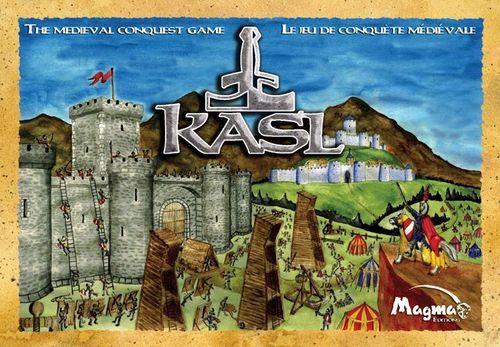
Kasl
Kasl Rulebook
Table of Contents
Table of Contents
KASL™ contents
1 game board, 4 complete armies in different colours, 48 territory cards, 1 recruitment chart, 16 plague markers, 7 six-sided dice, 1 book of game rules.
Game board
The game board represents a county in the Middle Ages, divided into 7 fiefdoms, covering 48 territories. Each fiefdom is a different colour and contains 4 to 8 territories. A kingdom point scale and a sequence of eight squares, each representing a round of play, are arranged around the edges of the board.
Armies
There are 4 complete armies, each containing 8 different units: infantry, archers, cavalry, war machines, Lords, fortified cities (level 1), fortresses (level 2) and castles (level 3). The first four units listed below each have their own combat value (CV).
- Infantry: CV=1
- Archers: CV=2
- Cavalry: CV=3
- War machine: CV=2
- Lord (no combat value)
Strongholds
Each player can have up to four strongholds on the board at the same time. Strongholds offer a defence advantage. There are three stronghold levels.
Level 1 – Fortified city
A fortified city gives the player an additional die (+1D6) in a defensive action only. At the beginning of each turn, for each fortified city the player has on the board, he is assigned one infantry unit. A player gains 2 victory points (VP) for each fortified city he has on the board at the end of the game.
Level 2 – Fortress
A fortress gives the player two additional dice (+2D6) in defensive action only. At the beginning of each turn, for each fortress the player has on the board, he is assigned one archers unit. A player gains 4 VP for each fortress he has on the board at the end of the game.
Level 3 – Castle
A castle gives the player three additional dice (+3D6) in defensive action only. At the beginning of each turn, for each castle the player has on the board, he is assigned one cavalry unit. A player gains 6 VP for each castle he has on the board at the end of the game.
Cards
The 48 cards represent the territories divided into seven fiefdoms of different colours.
Black plague
The 16 black plague markers are used to identify infected territories and to spread the disease.
Introduction
It is the Middle Ages, the era of seigniorial order, when decentralization of the structures of royal power has created a subtle balance between the Lords. The castle no doubt represents the new order best. By appropriating land, Lords make war on other Lords and banish them from their kingdoms. Calling on villagers and peasants the Lords mount armies worthy of their kingdoms. Defences are fortified and new attack forces enter into play, such as the terrifying cavalry and destructive war machines.
You can resist the enemy by building new strongholds. But watch out for the ever-present black plague; it can hit at any time, eliminating your armies and hindering the expansion of your kingdom. You will need to request the services of a Lord to provide moral support to your army.
As the Lord of your kingdom, you will be called upon to make difficult choices throughout the game. Raising an army, recruiting new troops, building new defences, fortifying your city and laying siege to your enemy are some of the challenges ahead. By building a diversified army and carrying out secret missions, you can amass great power to become Lord of the entire realm.
Game objective
Your objective is to build the largest kingdom with the help of your army, strongholds, Lords and mission cards (advanced rules) in order to obtain the most victory points (VP). At the end of the eighth round of play, the game is won by the player who has the most VPs.
A player's principal kingdom is represented, throughout the game, by the largest number of adjacent and connected territories that belong to him. There must be at least one stronghold on one of the territories forming a kingdom. A player can therefore hold several kingdoms if he has several strongholds on the board at the same time.
Rivers can be crossed only by bridges. Mountains block all access and connection between the territories concerned.
Example: Territories 21, 22, 36 and 38 are not connected to territory 29.
Preparation
-
Place the game board in the centre of the table so that all the players have a clear view of it.
-
Shuffle the territory cards and distribute them, face down, in piles of equal numbers to all the players.
-
Each player then places an infantry unit on each of the territories identified on the cards in his pile.
-
Throw a die to determine who will place additional units first. The player with the lowest number places his units first and so on, in increasing order.
Place your additional units: a fortified city, three archers and a Lord. All these units (city, archers and Lord) can be placed on any territory that belongs to you.
Place the remaining units of your colour next to the game board. You will be able to use these units during the game.
-
Once the additional units have been placed by all the players, shuffle the 48 territory cards and place them in a pile, face down, next to the game board.
-
Place the black plague markers on square 1 of the 8 round of play squares.
Note: When playing with two players, the installation is slightly different. Divide the cards into three separate piles. The third pile will be a neutral player of a different colour. Place one infantry unit on each neutral territory. This neutral player cannot attack. On the other hand, he can defend himself against the other two players.
Basic rules – How to play
For each round of play, the following steps must be completed.
1. Order of play
Determine your order of play at the beginning of each round of play. Calculate the number of territories in your principal kingdom. Indicate this number on the kingdom point scale using a unit of your choice bearing your colour. Each player follows suit. The player with the smallest principal kingdom plays first in this round and so on, in increasing order of size of each player's principal kingdom.
Note: If you do not have a stronghold at this stage, your main kingdom is represented by the highest number of adjacent and connected territories that belong to you.
If there is a tie between players, the player with the stronghold of the lowest level plays first.
If there is still a tie, the player with the fewest strongholds plays first. If there is still a tie, the player with the fewest Lords plays first. If there is still a tie, the player with the lowest figure on throwing the 1D6 plays first.
2. Black plague
At the beginning of each round of play one player throws a die (1D6). If he does not throw one of the numbers marked on the current round of play square beside the sign of the black plague, pass to step 4. If he throws one of the numbers on the current round of play square, the black plague will appear on one of the 48 territories. Draw a card from the pile without looking at it. This territory is infected by the plague. Withdraw all the units and strongholds on it. They are considered to have been automatically destroyed and returned to the affected player. Place a black plague marker on the territory to indicate the presence of the plague. Once it has appeared, the plague cannot appear again.
3. Spreading the plague
At the beginning of the next round of play, following the discovery of the plague, one player must throw 1D6 for each territory adjacent to the infected zone. On a throw of "1", the plague is spread to this territory. Withdraw the units from the territory as in the preceding step and replace them with a black plague marker. The plague can cross rivers but not mountains.
All the players now take their turn in carrying out steps 4 to 9 to complete a round of play.
4. Automatic recruitment
You automatically receive additional units for each of the strongholds you own. For a fortified city, you receive one infantry unit. For a fortress, you receive one archery unit. For a castle, you receive a cavalry unit. This new unit must be placed on the territory where there is a stronghold.
Note: If you do not have a stronghold at this stage, you must place a fortified city and an archers unit on one of your territories. If you do not have a Lord on the game board, you must add a Lord on the territory where you have just built your new fortified city.
5. Service of a Lord
You obtain the service of a Lord if one of the 7 fiefdoms is completely occupied by your army even if the black plague is present in the fiefdom. Take one Lord from your available units and place it on one of the territories of the fiefdom completely occupied by your army.
Only one Lord can occupy a territory at a time. If you occupy more than one fiefdom at the same time, you must choose which of them will receive a new Lord. Only one Lord can be recruited per turn.
Each player can have a maximum of 4 Lords on the board at the same time. The Lord cannot be alone in a territory. He must be accompanied by one of the 4 basic CV units (infantry, archers, cavalry, war machine).
During an attack or a defence, a Lord entitles you to an additional throw of the die if the first throw is 1. Therefore, if the throw of the die is 1, you continue throwing it again until a number other than 1 is obtained. A Lord also entitles you to an additional +1D6 when attacking only. Each Lord on the board counts for 2 VP at the end of the game.
6. Strategic choice
You must choose one of the three following actions (A or B or C).
A. Additional recruitment
To recruit new units, calculate the number of territories in your principal kingdom. If, for example, other players have played before you and have conquered one or more of your territories, this number may be different than the number calculated during step 1 – ORDER OF PLAY.
The type and number of new units that you can recruit is indicated on the recruitment chart (see reverse side of the game rules), where the size of the KINGDOM crosses the highest stronghold level you possess.
Note: This stronghold may not necessarily be part of your principal kingdom. The recruitment chart indicates the number of units of each type that you can recruit. You must make do with the units available, no matter what type they are.
Place the newly recruited units on one or more territories belonging to your army.
B. Fortification of a stronghold
To fortify a stronghold, take one of the available army units which is not yet on the board. To make a fortified city (level 1) become a fortress (level 2), add a level 2 unit. To make a fortress (level 2) become a castle (level 3), add a level 3 unit.
Each time you fortify a stronghold, you receive the help of a new infantry unit. Place this unit on the territory where the fortification has taken place.
C. Building a new fortified city
To build a new fortified city, take a new fortified city unit (level 1) that is not on the board. Place it on one of your territories.
When you are constructing a fortified city, you receive the help of a new archers unit. Place this unit on the territory where the new construction is taking place.
7. Attack
If you wish, you can attack your enemies. The goal of an attack is to take possession of a territory by eliminating all the enemy units on it. Attacks are resolved using the dice. If you decide not to attack, pass to step 8.
If you decide to attack, the following rules apply:
- The territory must be adjacent to one of your territories and accessible without obstruction (mountain or river without bridge will block your access).
- You must have a minimum of 2 units with CVs in the territory from where you mount your attack.
- You can attack one or more territories as many times as you like and you can stop at any time.
You must begin by identifying which territory will attack and which territory will be attacked. You then throw the red dice at the same time as your enemy throws the white dice.
For the attack, if you have a total of 2 CVs or less in the territory declaring an attack, throw 2D6 red. If you have a total of 3 CVs or more in the territory declaring an attack, throw 3D6 red. If one of your Lords is present in the territory declaring an attack, add an additional 1D6 red. To summarize, as an attacker, you can throw from 2D6 to 4D6 red, depending on the situation.
For the defence, if you have a total of 2 CVs or less in the territory that is being attacked, throw 2D6 white. If you have a total of 3 CVs or more in the territory that is being attacked, throw 3D6 white. If the attacked territory has a stronghold, add one white die for each level of stronghold (level 1 = +1D6, level 2 = +2D6, level 3 = +3D6). To summarize, as a defender, you can throw from 2D6 to 6D6 white, depending on the situation.
Result of an attack
Each player must observe the results of his dice. For each 5 or 6 thrown, the adversary loses 1 CV.
Example: As the attacker, on four throws of the dice, I obtain the following numbers: 3, 5, 5 and 6. On three throws of the dice, the defender obtains: 2, 4 and 6. In this example, as the attacker, I score 3 damage points against the defender, equal to 3 CVs. The defender scores 1 damage point against me, equal to 1 CV.
The attacker and the defender simultaneously lose the total number of CVs obtained by their adversary. To lose one unit, the attacker and the defender must have an equal or lesser value in their territory. If 1 CV is lost and the territory has an archers and a cavalry unit, the player does not lose any units for this throw of the dice.
The owner of a territory that suffers a loss decides how the units will be removed. If the player loses 3 CVs, he may withdraw 3 infantry units, or 1 infantry unit and 1 archers unit, or 1 cavalry unit, depending on which units he has on the territory involved.
If the adversaries have a Lord in one of the territories involved, they are entitled to throw any die which comes up as 1 again. This privilege applies to the attacker and the defender. During an attack, if only the Lord is left in the territory, he is automatically eliminated.
Capturing a territory
As soon as you eliminate the last unit with a CV in a territory, you can immediately occupy it by moving one or more of your basic units which have a CV, according to the following conditions:
- You must always leave at least one basic unit with a CV on the territory from where you launched the attack.
- You can move the number of units available of your choice, without restriction.
- You can also move your Lord if you have one in the territory.
Vacant territory
It is possible that a combat can result in both players' units being eliminated at the same time, or only the attacker's units may be eliminated. This leaves one or more territories vacant and they may be occupied later on by a player who decides to attack, as usual, from another territory.
Cavalry against infantry, archery or war machine units
If, as an attacker, you only have cavalry units and the defender only has infantry, archers or war machine units, you do not have to throw the dice. You automatically take control of the enemy territory. Naturally, you must meet the conditions for capturing a territory.
This rule does not apply if the defender is in a stronghold.
Laying siege to a stronghold
You have laid siege to your adversary as soon as all the units in an enemy territory containing a stronghold have been eliminated. You then replace this stronghold with a stronghold of your colour with the same level.
If you already have 4 strongholds on the board, the adversary's stronghold is still destroyed, but it is not replaced.
The rule concerning a vacant territory also applies to a territory occupied by a stronghold. This vacant territory can be occupied later on by a player who decides to attack, as usual, from another territory.
The owner of the stronghold nevertheless retains possession of it. The bonuses and advantages provided by the stronghold remain.
War machine
The presence of a war machine during an attack allows you to cancel the additional defence dice normally obtained by the defender due to his strongholds (level 1 = +1D6, level 2 = +2D6, level 3 = +3D6). If the war machine is eliminated from the territory, the advantage also disappears.
8. Redeploying units
If you want, you can move a number of units from one territory to another of your territories adjacent to it. You must leave one basic unit (infantry, archers, cavalry or war machine) in the territory before moving the units. You can make as many movements as you have strongholds on the board.
9. Redeployment of the Lords
If you want, you can move one or more Lords from one territory to another of your territories adjacent to it. You can make as many redeployments as you have strongholds on the board.
End of the game
When all 8 rounds of play have been completed, calculate the number of victory points (VP).
- Calculate the number of territories in your principal kingdom and record this number on the point scale.
- Add the value of each of stronghold (2, 4 or 6 VP) you have on the board.
- Add the value of each Lord (2 VP) you have on the board.
The player who accumulates the most VPs is declared the winner.
Advanced rules
Preparation
Apply the following rule once the additional units have been placed for all the players.
Shuffle the 48 territory cards and have each player pick 2 cards at random. These cards will be used for secret missions.
Place the remaining territory cards, face down, away from the board.
Secret missions
Using the two territory cards you received at the beginning of the game, you can obtain bonus VPs by carrying out one or two missions using these cards.
First type of mission
Build a stronghold on one of the territories identified on one of your cards. Only one of the two cards can be used to carry out this type of mission.
- Fortified city = +10 VPs
- Fortress = +15 VPs
- Castle = +20 VPs
Second type of mission
Conquer a complete fiefdom identified on one of your territory cards. Only one of your two cards can be used to carry out this type of mission. Fiefdom = +5 VPs.
You cannot use the same card to carry out two different missions.
Black plague
Instead of throwing the die each time to obtain one of the numbers on the board, use the following rule: Only once in each game, one of the players can declare an outbreak of the black plague. If you have the smallest principal kingdom during a turn, you can use this right.
If you decide to take advantage of this disaster, you must sacrifice one of your mission cards so that the territory identified on the card is banished. You withdraw all the units from the territory and place a black plague marker on the infected territory. This territory can no longer be entered.
The card you sacrificed can no longer be used to carry out a secret mission.
End of the game (advanced rules)
Add up the VPs for each of your completed missions (5, 10, 15 or 20 VPs) in addition to the VPs normally obtained for the principal kingdom, strongholds and Lords.
The player who accumulates the most VPs is declared the winner.
Summary of combats
Infantry: 1 CV, Archers: 2 CV, Cavalry: 3 CV, War machine: 2 CV
Number of basic throws of the dice (attack and defence):
- Total of 2 CV or - = 2D6
- Total of 3 CV or + = 3D6
Damage: results when a 5 or 6 is thrown with the dice.
- Fortified city (level 1): +1D6 in defence.
- Fortress (level 2): +2D6 in defence.
- Castle (level 3): +3D6 in defence.
- Lord: whenever the die is thrown as 1, throw it again. Provides +1D6 in an attack.
Summary of a round of play
- Order of play
- Black plague
- Spreading the plague
- Automatic recruitment
- Service of a Lord
- Strategic choice
- Attack
- Redeploying units
- Redeploying Lords
Recruitment chart
Kingdom size (rows); columns show the units you may recruit: I = Infantry, A = Archers, C = Cavalry, W = War machine.
| Kingdom size | Level 1: I / A / C / W | Level 2: I / A / C / W | Level 3: I / A / C / W |
|---|---|---|---|
| 1 - 4 | 1 / 1 / 0 / 0 | 0 / 1 / 1 / 0 | 0 / 0 / 1 / 1 |
| 5 - 8 | 2 / 1 / 0 / 0 | 1 / 1 / 1 / 0 | 0 / 1 / 1 / 1 |
| 9 - 12 | 2 / 2 / 0 / 0 | 1 / 2 / 1 / 0 | 1 / 1 / 1 / 1 |
| 13 - 16 | 3 / 2 / 0 / 0 | 2 / 2 / 1 / 0 | 1 / 2 / 1 / 1 |
| 17 - 20 | 3 / 3 / 0 / 0 | 2 / 2 / 2 / 0 | 2 / 2 / 1 / 1 |
| 21 - 24 | 4 / 3 / 0 / 0 | 2 / 3 / 2 / 0 | 2 / 2 / 2 / 1 |