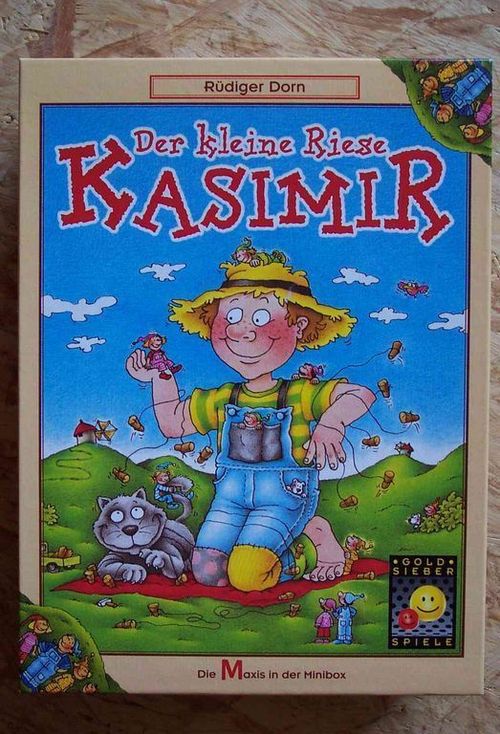
Der Kleine Riese Kasimir
Der Kleine Riese Kasimir Rulebook
Table of Contents
Table of Contents
Game Components
- 1 game board
- 4 child figures
- 38 small peg chips with values: seven at 1, seven at 2, six at 3, five at 4, four at 5, three at 0, and three at -3, plus 3 clock chips
- 36 movement stones in 6 colours
- 1 small bag
- 3 large bonus chips with values +1, +2 and +3
Before the first game, all chips must be carefully pressed out of the punch sheet.
Object of the Game
The players help the little men untie Kasimir. They collect the pegs with which Kasimir is tied. These pegs have different point values. The player who helps the most and thus collects the most points wins.
The Game Board
The game board is completely divided into 38 coloured fields, all of which have irregular shapes. For a better overview, the outlines of the fields are shown again on the last page of the rules, where the outlines of the fields are drawn.
Example: the boy's hat consists of 2 fields. The red blanket consists of 6 fields.
Transcriber's note: the board itself is not reproduced in the rules text. The last page of the printed rules shows only an outline of the field layout, which is a picture and cannot be transcribed as text. Players need the physical board to play.
Game Set-Up
The 38 peg chips are mixed well, with the peg side facing up. One chip is placed on each field of the board, without turning the chip over.
The three large bonus chips are placed within reach next to the board so that their values are visible.
The youngest player becomes the starting player and places his child figure first, on any field. Then, clockwise, each player places his figure on a field on which no other figure stands yet. The peg chip on this field may not be turned over.
Now the 36 movement stones go into the bag and are mixed well. Each player draws 5 movement stones without looking into the bag. He lays the stones out in front of him, visible to all.
Course of Play
When a player is on turn, he must carry out one of the following three actions:
- Movement: move your child figure, collect a peg chip, turn over a peg chip, draw movement stones or
- Take a peg chip from another player or
- Exchange movement stones
I. Movement
If the player chooses the Movement action, he first moves his game figure. If the move ends on a field on which a peg chip lies, the player must take the chip. After that, the player must turn over another peg chip. Finally, he draws movement stones.
Moving the figure
To move the figure, the player needs movement stones in the colours of the fields he wants to enter.
A figure always moves onto a directly adjacent field. No other figure may stand on that field. The player must immediately give up one movement stone in the colour of that field. The stone is placed to the side. The player may move across as many fields in this way as he likes.
He does not have to use all of his movement stones. His move may therefore be shorter than five fields. He must, however, move at least 1 field.
To enter the two-coloured fields, such as socks, knee patch or shirt, 1 movement stone of either of the two colours is sufficient.
The braces and the hat band cannot be crossed with the figures.
Note: for the sake of peace, fields are considered adjacent in case of doubt.
Taking a peg chip
If there is a peg chip on the field on which the player has ended his movement, he must take the chip. The player may not leave the chip lying. He shows the chip to the other players and places it face up in front of himself. If it is a chip with a clock, he receives the bonus chip with the lowest value that is still left. The chip with the clock is placed visibly next to the board.
If he ends his movement on an empty field, he receives no chip.
Turning over a peg chip
If possible, the player must then turn over a peg chip on another field of the same colour. If the chip is face down, it is turned face up; if it is face up, it is turned face down again. If there is no peg chip on any other field of this colour, no chip may be turned over.
If the figure stands on a two-coloured field, the player may choose either of the two colours and turn over a chip on a corresponding field. If only fields of one of the two colours still have peg chips, the player must choose that colour.
Drawing movement stones
Now the player draws one new stone from the bag for each movement stone he has used. After that, the stones that were set aside earlier go back into the bag. This ends the player's turn.
II. Taking a Peg Chip from a Fellow Player
If a player has collected a peg chip with the value 0, he may, in a later round, take 1 peg chip from one of his fellow players. The chip with 0 points is removed from the game.
This action counts as a complete turn.
III. Exchanging Movement Stones
A player may also exchange any number of his movement stones. He chooses the stones he wants to give up and places them to the side. Then he draws as many movement stones from the bag as he has placed to the side. Only after he has drawn the new stones does he return the previously chosen stones to the bag.
This action counts as a complete turn.
End of the Game
The game ends when a player takes the third chip with a clock. If the third clock chip is revealed by turning over a peg chip, the game does not yet end.
Each player adds up the points on his peg chips and bonus chips. The player with the highest total is the winner.
Variant
Older players may play a somewhat more tactical variant by changing the procedure of the third action option, exchanging movement stones, as follows:
A player may exchange any number of his movement stones.
He announces how many stones he wants to exchange and draws that many stones from the bag. Only after drawing the stones must he decide which ones he wants to put back into the bag. He must return as many stones as he has drawn.