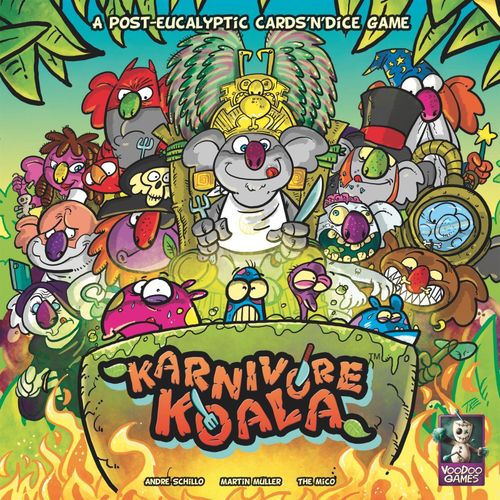
Karnivore Koala
Karnivore Koala Rulebook
Table of Contents
Table of Contents
Content
- 6x Koala Kings, identified by their card backs and a yellow-red card name
- 24x Workbears, identified by a yellow card name
- 16x Huntbears, identified by a red card name
- 16x Villagebears, identified by a blue card name
- 24x Backstabbears, identified by a purple card name
- 14x Mutant Animals, identified by their card backs and a green card name
- 5x engraved special dice. Each die shows four symbols: CROWN, SPEAR, KOALA and SKULL (the component key lists 1x CROWN symbol, 2x SPEAR symbol, 2x KOALA symbol and 1x SKULL symbol)
Setup
Shuffle the animal draw pile consisting of the fourteen animal cards and place it face-down in the middle of the table. Then draw the top three animal cards and place them face-up and next to each other in front of the animal draw pile. They now each represent one dish of your menu.
Shuffle the six koala kings and let each player randomly draw one. The drawn koala king represents a player's tribe throughout the whole game. Put all remaining koala kings back into the game box.
Next determine the starting player by checking for the player who last ate meat. This player now places their koala king underneath the main dish followed by all other players in a clockwise order who place their koala kings underneath each other.
As a last step, shuffle the koala deck and place it within easy reach of all players. During the game it will be necessary to form a face-up koala discard pile which should be created next to the koala draw pile. Every time a koala card gets discarded or removed from the game, put it face-up on the koala discard pile.
Now, let each player draw three cards from the koala draw pile, beginning with the starting player. The drawn cards form a player's hand cards and must not be revealed to other players throughout the game.
Example: the following image shows the setup of a regular game of Karnivore Koala. On top you can see the animal draw pile and in front of it the Cameleon as the appetizer, the Oystrich as the main dish and the Octoturtle as the dessert. Beneath them are the koala kings of all three players and on the bottom there is the koala draw pile as well as a space reserved for the koala discard pile.
Game Rounds & Turns
Each game of Karnivore Koala consists of subsequent rounds divided into successive player turns in which the players act. A round is always player related and a new player's round starts with each of their turns and lasts until the start of the same player's next turn.
Example: in a three player game, player 1's round would start as soon as it becomes their turn. Player 1's round will last until the turns of player 2 and 3 have been finished and it becomes player 1's next turn.
Think of a round as the time between a player's current and their next turn.
Starting a Game
When you start a new game of Karnivore Koala, you always begin with the starting player's turn. After the starting player has completed their first turn, continue with the next player in a clockwise order and repeat that for each player and the rest of the game.
Actions & Phases
During each of their turns, players step through different phases and perform all their desired actions like placing cards, assigning dice, using effects, hunt for animals, etc.
Each turn is divided into two phases that are resolved in the following given order:
- Dice Phase
- Tribe Phase
1. Dice Phase
Take the five special dice and roll them once. You may then either accept the rolled results or re-roll any number of dice by discarding one of your hand cards of your choice.
After the first re-roll you may still perform additional re-rolls in the same way, for as long as you discard one hand card for each re-roll you want to perform.
The dice phase ends as soon as a player accepts their dice roll results or may not perform any further re-rolls (because they cannot discard any further hand cards). At this time the dice results may not be changed until the end of the turn.
Example: Player 1 rolls the five dice and scores two spears, one koala, one crown and one skull.
Player 1 isn't quite happy with their roll and would like to roll another crown and another koala symbol. Player 1 discards one of their hand cards and rerolls the die with the skull result and one of the dice with a spear result.
The new results are another spear and one koala.
Player 1 discards a second card and this time takes both of the spear symbols and rerolls them.
The new result shows a skull and a crown. Player 1 keeps the crown but to reroll the skull symbol, it would be necessary to discard their third hand card and would leave them with no hand cards to play in their turn.
2. Tribe Phase
During the tribe phase a player can take any of the following actions in any order and as often as possible.
Place Koalas
With this action, a player may place their remaining hand cards into their tribe. Just place your workbears to the left side of your koala king and all village- and huntbears to the right side of it. Cards are always placed face-up so that every player is aware of the cards in each tribe.
All cards in a tribe, except for the koala king, are referred to as koalas.
There may never be more than a total of seven koalas in a tribe made up of any combination of workbears, huntbears, and/or villagebears. King Koalas do not count towards the limit of koalas in a tribe.
A player may also choose to keep any amount of hand cards to use them in upcoming turns. In this case just do not place them in the tribe!
Each time an eighth koala is placed into a tribe (either by you or another player), the controlling player of the tribe must remove one koala of their choice and replace it with the new one. The removed koala is then put on the koala discard pile.
Assign Dice
It is finally time to make use of the dice results you have rolled during the dice phase. As you know each die has four different symbols on it. These may now be assigned to those villagebears and huntbears of your tribe that show a matching symbol in their card description.
Every time you assign a die to a koala, this koala counts as being activated and you must then immediately use its card effects.
Example: a Barbearian shows a spear symbol within its card description. This means you may assign one die result showing a spear symbol to it in order to activate it and use its effect to immediately gain three spear symbols. The Freebootbear shows a koala symbol which means that you may assign a die result showing a koala symbol to it in order to activate it and use the Freebootbears effect.
NOTE: you may only assign die symbols to koala cards and you cannot use symbols generated by effects - like the three spears that the Barbearian provides - to assign those to any koala cards.
As long as a koala card just shows a single symbol in its card description, you may only ever assign one die per turn to it.
If a koala cards shows two or more symbols in its card description, you may still only assign one die per turn to it, but it can be any die matching one of the shown symbols.
Some cards show a number next to their symbols. These cards are the only ones that can have more than one die assigned to them per turn. You may assign a maximum amount of dice to these cards equal to the shown number next to the symbol.
NOTE: Each time you assign a die to it, you must then immediately use its card effects.
Assign Skulls
Die results showing skull symbols may be assigned just as any other symbols you have rolled, meaning that you can use them to activate koalas and use their effects as long as they show a matching skull symbol in their card description. The only difference is that skull symbols always need to be assigned first, before any of the other actions of the tribe phase may be performed and any other actions are taken.
If you do not have a koala card anymore that you can assign a skull symbol to, you must then assign each remaining skull symbol to any one other koala card in your tribe (this includes your koala king and your workbears!). Until the end of the turn, these koala cards may not be activated nor can you assign dice to them, and they may not be removed voluntarily by placing an eighth koala in your tribe.
If you have to assign skull symbols to koala cards that cannot usually have them assigned to, you may only ever assign a maximum of one skull symbol to each of them.
At the end of the turn, remove all inactivated koala cards with an assigned skull symbol from your tribe and put them on the koala discard pile.
Unlike your normal koalas, koala kings cannot be removed from a tribe and in case you had to assign a skull symbol to them, you will simply remove their skull symbol at the end of the turn.
Example: player 3 has rolled two skull, two koala and one spear results. The skull results must be assigned first, so they put the first one on their Luchabear, activate it and use its effect. Then there is no more koala in their tribe showing a skull symbol, so they have to assign it to one of their other koalas. Player 3 decides to assign the skull symbol to their Subearhero which means that he cannot assign any further dice to it, activate or remove it in this turn. After assigning the skulls, player 3 may continue with their koala phase normally. At the end of the turn, player 3 will have to remove the Subearhero because it was inactivated and had a skull symbol assigned to it. The Luchabear also has a skull symbol on it, but since it was activated and its effect used, it is not removed.
Unassigned Dice
It may happen that you cannot assign or use all your rolled dice results, or that you simply do not want to assign them all (except for skulls that must be assigned whenever possible). In this case you can simply leave these dice unused.
Use Dice
Besides assigning dice to your koalas, you may also use them for immediate effects.
Spear symbols may be assigned to koalas with a matching symbol, or they may be set aside and used for hunting animals. You may add one spear to your hunt for each spear symbol used this way.
As another possibility you may always spend two crown symbols to move any one koala of your choice from any one other player's tribe to your own tribe.
Assign Crowns
Die results showing crown symbols may usually be assigned to your koala king and just as with village- and huntbears you may then benefit from your koala king's special power.
Hunt
Just with all actions during the koala phase you may also hunt at any time and even hunt two times in the same turn if you can afford it.
As already mentioned, each player first needs to hunt for an appetizer. As soon as a player manages to hunt their appetizer, they may hunt for the main dish next. All other players that have not yet hunted their appetizer must still hunt for it before they may also hunt the main dish. At last, after hunting the main dish, a player needs to hunt for the dessert.
To hunt an animal, check the symbols on the specific animal card and compare them to the symbols of all your workbears. If you have one workbear or any combination of several workbears that together show symbols matching those on the animal card, you are allowed to hunt it.
NOTE: if a workbear provides more than one symbol, you may choose to use this workbear for either one or both of the symbols!
Each animal has two symbols on its card that both must be matched with your workbears. The main dish has an additional third symbol that has to be matched as well. This symbol is represented by the card back of the top card on the animal draw pile. Please note that this card can change at any time when a new animal is drawn from the animal draw pile!
Example: to hunt the main dish it requires one fish plus two reptile symbols. The workbears provide one fish, one bird and two reptile symbols. Now the player just needs three spears. The player has already assigned a skull symbol to the Luchabear at the beginning of its tribe phase, which now grants them one spear. The player assigns one koala symbol to the Pathfindbear which grants a second spear. Together with the remaining rolled spear symbol the player has three spears and may hunt the main dish. After the hunt action, all workbears that provided symbols for the hunt and all huntbears that have been activated are removed, in this case the Luchabear and the Pathfindbear. If the player did not perform a hunt action, the Luchabear would have been removed by the end of the turn because it was activated.
If there are two of the same symbols shown for an animal card, you will need one workbear for each of the symbols shown. As soon as you can match all of an animal's symbols, you can hunt it and the only thing you need to do now is gather three spear symbols.
During your action phase you will gather spears either by activating card effects or by directly using spear dice results or a combination of both. If you have at least three spears you can successfully hunt the animal.
When a player has successfully hunted an animal, place the animal card in front of them and fill the empty space with a new face-up animal card from the animal draw pile. From now on this card acts as a specific dish (appetizer, main dish or dessert), based on its location. All other players still in need to hunt for that specific dish will now need to hunt this newly drawn animal card. In addition each time a new animal gets drawn from the animal draw pile, the third symbol of the main dish may change.
Remove Koalas
Whenever you use a workbear to provide an animal symbol for your hunt, or activate a huntbear, you need to remove it immediately after the hunt action or at the end of your turn, if no hunt action is being made. Villagebears do not need to be removed after being activated.
Backstabbears
You might be wondering when to use all those backstabbears. Backstabbears are normally played at any time (and during any phase) of a player's own turn. Sometimes, backstabbears may also be played iduring another player's turns. In such cases, this will be clearly written in the effect description of the specific backstabbear card.
Backstabbears are played directly from a player's hand and do not need to be placed in a tribe first. Whenever a backstabbear card is played, resolve its effect and immediately discard the card thereafter.
Backstabbears do not count towards the total koalas in a tribe and do not need to be activated. Instead they are immediately activated when played.
End of Turn
Once a player has finished its koala phase, the player's turn ends. At the end of their turn, a player always gets the chance to discard or keep any number of remaining hand cards. If the player has less than three hand cards he draws koala cards until they have three hand cards again.
If the koala draw pile runs out of cards, immediately re-shuffle the koala discard pile back into the koala draw pile and continue playing normally.
As soon as a player has drawn up to three hand cards, it becomes the next player's turn.
Victory
As soon as a player successfully hunts a dessert, the game immediately ends and the player that managed to hunt the dessert becomes the winner of the game!
Congratulations, you are a true Karnivore Koala!
Advanced Mode
Karnivore Koala was meant to be an easy and fast game, but it also offers the possibility to play in a more advanced way, which will be more difficult, and is suited for experienced players or those that just want to look at all the koalas for a little longer than the regular play time.
In the advanced mode Karnivore Koala is played using the normal rules, except that players need four spear symbols to hunt an animal.
Expert Mode
If the advanced mode is still not challenging enough, you can play in expert mode. Four spear symbols are required to hunt each animal, and the third animal symbol (as with the main dish) is now applied to the appetizer and the dessert as well.