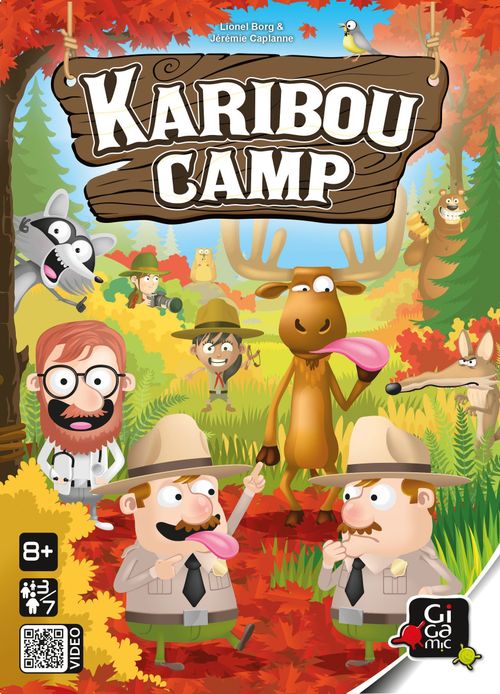
Karibou Camp
Karibou Camp Rulebook
Table of Contents
Table of Contents
Contents
- 49 Animal cards (7 species x 7 cards) (fig. 1a), 7 Scout cards (fig. 1b), 8 round tiles showing the animals and their sign (fig. 1c), 3 x 2 Team cards and one Coyote card (fig. 1d), 1 Giga-pawn (fig. 1e), 7 score discs (fig. 1f), rulebook.
Principle and Goal of the Game
In Karibou Camp, the players form teams and try to gather a family of animals by exchanging the cards in their hand with the cards in the center of the table. Once a player has gathered a family, they must make it understood by their teammate by giving a sign. If the teammate notices it, they quickly take the Giga-pawn and place it on the round tile corresponding to the animal they think they have recognized! But be discreet, because at any moment the other players can intervene and steal your points.
The first player to reach 9 points wins the game and becomes the chief of the camp!
Setup
(fig. 2: example setup for 5 players)
- Depending on the number of players, use the following Team cards. A team is made up of 2 identical cards (the Coyote is only used if the number of players is odd):
| Number of players | 3 | 4 | 5 | 6 | 7 |
|---|---|---|---|---|---|
| Number of 2-player teams (chosen from Veterinarian, Photographer or Forest Ranger) | 1 | 2 | 2 | 3 | 3 |
| Coyote (1 player alone) | YES | NO | YES | NO | YES |
Example with 5 players: the players take 2 teams and the Coyote. They choose to play with the Veterinarian and Photographer teams. The Forest Ranger team is returned to the box. The players add the Coyote card to these 4 cards.
-
The Team cards are shuffled face down. Each player receives one at random and reveals it. Players who receive the same Team card are teammates for this round. Note: with 3, 5 and 7 players, the Coyote plays alone; see the end of the rules.
-
Each player receives a score disc, then the Giga-pawn is placed in the center of the table with the 8 round tiles around it.
-
Shuffle all the Animal cards (and the Scout cards), then deal 5 to each player. If a player is dealt 4 or 5 identical animals at this point, they immediately discard them and receive 5 new cards.
-
Place face down in the center of the table the number of Animal cards corresponding to the number of players:
- with 3 players: 3 Animal cards
- with 4 and 5 players: 4 Animal cards
- with 6 and 7 players: 5 Animal cards
The other Animal cards form a pile next to the play area.
Playing the Game
The players shout the war cry "Karibou Camp!" then simultaneously turn face up the Animal cards in the center of the table. Each player may then exchange cards from their hand with the cards on the table, following these rules:
- a player who wishes to exchange one of their cards first places the card from their hand in the center of the table, then takes one that is available;
- it is forbidden to take a Scout card.
Exchanges end:
- as soon as a player places a Scout card on the table while shouting "Scout!": exchanges stop immediately (the animals flee before the horde of little monsters that land);
- or when no player wishes to make any further exchange.
Cleanup then takes place: if the cleanup is caused by a Scout card, the player who played it completes their hand by taking a card from the center of the table or by drawing the top card of the Animal card pile. No exchange is allowed during cleanup. If another player is missing a card, they must draw one from the Animal card pile.
The Animal cards remaining on the table are discarded, and new ones are placed face down (the number corresponding to the number of players, as in the setup). Then the players shout "Karibou Camp!" again before turning over the Animal cards and beginning the exchanges, and so on.
The Signs
At any moment during the game, as soon as a player has exactly 5 identical animals in their hand, they must signal it to their teammate by discreetly making a sign. Each animal is linked to a part of the body that the player must use to make their teammate understand which animal family they have managed to gather:
| Elk | Polecat | Bear | Marmot | Raccoon | Squirrel | Duck |
|---|---|---|---|---|---|---|
| the tongue | the nose | the teeth | the eyes | the hands | the ears | the neck |
If a player sees that their partner is making a sign to them, they take the Giga-pawn and place it on the corresponding Animal tile.
Example: Régis is teamed with Christophe and has just gathered 5 polecats. He tries to discreetly wiggle his nose to let Christophe know. Christophe spots his partner's sign, then takes the Giga-pawn and places it on the Polecat tile.
If a player sees their partner making a sign to them but cannot identify which animal it refers to, they may still take the Giga-pawn and place it on the round tile representing the whole set of animals. The team will score fewer points, but this prevents a player from another team from spotting the sign before they have found it.
Example: Nicolas is teamed with Simon, has just gathered 5 bears, and signals Simon by running his tongue over his teeth. Simon does not know what to think: is Nicolas making the bear sign or the elk sign? In doubt, he takes the Giga-pawn and places it on the tile corresponding to the whole set of animals.
If a player spots an opponent making a sign to their partner, they may beat them to it and take the Giga-pawn first by shouting the name of the person they accuse.
They will score more points if they place the Giga-pawn on the animal that corresponds to the family the player has gathered, but they may also place it on the tile representing the whole set of animals.
Scoring Points
As soon as the Giga-pawn has been placed on a round tile, the round ends. The player who gathered a family (or who is accused of having done so) shows their cards to all the players, then the points are distributed and adjusted on the score discs:
- a player has gathered a family and their teammate has placed the Giga-pawn on the corresponding round tile: both players score 2 points. (fig. 3a)
- a player has gathered a family and their teammate has placed the Giga-pawn on the tile representing the whole set of animals: both players score 1 point. (fig. 3b)
- a player has spotted an opponent's sign and has placed the Giga-pawn on the corresponding round tile: they score 2 points. (fig. 3c)
- a player has spotted an opponent's sign and has placed the Giga-pawn on the tile representing the whole set of animals: they score 1 point. (fig. 3d)
- in case of error: if a family is complete but the Giga-pawn is placed on the tile of a different animal, or if the family is incomplete, or if a player wrongly accused an opponent of having completed a family: all the other players, other than the team or the accuser who made the mistake, score 1 point.
Example: Christophe shakes his head, which makes his opponent Simon believe that he has a family of ducks. Simon takes the Giga-pawn and places it on the Duck tile, accusing Christophe. Christophe simply had a sore neck (or he was trying to trap an opponent) and shows everyone that he still holds several different animals. Everyone scores 1 point except Simon, who was mistaken!
Once the points have been distributed, the Animal cards are shuffled again and a new round begins. The Team cards are shuffled and dealt again at random, then each player receives 5 Animal cards, and so on.
The Coyote
With 3, 5 and 7 players, the player who receives the Coyote card plays solo. They receive 6 cards instead of 5 at the start of the round. Their goal is to gather 6 identical animals in their hand. As soon as they succeed, they take the Giga-pawn and place it on the round tile corresponding to the family they have gathered, to score 2 points.
Nobody can accuse the Coyote of having a family, but the Coyote can accuse the others!
End of the Game
Points remain secret during the game. As soon as a player totals 9 or more points, they win. If several players reach or exceed 9 points at the same time, the highest score wins. There may be ties, in which case the players share the victory!