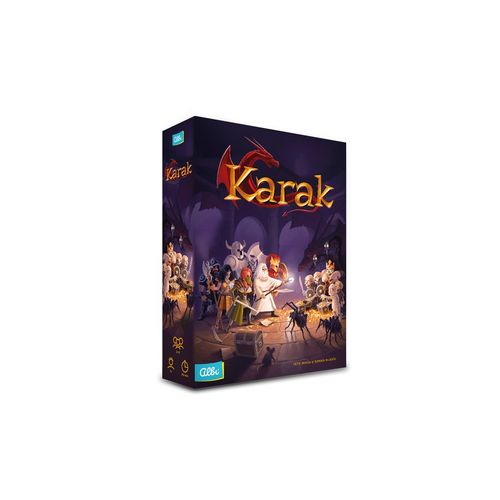
Karak
Karak Rulebook
Table of Contents
Table of Contents
Contents of the Game
- 80 dungeon tiles (including the starting card with a light-coloured back side)
- 6 cardboard hero figures with 5 stands
- 6 hero cards
- 5 inventory sheets
- 25 HP tokens
- 1 bag for monster and treasure tokens
- 43 monster tokens (1 dragon, 2 Fallen, 12 skeleton turnkeys, 3 skeleton kings, 5 skeleton warriors, 8 giant rats, 4 giant spiders, 8 mummies)
- 10 locked treasure chest tokens
- 2 dice
- 1 curse token
- rulebook
- artbook
Objective of the Game
The player who has collected the most treasure becomes the victor. The game ends once any player defeats the strongest monster of the game — the dragon — and loots its treasure with a ruby.
Each player counts the points from their treasure:
- Treasure collected from chests or by defeating The Fallen is worth 1 victory point (VP).
- The dragon ruby is worth 1.5 VP.
The player with the most VPs wins the game.
Setup
- Place the starting dungeon tile in the middle of the table.
- Shuffle the remaining tiles and place them to the side, face down, so that every player can reach them.
- Each player receives one inventory sheet and five HP tokens, which they place on the inventory sheet.
- Each player picks one hero card, either of their own choice or randomly (whichever the players agree on), and places it on the inventory sheet.
- Fit the hero figures into their respective plastic stands.
- Each player places their hero figure on the starting tile. The colour of the stands corresponds to the colour of the hero cards.
- Roll the dice to determine starting player.
The Gameplay
The game is played clockwise. The active player has 4 moves, meaning they can move up to 4 tiles. During these moves, one of the following situations will occur:
- A. Entering an undiscovered zone
- B. Fighting a monster
- C. Moving over a discovered zone
A. Entering an Undiscovered Zone
When moving into an undiscovered zone, the player takes one dungeon tile, connects it to the tile they are leaving and moves their hero onto the new tile. The new tile must be continuous only with the tile from which the hero came. All other routes can form a dead end.
Note: Karak's underground labyrinth is a really dark place — it's no wonder that heroes don't know what is waiting for them in a newly uncovered room or corridor.
-
Tunnel. If the new tile contains a tunnel, nothing special happens and the player can move on, if this was not their 4th move.
-
Room. If the new tile contains a room, the player draws one token from the bag of monsters and treasures.
- a) If a treasure was drawn, the player places it on the new tile and can still move on, if this was not their 4th move.
- b) If a treasure was drawn and the player owns a key, they can collect the treasure and discard the key. In this case the player's turn is over.
- c) If a monster was drawn, the player places it on the tile and resolves combat.
-
Teleportation Gate. If the new tile contains a teleportation gate (TG) and there is only one discovered TG in the whole dungeon, it is inactive and cannot be used. If there are more TGs in the dungeon, the player can move between them, spending one move for the teleport.
-
Healing Fountains. If the new tile contains a healing fountain (HF), players may decide to heal themselves, if they end their turn right away. Otherwise they can still move on.
B. Fighting a Monster
When fighting a monster, the player rolls both the dice. Add all the equipment power to the total, and as many magic bolt spells as can be used, each adding a bonus of +1; if possible, a hero's skill can be used as well.
-
Loss. If the total (with all its bonuses) is lower than the monster's strength, the player loses, flips one HP token on his hero's inventory, with a skull now facing up, and moves their hero back to the tile they came from. The monster stays on the tile where it was discovered.
-
Tie. If the total (with all its bonuses) equals the monster's strength, it is a tie and nobody got hurt. The monster remains on the tile where it was discovered, and the hero must return to the tile they came from.
-
Victory. If the total (with all its bonuses) is bigger than the monster's strength, the player won and defeated the monster. The monster's token is flipped, showing an equipment which the hero loots and places in their inventory sheet. If there is no more space in the inventory, the player chooses an equipment to place on the tile where they are standing. This equipment can be collected by any other hero entering this tile.
No matter the result, after the combat is resolved, the respective player's turn is over.
C. Moving over a Discovered Zone
When moving through a discovered zone, the hero moves along continuous tiles.
- Even when moving over a discovered zone, the hero is still limited to 4 moves.
- If there is a monster in a room, the hero cannot pass it and has to fight it once they enter the room.
- If the player wants to collect an equipment lying on a tile, unlock a chest or heal at the HF, they have to finish their turn on that tile (they can thus move less than 4 moves).
- Monsters and treasures spawn in rooms only when the rooms are discovered for the first time.
End of a Turn
A turn ends in these cases:
- once a player has moved 4 times
- after a fight with a monster (no matter the result)
- after unlocking and collecting a treasure
- after collecting an equipment
- after healing at the HF
End of the Game
The game ends immediately after one of the heroes defeats the dragon in combat. The hero who defeated the beast will get its treasure, but that doesn't mean they are automatically declared winner. The winner is the player who has the most treasure points at the very moment the game ends. It may thus happen that a player becomes the winner without being the one who defeated the dragon.
Hit Points and Healing
Anytime a player loses a fight with a monster, they flip an HP token so the skull now faces up. Once a player loses their last HP, their hero falls unconscious.
If that happens, the player misses their next turn while healing one HP (flipping it with the heart now facing up), being able to play again in the coming turn. If a player moves to a HF, they can end their turn there and heal all their HP to the maximum. Healing also lifts Karak's curse.
Good to know: If a hero fights a monster from the starting tile and loses the combat, they return back to the starting tile, thus ending their turn on a HF and healing their wounds.
The Equipment
Anytime a player defeats a monster, they loot an equipment that is shown on the other side of the monster token. The equipment can be one of the following: A. Weapons, B. Spells, C. Key.
The player places the equipment on the equipment sheet. The equipment sheet has two slots for weapons, three slots for spells and one slot for a key. A player can only place the equipment into its respective slot; they cannot put a spell into the weapon slot, and vice versa. This means a player can only have two weapons, three spells and one key at the same time. If they want to get additional equipment, they must discard one piece of equipment they already possess onto the tile their figure is currently occupying.
A. Weapons
There are three types of weapons — daggers, swords and axes. They can be received by defeating a giant rat, skeleton warrior or skeleton king. A weapon can also be received by collecting it when standing on a tile where another player left it. The numbers depicted on the weapon card are always added to the total when rolling the dice.
When a player collects a weapon, they place it on one of the two possible slots for weapons. At any given moment, a player can thus own a maximum of two weapons.
B. Spells
There are two types of spells in the game: a magic bolt and a portal of healing. Once a player obtains a spell, they place it in one of the spell slots; each player can thus have a maximum of three spells. After using a spell, the player discards it from the game (meaning they do not return it to the bag).
Magic Bolt: The magic bolt spell can be acquired by defeating a mummy. When using it, a bonus of +1 is added to the total when rolling the dice; however, it can be used after the roll if the player wants to. In addition, more than one spell can be used during one fight.
Portal of Healing: The portal of healing spell can be acquired by defeating a giant spider. The portal of healing spell can be used either on the caster or on any other player. The target is then moved to any revealed HF and all of their wounds are healed; any curse is removed as well. This does not cost any moves, and it does not end the turn. Thus it can be used any time during the caster's turn.
C. Key and Treasure
A key can be acquired by defeating a skeleton turnkey. After receiving it, the player places it on the hero card in the key slot. Each player can thus own a maximum of one key. A key can be used to unlock any chest. To unlock a chest, the player has to end their turn on a tile with a chest, collect the treasure and discard the key from the game (meaning they do not return it to the bag).
Anytime a player owns more pieces of equipment than they are entitled to, they have to place the excess equipment of their choice on the tile where they are standing, making it accessible for the other players to collect it.
The Curse of Karak
If any player defeats a mummy, one player becomes cursed. The player who defeated the mummy chooses another player and places the curse token on their inventory sheet.
The player whose hero was cursed and has the curse token on their hero's card cannot use their hero's skills. Thus the Warrior can roll the dice only once and dies just like the others, the Swordsman can roll 1 and his turn ends after any combat, etc.
The curse can be lifted by finishing one's turn on a tile with a HF and removing the curse token along with restoring all HPs. The curse can also be passed on when another mummy is defeated, and the player moves the curse token to another player. However, the token does not have to be moved; it can stay with the previous owner.
The Heroes
Argentus, the Wizard
Skills:
- Magical Affinity. The Wizard knows how to use the magic bolts more effectively, and for this reason his scrolls are not consumed when used. However, this does not apply to the portal of healing and if the Wizard is cursed, he has to discard the magic bolt spells during combat just like the others.
- Astral Walking. The Wizard can move through walls, thus he does not have to respect the continuity of the dungeon. This, however, can be used only while moving over the discovered tiles.
Horan, the Warrior
Skills:
- Double Attack. The Warrior is skilled at combat. In any combat, he can reroll the dice if the first roll is not to his liking. He does not lose a HP in the first loss. However, he must accept the second roll's result.
- Reincarnation. If the Warrior loses his last HP, he does not fall unconscious like the other weaklings, instead he teleports to any tile with a HF, where all his HPs are replenished. However, his turn ends anyway.
Lord Xanros, the Warlock
Skills:
- Sacrifice. The Warlock can sacrifice one HP to gain a bonus of +1 to his strength. He can decide to do that after rolling the dice but can gain the bonus only once per combat. He can also sacrifice his last HP but then falls unconscious for his next turn.
- Magic Swap. The Warlock can swap his position with any other hero, meaning the Warlock moves to a tile occupied by another player and the respective player is moved to the tile where the Warlock stood. This action costs 4 moves so it can be performed only at the beginning of the Warlock's turn; however, the Warlock can use the ability of the tile where he ended his turn (unlocking a chest, healing, etc.).
Aderyn, the Thief
Skills:
- Backstab. The Thief can attack from the shadows. Thanks to that, she wins any combat that would normally result in a tie.
- Stealth. The Thief can move in the shadows. When entering a tile with a monster, she can decide if she wants to fight it or leave it and continue moving.
Victorius, the Swordsman
Skills:
- Combat Training. The Swordsman is an experienced fighter, and his strikes are always precise. If any die roll yields a 1, he can reroll it as many times as necessary to gain a better outcome.
- Unstoppable. If at least one of the dice yields a 6 during combat, the Swordsman can continue his turn afterwards. He can even fight the same monster if the combat was a tie, or if he lost.
Taia, the Oracle
Skills:
- Farseeing. The Oracle has the best knowledge of all her enemies. If she fights in the first move of her turn, she gains a bonus of +1 to her roll.
- Fateweaver. The Oracle can influence her future. Anytime she is supposed to draw a token from the bag of monsters and treasures, she draws two tokens instead, choosing one to place on the tile and putting the other one back in the bag.
Bestiary
- Rat. The rats usually appear near the remains of fallen adventurers. The huge rats of Karak Castle shouldn't be a problem for a skilled hero.
- Skeleton King. Kings trapped in the labyrinth; their mighty war axes are just as deadly as when the kings were alive. Worthy foes — don't underestimate them.
- Skeleton Warrior. Skeletons of once proud knights, risen to face invaders. Skilled fighters who are hard to beat or even stop; the reward is their sharp swords.
- Skeleton Turnkey. Unarmed, but not defenseless. Only their keys can open the magical treasure chests of Karak.
- Giant Spider. Enormous, silent and deadly. You can't often find magic scrolls near their underground lairs.
- The Fallen. Adventurers who reached Karak's gold, lost their minds, and now guard the very treasure they tried to steal.
- Mummy. The original builders of Karak's labyrinth, obsessed with wealth; the dark magic they used to gain immortality comes with a curse.
- The Dragon. The strongest monster of the game and the source of the dark power corrupting the castle. Defeating it ends the game.
Summary of the Rules
The Basic Rules
Movement
- Each player can move up to 4 spaces during their turn.
- When discovering a room, the respective player draws a token from the bag.
- Combat, healing, collecting equipment or unlocking a chest ends a turn.
Combat
- A monster is defeated by having a bigger total of the dice roll and equipment bonuses.
- After the dice are rolled, spells can also be used. However, they are discarded afterwards.
- After losing all of their HPs, the player skips one turn to restore one HP.
Curse
- When defeating a mummy, the respective player chooses a player to curse.
- The cursed player loses their hero's skills until the curse is lifted.
- A curse can be lifted by healing at the HF (along with the healing of all wounds).
End of the game and declaration of the winner
- The game ends once the dragon has been defeated.
- The player with the most VPs is the winner.
Hero's Skills
- The Warrior — Has two rolls instead of one. Teleports to a HF after death, and thus does not lose a turn but fully heals himself.
- The Thief — Wins a combat when there is a tie. Can evade a monster — doesn't have to fight it.
- The Wizard — Does not discard "magic bolt" spells after use. Can move through walls.
- The Warlock — Can sacrifice a HP for a bonus of +1 power in combat. Can swap positions with another player at the cost of 4 moves.
- The Swordsman — Always rerolls if the number is 1 (on a single die). If a 6 is rolled (on a single die), he can continue his turn after the combat.
- The Oracle — Has a bonus of +1 to combat on her first move. Draws two tokens from the bag, chooses one and returns the other.
Authors: Petr Mikša (game design), Roman Hladík (artwork).