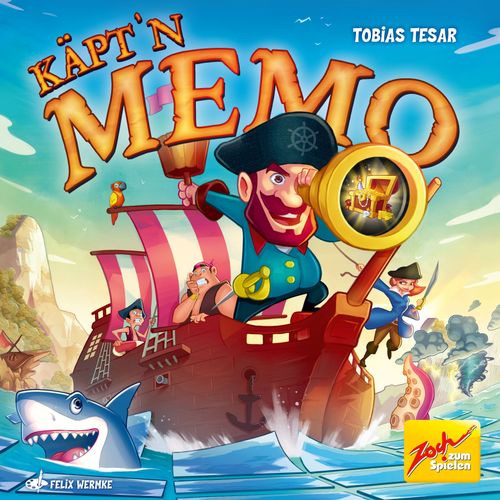
Käpt'n Memo
Käpt'n Memo Rulebook
Table of Contents
Table of Contents
Game Materials
- 1 ship
- 5 sailors (game figures)
- 24 barrels
- 5 ship chests (folding sheets). Before the first game, fold the 5 chests as shown on the folding sheets.
- 1 saber (stick the saber into its stand)
- 10 telescope tiles
- 64 coins: doubloons with values 1 (24 x) and 2 (40 x)
- 60 small sea cards, including:
- 30 dangers: 5 x each of hurricane, giant octopus, sawfish, pirate ship, iceberg, and reef
- 18 treasure troves
- 4 telescopes
- 1 pair of palm trees
- 7 ruby finds: 3 x 2; 3 x 3; 1 x 4 rubies
Game Idea and Objective
Numerous voyages help you discover what is hidden underneath the waves of the Memorian Sea.
On each voyage, a different player becomes Captain Memo. As captain, you determine the course, with the objective to find 5 treasure troves in the sea per voyage. If you navigate carefully, you can also collect valuable rubies and helpful telescopes.
All the other players are sailors and accompany the captain. If his maneuvers become too risky, clever sailors will disembark early – or even raise a mutiny.
If you master all challenges as a great captain and as a smart sailor, you will gain coins, treasure troves, barrels, and rubies… and, if you are the richest seafarer, also win the game!
Set-up of the Game
- First of all, you need a sea! Mix all 60 sea cards, face down. Draw 12 of them and form them into a face-down draw pile. Use the remaining 48 cards to set up the Memorian Sea as a 7-x-7 grid, showing only the waves (the backs of the cards). Leave one space in the middle empty and place the saber there!
- Put the coins, the barrels, and the telescope tiles next to the sea.
- Each player takes one game figure as well as the ship chest of the same color. Any excess figures and ship chests are put back into the box.
The person who has last disembarked a ship becomes the captain of the first voyage. This player places their game figure at the front (the bow) of the ship.
Set-up for Pros
… that is, for experienced sea dogs and the captain's closest friends!
Have you already played the game a few times? In this case, you can purposefully pick 12 sea cards to form the draw pile at the beginning of the game. Try out this variant: Use 3 treasure troves and 1 card of each danger – the rest (3 cards) is still random. Or come up with your own composition for the draw pile.
Course of the Game
The game consists of numerous voyages.
On each voyage, one player takes on the role of the captain and steers the ship across the Memorian Sea by revealing cards and setting the course. The captain's task is to discover 5 treasure troves on this voyage, without capsizing the ship. The other players are sailors and decide during the voyage whether to stay on board, jump off or mutiny.
The Voyage
The captain is standing at the bow of the ship. All the other players accompany the voyage as sailors; they position their figures in any order on the places behind the captain.
Now the captain decides where the voyage will start. To this end, he points the bow of the ship at the edge of the sea to a card of his choice. The bow of the ship indicates its course.
From now on – until the end of the voyage – you constantly repeat the following 3 steps:
- The captain reveals the card in front of the bow of the ship.
- The captain moves the ship … and, in doing so, determines the further course.
- The sailors decide what they want to do.
A voyage always ends only when the captain has found 5 treasure troves OR the ship capsizes. After that, you prepare for the next voyage – with a different captain!
Step 1: Reveal the Card in Front of the Bow of the Ship
The captain reveals the card the bow of the ship is pointing at. Then he or she immediately carries out the action of this card:
Dangers – CAPSIZING? Each single danger is harmless. Leave it in place, face up! But once the second card of the same danger is revealed, the ship capsizes immediately, and the voyage is over.
Treasure troves – SUCCESS! Leave them in place, face up. As soon as 5 treasures have been revealed, the voyage ends. The captain takes 3 of the revealed treasure troves and puts them underneath his ship chest. Then each sailor on board receives 1 barrel to put into their ship chest.
Telescopes – TAKE A PEEK! Take the revealed telescope and keep it! Every time you are the captain, you may use your collected telescopes in the following way: Put it in the supply and secretly look at one face-down sea card of your choice.
Palm trees – SWAP / REST Leave the revealed palm trees in place, face up. Nothing happens.
Variant for experienced players: When you reveal palm trees, swap two face-down cards in the sea without looking at them. Then take the palm tree card out of the sea and mix it face down into the draw pile.
Rubies Once you, as captain, reveal any rubies, you collect them immediately – but only if you have revealed enough treasure troves by then: For every ruby (on the card), one treasure trove has to be visible in the sea. In total, you may only collect as many rubies during a voyage as there are treasure troves visible in the sea. Any rubies you may not immediately collect are left in the sea, face up – and cannot be picked up any more on this voyage. You take any ruby card you collect out of the sea and lay them down face up in front of you. At the end of the voyage, you shove all rubies you have collected under your ship chest – even if the ship has capsized.
Example: The yellow captain could not collect the first 3-ruby card, since up to then he had collected only two treasure troves on this voyage. But he can collect the second 3-ruby card, since he has meanwhile revealed three treasure troves. He puts this card face up in front of him.
Example: After that, the yellow captain gets to a 2-ruby card. He may not collect it, since he has already put as many rubies (3) in front of him on this voyage as there are treasure troves visible in the sea.
Step 2: Move the Ship and Determine the Further Course
You, as captain, place the ship on the sea card you have revealed. If you have been allowed to take the revealed card, you place the ship in the gap created there.
At the moment you place the ship, you also determine the further course by pointing the bow of the ship to the adjacent face-down card that you will head to next. Once you have placed the ship, you may no longer change the chosen moving direction. You always have to observe all navigation rules, especially the special case „Long-distance sail" (see below).
When placing the ship, the captain determines the further course.
The Navigation Rules
- The saber space in the middle is not a playing space. You can neither enter it nor jump over it.
- The ship never sails diagonally. The bow of the ship may never be aligned on the diagonal.
- Once a card is face up, you may not re-enter it with your ship.
- When the captain determines the course, the ship has to be pointed to an adjacent face-down card, if there is one. If the captain has already revealed or collected all adjacent cards, a long distance sail takes place (see below).
Special Case „Long-Distance Sail"
If there is no adjacent face-down card, the captain heads for a card that is further away. In this case – and only then – the ship jumps over all gaps and face-up cards on its next move in the chosen direction, until it reaches the next face-down card.
The captain must not choose a moving direction in which all cards are lying face up.
If the ship reaches a space surrounded by face-up cards (or gaps), the captain has no other choice when determining the course but, as an exception, pointing the bow of the ship at one of these face-up cards (or gaps). This way, the captain heads for the next face-down card (x) in this direction. Any face-up cards lying in between are jumped over on this „long-distance sail."
Step 3: The Sailors' Decision
After the captain has determined the new course, but before the next card is revealed, each sailor (in any order) decides whether to …
- … stay on board, hoping that the captain will find (more) treasures.
- … jump off the ship: In this case, the sailor removes his figure from the ship and immediately gets 1 doubloon for every currently visible treasure trove.
- … mutiny: If a sailor on board thinks that the ship will capsize (e.g., because he has memorized what is hidden under the card that the captain is heading to), he can grab the saber from the middle and raise a mutiny.
MUTINY!
A mutiny can be raised only by the first sailor to grab the saber. Other sailors willing to mutiny are left with nothing: They cannot leave the ship until the end of the mutiny. Sailors who have already left the ship cannot mutiny.
If a mutiny takes place, the captain has to immediately reveal the card he was heading to:
- ➙ If the ship capsizes now, the mutiny is successful. The mutinous sailor gets 1 barrel from the supply and adds it to his ship chest. This ends the current voyage. The captain and the other sailors on board go away empty-handed.
- ➙ If the mutiny fails, since the ship does not capsize, the mutinous sailor is thrown off board and goes away empty-handed. Then the captain continues the voyage (with the remaining sailors on board).
- ➙ At the end of the mutiny, the saber is put back in the middle.
The Abandoned Captain
The captain never leaves his ship. If the last sailor leaves the ship, the captain continues the current voyage „abandoned." At this moment, the abandoned captain gets a telescope from the supply and puts it in front of him. A player who owns telescopes may store them for as long as he wants and use them anytime during a voyage when he is the captain – on the current or a later voyage.
Each of these telescope tiles allows you to TAKE A PEEK, as described on p 9. (The printed rulebook shows two telescope tiles here: "A telescope from the supply" and "A telescope found on the high seas.")
Ending the Voyage
The voyage ends …
- successfully, as soon as the captain reveals the 5th treasure trove. Now the captain takes any 3 of the treasure troves he has revealed in the sea and stacks them – as a reward – under his ship chest. Every sailor still on board takes 1 barrel from the supply and throws it into his own ship chest.
- unsuccessfully, as soon as the same danger has been revealed twice: The ship capsizes. The captain and the sailors on board get nothing. However, the captain may keep any rubies and telescopes collected along the way.
Don't forget: Even after a successful mutiny, the voyage ends unsuccessfully. In this case, the mutinous sailor gets 1 barrel for his ship chest.
Preparing for the Next Voyage
Once a voyage is over, turn all sea cards over, so that they are face down again, and fill any gaps with face-down cards from the draw pile. The player to the left of the current captain becomes the new captain and starts a new voyage (from any spot at the edge of the sea).
Ending and Winning the Game
The game ends if you can no longer refill all gaps in the sea when preparing for the next voyage.
Now all players open their ship chests and add up the values of their treasures:
- Each BARREL has a value of 5 doubloons.
- Each TREASURE TROVE has a value of 2 doubloons.
- Each individual RUBY has a value of 1 doubloon.
- DOUBLOONS are worth their indicated value.
The player who accumulates the highest total value with all the treasures he has collected wins. If there is a tie, the player involved who could bag more rubies prevails. If there is still a tie, the tie is broken by the number of treasure troves or, finally, of barrels.
Example: 3-ruby card and 2-ruby card, 6 treasure troves, doubloons with a total value of 7, and 3 barrels.
Final score: 3 + 2 + 12 + 15 + 7 = 39
Example of a Voyage
- At a starting space of his choice, the captain reveals the card in front of the bow of the ship. It is a hurricane. But one hurricane alone has no effect. The captain moves the ship onto the discovered card.
- In doing so, he turns the bow of the ship to the left since this is where he wants the ship to move. All the sailors decide to stay on board. Now the captain reveals the next card. It shows a treasure trove.
- After arriving at the treasure trove, the captain steers the ship to the right. The black sailor decides to disembark. This gives him 1 doubloon (for his ship chest), since there is 1 treasure trove visible in the sea.
- Now the captain discovers a telescope in front of the bow of the ship. He takes it out of the sea and puts it in front of him. He moves the ship into the gap that has come up and continues steering in a straight direction. On the following game turns, the captain first reveals a second treasure trove and then an iceberg. Since there are neither two icebergs nor two hurricanes visible, the ship doesn't capsize. After that, he finds 3 rubies. He may not collect them, since there is not yet a treasure trove for each of these visible in the sea.
- After arriving at the rubies, the captain steers the ship sideways. The blue sailor finds this very dangerous. („... wasn't there an iceberg lying there?… In that case, a second iceberg would come up now… and the ship would capsize…") He shouts „Mutiny!" and grabs the saber.
- Is the mutiny successful? No! There is no second iceberg and no second hurricane visible in front of the ship (but instead, a third treasure trove). The blue mutineer has to disembark – without a reward. The voyage continues.
- Just a few turns later, there are even 4 treasure troves visible. Success is within reach! But some dangers have become visible as well. If the second danger of one type appears, the ship will capsize! … Therefore, after the captain's next choice of the course, the red sailor prefers to leave the ship. This gives him 4 doubloons (= 1 for each face-up treasure trove). The green sailor stays; if he also left the ship, the captain would be „abandoned" and get a telescope.
- The green sailor can be happy, together with the captain: The next card shows the 5th treasure trove! This voyage ends successfully. The captain takes any 3 face-up treasure troves out of the sea. The green sailor gets a barrel.