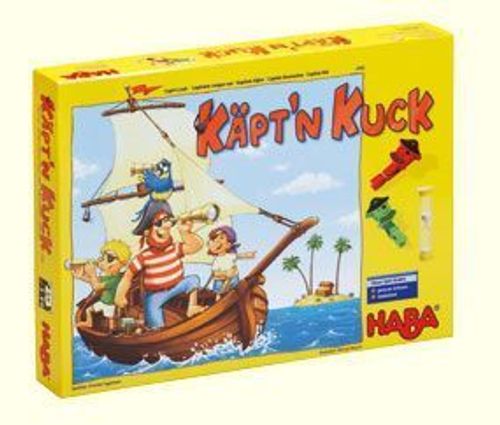
Käpt'n Kuck
Käpt'n Kuck Rulebook
Table of Contents
Table of Contents
Contents
- 1 sea chart (game board with spaces along its edge)
- 4 sailors (mounted on clips)
- 4 eye patches
- 4 spyglasses
- 30 treasure cards
- 1 pirate coin
- 1 hourglass
- 1 rulebook
Players: 2 to 4 treasure hunters, ages 5 to 99. Length: about 15 minutes.
Goal
Players take turns being Captain Look. The captain spreads the treasure cards on the sea chart. The other players are the sailors: during a limited time they use their spyglasses to discover the treasures and memorize the illustrations.
When time runs out, the treasures are collected. A sailor who correctly announces a treasure receives one point as a reward. The goal of the game is to collect as many points as possible.
Setup
- Lay the sea chart in the middle of the table.
- Each player takes one eye patch, one spyglass and one sailor.
- Clip the sailors onto the large striped start square of the sea chart.
- Shuffle all 30 treasure cards and stack them face down next to the sea chart.
- Prepare the hourglass.
- Put the pirate coin back in the box. It is only used in the "pirate" variant.
Playing the Game
The player who most recently travelled on a boat begins. If the players cannot agree, the youngest player begins. This player is the first Captain Look; the other players are the sailors.
Searching for Treasure
- Sailors: Each sailor puts on their eye patch and looks through the spyglass with the other eye, holding the spyglass so that its large opening faces them.
- Caution: Do not look at the sea chart through the spyglass yet. Look at the ceiling or at the other players, for example.
- Captain: Take the first 8 treasure cards from the stack and lay them face up on the sea chart, arranged as you wish. Make sure the treasure cards do not overlap. Then give the starting signal by saying "Treasures in sight!" and turn the hourglass.
- Sailors: All sailors now look at the sea chart through their spyglasses at the same time. They try to discover as many treasures as possible and to memorize them well.
Collecting the Treasures
- When the sand has run out, the captain says "Stop." The sailors may no longer look at the sea chart.
- The captain quickly gathers all the treasure cards and holds them in hand.
Announcing the Treasures
- The sailors put their spyglasses and eye patches aside.
- Each sailor, in turn, announces a treasure they think they saw on the sea chart. The sailor seated to the left of the captain begins.
- The captain checks whether the announced treasure is among the cards the captain is holding:
- Yes: "Well done!" The captain gives you that treasure card as a reward. Place it in front of you, face up. (This is a good treasure.)
- No: "Too bad!" You may not guess any more treasures during this turn. (This is a bad treasure, and your turn is over.)
Important rules for sailors:
- Each treasure may be named only once. If a treasure is named a second time, the sailor who named it may no longer guess during this turn.
- If a sailor can no longer announce a treasure, that sailor's turn is also over.
- Sailors keep guessing treasures until the captain has no cards left in hand, or until no sailor is still allowed to announce a treasure.
- If the sailors may no longer guess and the captain still has treasure cards in hand, the captain places the remaining cards in front of themselves, face up.
Counting and Moving
- When all eight cards have been revealed, every player, including the captain, counts the treasure cards they have collected.
- Each player moves their sailor forward by the corresponding number of spaces, clockwise, along the point track (the squares on the edge of the sea chart).
- Then shuffle all 30 treasure cards together again. The sailor seated next to the captain, in clockwise direction, becomes the new Captain Look, and a new turn begins.
End of the Game
The game ends:
- With 2 players: when each player has been Captain Look three times.
- With 3 or 4 players: when each player has been Captain Look twice.
The winner is the player whose sailor is farthest along the point track, that is, the player who collected the most points. In case of a tie, there are several winners.
Variants
"Pirate" Variant
Play by the rules above, with the following changes:
- Use the pirate coin.
- Before giving the starting signal, the captain places the pirate coin on the edge of any treasure card laid on the sea chart. That card becomes the pirate's treasure. The treasure shown on it must not be named by the sailors during the game.
- Once the time has run out, the captain turns over the pirate's treasure card and places the pirate coin on it. The captain takes the other cards and keeps them hidden in hand.
- If a sailor announces the pirate's treasure, that sailor may no longer announce any treasure during this turn.
"Pros" Variant
The game is more difficult if, instead of playing with 8 treasure cards, you play with more, for example 10 treasure cards.