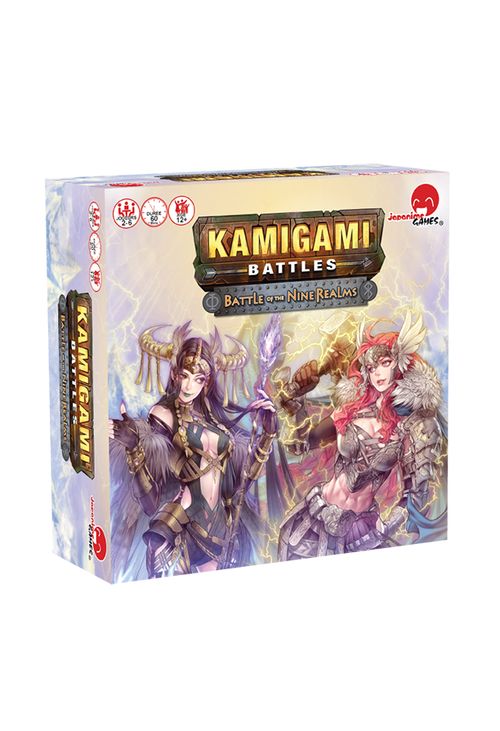
Kamigami Battles: Battle of the Nine Realms
Kamigami Battles: Battle of the Nine Realms Rulebook
Table of Contents
Table of Contents
Game Components
- 1 Manual
- 22 Dividers
- 80 Energy tokens (20 Five Energy and 60 One Energy)
- 18 Oversized Cards:
- 12 God Cards
- 6 Temple Cards
- 180 Standard Sized Cards:
- 90 Warrior Cards — 18 Kinds, 5 of Each
- 90 Disciple Cards — 18 Sacred Guardian, 48 Priestesses, 24 Bishops
- 21 Randomizer Cards (1 of each Warrior, and 1 of each Disciple)
Game Overview
In this game, you will be one of the Gods of mythology. You will gather ancient Warriors and Disciples, and send them out to attack your opponents. Each God has a pool of life force, called Energy (represented by the energy symbol). By reducing a God to 0 Energy, you can Seal that God away!
Temples are your God's place of worship and they can provide Energy and extra powers to the Gods when they need it. They can be attacked instead of the opponent's God and their Energy is reduced as in a normal attack. A Temple with zero Energy is destroyed and turned face down.
The game can be played as a Free for All, with 2 to 6 players. You win a Free for All Match by eliminating all of the other Gods or by reaching 25 Energy.
The game can also be played as a Team Match if you play with 4 or 6 players. A team wins together if they can eliminate the opposing team's Main God.
Card Types
God Cards
- Name and Title
- Spheres of Influence: These are the areas the God has influence over. These determine which Temple can be paired with this God.
- Abilities: These will be either Act or React Abilities.
- Pantheon: The Mythology that the God is aligned with.
- Set and Card Number: Useful for sorting, but otherwise has no impact on the game.
Temples
- Title
- Sphere of Influence: This determines which Gods can use this Temple.
- Abilities: These will be either Act or React Abilities.
- Set and Card Number: Useful for sorting, but otherwise has no impact on the game.
Disciple
- Title
- Cost: This is the cost in Faith Points to buy this card.
- Disciple Type: There are 3 types of Disciples. The types are used in Deck Building when combining Expansions.
- Abilities: These will be either Act or React Abilities.
- Set and Card Number: Useful for sorting, but otherwise has no impact on the game.
Warrior
- Title
- Chaining Colors: The Chaining Colors consist of a Primary Color and two Secondary colors which indicate which other warriors may be played this Turn.
- Cost: This is the cost in Faith Points to buy this card.
- Abilities: These will be either Act or React Abilities.
- Set and Card Number: Useful for sorting, but otherwise has no impact on the game.
Free for All Rules
(Player vs. Player)
You may play a Free for All Game with 2 to 6 players.
In a Free for All Game, all the other players will be your opponents.
Setup
- Shuffle all the God cards together and give each player 2 Gods at random. Choose 1 God to play and set the other aside.
- Use a method of your choosing to determine a starting player or the owner of the game chooses who is the starting player.
- If playing with Temples (see glossary for more info on the Temples), in Turn order, players pick Temples based on their God's Spheres of Influence (See God card description).
- In a Free for All Game, each God begins with 15 Energy and each Temple begins with 5 Energy. Put the appropriate tokens on your God and Temple.
- Shuffle the Warrior Deck and deal out 6 random cards to the Hall of Heroes. If you draw multiples of the same Warrior type, stack the cards of the same type together. There should always be 6 different Warrior cards available to purchase in the Hall of Heroes. You will then put the Warrior Deck next to the Hall of Heroes to draw from.
- Sort the Priestess, Bishop, and Sacred Guardian Disciple Cards in their own separate piles next to the Hall of Heroes.
- Each player takes 8 Priestess cards and 2 Sacred Guardian cards (two types of Disciple cards). This will be your starting Draw Deck. Shuffle your Draw Deck well, then draw 5 cards from your Draw Deck for your starting Hand.
- The starting player takes the first Turn.
The play area is arranged with each player's own area around a central Hall of Heroes.
End of the Game
When any God's Energy is reduced to 0, that player is out of the game. The game still continues with any remaining players. When only 1 player remains, they win immediately. The game can also end when 1 player's God reaches 25 Energy. As soon as this happens, that player wins.
Playing the Game
Kamigami Battles is played in Turns, starting with the first player and going clockwise. During your Turn, you may play any number of Warrior cards and Disciple cards, and use your God Abilities, following the game rules and the instructions on the cards themselves. Some cards have abilities that contradict these rules. In all cases, the text on the cards takes precedence over the rules.
During the game, each player has their own Draw Deck of cards and their own Discard Pile. When you draw cards, always take them from your Draw Deck. When you discard, always put them in your Discard Pile.
Your Turn is divided into 5 Phases, which you must play in order:
- Starting Phase
- Play Phase
- Recruit Phase
- Discard Phase
- End Phase
You can also use your God's Act Abilities during any Phase. Unless noted, Act Abilities can only be used once per Turn on that player's Turn.
Once you have completed all 5 Phases, your Turn is over and the player sitting to your left starts their Turn. Play continues clockwise around the table until the game ends.
Starting Phase
Often, nothing will happen during your Starting Phase, and it will simply end immediately and you will move on to the next Phase. Sometimes, you (or another player!) will want to use a God's or Warrior's React during this Phase.
Play Phase
You may play Warrior and/or Disciple cards from your hand during this phase.
Disciple Cards. When you play some Disciple cards, you gain Faith Points equal to the number shown on the Faith Point symbol. You can use these Faith Points to Recruit new cards for your Draw Deck during the Recruit Phase. You may play Disciple cards any time during your Play Phase. Disciple cards are never part of a Chain and have no restriction on how many you can play.
Warrior Cards. When you play a Warrior card, you can use any one Act or React Ability on that card. If you play a card with more than one Act Ability, you must choose only one to use. The other Abilities on that card are ignored. You must completely resolve the Act Ability you have chosen before playing any other cards except cards with a React Ability.
See "Card Abilities" for more information.
Colors: Each Warrior card has a color in the top left corner. This symbol indicates the Primary Color of the card. There are also 2 smaller color symbols to the side of the Primary Color Symbol. These are called Chaining Colors. The Chaining Colors limit which Warrior cards you can play during your Turn.
You can always play any one Warrior card during your Play Phase. You can only play a second (or third, etc.) card if the new card's Primary Color matches the Chaining Colors of the previous card you played. That new card will now give you a new set of Chaining Colors, and you can play another card that matches it. This can continue until you run out of cards or simply have no cards matching the Chaining Colors to play.
Play Example: Alisha plays Aries from her Hand (a red card). Alisha then resolves the Act Ability on Aries (an attack). Now she checks her Chaining Colors: the Chaining Colors on Aries shows green and white. So, she could play any green or white card from her hand. She decides to play the white card, Capricorn. After resolving the Ability, her Chaining Colors are blue and green. Alisha may play another card, but only if its Primary Color is blue or green. In the end, Alisha played cards in the order shown here.
Special Ruling: The Chaining Colors do not reset if you play a Disciple card after a Warrior card. After you play a Disciple card, you still have the same Chaining Colors that you had before you played that card. Note that Disciple cards have no color, so you can play them after any Warrior card.
Play Example: Anja plays Aries, resolves the Act Ability, and then plays 2 Priestess cards. At this point, white and green, the Chaining Colors on Aries, are the only Colors of Warrior cards Anja may play.
Card Abilities
Every Warrior and Disciple card in Kamigami Battles has one or more Abilities. There are 2 different types of Abilities: Act Abilities and React Abilities. The Ability type is listed to the left of the Ability description. This indicates when you are able to play that card: Act Abilities can only be used during your Turn, while React Abilities can be used at any time.
Act Abilities: When you play a card on the Play Phase of your Turn, you may use one of that card's Act Abilities. If a card has multiple Act Abilities, choose one to use when you play the card and ignore the rest.
Play Example: Anne plays the Mermaid card, which has 2 Act Abilities. She chooses whether to gain 2 Faith Points or to increase 1 God's Energy by 1.
React Abilities: You may play a React Ability only when the Ability itself allows you to do so. The Ability text will explain when that card can be played. Cards played using their React Abilities are not restricted by the Chaining Colors.
Play Example: Isabella is being attacked by another player, so she can play her Noble Star card for its React Ability: She can force the Attacker to attack a different God. She does not get to use the Noble Star's Act Ability to draw a card.
Attacking Other Gods and Temples
An Attack is a special type of Act Ability. Attacks allow you to try to reduce the amount of Energy that another God or a Temple has.
When you use an Attack, choose 1 God or a Temple controlled by an opponent. You must decide to play any React Abilities or cards with a React Ability before your target plays cards, unless your React is played in reaction to cards played by your opponent. The player whose God or Temple is the target of the Attack may play 1 or more cards with the React: Defend Ability to protect themselves from your Attack.
Once all players have had a chance to play cards, resolve the Attack. Subtract the Defense Value of all Defend Abilities played from the Attack Value of your card. If any Attack Value is left, the God or Temple loses that much Energy.
Play Example: Alisha plays Aries to use its Act: Attack Ability to attack Isabella's God. Aries usually has an Attack Value of 2, but since this is the third Warrior Alisha played this Turn, she gets +4 Attack for a total of 6. Isabella Reacts by playing a Libra from her hand, which has a Defense Value of 4 when played in this way. Isabella reduces her God's Energy by 2, which is the difference between Aries' Attack Value and Libra's Defense Value. Alisha could now play another Warrior card if its Color matches the Chaining Colors on her Aries (green or white).
Recruit Phase
During the Recruit Phase, you may spend any Faith Points you gained during your Play Phase to add new cards to your Draw Deck. You can only use Faith Points during the same Turn you gain them. When your Turn ends, any remaining Faith Points are removed from the pool of Faith Points.
Faith Point Costs. The number in the top right corner of each Warrior card and Disciple card is the Faith Point Cost of the card. You may Recruit a card by paying that many Faith Points.
Play Example: The cost to Recruit the Cancer card pictured to the right would be 3 Faith Points.
You may Recruit as many cards as you wish if you have enough Faith Points. There is no limit to the number of cards you can Recruit each Turn.
Play Example: Alisha gained 6 Faith Points during her Play Phase. She could Recruit one Libra Warrior card that costs 6, or Recruit any combination of cards with a total cost of 6 Faith Points, such as a Priestess Disciple and a Capricorn Warrior.
When you Recruit a card, put it on top of your Draw Deck, face down (you will draw that card at the end of your Turn). If the Warrior stack you recruited from is empty, refill that stack from the Draw Deck (you may even purchase the newly revealed card, if you have enough Faith Points).
Discard Phase
Once you have finished your Recruit Phase, place all the cards you played this Turn and any cards still in your Hand into your Discard Pile, face up. You may not hold cards from Turn to Turn. If any other players played React cards during your Turn, they must put those cards in their Discard Piles at this time.
End Phase
Draw 5 cards from your Draw Deck to refill your hand.
Reshuffling Your Draw Deck
If your Draw Deck runs out of cards, do not reshuffle your cards right away. The next time you need to draw a card (but you cannot because there are no cards in your Draw Deck), reshuffle your Discard Pile, create a new Draw Deck, and draw.
God Abilities
Each God has their own unique abilities. You may activate your God Abilities whenever the requirements for that ability are met, and you may activate more than one Ability each Turn.
You may activate a God React Ability as many times as you want as long as you can pay any required costs, unless the Ability states otherwise. Each Act Ability can only be played once per Turn, unless they state otherwise.
Play Example: Thor, the God of Thunder, has 2 God Abilities. The first Ability, War Drum, can only be used during Thor's Discard Phase. By paying 1 Energy, they can put a red Warrior card they played that Turn on top of their Draw Deck, instead of on their Discard Pile. They can use this Ability more than once, if they wish, by paying 1 Energy each time. The second Ability, Smash, can only be used when Thor plays a Warrior card with the Attack Ability. By paying 1 Energy, Thor can increase that card's Attack Value by 2. This Ability can only be used once per attack, as stated on the card, so she couldn't spend 2 Energy to increase the same Attack Value by 4.
Team Match Rules
A Team Match will consist of exactly 4 or 6 players.
Separate the players into even teams. Each team chooses 1 player to be their Main God. All other players on the team will be Support Gods. A team can be 2 or 3 players.
Players sit around the Hall of Heroes such that no 2 players on the same team are seated next to one another.
Winning Conditions
In a Team Match, there is only 1 way to win: Eliminate the opposing team's Main God by reducing them to 0 Energy.
Setup
- Separate the God Cards by Pantheon. Give one set of Gods to each Team randomly. Each player chooses 1 God from the pile given to their team. The rest are set aside. Once everyone has selected their God card, reveal them at the same time.
- If playing with Temples (see glossary for more info on the Temples), randomly pick one player and go clockwise picking Temples in order, based on their God's Spheres of Influence (See God and Temple card descriptions).
- Each Main God player receives 20 Energy (using the Energy Tokens), Support Gods each receive 10 Energy. Put the appropriate tokens on your God and Temple. Temple Cards receive 5 Energy.
- Shuffle the Warrior Deck and deal out 6 random cards to the Hall of Heroes. If you draw more of the same card, stack cards of the same type together. There should always be 6 different Warrior cards available to purchase in the Hall of Heroes.
- Sort the 3 disciple cards into their own separate piles and place in the Hall of Heroes.
- Each player takes 8 Priestess cards and 2 Sacred Guardian cards (two types of Disciple cards). This will be your starting Draw Deck. Shuffle your Draw Deck well, then draw 5 cards from your Draw Deck for your starting Hand.
- Randomly choose which Team will play first. The game starts with the Main God of the chosen Team.
Game Play
Game play proceeds same as in Free for All except as noted below.
Sealing a God
In a Team Match, a Support God can be Sealed if their Energy is reduced to 0.
If your God is Sealed, you must immediately discard all cards you have in play and any cards in your hand. Then, reshuffle your Discard Pile to create a new Draw Deck. Do not draw any cards at this time.
A Sealed God is treated as if they were removed from the game. They cannot be the target of any Abilities or effects.
If your God is Sealed at the beginning of your Starting Phase, you gain 1 Energy. If this brings your total to 5 Energy, your God escapes from the Sealed Condition and you come back into the game. Immediately draw 5 cards from your Draw Deck and begin your Turn as normal. If you still have less than 5 Energy, the rest of your Turn is skipped: you don't get to take any actions.
Remember: The Main God on each team cannot be Sealed: if this God is reduced to 0 Energy, their Team loses the game!
End of the Game
If a team's Main God is reduced to 0 energy, that team is eliminated. If only one team remains, the game ends, and that Pantheon is left to rule the planes.
Notes on Abilities
A few of the Abilities can create special situations:
Loki's Lark Ability: The Gods lose Energy whether they choose to draw cards or not.
Hel's Revive Ability, Taurus' React Ability: These Abilities take effect before the God affected is reduced to 0 Energy, so this can prevent a God from being Sealed or eliminated from the game.
Valkyrie's Abilities: When an Ability prevents Banishing a card, it means that the card never goes to the Netherworld. As a result, Abilities that trigger when a card is Banished, such as Hel's Devour Ability, cannot be used.
Combining Expansions
If you have multiple sets of Kamigami Battles, you can mix them together to create a much more varied game. We do not suggest just shuffling them all together, but you may if you want to. Here are our suggestions for combining sets.
For Gods, you can just shuffle them together and deal them out randomly for Free For All. For Team play, each Team would randomly get one Pantheon to choose their Gods from. After Gods are chosen, players could choose from all available Temples.
To make the Warrior deck, choose 6 Red Warriors, and 3 each of Blue, Green, White and Yellow Warriors. You can either do this randomly, using the randomizer cards provided, or choose specific cards.
Choose one Level 1 Disciple, one Level 2 Disciple, and one Level 3 Disciple to play with. To make the starting decks, each player receives eight Level 1 Disciples and two Level 2 Disciples. You can determine the level of the disciple by the roman numeral on these cards.
Glossary
Abilities: Abilities are listed in the bottom portion of Disciples, Gods, Temples and Warriors Cards. They can be either Act or React Abilities.
Act: Act is a type of Ability on God, Warrior, Disciple, and Temple cards. You may play Warrior and Disciple cards from your hand during your Play Phase to use their Act Abilities. If the card has 2 or more Act Abilities, you must choose 1 of them to use when you play the card. All other Abilities on that card are ignored. God and Temple Cards can use each Act Ability once on their Turn.
Activation Cost: An Activation Cost is any cost that must be paid for an Act or React action to take effect. It is separated from the rest of the power by a colon, ":". This Activation Cost is paid even if the Ability is canceled by another React Ability.
Adjudication: Adjudication is a type of action. When any ability requires Adjudication, reveal the top card of your Deck. The Ability will explain what happens if a certain type of card is revealed. Put the revealed card on your Discard Pile after resolving the Adjudication.
Attack: Attack is a type of Act Ability. When you declare an Attack, choose a God or Temple controlled by an opponent. That God or Temple takes damage equal to the Attack Value minus the total Defense Value of React cards played.
Attacker: The Attacker is always the card whose Act is used to create the Attack. Gods, Warriors and Disciples can be Attackers.
Attack Value: The Attack value of an Attack is the total of the Attacker's Attack value plus any modifiers to Attack.
Banish, Banished or Banishing: When a card is Banished, it is removed from play and put aside in the Netherworld. Only cards or abilities that reference the Netherworld can affect cards in the Netherworld.
Chain: A Chain consist of the current player's Warriors played.
Chaining Colors: The Chaining Colors dictate which cards can be played after your first Warrior is played. In order to play an additional Warrior during your Play Phase, you must match the Chaining Colors of the previous Warrior played. If a card Ability changes either the Primary Color or Chaining Color, that card's color change remains until the end of the Turn.
Color Symbol: The Color symbol of the card defines it for purposes of game play. When a rule references the Color of a card, it is always referring to the card's Primary Color. There are 5 Colors in the game: Blue, Green, Red, White and Yellow.
Draw Deck: Each player has a Draw Deck that contains their Warrior and Disciple cards. When your Draw Deck is empty and you need to draw a card, reshuffle your entire Discard Pile and make it your new Draw Deck.
Defense: Defense is a type of React ability. When a God or Temple is attacked, you may play cards with React Defense from your hand to reduce the damage. At the end of the Attack, the defender's total Defense Value is subtracted from the total Attack Value. Any Attack damage left is the amount of Energy lost by the defending God or Temple. All Defense cards you play are put into your Discard Pile during the next Discard Phase.
Discard Phase: During the Discard Phase, you must discard all the cards in your hand and any cards in the Play Area. Any effect that happens in the beginning of the Discard Phase would occur prior to discarding any cards. If an effect refers to the end of your Discard Phase, it would occur after all cards are discarded, but before your move to your End Phase.
Discard Pile: During your Discard Phase, you must place all cards you played this Turn, along with all cards remaining in your hand, face up in your Discard Pile. If your Draw Deck runs out of cards, reshuffle your Discard Pile and make a new Draw Deck. The Discard Pile is open information. You may look through any player's Discard Pile at any time, but the order of the cards must remain the same.
Disciple: Disciple is a type of card. Disciple cards may have Abilities, such as producing a Faith Point or protecting your God in some way. Disciples have a rating of I, II or III which is used for deck building purposes. It does not have any bearing in actual game play.
Eliminated: A God is Eliminated when their Energy is reduced to 0 in a Free for All or in a Team Match if they are the Main God for their team. If a Support God is reduced to 0 in a Team Match, they are just Sealed.
End Phase: During the End Phase, you must resolve any effects that happen during your End Phase. These effects must be used before your opponent's Starting Phase. Any effects that may be used during your End Phase that are not used before your opponent begins their Turn will be lost.
Energy: Energy is the life force of a God or the power of a Temple. If your God runs out of Energy in a Free For All Match, you are immediately eliminated. In a Team Match, a Support God is Sealed if they run out of Energy. Certain God Abilities require you to pay Energy to activate them. If your Temple is reduced to 0 Energy it is destroyed and is turned face down.
Faith Points: Faith Points are used to Recruit new Warriors and Disciples during the Recruit Phase as well as pay some Ability costs. Usually, Faith Points are produced by Disciple cards, but some Warrior cards can produce Faith Points as well.
Free For All: Free for All is a style of play where players play on their own against all their opponents. You win a game of Free for All by either your God reaching 25 Energy or Eliminating all of your opponents' Gods.
God: Your God is your avatar in the game. In a Team Match, each team has 1 Main God. All the other Gods on that team are Support Gods.
God Ability: Every God has unique abilities. You may activate your God's React Abilities as many times as you can pay the costs of this ability, and at any time. Act abilities can only be activated once per Turn, and only on your Turn.
Hall of Heroes: The Hall of Heroes is the name used for the card piles in the center of the table. There are always 6 different face up Warrior cards to choose from in the Hall of Heroes.
Netherworld: The Netherworld is an area where cards can be sent. No cards begin the game in the Netherworld. Cards in the Netherworld are not "in play", and cannot normally be targeted by any Ability or effect. Cards in the Netherworld cannot be recruited with Faith Points. Once a card has been put into the Netherworld, it will remain there for the rest of the game, unless another card's Ability states otherwise.
Pantheon: Each God belongs to a Pantheon which dictates which team a God may play on in Team Matches. The God's Pantheon has no effects in the game otherwise.
Play Area: A player's Play Area is the area that Warriors and Disciples are played either during their Turn or an opponent's Turn. All cards in the Play Area are Discarded to the Discard Pile during the Discard Phase unless stated otherwise.
Play Phase: During the Play Phase, you may play any Act abilities from your God. You may also play Disciples and Warriors and use 1 Act ability from any card you play. Any effect that happens in the beginning of the Play Phase would occur prior to playing any cards. If an effect refers to the end of your Play Phase, it would occur after all cards are played, but before your Recruit Phase.
Phases: A Turn is comprised of 5 Phases: Starting Phase, Play Phase, Recruit Phase, Discard Phase, and End Phase.
Primary Color: Each Warrior card has a color symbol in the top left corner. This symbol indicates the Primary Color of the card. There are also 2 smaller symbols to the side of the Primary Color. These are called the Chaining Colors. You can only play another Warrior card if its Primary Color matches 1 of the Chaining Colors on the card you just played. That new card will have its own Chaining Colors, which will limit what cards you can play next. If a card Ability changes either the Primary Color or Chaining Color, that card's color change remains until the end of the Turn.
React: React is a type of Ability on some Warrior, Disciple, and God cards. You may use a card that has a React Ability anytime the card Ability allows, even if it's your opponent's Turn. If a React Ability would negate another card's Ability, any Activation Costs are still paid but the Ability does not resolve.
Recruit Phase: During the Recruit Phase, you must purchase face-up cards from the Hall of Heroes. There is no limit to the number of cards you may purchase and any cards that are purchased are placed on top of your Draw deck. Any effect that happens in the beginning of the Recruit Phase would occur prior to purchasing any cards. If an effect refers the end of your Recruit Phase, then it would occur after all cards are purchased, but before your Discard Phase.
Round: A Round consists of all player's Turns. It begins with the first player's Starting Phase and end with the last player's End Phase.
Sealed: In a Team Match, if you control a Support God and your Energy is reduced to 0, your God is Sealed: You must discard all your cards and reshuffle your Draw Deck. As long as your God is Sealed, you take no actions and you cannot be the target of any Ability or effect. Each Turn, you gain 1 Energy until you reach 5 Energy, at which point your God escapes the Seal and you return to the game.
Spheres of Influence: A God's Spheres of Influence determine what Temples they may control. The Temple chosen must match one of the God's 3 Spheres of Influence. There are 6 Spheres of Influence: Sun, Moon, Life, Death, War and Peace.
Starting Phase: During the Starting Phase, you must resolve any effects that happen in your Starting Phase. While there are no actions to resolve specifically in your Starting Phase, if an effect is said to happen at the beginning of the Starting Phase it would occur before any other effects. If an effect is supposed to occur at the end of the Starting Phase, then it would occur after other effects. Priority of effects in the current Starting Phase starts with the active player.
Support God: Support Gods are only used in a Team Match. A Support God is not Eliminated when reduced to 0 Energy, but is instead Sealed.
Team Match: A Team Match will consist of exactly 4 or 6 players. In a Team Match, you can play either two 2-player teams, two 3-player teams, or three 2-player teams. One player is the Main God for each Team and the other players are the Support Gods. Gods for each Team should be chosen from one Pantheon. Game play ends when the opposing Team's Main God is Eliminated.
Temples: Temples are your God's place of worship. They can be attacked instead of the opponent's God and their Energy is reduced as in a normal attack. A Temple with 0 Energy is destroyed and turned face down.
Turns: A player's Turn consist of 5 Phases. Once a player completes their End Phase, their Turn is complete. When a card refers to a Turn, it is referencing at any time in a Turn, unless it states otherwise.
Warrior: Warriors are a type of card. There are 6 Warrior piles in the Hall of Heroes at the start of the game. You may Recruit Warriors during your Recruit Phase. You may play Warrior cards during your Play Phase to use their Act Abilities, and also during your opponent's Play Phase to use their React Abilities, but react abilities can be used at any time. Warriors have 5 possible colors: Blue, Green, Red, White and Yellow.
Warrior Deck: The Warrior Deck is made up of only Warriors and is constructed from all the Warriors included in Battle of the Nine Realms, or a custom set of Warriors chosen by the players. It should consist of 18 Different Warriors and should contain 5 of each Warrior. The size of the starting deck should be 90 cards. This deck will always remain face down and is shuffled at the beginning of the game. If the deck is depleted of Warrior cards, the Hall of Heroes is not refilled.