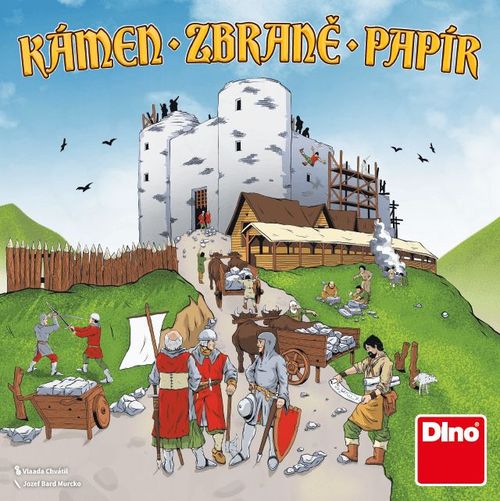
Kámen – Zbraně – Papír
Kámen – Zbraně – Papír Rulebook
Table of Contents
Table of Contents
Components
- 4 castle layout cards
- 52 wooden castle pieces (24 towers, 20 fortress walls, 8 gates)
- 179 resource tokens
- 48 event cards (20 construction cards, 16 combat cards, 12 development cards)
- 22 action cards (8 attack cards, 8 retaliation cards, 6 defence cards)
- 24 battle cards
- 1 first-move card
- 1 mood card
- 1 rulebook
Setup
Before playing, carefully punch out the cards and pieces. Place the resource tokens and the wooden castle pieces in the centre of the table. Shuffle the event cards, the action cards and the battle cards separately, and place each deck so that every player can reach it. Place the battle cards red side up. Place the mood card next to them, orange side up. At the start of the game, play follows the rules for the orange side.
The oldest player draws the first-move card and places it next to the castle layout card. This player starts the game and, at the end of his turn, passes the first-move card clockwise to the next player.
Translator's note: the setup text says the battle cards are placed red side up, but also says play begins with the orange side of the battle cards. The source does not state explicitly whether the battle deck is turned over at setup. The text is transcribed as printed.
Goal of the Game
Build your fortress faster than your opponents.
Order of Play
Each turn can be divided into several phases:
- Collecting resources
- Turning over event cards
- Battle
- Purchase
- End of turn
1. Collecting Resources
At the start of each turn, all players take three resources of each type and place them so that every player can see them. Resources are the cause of battle, and at the end of the turn they are used to buy cards.
Example: first turn with three players. Each player has taken three units of each resource, and at the same time the first player places five event cards on the table.
2. Event Cards
The first player turns over event cards equal to the number of players plus two. With 2 players, 4 cards; with 3 players, 5 cards; with 4 players, 6 cards. The cards are then placed in a row in the centre of the table so that everyone can see them. These event cards are valid only for this turn, and they consist of construction cards, combat cards and development cards. Players can buy these cards only in the Purchase phase.
3. Battle
Each player has two neighbours whom he fights in each round. Each player begins the battle with the neighbour sitting to his left, and defends against the neighbour sitting to his right.
Battle sequence
The first player takes one battle card and places it orange side up between himself and the neighbour to his left. This means that the player challenges the opponent to battle. The battle card shows stone, weapon and scroll symbols (for example, two weapons, one stone and one scroll). The players look at the card, and then the battle continues.
The battle mechanic is similar to the well-known game "Rock, Paper, Scissors". Both players clench their fists and raise their hands in front of them. Then they make three quick pumps, counting aloud to three. On "three", the players choose one of the symbols: a clenched fist for stone, an open palm for scroll, and two extended fingers for weapon. Stone beats weapon, weapon beats scrolls, and scrolls beat stone.
Note: these symbols can be regarded as three possible strategies for conducting battle. Stone means a defensive position, weapon stands for attacking action, and scroll means negotiation. A strong defence can stop an attack, a fast attack leaves no room for diplomacy, and the right diplomatic approach can break any defence.
Unlike the usual rules of "Rock, Paper, Scissors", in this game what matters is not who won, but what the winner takes as a trophy. The answer to this question is given by the battle card. The winner receives the number of resources shown on the picture on the card. He receives the resources with which he won the battle. In the case described above, the player receives two units of weapons if he won through weapons, one scroll if he won through diplomacy, and one stone if the player successfully defended. Because of this, the players develop a strategy for conducting battle. You must consider which resources your opponent may win and which resources he needs, but above all you must guess what your opponent will do. Therefore you must decide as quickly as possible! You must not think for longer than a few seconds before a battle.
Example: which symbol would you choose if the battle card above had been drawn? Weapons would bring more, because the card shows two units. You could also choose a stone and stop all attempts by your opponent to take your weapons, because a small victory is better than a defeat. But what if your opponent thinks the same way? Then a scroll is the best way out and will surprise your opponent. If the players draw, the game continues. If a draw happens three times, the battle ends and neither player receives trophies.
Trophies
The winner takes from the defeated player the number of resources shown on the battle card. If the defeated player does not have enough resources, the winner takes whatever the opponent has.
Example: during a battle the opponents think alike and both choose stone as their first symbol. Draw. The game continues, and both opponents choose a scroll; another draw, the second time. On the third time, one player chooses a scroll and the other chooses weapons. The second player wins and takes two units of weapons from the first player (the weapon symbols are shown on the BATTLE CARD). But because the first player has only one card left, the winner receives only the one remaining unit of weapons.
The battle continues
After the first battle, play continues clockwise. The second battle is begun by the player who was attacked in the first battle. The battle circle is closed when the last player clockwise attacks the very first player with whom the whole battle began. Thus, each player fights twice: once in the role of the player being attacked, and a second time in the role of the attacker. If there are only two players, the first player attacks first and the second player defends, and then everything happens in reverse. After the battle is over, it is time for purchases.
4. Purchase
It is time to bid for the event cards laid out on the table. Each card shows its minimum cost. Construction cards must be paid for with stones, development cards with scrolls, and battle cards with weapons. The first player chooses one or two cards to put up for bidding.
Simplified variant
The first player simply chooses one card, names it and offers his price for it. The price must be reasonable from the point of view of the resource type, and must not be lower than the minimum cost shown on the card itself. The next player clockwise may either offer a higher price or pass. The player choosing the card has an advantage throughout the bidding. When his turn comes, he is not obliged to beat the previous bid; he may simply match the highest offer. Bidding continues until all players except one have passed. The player who wins the bidding pays the offered price. If he does not have enough resources to make the purchase, he may pay with other resources. However, the value of those other resources is reduced threefold.
Thus, three other resources count as one required resource. It is forbidden to offer a bid higher than the one the player is able to pay.
Example: you have 7 stones, 2 scrolls and 3 units of weapons. When buying construction cards, the maximum bid you can offer is 8 stones (using 3 units of weapons to compensate for 1 missing stone). When buying development cards, the maximum bid you can offer is 5 scrolls (using 3 units of weapons to compensate for 1 scroll, and 6 stones to compensate for 2 more scrolls). If you are interested in battle cards, you can bid at most 5 units of weapons (using 6 stones instead of the 2 missing units of weapons). You will keep two scrolls and one stone, which cannot be used this time.
Two cards
Two cards may also be put up for bidding. The bidding proceeds in the same way as for one card. The price must reflect the sum of the minimum costs of both cards. If you choose cards of different resources, you must offer a combined price.
For example, for a construction card and a development card you must offer a price in which one stone is worth at least one scroll, and one scroll is worth at least one stone.
If another player wants to outbid your bid, he may offer a higher price for only one of the cards. However, it does not matter how many stones a player could pay for a card: if he does not have enough scrolls to pay for the other card, his bid will not be accepted. Therefore, it is recommended to separate the offered price by resource, so that it is clear how many resources must be paid for each card.
Example: you have 6 stones, 8 scrolls and 9 units of weapons. The price of a construction card is 7 stones, and you are interested in buying this card. However, the other player has more stones than you, and you fear he may outbid you. Therefore you decide to put up for bidding also a battle card that costs 5 units of weapons. Based on your resources, you offer 7 stones and 10 units of weapons for two cards (3 scrolls for 1 stone and 3 scrolls for 1 unit of weapons). Thus it is clear how many resources you are prepared to give for each card. The remaining 2 scrolls do not take part in this bidding.
To outbid your bid, the other players must offer either 8 stones and 10 units of weapons, or 7 stones and 11 units of weapons, for two cards. If nobody offers more than your bid, you win. But if at the very start you decide to make a minimum bid of 7 stones and 5 units of weapons, there is a risk that another player will raise the bid to 10 stones and 5 units of weapons. You will no longer be able to beat that price.
Purchased cards come into play immediately (see below), and the bidding continues.
The next player clockwise has the right to choose one or two cards and start bidding. You may always pass if you are not interested in those resources, or if you do not have enough means to take part in the bidding. You may not choose cards whose minimum price you are unable to pay.
Bidding is considered finished only when no cards remain on the table, or when all players have used the opportunity to put up cards for bidding.
Cards that remain go to the discard pile, are reshuffled, and come back into play when there are no event cards left.
Using purchased cards
- Some cards allow you to hold more cards during the resource collection phase (for example, the Mine card allows you to have 5 stones instead of 3).
- Some cards give discounts on purchases (for example, the Engineering card allows you to pay two resources fewer than you offered during the bidding). Only one card may be used during a single bidding. If you are bidding for two construction cards, the discount from the Engineering card can be used only once. If you hold the Engineering card and the Science card, and the bidding involves a construction card and a development card, you must choose which card the discount is applied to, because the discount cannot be used for both cards.
- Some cards allow you to exchange resources at a favourable rate.
Translator's note: the source sentence on the discount rule for two construction cards is garbled in the original Russian text; the wording above is the closest faithful reading.
If you buy a development card, place it in front of you to use its bonuses. You may use discounts and favourable exchange rates in all bidding (except the bidding for that card).
Event card types
Combat cards
Combat cards are paid for with units of weapons. They give one to four action cards each. Event cards are discarded immediately after they are turned over, and instead you take the corresponding number of action cards. Action cards stay in the players' hands. Players do not reveal them to their opponents, so that they can be used in battle in a later round.
Action cards
Action cards are used during battle. The card text always states when the card may be used and what the consequences of its use are. Some cards are used before the attack (right after the battle cards are turned over, but before the symbols are chosen), and others are used after a victory or a defeat.
- Attack. This card is used during an attack. When challenging an opponent to battle, you must take into account the direction of the arrow in the upper part of the battle card. If the arrow points to the left, the card can be used to attack only the opponent to your left. Using this card against the player to your right is impossible. Each card states when it may be used and what the consequences of its use are.
- Retaliation. This card is applied against the opponent on your right after the end of his attack (taking into account the outcome of the battle). On retaliation cards the arrow points to the right. Consequently, they cannot be used against players to your left. Retaliation cards are used immediately after the battle ends (after the winner has received his reward). The effect of the card is stated on the card.
- Defence. This card serves as protection against attacking cards and retaliation cards.
In each round, only one attacking card and one retaliation card may be used. If the defending player has successfully used one defence card, he may use one more such card. Action cards that have gone to the discard pile are reshuffled and come back into play once there are no cards left on the table. If the cards from the discard pile have also run out, and it is your turn to draw a new card, you must take any card from the hand of the player who holds the most cards. If that player is you, no new card is dealt to you.
Example: it is your turn to attack. You turn over a battle card, which shows many resources. Before the battle is fought you play the attack card "Ambush" to win without a fight. But your opponent chooses a defence card. Thus both cards go to the discard pile without consequence. At the same time you may bring into play another attack card (for example, another "Ambush"), but if you have no such card, the battle begins. If the opponent wins the battle, you may still play the attack card "Truce", which can be activated after a defeat. If your opponent has no defence card at all, "Truce" comes into force and the battle ends in a draw. But the opponent may still play a retaliation card (for example, "Raid") to rob you. If you have only one defence card left, you must keep it for the next battle. Thus the "Raid" card remains unblocked, and you lose two resources. If you nevertheless decide to use a defence card to block "Raid", your opponent may try once more to play a retaliation card. But after that the battle is finally over.
Construction cards
Construction cards are paid for with stones. Whoever quickly builds the fortress wins. The construction cards show towers, walls, gates and other parts of the fortress. After buying any part of the fortress, you must immediately install it on your plot of land according to the plan. After that, the card goes to the discard pile. A fully built fortress consists of six towers connected to each other by the walls of the fortress rampart, and one gate. One more gate divides the inner courtyard into two parts.
Example of a fortress: the walls that form the perimeter of the fortress must have only one gate. The rampart must also be one. Gates cannot be built if the card calls for building walls.
Building the fortress
Parts of the fortress must be built only in the way shown on the card. You may not change the position or leave out any parts. However, you may demolish parts of the fortress that have already been built, but you must pay one stone for this. If you cannot or do not want to build the part of the fortress shown on the card, you may send it to the discard pile without any consequences.
Example: the fortress can be completed using any of the parts shown below. When building card A, an ordinary wall must be built instead of a gate. When building card B, you must first demolish one wall, paying one stone.
Example: the fortress cannot be completed using the following parts. Part C does not have the shape you need; to build it you must demolish one of the corner towers. Part D has the shape you need, but it does not fit, because the fortress rampart must have only one gate. So if you nevertheless decide to build this part, you will have to demolish several parts that are already built.
Mood card
When the battle card deck runs out, all the discarded battle cards are reshuffled, and the mood card is turned red side up. This means that the red side of the battle cards now comes into play. Also, when retaliation cards are successful, you receive one more resource.
End of the game
The game ends when one of the players builds a fortress. The round does not have to be finished. In a four-player game, second place goes to the player sitting clockwise from the winner. That player did not have to attack the winner, and so he has the best relations with the lord of this region.
Advanced rules
Unlike the regular rules, the player with the first-move card decides how he will attack: clockwise or counter-clockwise. The battle then proceeds in that direction.
5. End of Round
The Start of Game card (first-move card) passes to the next player clockwise, who begins a new round with resource collection.
Translator's note: the source calls this card "Start of Game card" here and "first-move card" elsewhere; they are the same card. Setup and the Order of Play section say it passes at the end of the player's turn, while this section says it passes at the end of the round. Both are transcribed as printed.
Important: during play you may find that during resource collection not all players have enough resource cards. In such a case, players have the right to exchange resources in the purchase phase. For every three missing resources you receive one resource. If you have development cards, you may set a lower exchange rate. In this case the resources return to the bank. If nobody wants to exchange, then all resources of this type are confiscated and returned to the bank. You may take for yourself only those resources that come up during the turn.