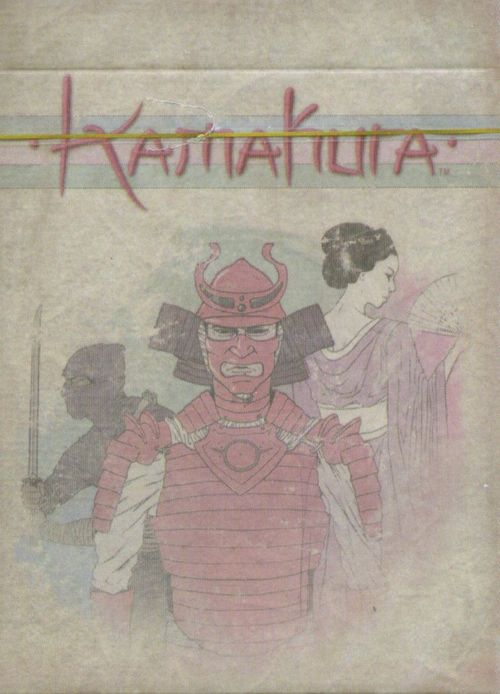
Kamakura
Kamakura Rulebook
Table of Contents
Table of Contents
Setting Up
- Separate the Territory cards and group the clans into 4 separate piles. Each player chooses a set of Territories and lays the cards face down in front of them in an order known only to them. Any remaining Territory piles are set aside. Shuffle the deck and deal each player 8 cards (this is called a Full Restock).
Objective
- A player wins by either capturing all of his opponents territories or by reaching a Territory value equal to 17 or more (players start with a Territory score of 10).
Territories
- There are 4 Territory cards:
- Farm (1)
- Village (2)
- Fortress (3)
- Palace (4)
Each Territory card has a point value indicated on the top right corner. Each Territory represents a different clan of feudal Japan: Tachibana, Fujiwara, Minamoto, and Taira. Clans have NO disadvantage or advantage over one another. Territory card value does NOT play a role in the attacking power of a unit. (Example: Any Soldier and Weapon can capture any Territory card.) If a player ever runs out of territory cards, he is out of the game.
Gameplay
-
To determine who goes first, place the deck in the middle of the table and everyone draws one card. Each of the players flip over their cards simultaneously. The player with the highest ranked weapon card goes first. If there is a tie, or no weapons were drawn, the tying players continue to flip over cards until there is a winner. Turns go in a clockwise direction.
-
Players take turns sending a Soldier armed with a Weapon in an attempt to take one of their opponents' Territories as their own. (You do this by placing your Soldier and Weapon above the Territory you wish to take.) If you successfully attack, you keep your Soldier, and discard all other cards played. The Territory is turned face up and added to your Territory score. This Territory card is out of play and cannot be taken back.
-
The defending player may choose to either defend or surrender his territory to be captured. If Defending, he must lay down a Soldier with a weapon equal to or greater than the attacking Soldier. The Defender can NOT lay down a soldier and weapon if he cannot beat the attack. If he successfully defends, he keep his Soldier, and discards all other cards played. If he surrenders, the territory card is flipped face up and given to the attacker. That territory card is now out of play and cannot be taken back.
-
The defending player may also choose to sacrifice 3 weaponless Soldiers to stop any kind of Soldier & Weapon based attack (This does NOT mean Arrow Barrages). This also nullifies any Soldier abilities. All Soldiers and Weapons in the attack are discarded including your own.
Weapons
- Players may arm their Soldiers with:
- Kunai (+1)
- Katana (+2)
- Naginata (+3)
- Yumi (+4)
You may use 3 Yumi in place of an Arrow Barrage (more about Arrow Barrages below).
- Players may also arm their Soldier with any two Weapons. This is called Dual Wielding. Dual Wielding is ONLY possible if you play the attacking Soldier, or you are defending against a dual wielding Soldier. If the attacker is Dual Wielding, the defender must also Dual Wield. The defender can NOT lay one weapon even if the weapon can match or exceed the attacking power. To determine the dual wield's attacking power, add each of the weapon's attack power together. A Dual Wielding Soldier is only defeated by matching or beating the dual wields power. The exception is sacrificing 3 weaponless Soldiers.
Soldiers
-
Samurai: This Soldier increases the power of their Weapon(s) by +1. This is called Warrior Strength. A Weapon can NOT exceed a +4. (Example: Yumi cannot exceed +4 with a Samurai.)
-
Ninja: This Soldier has the unique ability to overturn a battle with a Kunai if the requirements are met:
- Attack with the Ninja.
- The Ninja is being defeated.
You can play a Kunai and overtake the battle. This is called a Hidden Blade. However, if the defender also has a Kunai, he can counter the hidden attack and still defeat the Ninja. The attacker may choose to again lay down a Kunai which can also be countered. This goes on until the last Kunai is played. Hidden Blades can be played before a Ninja is being sent back. (Example: Geisha is played to reverse Ninja, Hidden Blades can be thrown down.)
- Geisha: This Soldier has the ability to turn an attacking Soldier against its owner if the requirements are met:
- Defend with the Geisha.
- The attack power is greater that the opponent's soldier.
This is called Deception. The player now chooses an enemy territory of the original opponent. She is now attacking her opponent with their original soldier and weapon. (Example: Ninja attacks with a Naginata (+3) and the defender plays a Geisha with a Yumi (+4). The Ninja and Naginata are being send back because the Geisha exceeds his attack by +1.)
-
However, if the new defender has a Geisha that exceeds the attacking Soldier's attack power, the Soldier can once again be turned back, this can go on until someone defeats or is defeated by the original Soldier.
-
Deception does NOT use up your turn. You may use the ability of a turned back soldier. Geishas cannot turn other Geishas back. (Example: If the attacker lays down a Geisha as the original soldier, she cannot be sent back.)
Barrages and Walls
-
Arrow Barrages can be played directly on Territories, but count as your entire turn. If the player has multiple Barrages he can play them on multiple Territories in one turn, but NOT on a single Territory. (Three Yumis can be used as an Arrow Barrage.) If any Barrages are undefended, turn the Territory card face up and add it to your attack score. This Territory card is out of play and cannot be taken back.
-
Walls are the ONLY cards that can protect the defending Territory(s) from Arrow Barrages and are played immediately after the Barrage. If a player has multiple Walls, he can play them on multiple Barrages or two on a single Barrage. If the defender plays two Walls on a single Arrow Barrage, the Barrage is reversed onto the attacker. The Territory is chosen by the reversing player's choice. Once the battle is over, discard both the Walls and Arrow Barrages played.
Restocking
-
On a player's turn, if he has any combination of Soldier and Weapon he must play it. Arrow Barrages & Walls do NOT count towards this.
-
When a player has no combination of Soldier and Weapon to play and it is his turn, he is strongly recommended to draw from the remaining card pile up to 8. This is called restocking. This is the ONLY way to draw cards and it takes up your entire turn. If a player's hand is ever unplayable upon restocking, he may show his hand to the other players, discard his hand, and receive a Full Restock.
Team Battles
-
You and your teammate should sit directly across from your opponents. You may only attack and defend against the person sitting across from you (just for now).
-
Your first opponent may be defeated by your Territory Score, however all of your opponents afterwards must be defeated by capturing all of their Territories. When your opponent has been defeated, choose another opponent to target. If you have multiple opponents, you may choose which to attack on your turn. Alternate turns with your teammate(s). Repeat this until there is a victor.
-
When defending and you have NO moves with which to defend yourself, you may ask one of your teammate(s) for Soldiers OR Weapons. You may NOT ask for a specific Soldier or Weapon. That teammate may give you a single card of that kind when asked (if they have one) and he chooses which card to give. Also, when defending against any Arrow Barrages, you may ask one of your teammate(s) for a single Wall.
-
When attacking, if your opponent ends up reversing/countering an attack (such as the Geisha's Deception or the Ninja's Hidden Blade) you may ask for Soldiers OR Weapons as well.
FAQ's
Q. How can I play with more than 4 people?
A. Get another deck! Kamakura is completely compatible with multiple decks.
Q. Do you plan on expanding the game at all?
A. Yes! We plan on releasing expansions featuring new artwork and gameplay.