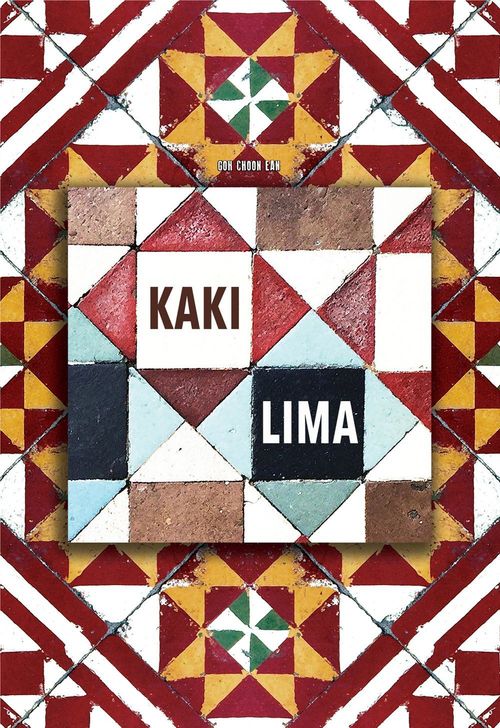
Kaki Lima
Kaki Lima Rulebook
Table of Contents
Table of Contents
Game Setup
- Shuffle together all Kaki Lima and Lokasi Cards (Green, Red, Orange) and lay them face up in a 5 x 10 grid, leaving 4 gaps in the grid:
- Row #2, Columns #4 and #7 (gaps A and B)
- Row #4, Columns #4 and #7 (gaps C and D)
- Shuffle all Langkah Cards and place them face down in one of the grid gaps to form a Draw Pile (gap A).
- Open the top Langkah Card of the Draw Pile and place it face up in another grid gap to start a Discard Pile (gap C).
- Place the Scoreboard at the top left of the grid (E).
- Place the 6 Jom! Cards face up on the right hand side of the Scoreboard (F).
- Place the Star Token on the left hand side of the Scoreboard (G).
- Form a pool of Clearing Tokens in one of the grid gaps (D).
Each player starts with:
- A Pedestrian Punchout on a stand (H)
- Place on any Green Kaki Lima Card along the outer border of the grid.
- Pedestrians can be on the same card.
- A Pedestrian Score Token (J)
- Place on the left hand side of the Scoreboard.
- A Pi Mana? Task Card (K)
- Distribute randomly.
- Pi Mana? Paper Clips (L)
- 5 to check off completed tasks.
- 1 to mark and keep track of Blocked Paths cleared.
- Jom! Tokens (M)
- 6 to mark locations reached and pedestrians met on Jom! Cards.
- Return for re-use once a Jom! Card is claimed.
- Langkah Cards (N)
- Deal 3 to each player at the start.
- Players draw 1 from the Draw Pile to end their turn.
- Maximum of 5 cards allowed in hand.
- Refer to back cover of the Rulebook for a list of Langkah Boosters.
- A Reference Card (P)
- Distribute according to Pedestrian.
Game Overview
Pedestrians aim to strike the best balance of completing tasks on their Pi Mana? Card, exploring different places in town, meeting other pedestrians, and clearing Blocked Paths.
Beginning with the first player, pedestrians take turns in clockwise order. The end round is triggered once a pedestrian completes all five Pi Mana? tasks. Everyone takes one last turn, ending with the player who triggered the end round. Scores are then tabulated. (See page 9) The pedestrian with the most Victory Points (VP) on the Personal Achievement (PA) track wins.
Gameplay
On Your Turn
- Play Langkah Card(s) from your hand.
- a) Put down the card(s) you want to play.
- b) Move your pedestrian forward onto adjacent Green or Orange Cards without any immediate reversal of steps** for the duration of the played card.
- c) Steps cannot be taken onto Red Cards.**
- d) One Langkah Card is played each turn.**
- e) When walking, the exact number of steps shown on the card must be taken.
- Check off tasks completed on your Pi Mana? Card.
- Everytime you land on an Orange Lokasi Card:
- a) Resolve the Lokasi Action. (See pages 7 & 8)
- b) Check off any task related to that Lokasi on your Pi Mana? Card using a Paper Clip.
- Note that the task involving another pedestrian cannot be checked off unless they are on the same indicated Lokasi Card as you are.
- Tasks can be checked off when completed outside your turn.
- Tasks can be completed in any order.
- Everytime you land on an Orange Lokasi Card:
- Place Jom! Tokens and claim Jom! Cards.
- a) Place Jom! Tokens on Jom! Cards next to locations reached and pedestrians met since the start of the game.
- b) Claim a Jom! Card if you are the first to place Jom! Tokens next to all locations or all active pedestrians on that Jom! Card.
- Note that if there are 5 or more players, the first to Jom! 4 other pedestrians is entitled to claim that particular Jom! Card.
- Return Jom! Tokens to respective pedestrians after claiming cards. These can then be used to Jom! locations and pedestrians on unclaimed Jom! Cards.
At the End of Your Turn
- Move all played Langkah Cards to the Discard Pile.
- Except when you reach an empty Gathering Spot. If so, Langkah Cards are kept aside, and are discarded in exchange for 1VP per step once another pedestrian arrives.
- If no one arrives by the start of your next turn, discard the cards then.
- Draw a Langkah Card to end your turn.
- Even if two or more Langkah Cards were played on your turn.
- A maximum of 5 cards is allowed in your hand at any time.
- You may also choose not to walk anywhere on your turn and just draw a card.
At Any Time
- Clear Blocked Paths using Clearing Tokens.
- a) In an individual clearing, the targeted Red Card must be on the same continuous row or column you are on.
- Red Cards along your walking path can also be cleared, and not necessarily the closest ones.
- The 4 gaps in the grid do not count as part of a continuous row or column.
- b) In a collaborative clearing, the targeted Red Card can be anywhere on the grid. (Collaborators decide where)
- One player contributes a Langkah Card, passing it to the player contributing a Clearing Token.
- c) Flip over a Red Card and place a Clearing Token on top to indicate a Cleared Path.
- d) Mark the number of Blocked Paths you clear either individually or collaboratively on your Pi Mana? Card using a Paper Clip.
- a) In an individual clearing, the targeted Red Card must be on the same continuous row or column you are on.
- Ajak other pedestrians to:
- i) Clear Blocked Paths collaboratively.
- ii) Meet up at Lokasi Cards. (See Pages 7 & 8)
- iii) Walk together for any number of steps. (See Page 9)
Lokasi Cards and Actions
Score for Gathering at These Places
VP scored = number of steps taken. Among the many places in George Town to experience Penang's social culture.
- Arts-ED: A non-profit organization that promotes community-based arts and culture education in the George Town UNESCO World Heritage Site as well as other parts of Penang, Malaysia.
- Hin Bus Depot: A community art space and creative hub that includes a gallery, artist studios, retail stores, food and beverage outlets, a reading room, and a weekly pop-up market.
- Kopitiam (Coffee Shop): Traditionally known for serving Hainanese coffee, half-boiled eggs and kaya (coconut and egg jam) toast, most kopitiams now include a variety of hawker food stalls.
- LUMA: Alongside a spirit of keeping an open house, LUMA operates with the vision of lighting up arts and culture in Penang, primarily through media and audio-visual support.
- Roti Bakar (Grilled Bread) Stall: Lining many streets with giant umbrellas to shade customers from the sun, roti bakar stalls are popular pitstops among Penangites. Other than its specialty benggali bread, customers also get their pick of nasi lemak (rice cooked in coconut milk), kuih-muih (sweet and savoury bite-sized snacks), and sometimes even roti canai (fluffy flatbread served with curry).
Trade Cards at These Places
Trade Cards (optional action) --- with any other player. Long queues... so why not exchange smiles and greetings while waiting.
- Chendul Stall: A dessert of Teochew origin, chendul is a refreshing concoction of shaved ice, pandan-flavoured flour jelly and kidney beans, immersed in coconut milk, and sweetened with gula melaka (palm sugar).
- Rojak Stall: A tasty fruit and vegetable salad topped with dark toffee-like prawn paste sauce and crumbed peanuts, rojak also lends its name to mean 'eclectic mix' in socio-cultural contexts.
Draw an Extra Card at These Places
Draw an extra card at these places --- maximum 5 cards allowed in hand. Foodie spots... gain extra energy for your walk after munching on something yummy!
- Chendul Stall
- Hin Bus Depot
- Kopitiam
- Rojak Stall
- Roti Bakar Stall
Maximize Your Hand at These Places
Maximize your hand at these places --- draw till you have 5 Langkah Cards. Attain steps for your journey when you visit a spiritual space on the 'Street of Harmony'.
- Chinese Temple: Originally dedicated to the Goddess of the Sea for the safe passage of Chinese immigrants to Penang, this temple was rededicated and renamed in 1862 to Kuan Yin, the Goddess of Mercy, who is believed to provide relief from all suffering.
- Church: The St. George's Anglican Church is the oldest Anglican church in South East Asia. Built in the 1800s by Indian convict labourers, it was modelled after St. George's Cathedral in Madras.
- Hindu Temple: Named after a goddess protector, the Arulmigu Sri Mahamariamman Temple started as a small shrine, and has stood on the same site since 1801, making it the oldest Hindu temple in Penang.
- Mosque: The Kapitan Keling Mosque was originally built with stone from India, and has served as the centre for the Tamil Muslim community in George Town since the early 1800s.
Pick Up a Clearing Token from These Places
Pick up a clearing token from these places --- use immediately or keep for later. Get the right info, tools, and support to clear blocked kaki lima.
- GTWHI - George Town World Heritage Incorporated: Established by the Penang State Government to promote, monitor and manage the George Town UNESCO World Heritage Site, GTWHI is dedicated to protecting and preserving George Town as a sustainable city. Fun fact: Kaki lima is part of their logo.
- Hardware Shop: Cheapside Lane is a treasure-trove of hardware, from the tiniest screw to the largest shears... just the perfect place to get tools for path-clearing.
- MBPP - Majlis Bandaraya Pulau Pinang (City Council): The Penang Island local government has been tasked since 1856 to take care of the daily lives of the general public. This includes cleaning drains, greening parks, collecting trash, systemizing parking, and safeguarding the accessibility of sidewalks and kaki lima.
Play Another Card at These Places
Play another card (optional action) --- after drawing a Langkah Card. New notes, clean clothes, fresh fish... walk on with an extra skip in your step!
- Bank: This building housed the first international bank on Lebuh Pantai (Beach Street), one of Penang's oldest roads, and has witnessed the growth of George Town's financial district for over a century.
- Dhobi: The trade of open-air laundry, hand-washed and pressed using charcoal iron came to Penang from India in the 1910s. While methods may have changed, the dhobi reference to laundromats in Penang still remains.
- Market: The Chowrasta market is one of the oldest surviving traditional markets in Malaysia. Uniquely, it features stalls selling a great variety of goods, from jeruk (pickle) and seafood, to souvenirs and second-hand books.
** Optional action.
Walk Together
Ajak pedestrians on Clear Paths (Green Cards) and Cleared Paths (flipped Red Cards) to accompany you on your walking path.
- Pedestrians on Clear and Cleared Paths can also be the ones who ajak other pedestrians to 'pick them up' on their walking paths.
- Pedestrians can choose to walk together for any number of steps.
- Accompanying pedestrians to Gathering Spots will score VP according to steps taken from pick-up points.
Example: Lay Ting walks 3 steps to the Gathering Spot. She picks up Aunty Toh on the way and scores 3 VP when they arrive there. Aunty Toh accompanies Lay Ting for 1 step to the Gathering Spot and scores 1 VP when they arrive there.
Game End and Scoring
The end round is triggered once a pedestrian completes all 5 tasks on a Pi Mana? Card.
- Everyone takes one last turn ending with the pedestrian who triggered the end round.
- On the Community Achievement (CA) track:
- a) Mark the total number of Blocked Paths cleared with the Star Token. The number in the corresponding green CA Star will count later as the multiplier for bonus Victory Points (VP) from Blocked Paths cleared.
- b) See how well you have done as a community:
- 0-3: Aisey! Apa ni? You have a long way to go in building an accessible neighbourhood.
- 4-6 (1 CA Star): Boleh tahan lah. Not bad, with some work, you might do wonders together!
- 7-9 (2 CA Stars): Hebat jugak! Go ahead, pat each other on the back for great teamwork!
- 10-12 (3 CA Stars): Wah, champion! You make an excellent neighbourhood! Time to celebrate with chendul!
- On the Personal Achievement (PA) track:
- a) In addition to the VP already scored through Gathering Spots, score Victory Points (VP) for:
- i) Tasks completed.
- ii) Jom! Cards claimed.
- iii) Blocked Paths cleared.
- 2 VP for each path cleared.
- Bonus VP for [number of paths cleared] x [CA Star number].
- b) The player with the most VP on the PA track wins.
- Tie breakers: i) Most tasks completed. ii) Most steps on Langkah Cards left in hand.
- a) In addition to the VP already scored through Gathering Spots, score Victory Points (VP) for:
Example (Lay Ting's score): Gathering Spots = 6 VP; Tasks completed = 12 VP; Jom! Cards claimed = 8 VP; Blocked Paths cleared: 5 x 2 VP = 10 VP, 5 x CA 3 = 15 VP. Total: 6 + 12 + 8 + 10 + 15 = 51.
Langkah Boosters
Refer to this list when a Langkah Card shows a booster.
- Steps may be taken diagonally (not just on adjacent cards).
- Steps may be taken in reverse directions (immediate back and forth movement).
- Steps may be taken around Blocked Paths (counting Red Cards as steps).
- Double the steps of another card (with optional activation of its Booster).
- Combine the steps of this card with another card (with optional activation of its Booster).
- Swap with top card of the Discard Pile (play immediately or place in hand).
- Pick up a Clearing Token (use immediately or keep for later).
- Active Clearing Tokens may be moved to clear different Blocked Paths (no points awarded).
Lokasi Actions Summary
- Score for Gathering: Points = number of steps.
- Maximize Your Hand: Draw till you have 5 cards.
- Trade Cards: With any other player. (Optional action)
- Pick Up Clearing Token: Use immediately or keep for later.
- Draw an Extra Card: Max. 5 cards in hand.
- Play Another Card: After drawing a card. (Optional action)
Scoring Summary
Victory Points (VP) are marked on the Scoreboard.
- During the game for: i) Meeting other pedestrians at Gathering Spots.
- At the end of the game for: ii) Tasks completed. iii) Jom! Cards claimed. iv) Blocked Paths cleared.