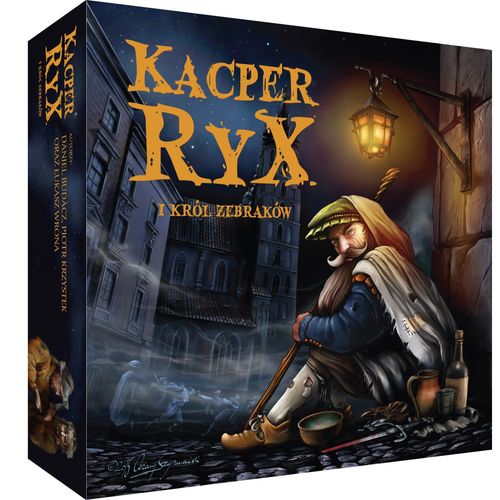
Kacper Ryx i Król Żebraków
Kacper Ryx i Król Żebraków Rulebook
Table of Contents
Table of Contents
Game Components
Board
Labelled parts of the board: magical location (Lokacja magiczna), district (Rewir), investigation track (Tor investygacji; the top track also marks Time, "Czas"), action track (Tor akcji; Punkty akcji), peace points track (Tor punktów miru), district number (Numer rewiru), district wealth (Zamożność rewiru), ducats, zbir limit (Limit zbirów), special action card limit (Limit kart akcji specjalnych), tavern (Karczma). The "Course of a turn" reminder printed on the board: 1. economic phase, 2. action phase, 3. task phase, 4. investigation phase.
The board shows a map of Kraków divided into 10 numbered districts, each with a wealth value printed next to its number. Taverns and magical locations are printed on the map with their values. The top track shows markers for 2 players, 3-4 players and 5 players.
Cards
- Basic action cards x 20: name, effect, action points, cost in ducats, and the name of the action on the other side of the card.
- Special action cards x 45: name, effect, cost in ducats, action points.
- Companion cards x 20: name, effect, type of action - talent (talent) or skill (umiejętność).
- Investigation cards x 35: story description, effect, card number, investigation points.
- Task cards (Duel) x 15: name, story description, task completion conditions.
- Task cards (Guild War) x 30: name, story description, task completion conditions, peace points, minimum number of players.
Other components
- Action point and peace point markers x 10
- Herst pawns x 5
- Tavern and magical location pawns
- Zbir tokens x 60
- Six-sided dice (k6) x 18
- Ten-sided die (k10) x 1
- Ducats x 60
- Herst boards x 5 (each shows the herst's advantage - "Przewaga")
- Companion tokens x 3 (showing, in turn: 2 ducats; 4 ducats or 1 investigation card; 6 ducats or 2 investigation cards)
- Tavern and magical location tiles x 15
- Magic tokens x 15
- Kacper Ryx pawn
- Wound tokens x 5
- Time token and investigation token
- Apprentice (żak) tokens x 4
Game Variants
The game Kacper Ryx i Król Żebraków offers two variants of play.
Duel - a 2-player variant that the players should finish in about 30 minutes.
Guild War - a variant for 3 to 5 players that the players should finish in about 90-120 minutes.
Both variants can be enriched with additional rules, which can be found later in the rulebook (see Additional Rules).
Guild War
Setup
-
The players set up the game board on the table. Depending on the number of players, 8 districts (3-4 players) or all 10 districts (5 players), marked with the appropriate colours on the board, will be used.
-
Each player draws one herst board, which they place in front of themselves, and then receives the corresponding herst pawn. The players read the description of the advantage resulting from possessing the herst, printed on the given board.
Unless stated otherwise in the rulebook or on cards, "zbir" (henchman) also means the herst.
-
Each player places on their herst board all of the tavern and magical location pawns, zbir tokens, and the peace point and action point markers in the colour matching that herst.
-
Each player places their peace point marker on space 3 of the peace track.
-
In a game of 3 or 4 players, remove from the task deck the cards marked with the symbol "5", that is: Flisaczy druh, Oppidum Judaeorum, Pan Kleparza, Miedziany Szlak. All players receive 3 task cards each (except the player who controls the herst Swojak), which they do not reveal to the others. The remaining cards are placed in the task deck next to the board.
-
All players roll a die and the player with the highest result begins the auction (if several players got the highest result, they repeat the roll until one of them wins), that is, places their action point marker on the action track on a chosen space from 0 to 10. Then the next players - clockwise - place their markers on free spaces. When all players have placed their markers on the action track, the player who placed their marker closest to space 10 is the first to place their herst in a chosen district and marks a tavern there with their pawn (but not a magical location!). They also draw a tavern tile. Possessing a tavern means controlling the given district. The player also receives ducats equal to the position of their marker on the action track (e.g. choosing space 7 they receive 7 ducats). Then, in the order of the action track (from 10 to 0), the other players perform the action described above. It is not allowed to place a herst in a district already occupied by another player.
Taking a high position during the auction allows you to choose the best district in which you start the game and enriches you with a large stock of cash. On the other hand, you lose many valuable action points in the first turn and expose yourself to attack from the other players.
- Each player receives an identical set of 4 basic action cards (Murder/Brawl, Theft/Begging, Movement/Trade, Recruitment/Bribery) and lays them in front of themselves with either side up. The 4 revealed actions are active.
We recommend starting the first game by choosing the basic action cards: Brawl, Movement, Theft and Recruitment.
- Next to the board lay out three companion tokens in the order: [2 ducats], [4 ducats / 1 investigation card], [6 ducats / 2 investigation cards]. Then place the companion deck next to the [4 / 1] token and draw 3 cards from the top of the deck, laying them out next to each of the tokens in turn, starting from the [6 / 2] token. Then, on the investigation track, place the investigation token and the time token on the outermost spaces.
Goal of the Game
The game is won by the player who earns the most peace points (punkty miru). They can be earned during the task phase by completing the goals described on the task cards held. Additionally, peace points can be earned by recruiting companions and by performing basic actions (Theft and Murder) with great success.
Moreover, at the end of the game each player receives:
a) 1 additional peace point for every 8 ducats held,
b) 1 additional peace point for every tavern held,
c) 3 additional peace points for every magical location held.
IMPORTANT! During play a player immediately loses 1 peace point each time that, as a result of Murder or Brawl (but not the effect of an investigation card), their herst is stunned (that is, when it receives a second wound).
End of the Game
The game ends at the moment when on the investigation track the investigation token and the time token are on one space, or when the investigation token passes the space occupied by the time token. If the investigation token lands on the space with the time token or passes it, the game ends after the investigation phase currently being played.
(Illustration: investigation track with the time token moving toward the investigation token from the left, and the investigation token moving toward the time token from the right.)
In the case when it is the time token that lands on the space with the investigation token in the economic phase, the game ends at the end of that turn, after the investigation phase (regardless of its results).
The game ends immediately with the victory of a player who, during it, earns 30 or more peace points.
Course of Play
The game consists of several turns, most often 3 to 5. Each turn consists of 4 successive phases:
- the economic phase
- the action phase
- the task phase
- the investigation phase
In every phase the players are bound by the golden rule of order.
THE GOLDEN RULE OF ORDER:
In every phase players perform their activities starting with the one whose action marker is closest to space 0 on the action track. If the markers of two or more players occupy the same space, the order is decided by which marker is on top of the stack.
A player performs actions until their marker does not get ahead of another player's marker (in the action phase) or until they perform all of the intended activities (in the other phases); then the initiative passes to the next player - according to the order of the markers on the action track.
Example 1: The markers of Ania, Tomek and Kacper are on space 0. Ania's marker is at the bottom, Tomek's marker is on it, and Kacper's marker is on top. Kacper plays the economic phase first, after him Tomek, and Ania last.
Example 2: Ania's marker is on space 2, Tomek's marker on space 0. Tomek plays the phase first.
1. Economic Phase
Players in turn draw income from their taverns:
-
They take ducats equal to the sum of the [ducat] value given under each tavern they control.
-
They draw cards so as to have in hand a number equal to the sum of the [special action card] value given under each of their taverns.
-
They place on the map zbirs so that their total number reaches a value equal to the sum of the [zbir] value given under each of their taverns. In this case the herst is not taken into account.
New zbirs are placed by players in districts in which they control a tavern or a magical location, or in the district where their herst is present.
A player with 2 taverns of total zbir limit 3 may place 2 zbirs if they currently have only 1 on the map (not counting the herst). If they have more than 3 zbirs (not counting the herst), they do not move any, but also do not remove the excess from the board.
A player with 2 taverns of total special action card limit 4 may draw 2 cards if they currently have only 2. If they have more than 4, they do not draw any, but also do not discard the excess from hand.
(Example tavern tile "U Koniara": 6 ducats, 1 special action card, 1 zbir.)
NOTE! The activities described below are performed by the players starting from the second turn.
At the beginning of the economic phase, move the time token by 1 space in a game of 4 or 5 players, or by 2 spaces in a game of 3 players.
Then move the players' markers to space 0 on the action track (or otherwise - see investigation card no. 7). To do this, move the whole stack from space 10 without changing the arrangement of the markers in it. It may happen that one or more players finished the action phase of the previous turn before their action markers reached space 10. In such a situation their markers should be moved to space 0 in turn, starting with those closest to space 10 and placing them on top of the stack being formed there.
Example: Ania ended the turn with her marker on space 10, Tomek and Kacper on space 9 (Tomek's marker is placed on Kacper's marker). So the order of the players in the next turn will be: Tomek, Kacper and Ania. Ania's marker, being first on space 10, is moved to space 0. Then, keeping the order in the stack, Tomek's and Kacper's markers are moved simultaneously from space 9 onto Ania's marker on space 0.
Discard the companion card marked with the [2 ducats] token. The remaining two cards (marked with the [4 / 1] and [6 / 2] tokens) are moved to the left, toward the [2 ducats] token. Finally, place a missing card from the deck in the place of the missing card, next to the [6 / 2] token.
In the economic phase players heal wounded hersts by removing a wound token from their board. After being stunned, the player places the herst pawn in a district in which they have a tavern or a magical location, and in case of having neither, in their turn, such a player may place in any district participating in the game their herst and 2 zbirs. They also receive 5 ducats and a special action card.
Players also activate the companion cards whose skills (umiejętności) they used in the previous turn, by turning them face up.
After performing the above activities players refill their task cards. First they may discard from hand any number of task cards held, then they draw new ones so as to have exactly 3 (other cards may affect this number, e.g. the companion card Magister Wolski).
When the deck of special action cards, tasks or investigation cards runs out, collect them from the discard piles, shuffle them and form new decks. Used companion cards are not used again in the game.
2. Action Phase
In this phase players use mainly basic action cards, as well as special action cards and companion cards.
As part of their activities a player may:
- perform a basic action,
- use a special action card,
- use the skills of one or more companions,
- flip a basic action card to its other side without applying its effect (this requires moving the player's marker on the action track by 1 space),
- pass.
Using a basic or special action card requires moving the player's marker on the action track by the value indicated on the card (players cannot go beyond space 10). The order of the players' activities is determined according to the golden rule of order.
The action phase ends when the markers of all players are on space 10 of the action track and/or when the players have passed earlier (see Passing, below).
Example: Tomek's marker is on space 1, Kacper's marker on space 4, Ania's on space 5. Tomek decides to perform the Murder action. After performing the action he moves his marker by 1 space and flips the card to the Brawl side. His marker is still closest to space 0, so he may perform the next action. He may now perform the Brawl action; instead he decides to perform the Trade action and moves his marker by 2 spaces, covering Kacper's marker on space 4. Tomek's marker is now on top of the stack, so he may perform the next action. If it is an action of value 0, his marker will remain on space 4, so Tomek will be able to perform yet another action. If he performs an action of cost 1 or higher, his marker will move further, and Kacper will finally be able to play his own actions.
During this phase you will perform several actions each in turn. So remember to plan your next moves well.
Basic actions - players have 4 double-sided basic action cards. A player may use only the revealed action on a given card. After performing a basic action the card must be flipped. The number visible on the card in the lower right corner determines by how many spaces on the action track the player's marker is moved after performing the action. A card can also be flipped to its other side without performing the action; however, this requires moving the marker on the action track by 1 space. One of the cards also requires paying a cost in ducats.
The four basic action cards (front / back):
Movement (Ruch) (action points 0; back: Trade) - Move up to 3 zbirs to neighbouring districts or 1 to any district.
Trade (Handel) (action points 2; back: Movement) - Draw a special action card from the deck.
Begging (Żebry) (action points 2; back: Theft) - Indicate a district. You gain ducats equal to the number of zbirs you have there, but not more than the wealth of the chosen district.
Example: Jacek has 4 zbirs in the Rynek Główny. He collects 4 ducats. Monika has 3 zbirs in Grzegórzki. She collects only 2 ducats.
Theft (Kradzież) (action points 1; back: Begging) - Indicate a district in which you have at least one zbir. Roll a die:
- 1-2: you receive an investigation card;
- 3: you succeed but also receive one investigation card;
- 4-5: you succeed;
- 6: you succeed and receive a peace point.
Success: you receive ducats equal to the wealth of the district.
Bribery (Przekupstwo) (cost 3 ducats, action points 0; back: Recruitment) - Discard at random one of the investigation cards you hold, OR place 1 zbir in a district according to the normal rules. The player places the zbir in a district in which they control a tavern, a magical location, or have their herst. The zbir limit resulting from the sum of the zbir values of the taverns held may be exceeded.
Recruitment (Werbunek) (action points 2; back: Bribery) - After paying the cost, draw the chosen companion card. The player chooses a companion card and pays its cost in one of two ways:
a) by paying 2, 4 or 6 ducats respectively;
b) by drawing from the deck 1 or 2 investigation cards respectively. In this way it is not possible to take the companion lying next to the [2 ducats] token.
After taking a companion, move the remaining companion cards so that the more expensive cards become correspondingly cheaper, and place a new card from the deck so that it is now the most expensive.
Murder (Zabójstwo) (action points 1; back: Brawl) - Indicate a zbir in a given district in which you have at least one of your own zbirs. Roll a die:
- 1-2: you receive an investigation card;
- 3: you succeed but also receive one investigation card;
- 4-5: you succeed;
- 6: you succeed and receive a peace point.
Success: inflict one wound on a zbir or herst.
The target of a murder may be a zbir or a herst. Inflicting a wound on a herst consists of placing a wound token on its board. If the herst is already wounded, it is stunned. A stunned herst is removed from the game and placed on the herst board, and the player who controls it loses one peace point. Healing a herst takes place in the next economic phase (see Economic Phase). Inflicting a wound on a zbir means removing it from the board and placing it back on the herst board.
Brawl (Burda) (action points 3; back: Murder) - Conduct a brawl in order to take a neutral tavern or magical location, or one controlled by another player. Players receive 1 die for each zbir, and 2 for a herst present in the district. The winner is the player who gained more successes. In case of a tie the attacker wins. Results of a die roll: 1: a defeat and an investigation card; 2-3: a defeat; 4-5: a success; 6: a success and inflicting a wound.
The player conducts a brawl in a chosen district in which they have at least 1 zbir. The target of the brawl may be a neutral tavern or magical location, or one occupied by another player. The brawl proceeds as follows:
-
The attacking player chooses the target of the brawl.
-
The other players having zbirs in the attacked district declare themselves on the side of the defender or the attacker, or remain neutral. In the first and second case all the rules described below apply to them. Players may win allies over to their side by offering them ducats in exchange for support. A player who takes part in a brawl must commit to it all the zbirs they have in the district.
-
All participants of the brawl may use special action cards (but only those marked with the text "play during a brawl"), playing one card at a time in turn: the attacker, his allies, the defender, his allies. Each player may in this way play any number of cards, until all pass.
Example: Tomek is the attacker. He plays a special action card. Kacper, as the defender, also plays an action card, as second. Tomek passes. Kacper plays 2 more cards and passes.
-
Players count the dice with which they will roll. The attacker receives 1 die for each zbir taking part in the brawl, 2 dice for an unwounded herst (1 if wounded), and dice gained through the playing of special action cards and companions. By the same rules the defender and the allies of the defender and of the attacker count dice. Additionally the defender receives 2 dice for the tavern or magical location he is defending.
-
Players roll their dice. (Illustration: 1 die per zbir; 2 dice per herst; 1 die for a wounded herst; 2 dice for the defended tavern or magical location.)
-
The brawl is won by the attacker if the total number of successes rolled by him and his allies - that is, results of 4, 5 or 6 on the dice - is equal to or greater than the number of successes obtained by the defender and his allies. The attacker's victory in a brawl means taking over the tavern or magical location. The defeated defender removes his tavern or magical location pawn from the map, and the victorious attacker places his own pawn in its place. The defender hands over to the attacker the appropriate tavern or magical location tile.
-
The attacker and his allies count the wounds inflicted on the opponent, that is, the results of 6 rolled on the dice. The losses are then divided evenly between the defender and his allies. All losses that cannot be divided evenly are taken by the defender. Then, in the same way, losses are inflicted on the attacker and his allies.
Example: The attacker and his two allies inflicted 7 wounds in total. The defender and his ally therefore each receive 3 wounds, and the defender receives also an additional, odd wound. The defender and his ally inflicted 2 wounds in total. This means that the attacker will receive both, and his two allies none, since an even division of 2 wounds among 3 players is impossible.
Each player decides whether a wound received applies to their zbir taking part in the brawl or to their herst (see Murder).
A player who received wounds may use a special action card - Szpital św. Rocha.
-
Each player draws an investigation card for each result of 1 rolled by them on a die.
-
Regardless of the outcome of the clash, the zbirs that survived remain in the district in which the brawl was fought.
Brawl in a neutral tavern or magical location - when the target of the brawl is a neutral (not occupied by another player) tavern or magical location, the player sitting to the left of the attacker rolls 2 dice on behalf of the lawful defenders. The other players whose zbirs are in this district may take part in the brawl on one side or the other, under the rules described above. In case of the attacker's victory, he places his pawn next to the occupied tavern or magical location and draws the appropriate tile.
Special actions - a player may use one or more of their special action cards during their turn or at the moment described on the given card. Playing most cards requires moving the player's marker on the action track by the number of spaces indicated on the card. Additionally some special action cards require paying a specified number of ducats.
(Example card "Samopał": inflict a wound on any one on a zbir board. Cost 0, action points 0.)
Players can obtain special action cards in several ways:
- in the economic phase, by topping up their number to the limit resulting from the parameters of the taverns held,
- by using companion talents,
- by performing the basic action Trade.
Companion cards - each player may have a maximum of 3 companions. A player who already has 3 companions and wants to take another must first discard one of those already held. Each companion has a talent or a skill.
Talent - its effect persists as long as the companion remains under the player's control.
Skill (umiejętność) - can be used only once per turn. After using a companion's skill, its card must be turned reverse-side up to mark that it has been used. The player turns the card face up again in the next economic phase.
(Example card "Kulas, Szkolnik" - skill: Perform the Theft action. On success, additionally take from the player who has a tavern in that district ducats equal to its income.)
Passing - A player who has passed during a turn cannot perform any more of the above-listed activities in it (except playing some special action cards). Their marker stays on its space, but is ignored when determining the player with the initiative. The earlier a player passes, the greater the chance of being the first player in the next turn (see Economic Phase).
3. Task Phase
In this phase players - according to the golden rule of order - may reveal those of their task cards whose goals they have fulfilled. After completing a task they move their marker on the peace points track by the value indicated on the card. Revealed cards must be discarded. Players draw new task cards up to 3 in the nearest economic phase (see Economic Phase). One player cannot reveal two identical task cards in the task phase (e.g. Trójca Święta).
(Example task card "Oppidum Judaeorum": "Control Kazimierz and draw profit from it." Worth 2 peace points; marked "5" = minimum number of players.)
4. Investigation Phase
This phase represents the actions of the sleuths of the royal investigator Kacper Ryx and his subordinates. The investigation cards will give you a good scorching and will surely cool your criminal zeal a bit...
Players, according to the golden rule of order, reveal the investigation cards gathered in this turn and apply their effects. Players most often receive investigation cards:
- after rolling a 1, 2 or 3 on a die when rolling in the basic actions Theft and Murder,
- after rolling a 1 on a die when rolling in the basic action Brawl.
After applying the effect of a card, move the investigation token on the investigation track by the number of spaces indicated on the card to the left, toward the [time token], or in the case of a negative number toward the [investigation token side - the right]. When, after all players have applied the effects of their investigation cards, the investigation token in the given phase lands on the space with the time token or passes it, the whole game must be ended after the end of the turn.
(Example investigation card: "One of your henchmen applied himself to his work more than he should have, leaving on the streets the cooling body of a poor wretch he was only supposed to scare. Roll a die: 1-2: the city thugs decide that the killers will not be caught anyway. Nothing happens. 3-6: Kacper Ryx appears on the spot, who after a short investigation quickly catches the perpetrator. Remove one of your zbirs from the board." Investigation points 1.)
Each time a player receives an investigation card, they place it in front of themselves face down. Peeking at the gathered investigation cards is not allowed. They are revealed only in the investigation phase.
During the action phase, using the basic action Bribery, a player may discard a random investigation card.
Duel
Setup
This variant differs in some respects from Guild War:
-
The map is limited to only 6 districts within which the players may perform their actions: Stradom, Rynek Główny, and the Quarters: Sławkowski, Garncarski, Rzeźniczy and Grodzki.
-
During the Duel a separate deck of task cards must be used.
If the players do not decide to introduce the additional rule Kacper Ryx (see Additional Rules), the card Nieustraszony must be removed from this deck.
-
Draw at random and lay out next to the board 4 revealed task cards.
-
From the companion deck remove the following cards:
- Stanisław Stadnicki
- Samuel Zborowski
- Magister Wolski
- Erazm Czeczotka
- From the special action card deck remove the following card:
- Tumult
-
From the investigation deck remove the cards with the symbol "3+".
-
Each player draws one herst card, which they place in front of themselves. In this variant players do not use the advantage described on the card resulting from possessing the given herst.
-
The time token and investigation token are not placed on the investigation track, and the players' markers are not placed on the peace points track. They do not take part in the game.
Changes in the Course of Play
In a situation where a Brawl takes place, both neutral taverns and magical locations and those controlled by players (if they take part in the game) provide the defender with 3, and not 2, dice.
Course of Play
-
The auction and the first economic phase proceed according to the rules of the Guild War variant.
-
A turn consists of only three phases:
- the economic phase,
- the action phase,
- the investigation phase.
They proceed according to the rules described in the Guild War variant. Players apply the effects of investigation cards, but do not move the investigation token, since the investigation track does not take part in the game.
Victory Conditions
The game is won by the player who first collects 4 task cards. A player receives a card after fulfilling the task described on it, at any moment of the action phase during their turn (also right after performing an action, and before the opponent performs an action). After gaining a task card, the player places a new card from the deck in its place. If, however, their marker has already passed the opponent's marker on the action track, they have no right to take a new task card, even if they meet the conditions described on it.
Example: Tomek performed the action "Begging", gaining 4 ducats. He now has 21. His initiative marker landed on space 5, getting ahead of Kacper's marker, which is on space 3. Before the initiative passes to Kacper, however, Tomek declares that he is fulfilling the task "Magnat" and takes the appropriate card from the pool. In its place the next task card "Pański gest" is laid out; Tomek can no longer fulfil this task, even though he has the right number of ducats. Kacper takes the initiative.
A task card gained by a player cannot be taken away from them, even if they stop meeting the conditions described on it.
Additional Rules
Kacper Ryx
This rule can be introduced into both the Guild War and Duel variants.
At the beginning of each investigation phase, players roll a ten-sided die (Guild War) or a six-sided die (Duel) and place the Kacper Ryx pawn in the district whose number matches the result rolled. The player who has a tavern (but not a magical location) in the district where Kacper Ryx appeared immediately receives an investigation card. Moreover, in the next action phase the number of investigation cards drawn because of actions performed in the district occupied by Kacper Ryx is doubled.
A result of 3 during a murder test means drawing 2 investigation cards, while rolling two 1s during a brawl causes drawing as many as 4 investigation cards.
In the next investigation phase, roll again for Kacper Ryx. If the result is repeated, Kacper Ryx stays in his place. If the number rolled is of a district that is inactive in this game (when playing with 3 or 4 players), the roll must be repeated until a result is obtained that allows placing the Ryx pawn on the board.
Magic
This rule can be introduced in the Duel or Guild War variant.
Kraków has become in recent years one of the most important nests of European alchemists and magicians. Both eminent specialists and a huge group of charlatans and forgers have their workshops here. It is hard to tell who really knows the subject and who only knows how to do tricks. Fear of black magic and necromancy keeps devout townspeople and ordinary thugs in awe.
Magical locations, besides the 3 peace points they offer at the end of the game in the basic variant, also provide magic tokens. In the economic phase players receive 1 magic token for each magical location controlled. In no case may they have more than 3 magic tokens.
This token allows rerolling any roll made by the player (a Theft or Murder test, a die during a Brawl), but the second result (even a worse one) stays in force.
Only one magic token can be used during one action, so only one roll can be repeated.
If a magical location is lost, the player does not lose the magic tokens gathered.
Trade (Fach w ręku) - Herst Abilities
(Printed heading: "Fach w ręku" - "A trade in hand".) This rule can be introduced only in the Guild War variant.
During play the herst abilities listed below can be used. Abilities cannot be used when the herst is wounded or stunned.
Swojak Furia (Fury): use before rolling dice in a Brawl in which Swojak takes part. You immediately receive a wound token and 2 additional dice.
Maestro Warsztat (Workshop): pay 1 ducat when you use the Trade action. Draw an additional special action card.
Francuzik Oburęczny (Ambidextrous): during a Murder action in which Francuzik takes part, you may decide to roll 2 dice instead of 1. Regardless of the result, both results must be applied, which means a greater chance of killing a zbir, inflicting 2 wounds on a herst, but also drawing 2 investigation cards. You must decide whether to use this ability before the roll.
Rajfurka Miłe panie (Nice ladies): when you gained a tavern as a result of a brawl in which Rajfurka took part, you may take a revealed companion card without using the basic action Recruitment (but after paying the appropriate cost).
Paser Pośrednik (Intermediary): during the action phase discard any number of special action cards and/or task cards. For the first card discarded you receive 2 ducats, for each subsequent one 1 ducat more (3, 4, 5, etc.). You may discard cards only once per turn.
Example Setup of a Three-Player Game
By performing the activities described below, players can prepare a three-player game, which can then serve as a training game. It is therefore worth deciding already while reading whose hero from our guide they will control. (The setup is shown in an illustration on pages 19-20 with numbered markers [1]-[18]; the numbers are kept below.)
Asia, Paweł and Magda sit down to play the Guild War variant. Before starting, they remove from the task deck the cards with the symbol "5". They lay out the board with the map of Kraków [1], and then draw herst boards, after which they place them in front of themselves [2]:
- Asia drew Swojak,
- Paweł drew Rajfurka,
- Magda drew Paser.
Rajfurka's ability allows Paweł to take a companion card. By drawing, he got Magister Wolski, but he will receive the additional task card only in the economic phase of the second turn, since the number of cards dealt before the start of the game is affected only by the ability of the herst Swojak. Thanks to Paser's ability Magda receives 5 ducats. Swojak's ability will be considered at the moment Asia draws task cards.
On the herst board players lay out all zbir tokens, tavern pawns and herst pawn, as well as two markers in the colour matching the herst [3]. Then all place one of their markers on space "3" of the peace points track [4].
Paweł and Magda should receive 3 task cards. Thanks to Swojak's ability, Asia should receive 5 task cards, then look through them and discard 2. For the purposes of this guide let us assume that among the drawn cards one is predetermined: so among the cards held by Magda was Pod Wawelem, Paweł's Ignorantia iuris nocet, Asia's Axis Mundi. The deck of task cards is then placed next to the board [5].
The auction begins. Each of the players rolls a k6 die:
Asia rolled "4", while Paweł and Magda both rolled "6". They must therefore repeat the roll to determine the winner. In the second roll Magda gets "4" and Paweł "3" [6]. The first player will therefore be Magda.
Magda places her second marker on a chosen space of the action track - she decided on space "4". Then, clockwise, Paweł, who sits to her left, takes space "3", and finally Asia space "5" [7].
Asia's marker takes the highest position on the action track, so she is the first to place her herst pawn in any district (but only one that takes part in the three-player game) - she chooses Rynek Główny and there, next to the herst, she also places at Piwnica Świdnicka the pawn of her own tavern. From the pool she takes and places next to her herst board the tile of Piwnica Świdnicka [8]. She also draws and places on her herst board 5 ducats, since her action marker is on the space with that number [9].
Second in order, Magda places her pawn in the Stradom district and places her tavern pawn next to Smocza Jama [10]. She draws 4 ducats and the tile of the appropriate tavern [11].
Last, Paweł places the herst pawn in Kwartał Grodzki and places his own tavern pawn next to Drewniana Klet [12]. He draws 3 ducats and the tile of the appropriate tavern [13]. It is worth noting that in this way each of the players chose their position on Kraków's board so as to meet the condition of one of their task cards already at the start of the game.
Everyone receives and lays next to themselves, with either side up, a set of 4 different basic action cards [14].
Next to the board players place the companion deck and three companion tokens. Then players reveal the top 3 cards of the deck and place them in turn one by one by each of the tokens [15].
Within reach of each of them players place the investigation card deck and the special action card deck [16].
Finally they place the time and investigation tokens on opposite spaces of the appropriate track [17].
The players now begin the economic phase of the first turn.
Paweł takes 4 ducats onto his board, which results from the value printed under the illustration of Drewniana Klet. Then he draws 1 special action card and places 3 zbirs in Kwartał Grodzki. Second in order Magda draws 4 ducats, 3 special action cards and places 1 zbir. Last is Asia, who receives 6 ducats, 2 cards and 1 zbir [18].
Players then proceed to the action phase, which Paweł begins, since his marker is closest to the beginning of the action track; he will perform his actions until his marker gets ahead of the marker of the player in front of him (at this moment that is Magda). The game started in this way can now be continued by players who want to begin the adventure with the game and get to know its rules better.
Summary of the Phases of Each Turn - Guild War (back cover)
1) Economic phase. In accordance with the golden rule of order, players:
- draw ducats,
- draw special action cards,
- place zbirs.
Starting from turn 2:
- move the time token by 1 space (in a 4 or 5 player game) or 2 spaces (in a 3 player game),
- move the action markers from space 10 to space "0", keeping the order in the stack; then, if any markers remained on spaces "1-9" of the action track, move them to the top of the stack, starting with those closest to space "10",
- remove a wound token from a herst or place it (after stunning) back in the district in which the player has a tavern or magical location,
- may exchange their task cards and top them up to 3,
- turn face up the companion card whose skill was used in the previous turn,
- after all players have performed the above activities, one of them removes the companion card marked with the [2 ducats] token, moves the remaining 2 cards by one place toward the token with the value [2 ducats], and next to the [6 / 2] token places a new card from the deck.
2) Action phase. In accordance with the golden rule of order, players may:
- use a basic action card,
- flip a basic action card,
- use a special action card,
- use a companion's skill.
The phase ends when the markers of all players reach space "10" on the action track and/or when the players pass.
3) Task phase. Players - in accordance with the golden rule of order - reveal cards containing tasks they have fulfilled and receive the appropriate number of peace points.
4) Investigation phase. Players reveal - in accordance with the golden rule of order - the investigation cards held and apply their effect, and take investigation points into account.
Brawl - dice
Defender: tavern / magical location - 2 dice; herst - 2 dice; wounded herst - 1 die; zbir - 1 die.
Attacker: herst - 2 dice; wounded herst - 1 die; zbir - 1 die.