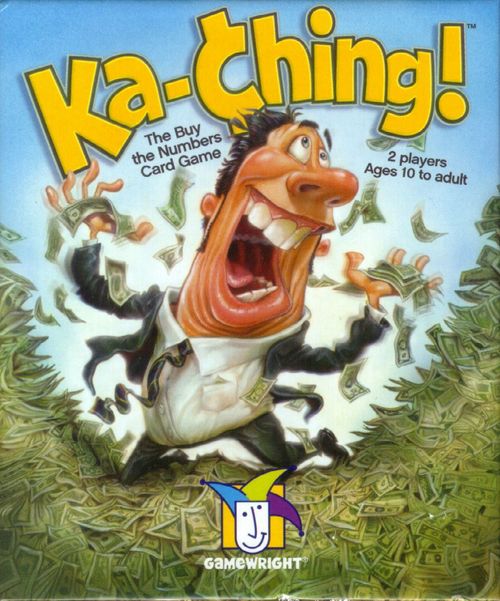
Ka-Ching!
Ka-Ching! Rulebook
Table of Contents
Table of Contents
Contents
- 35 stock cards divided into 5 colors
- 29 money cards with the values: $1 (10 cards), $2 (5), $5 (6), and $10 (8)
- 2 wild cards
Object
Compete against your opponent to make the most money by strategically buying and selling stock cards. Buy cards at face value. Sell two cards of the same color for the multiple of the two card values. Try to sell cards for as high a gain as possible and at the same time prevent your opponent from doing the same. The player with the most money at the end wins.
Set Up
- Separate the deck into two piles by card back.
- Remove the two multi-colored wild cards and place one face up in front of each player.
- Shuffle the 35 stock cards (grey back) and lay them out face up in the middle of the playing area in five columns of seven cards. The cards should overlap each other like shingles, with the numbers clearly visible.
- Deal each player money cards totaling $20 (5 x $1, 1 x $5, and 1 x $10). Keep money cards hidden in your hand throughout the game.
- Sort the remaining money cards according to value to form the bank and place them within easy reach of both players.
Sample starting layout: five columns of seven overlapping stock cards, a wild card at each end, and the bank of money cards below.
How to Play
The person who got paid most recently starts the game and play alternates between players. On your turn you can either:
- Buy the last unobstructed stock card from any column.
OR
- Sell two stock cards of the same color from your collection.
You MUST take one of these two actions every turn.
Buy One Stock Card
You may only buy the last unobstructed stock card from any column. (See illustration for example.) The cost of a stock corresponds to the value printed on the card. (i.e., A card with a value 5 costs $5.) Select a stock card and place it face up in front of you. Then pay the equivalent money to the bank. Put currency into corresponding piles and make change if you don't have the exact amount.
Note: Purchased cards always remain face up in front of you so that both players can see who owns what.
Sell Two Cards of the Same Color
You may only sell two cards of the same color per turn from your collection. The sale price is calculated by multiplying the two card values. Select the two cards you are selling, announce the sale price, and collect the money from the bank. Place the sold stock cards face down in a discard pile out of play.
Example: If you sell a red 4 and a red 5, you receive 4 x 5 = $20 from the bank. (You only paid 4 + 5 = $9, thus you make a gain of $11.)
Using Your Wild Card
You may sell your 2 wild card along with any one colored stock card that you bought, but you may do this only once during the game. Example: If you sell your 2 wild and a yellow 3, then you get 2 x 3 = $6. Place both cards in the discard pile.
Ending the Game
The game ends as soon as there are only two columns of cards left in play. When this happens, each player gets one last chance to sell two stock cards of the same color, if possible. (Any extra stock cards left in possession are worthless.) Count your money and compare totals. The player with the most money wins.
Variations
- Play an odd number of rounds (suggested three or five). First player to win a majority wins the game. Alternate starting players each round.
- Set a certain number of rounds before playing. Write down each player's money total at the end of each round. The player with the highest total profit at the end of the last round wins. Alternate starting players each round.
A Word from Gamewright
"Ka-ching!" ranks in our book as one of the best two-player card games we have ever seen. It is super easy to learn, plays quickly and yet offers endless opportunities for strategic challenge. It's also the first card game we've published that emphasizes multiplication as a skill. There are many subtle strategies that you will learn as you play, but here's one to get you started: Try to force your opponent into buying a card in order to uncover one that you need.
Game by Klaus Palesch and Horst-Rainer Rösner Illustrations by Gary Locke