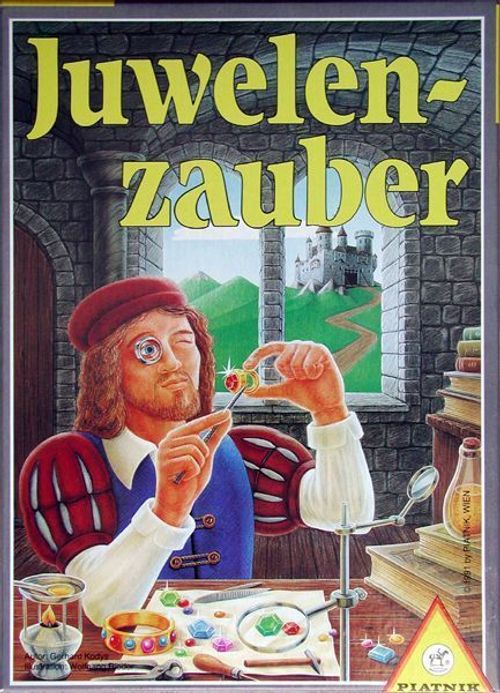
Juwelenzauber
Juwelenzauber Rulebook
Table of Contents
Table of Contents
Components
- 36 jewel tiles (each with 1, 2, 3, 4, 5 or 6 settings)
- 40 gemstone tokens in each of four colours: RED (ruby), BLUE (sapphire), YELLOW (topaz) and GREEN (emerald)
- 1 pawn
I. Rules for 2 to 4 Players
Object of the Game
Each player tries to direct the pawn so that, at the end of the game, they hold the greatest number of settings (spaces) on the most precious jewels (tiles).
Setup
The 36 jewel tiles are shuffled. They are then laid out in a checkerboard pattern as follows:
- 2 players: 16 tiles, in 4 columns of 4.
- 3 players: 25 tiles, in 5 columns of 5.
- 4 players: 36 tiles, in 6 columns of 6.
The tiles laid out in this way form the playing area. The remaining tiles (when playing with 2 or 3 players) are set aside; they are not needed again.
Each player receives all the gemstone tokens of one colour, and the pawn is placed beside the playing area.
Course of the Game
The youngest player begins by placing the pawn on any tile. Since play follows the clockwise principle, it is the player to the left of the youngest who starts.
The pawn may only be moved along a column or a row, like a rook in chess, and never diagonally. It may be moved as many spaces as the player wishes, but the pawn may not return to the tile it occupied on the previous position.
Example 1 (printed rules, page 2). The first diagram is labelled "Position of the pawn given by the youngest player". The shaded tiles are those where the next player may place the pawn: "Given the position of the pawn: tiles where it may be placed." The smiling-face pawn is labelled "Pawn placed by the 1st player (represents the last position for player no. 2)".
The second diagram is labelled "Last position of the pawn". It shows filled settings (black dots), empty settings (open circles) and the shaded tiles where the pawn may move.
After a move, the player must place one gemstone token (of their colour) into one of the settings of the jewel on the tile the pawn now occupies. This placement is made after the move has been played, and it is compulsory.
A player may not decline this placement, nor may they move the pawn onto a tile that is already completely occupied.
Example 2 (page 2 of the printed rules, lower diagram): the tiles shaded in grey show the possible moves. The tile with 1 setting and the tile with 5 settings are already complete, so they cannot be entered. Each filled setting is shown as a black dot, each empty setting as an open circle, and the pawn is shown as a smiling face.
Bonus turn. If a player fills the last empty setting of a jewel tile, they receive a bonus: they may take another turn. (Naturally, a player who fills a tile that has only one setting also receives this bonus.)
However, if a player completes a further tile during that bonus turn, they may not take yet another bonus.
Scoring
A player wins all the points of a tile if, on that tile, they have placed a relative majority of tokens.
Relative majority means that the player has placed one more token than each of their opponents on that tile. (See the examples below.)
If, at the time of scoring, some settings on a tile are still empty, they are considered to belong to an additional player, called "X". On a tile with 6 settings, it is not enough to have one token when all the other settings are empty!
The diagrams on page 3 of the printed rules illustrate this, with the tiles numbered 1 to 3:
- Example 1. On a jewel tile with 2 settings (earrings = 2 settings), there is one gemstone of player 'A' and one gemstone of player 'B'. The jewel is neutralised and counts for nobody.
- Example 2. On a jewel tile with 4 settings (bracelet = 4 settings), there are 2 gemstones of 'C', 1 gemstone of 'B' and 1 empty setting. The 4 points count for 'C', because 'C' has one gemstone more than 'B' and more than 'X' (the empty setting). (Relative majority.)
- Example 3. On a jewel tile with 5 settings (tiara = 5 settings), there are 3 gemstones of player 'B', 1 gemstone of player 'D' and 1 empty setting. Player 'B' takes the 5 points of the tiara, since 'B' has the majority.
End of the Game
The game ends when a player can no longer move the pawn, because every jewel tile on which it could move is completely occupied.
Each player takes the tiles on which they hold the majority of settings. Tiles that are neutralised (that is, tiles on which no player has the majority) are set aside.
The points are counted and the winner is the player with the most points. (See the example below.)
Example of final scoring (page 4 of the printed rules). The printed example uses a 4x4 layout of 16 jewel tiles, with the settings marked A and B for each player. Player 'A' scores a final total of 17 points (6 + 3 + 6 + 2). Player 'B' scores 15 points (4 + 5 + 2 + 3 + 1). The other tiles are neutralised (24 points) and count for neither player. Player 'A' is therefore the winner.
Tactical Advice
- Keep in mind that jewels with an odd number of settings are the easiest to win. (For a jewel with 4 settings you need to win 3 of them, exactly as with the jewel with 5.)
- Use the chances of a double move as often as possible, because it often happens that in this way you win two jewels in one move.
- Sometimes it can be more advantageous to neutralise a tile, that is, to arrange matters so that it belongs to nobody.
- Finally, do not neglect the possibility of deliberately putting yourself in a position where you cannot move, in order to end the game to your advantage.
II. Rules for 1 Player
Object of the Game
The player tries to fill all the settings of the exposed jewels (tiles laid out in a checkerboard). The player wins if they manage to fill them without becoming trapped, that is, without being unable to move the pawn any further.
Setup
In the basic version, the player lays out 16 jewel tiles in a checkerboard (4 x 4), as in the 2-player game. The game remains interesting because of the large number of possible situations.
An experienced player may set themselves challenges at will: the layout of the 3- or 4-player game, or tiles arranged in rectangles (3 x 5, 4 x 6, and so on).
Course of the Game
The movement rules are the same as in the 2 to 4 player game. Naturally, the counting of points becomes superfluous. The object of the game is reached as soon as the last setting has been covered with a gemstone.
If the player becomes trapped and can no longer move before reaching this object, they have lost. However, the player may compare their own results from one game to the next: the fewer settings left to fill, the better the result.