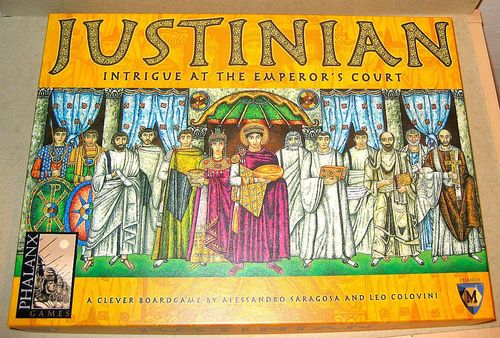
Justinian: Intrigue at the Emperor's Court
Justinian: Intrigue at the Emperor's Court Rulebook
Table of Contents
Table of Contents
2.0 Components
Each copy of Justinian contains:
- 1 game board (representing Justinian's court)
- 1 combined scoring and game phase card
- 12 character tiles (representing Justinian's counselors—numbered 1 to 12)
- 48 character cards numbered 1 to 12 (4 sets in 4 colors—numbered 1 to 12)
- 4 sets of 22 influence tokens (in 4 player colors)
- 8 scoring markers (2 each per player)
- 1 game phase token
- 4 player screens
- 1 rules booklet
2.1 The Game Board
The game board shows the court of the emperor Justinian. Place the 12 character tiles on the board to show the position of each counselor. You can use your influence tokens to try to move the tiles to increase your score when a scoring round begins. The numbers printed on the game board show the possible victory points that each counselor can award. At the top of the game board, above the tiles, is a space for placing your influence tokens. Each character tile is assigned a different space.
2.2 The Combined Scoring and Game Phase Card
You play the game in three phases. Each phase ends with a special scoring round. The current game phase is marked with the game phase token (see 2.7) on the game phase card. During the game, you may place influence tokens here to trigger a scoring round.
As you earn victory points, they are recorded on the scoring card.
2.3 The Character Tiles
The character tiles are placed in a row on the game board. Each tile has three holes that show the victory points that character will award during a scoring round. The more influence the character has in court (the farther the tile moves to the right), the more victory points will be awarded. If a character loses prestige (moves to the left on the game board), fewer points are awarded. At the end of the first game phase, the score awarded is shown in the top hole. At the end of the second phase, the middle hole is used, and at the end of the third phase, the bottom one.
2.4 The Character Cards
Justinian includes a deck of 48 cards. They represent the characters at court and correspond to the character tiles (see 2.3). At the start of the game you will receive cards from all four colors. During the game, you will try to increase the prestige of these characters.
2.5 The Influence Tokens
Each player receives a set of 22 influence tokens. These tokens are numbered 1 to 3 in either black or red (5 tokens of value 1, 4 tokens of value 2, 2 tokens of value 3 in each color). Black numbers are "positive" whereas red numbers are "negative." You may place your influence tokens on the game board to attempt to change the ranking of a counselor, or on the game phase card to influence scoring.
2.6 The Scoring Markers
You can track your victory points on the scoring card using your scoring markers. If you earn more than 100 points, place the second marker with the "100" side up in front of you. If you collect more than 200 points, simply turn the marker over to the "200" side.
2.7 The Game Phase Pawn
The game phase pawn marks the current game phase on the game phase card.
2.8 The Player Screens
Use your player screen to hide your influence tokens from the other players.
3.0 Starting Play
- Place the game board in the middle of the table. Put the combined scoring and game phase card next to the board.
- Now place the 12 character tiles face up on the game board. Place them in numerical order in a row, starting with character number 1 on the left and going to character 12 on the right.
- Each player chooses a color and takes all 22 influence tokens, both scoring tokens, and the player screen of that color. Place your "100/200" scoring marker next to the scoring card, and place your other scoring marker on the "0" space of the victory point chart.
- Mix completely all 22 of your influence tokens face down in front of your screen. Then, randomly draw 10 influence tokens and put them behind your screen face up (so you can see which numbers you have available). The other 12 tokens remain face down in front of your screen as a reserve.
- Divide the character cards into four piles by color. Shuffle each pile separately and deal 2 cards from each stack to each player, face down. The remaining cards are placed beside the board to form four draw piles (one of each color). Important: If you are playing with 2 players, each player is dealt 3 character cards per color instead of 2 (see 6.0).
- Place the game phase pawn in the "1" space of the game phase card.
- Randomly select a starting player, who will play first during the first game turn.
4.0 General Course of Play
Justinian is played in 3 game phases. At the end of each phase, one of the 4 colors will award victory points in a special scoring round. During each phase one or more game turns are played. A game turn consists of a number of player turns. During each player turn, that player will have an opportunity to place an influence token on the game board or game phase card.
4.1 A Game Turn
Beginning with the starting player and proceeding clockwise, each player takes player turns. During your turn, you place one token face down. You can play your token on any one of the spaces on the game board, or in the space for the current phase on the game phase chart.
If you do not want (or cannot) place an influence token on your player turn, you must pass for the rest of the game turn. When you pass, randomly choose 2 new influence tokens from your reserve and place them face up behind your screen.
Any other players who have not yet passed continue to play the current game turn. A game turn continues with unlimited player turns until all players have passed and each has drawn 2 new tokens.
Limitations:
- A maximum of 3 influence tokens (regardless of the color) can be placed on a single character.
- If all other players have passed, you may continue to play as many influence tokens on the game board as you choose (observing 1 above), but you may only place 1 more token on the game phase card during the current game turn.
- Once you have passed for a game turn, you cannot reenter play until the next game turn.
Important: You may always look at your own face down influence tokens on the game board and the game phase card.
Once all players have passed, the game turn is over. Each influence token on the game board is turned face up and moved onto the appropriate character tile.
Now the new character order is determined. The player who passed last during the game turn chooses to start from the left side or from the right side of the game board.
The influence tokens from all players on a character form one sum—black numbers are positive, red numbers are negative. If the sum is positive, the character moves towards the right on the game board. If it is negative, the character moves left. In either case, the number of positions moved is equal to the sum of the influence tokens, and any characters moved over are shifted in the opposite direction one space to make room for the moving character. A character moving right increases his prestige, and thus awards more points to a player during a scoring round.
After a character has been moved, return the influence tokens on that tile to the box. They have no further effect on play.
Examples:
- The player chooses to start from the left and continue to the right.
- There is a black 2 on the character Basilius (4), therefore he moves up two steps to the right and the two characters formerly in front of him are each moved one step to the left to make room.
- There are 2 tokens (a red 2 and a black 1) on character Giulianus (7). The sum of these two tokens is -1. He is moved one step to the left.
Important: Note that choosing to start from the left or from the right can be very important! It can greatly affect the movement of characters later in the order. In the example above, if the direction had been from right to left, the character rankings would look like this:
The player who passed last during the game turn becomes the new starting player in the next game turn. If there is no scoring round (see 4.2), a new game turn in the current game phase begins, with players again taking turns placing influence tokens in turn order.
4.2 Scoring Rounds
4.2.1 Starting a Scoring Round
During the game turn, you may place influence tokens on the game phase card. At the end of the turn, you may be able to trigger a scoring round. Each phase has a minimum number of influence points you must play in order to trigger a scoring. In the first phase, the minimum is 5 points. In the second, 9 points are needed, and in the third 12 points.
Important: The color of an influence token does not matter when it is played on the game phase card. All numbers are "positive" and are added together.
Example: A black 2 and a red 3 are 5 points.
At the end of the game turn (after the characters have been moved) you may have a chance to trigger a scoring round:
- Starting with the player who passed last, each player may choose to trigger a scoring round (if you have enough influence on the game phase card).
- If the last player to pass does not (or cannot) trigger a scoring round, each player in turn may choose to do so, until all players have passed, or a scoring round has been triggered.
If you trigger a scoring round:
- Turn your influence tokens face up. If you have at least the minimum number of influence points required, a scoring round is triggered.
- Turn all the influence tokens on the game phase card face up.
- The player who has the most total points of influence (not number of tokens) on the game phase card now chooses which color will score points this phase.
- If there is a tie for the most influence, the choice is made by the tied player closest (clockwise) to the player who passed last that turn.
- All other players score victory points equal to the sum of their influence tokens on the game phase card.
- Victory points are scored for the characters matching the cards in each player's hands.
You are never required to trigger a scoring round, even if you have enough influence to do so.
If you discover that you do not have the minimum required influence after turning your tokens face up, then you cannot trigger a scoring round and your tokens are turned face down again.
If a scoring round is not triggered another game turn in the same phase begins (see 4.1).
4.2.2 Scoring Points
When a scoring round begins, all influence tokens on the game phase card are turned face up. Each player except the player who chose the scoring color receives a number of victory points equal to the total influence points he had on the game phase card. Then all tokens on the game phase card are returned to the box.
Example: At the end of phase 1 player A has placed 5 points (a black 3 and a red 2), player B 8 points (a black 3, red 3 and black 2), player C 1 point (a red 1), and player D no tokens (0 points). Player B has the right to choose which color to score. Player A gets 5 victory points, and player C earns 1 point.
After the scoring color has been chosen, each player turns up both of his character cards that match that color and receives victory points for them.
A reminder: In a 2 player-game each player turns up all 3 cards of the appropriate color (see 6.0).
Every character tile has 3 holes. The number showing through one of the holes on the tile is the number of victory points you earn if your character card matches that character. In the first phase you score the points showing in the top holes; in the second phase use the center holes; and in the third phase the bottom holes on the character tiles determines your score.
Example: At the end of phase 2 player A has character cards for Belisarius (2) in the 7th spot and Niceforus (10) in the 9th spot in the scoring color. Belisarius scores 32 points and Niceforus 25 points. Player A scores a total of 57 points.
Hint: The farther to the right a character advances from his original position, the more victory points he will award. The farther to the left he moves the fewer victory points he will be worth.
At the end of the phase add up your points: the score of your 2 characters and any points you earned for tokens you placed on the game phase card. These points are marked on the scoring card with the scoring markers. If your total victory points are more than 100 or 200 points, take your second scoring marker and place it, appropriate side face up, in front of you as a reminder.
All character cards that match the color just scored are removed from play and returned to the game box.
Important: All used influence tokens are discarded, and they cannot be used again during the game. If you have played all of your tokens, you cannot influence the outcome of the game anymore!
If all players have played all their tokens before the end of the third game phase and no one has triggered a scoring round, then there is still a final scoring round. The player with the most points on the game phase card chooses the scoring color as normal (in case of a tie, the player closest to the player that passed last in the final game turn chooses the color). The game then ends.
Note: In certain rare cases, the game can end with fewer than three scoring rounds (because all players have played all their influence tokens during the first or second game phase).
4.3 Exchanging a Character
After victory points are awarded from a scoring round, and before the next phase begins, each player has an option to exchange one of his character cards, starting with the player who passed last that game turn. You may discard any character card in your hand to the bottom of the same color deck and draw the top card as a replacement.
Hint: If you don't think that you will be able to increase the prestige of the character on your card, you might want to replace it, hoping to get a higher counselor.
Discarded character cards are placed at the bottom of the matching deck, and may reenter the game later.
5.0 Winning the Game
The game ends once the scoring round of the third game phase is complete, or once all of the players are out of influence tokens and the final scoring round is complete. At this point, the player with the highest victory point total is the winner!
Important: Remember that only 3 of the 4 colors in the game will score points!
6.0 Special Rules for 2 Player Games
If you are playing a 2 player-game of Justinian, each player receives 3 character cards of each color instead of 2 (see 3.0). During a scoring round, all 6 characters of the chosen color are scored.