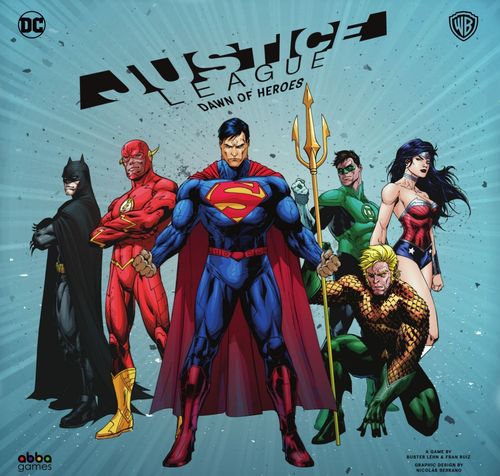
Justice League: Dawn of Heroes
Justice League: Dawn of Heroes Rulebook
Table of Contents
Table of Contents
Components
Scenery
- 6 game boards.
- 2 large building/rock tiles.
- 2 small building/rock tiles.
- 7 small scenery elements: (containers/energy weapon/files/spear/portals/mother boxes/Metallo).
- 6 traps y 6 decoys.
- 1 bridge.
- 4 car/wooden log - container tiles.
Character tokens
- 4 supervillain miniatures.
- 6 superhero miniatures.
- 7 superhero ally tokens.
- 8 villain tokens.
- 12 bystander/jokerified tokens.
- 1 bystander/Harley Quinn token.
- 18 henchmen tokens.
- 10 Parademon tokens. (Fast & slow).
- 1 bystander/Gorilla Grodd token.
- 1 Ally of Light token.
Character sheets
- 6 hero sheets.
- 4 supervillain sheets.
- 8 villain sheets.
- 3 henchmen sheets. (A, B, & C)
- 7 allied heroes' sheets.
- 2 Parademon sheets.
Cards
- 12 Batman cards.
- 12 Green Lantern cards.
- 12 "Ace up your sleeve" cards.
- 11 "Plan" cards.
- 6 victory cards.
Dice
- 4 6-sided dice (faces 1-3).
Damage tokens
- 16x 1 damage tokens.
- 8x 3 damage tokens.
- 8x 5 damage tokens.
- 6x 10 damage tokens.
Assorted tokens
- 1 Atlas defense token, 1 energy field defense token, 10x broken wall tokens, 1x Hawkman's defense.
- 11x initiative tokens.
- 8 Wall of Light cubes.
- 4x immobilized tokens, 2x "+1" die tokens, 4x "+4" attack tokens, 1x Jokerified skill token.
- 8 wall trap cubes.
- 12x The Flash energy tokens.
- 12x Aquaman energy tokens.
- 1 round track.
Books
- 1 tutorial book.
- 1 rulebook.
- 1 mission book.
- 1 interaction sheet.
General Structure
The game is divided into various missions, each with 2-4 playable chapters, including a final battle.
At the start of the game, the players decide which mission they want to play and set up the board following the instructions in the mission book, starting with the first chapter.
The players then decide who will play in the hero team and who will be the villains.
There can be a maximum of 4 players playing as heroes and 2 players playing as villains (we recommend that more experienced players control the villains).
The heroes choose which characters will take part on the mission, and will play with those characters for the entire mission.
The villains will take the characters indicated in the setup for each chapter, usually changing characters for each chapter, as indicated in the mission book.
Each chapter is divided into rounds, during which players will take turns to perform actions with their characters, trying to achieve the mission's goals.
Each team has different goals and the winning team of each chapter will receive special benefits for the final battle, such as secondary characters to help the team, special actions, etc., as indicated in the mission book.
Setup
- Choose a mission from the mission book.
- Each player on the hero team chooses a character, receives that character's sheet and token and places them on the board. Depending on the character, they might need to take tokens or cards that relate to the character.
- Players playing as "villains" will use the characters indicated in the mission book, and choose a "plan" card from the ones available for that chapter. They should take the character sheets and tokens needed, and the miniatures and tokens for the members of their team for the chapter to be played. They also need to shuffle the "Ace up your sleeve" deck of cards, from which they draw one card before starting the game.
- Set up the map boards in the center of the table using the tiles indicated, positioning them as indicated in the chapter.
- Next, put all of the scenery elements indicated in place. To do this, choose who will begin using your preferred method, and then both teams will take turns putting elements in place one by one (we recommend using the distribution recommended for the first games on each mission). Unless the chapter states otherwise, there are no restrictions or limits as to where scenery elements can be positioned, except for the starting squares of each team
- If there are other elements that need to be put on the board (bystanders, hidden characters, game targets, etc.), do it now, following the instructions in the mission book.
- Leave the damage, turn and broken wall tokens close to the board. Each player on the hero team receives two damage tokens for the injury track on each of their characters' sheets.
- Put the miniatures and tokens for the hero and villain teams in the starting positions for each team, as indicated in the set-up for the chapter, starting with the villains.
- Distribute the initiative tokens between the players. Check each character's initiative, and the one with the highest initiative gets the token numbered 1, the second gets token 2, etc. The player with token 1 will be the first to act every round and so on.
- Finally, leave the round track near the board, and place the round marker in the position indicated in the mission book.
How to Play?
Each character has a character sheet indicating what they can do during their turn.
All characters have basic initiative, life, movement and attack values. Each character also has a set of special skills, such as ranged attacks, additional movements or defenses that can be used during their turn.
On their turn, each character can carry out a movement and a basic action and, in some cases, additional actions.
To represent the variety of powers of the different characters, the control mechanics of each character is different from the others. In short, there are three different control systems; dice, cards and tokens.
Dice
Superman, Wonder Woman and the villains are controlled using dice. These dice will determine the effectiveness of attacks and the actions of the character. The sum of the dice will determine the final value of an attack or defense and thus the damage inflicted. Each die has 2 faces with values 1, 2 and 3.
Cards
Batman and Green Lantern use cards to represent the light constructs or the gadgets of these characters. Each of them will have a unique deck of 12 cards. At the beginning of the chapter, they draw 5 cards, and one additional card at the start of each of their turns. These cards represent various effects and actions (see Batman and Green Lantern).
All cards have two effects, a battle effect and an action effect. When playing a card, the player will have to decide whether to apply the damage of the battle effect or use the action, but not both. After playing a card, discard it forming a discard pile.
In both cases, the limit of cards in hand is 5; if a player reaches the limit, they are not allowed to draw any more cards.
If attacking an adjacent enemy, the basic attack value indicated for the character is added to the attack value of the cards (see Attack).
Tokens
The Flash and Aquaman use tokens that represent the energy of the characters. Depending on the actions they want to perform, the character uses up this energy. This can lead to that character being very limited in the actions they can perform.
Like card-controlled heroes, the basic attack value of the character is added to the attack value of the token, if attacking an adjacent enemy.
Character Sheet
Initiative
The initiative determines the order in which characters will take their turns each round. The higher the value, the sooner the character takes their turn. If two characters on different teams have the same initiative value, the villains always have their turn first. If two characters on the same team have the same initiative value, the players themselves will decide each turn which of them will go first.
When they finish their turns, the players must flip their initiative token to mark they have finished their turn.
Once all characters have taken their turn, advance the round marker 1 position to indicate that a new rounds starts, and all players flip their initiative tokens back.
Life
Every character has a pre-established life value, as indicated on their character sheets. If a character gets as many damage points as their life value, they are knocked out:
Knocked-out characters: If a character, hero or villain, is knocked out, lay the character's token flat on the square it ends up in after the attack (if there was a pushing attack, move the knocked out character as many spaces as needed).
If the knocked-out character is a member of the hero team, the villains draw an "Ace up your sleeve" card.
A knocked-out character can recover and return to the game if an ally moves to an adjacent square and does one of the two actions detailed below:
- Using an attack: characters may sacrifice their attack to aid recovering a knocked-out ally located in an adjacent square. Put the knocked-out character back up in the square it is in. This character returns almost completely healed, with only 3 damage points.
- Not using an attack: A character may aid recovering a fallen ally located in an adjacent square without the need to sacrifice their attack. In this case, the fallen character returns with damage points equal to half of their total life value (rounded up)
A fallen hero (main heroes or their allies) will recover on their own if they lose a full turn without playing. The hero recovers on their next turn with half their life points (rounding up).
Henchmen & Parademons: Henchemen & Parademons do not recover normally. The mission book indicates if these characters recover or not. If they recover after being knocked-out, they will return to the space indicated in the mission book. In both cases they can aid other villains normally.
IMPORTANT: During the final battle of each mission, characters cannot recover.
A knocked-out character can act the same turn it recovers.
Movement
This attribute indicates how many squares a character can move. Move the character from their current square to an adjacent one in any direction, paying 1 movement point
When moving, a character may find obstacles or terrains that affect the movement value (check Board and Scenery). When moving, a character may come up against a space occupied by other characters on the board, both allies and enemies. A character can move through a space occupied by an ally that is not engaged in battle, provided that they do not end their movement in the same square. If it is an enemy, a character cannot move through the space, and must engage in combat with the enemy. Also, if 2 allied characters are in adjacent squares, moving between them is not allowed under any circumstances, including super speed or jumping.
SPRINT: Additionally, all characters have a sprint capability, allowing them to add 2 points to their movement, by sacrificing any other action on that turn, including playing cards or tokens.
JUMP: There is a second type of movement, the jump, which is an unrestricted movement, which ignores engaging in combat and terrain modifiers. A character may include their jump actions into their movement whenever they want.
Attack
When making an attack, this attribute needs to be checked. Choose an enemy adjacent to your character and apply the final attack value as damage points. If the enemy uses a defense, discount the defense value from the attack value, and apply the result as the damage points.
In some cases, this attribute may have additional symbols; these symbols indicate special skills, such as distributing the damage between enemies, pushing enemies or disengaging from battle (see Battle Skills). Depending on the character and their control system, the way we apply an attack value will vary
Attacking with dice: Roll as many dice as indicated on the character sheet, add them up and add on any bonuses, if there are any. The result of this sum will be the final attack value.
Eg: Superman has a 3-dice attack +5. When making his attack, he rolls two 2s and a 1, meaning the final attack value would be 10 points (2+2+1+5=10).
Attacking with cards: play up to 2 attack cards and add their values; if the attack is on an enemy adjacent to the character, add the basic attack value of the character as well. The result will be the final attack value.
Eg: Batman has a basic attack value of 3 points. When attacking an adjacent enemy, he plays 2 cards, one with 3 batarangs and the other with 3 punches, giving an attack value of 9 points (3 batarangs + 3 punches + 3 basic attack value = 9).
Attacking with tokens: these characters may use their basic attack value and can use tokens to strengthen attacks.
Eg: The Flash has a basic attack value of 2 damage points, and he may spend up to 6 energy tokens to add another 8 points, for a possible total of 10 damage points. Aquaman can use 2 tokens for a total value of 11 damage points.
Battle Skills
Characters may have special battle skills. These skills are optional, and in all circumstances you will have to announce that you will use the skill before calculating the attack value.
Push: Push the enemy, in a straight line, as many squares as indicated by the attack, or in the case of dice-controlled attacks, as many squares as the lowest die rolled. If the attack is not with dice, or if the push is an action, the skill or attack will indicate how many squares it pushes the enemy back.
Eg: Wonder Woman attacks a villain and rolls a 1, 2 & 3 on the dice; she pushes the villain back one space, because the lowest die rolled is a 1.
If two characters collide as a result of this, the pushed character stops being pushed back, and both characters receive 1 damage point.
If a ranged attack pushes a character, but the characters (attacker and defender) are not in a straight line, the pushed character is pushed diagonally in relation to the attacker.
Warrior master: A warrior master can distribute damage between adjacent enemies. A player can assign the total damage value between all of the enemies surrounding the character as they want.
Martial artist: This skill allows the character to jump back from an enemy, disengaging from combat. This jump is made to one of the 3 spaces facing the enemy concerned.
Ranged Attacks
Some characters can make ranged attacks. In this case, apply the attack value to the enemy located within range of the attack. The range of an attack is indicated together with the value of an attack, in a target, the number of which indicates the maximum range in squares of an attack.
Count the squares from the position of the attacker to the position of the target in any direction, and, if it is within range, apply the total damage points like any other attack (ranged attacks can also be defended).
Before making a ranged attack, check that there is a clear line of sight from the center of the attacker's square to the center of the target square; if that line touches or crosses any other object on the board (characters, scenery, etc.) there is no line of sight. Knocked-out characters do not block the line of sight.
Characters engaged in combat cannot make ranged attacks to other enemies.
Super Speed
Some characters have super speed, such as The Flash, Superman or Power Girl, allowing them to make additional movements and disengage from combat. The player can choose to use their character's super speed, often instead of attacking. Super speed can be announced either before or at any point during their move. When a character uses super speed, they can move up to 4 additional squares and may not engage in combat until the end of their move; if the character was already engaged in combat, they immediately disengage from combat and may move freely.
Defenses
Some characters may carry out defensive actions during their opponent's turn. To defend from an attack, the player announces that they want to defend and pays for the action as required (tokens or cards). Discount the defense value from the final attack value. In the case of Wonder Woman, Lex Luthor and Hawkman, defense is an action that they must select during their active turn, and is applied against any enemy attack until their next turn.
Immobilize
In some exceptional cases, characters may use actions to immobilize an enemy for 1 turn. An immobilized character is unable to move under any circumstances, and cannot engage in combat, but they can carry out other actions, such as attacking. Put an immobilized token on the character's sheet or token. After that character's next turn, take back the immobilized token. All characters capable of immobilizing receive 1 immobilized token at the beginning of each chapter, that they can use only once per chapter.
Rescue
On some missions, characters will have to carry citizens from one place on the board to another. All characters can carry a maximum of 1 citizen, at a cost of -1 movement point. When carrying a citizen, put the character's token over the citizen's token. When moving that character, move both tokens together in a pile, remembering that the character will only be able to move one square less than usual. The character WILL NOT recover the movement point on the turn that they drop the citizen off. If a character carrying a citizen is attacked, the character will lose the citizen, who will be placed in a square adjacent to the character (chosen by the attacked player). Spend 1 movement point to take a citizen off the board.
Characters
There are several different characters on each team. In this section, we will look at the characteristics of the main heroes and villains, some of whom will require further explanation than that given in these rules:
Superman
Superman is controlled using dice, so the effectiveness of most of his skills is determined by the roll of a dice.
Superman has 24 life points, a basic movement value of 4 squares, and the skills detailed below. He can perform one of these skills each turn:
- Basic attack: To determine the effect of this attack, roll 3 dice and add up the results. Add an additional 5 damage points to the resulting value. The final value will be the amount of damage points inflicted by Superman with this attack. He is also able to push back his enemies as many spaces as the lowest dice rolled, if he announces his intention to do so before rolling the dice.
- Super speed: Super speed is the same for all characters. Add 4 points to the character's basic movement value, and move as many squares as you want within that maximum. In addition, super speed disengages from combat and prevents the character from being engaged in combat until the end of their move.
- Heat vision: This is a ranged energy attack, with a range of 4 squares and a damage of 1 die, to which we add 4 points to calculate the damage value.
- Super breath: Superman can use his powerful lungs to push other characters located up to 3 spaces away. To do this, roll the dice and add 2 to the result. Move the target as many squares as the result of the roll, always in a straight line in the same direction as the super-breath
- Healing: Superman recovers 4 damage points at the start of each of his turns.
Wonder Woman
Like Superman, she is controlled using dice. Wonder Woman has 22 life points, a movement value of 4 and the skills detailed below. She can perform one of these skills each turn:
- Basic attack: Roll 3 dice and add 4 points to the result to determine the effectiveness of the attack. Her attacks can also push opponents back, if she announces her intention to do so before rolling the dice. She is also a martial artist and a warrior master, so, in the same way, she can decide to jump back one square after making an attack and/or distribute damage points between the enemies adjacent to her, if she wants to.
- Atlas defense: Instead of making an attack, Wonder Woman can go into a defensive position, so that, on her enemy's turn, she will be able to defend incoming attacks by rolling 2 dice and subtracting the result from the attack value. In addition, Wonder Woman cannot be pushed when in the defensive position. To indicate this skill, put a defense token on Wonder Woman's character sheet, and remove it at the start of her next turn.
- Lasso of Truth: Wonder Woman can use her lasso to bring enemies closer to her position, or to get closer to their position. Instead of attacking, she may lasso an enemy up to 3 squares away, either to bring them to an adjacent square, or to move herself adjacent to the enemy. The enemy will also receive 1 die plus 2 damage points for this action.
- Healing: Wonder Woman recovers 3 damage points at the start of each of her turns.
Aquaman
Gets 5 energy tokens at the start of each chapter, and an additional token at the start of each turn. Aquaman has 20 life points, a movement value of 4 and a basic attack of 3 points.
On his turn, Aquaman can reinforce his actions by spending energy tokens, as many times as he can or wants to pay. The only limit to this is that he cannot use the same skill more than twice each turn (e.g. jumping or making a ranged attack more than twice in one turn). Aquaman can also defend himself on the enemies' turns, with no restrictions:
- Trident: By spending one token, Aquaman can use his trident to add 4 damage points to his basic attack. This attack also pushes the enemy back one square. If Aquaman does this action twice in one turn, it will add another 4 damage points to the attack, making a total of 11 damage points. However, the enemy will only be pushed back one square, even if the action is done twice.
- Sea shot: Aquaman can also spend 1 energy token to make a ranged attack up to a distance of 4 squares, causing 3 damage point. In this case, do not add Aquaman's basic attack value, unless the attack is on an enemy in an adjacent square.
- Jump: Aquaman can use his incredible jumping skills as an action. By spending 1 token, he can jump two additional squares with no movement restrictions; i.e. he does not have to engage in combat and is not affected by terrains.
- Defense: During the enemies' turns, Aquaman can spend tokens to reduce the strength of an attack by 3 points per token spent.
- Healing: Aquaman recovers 1 damage point per turn.
- Tokens: Aquaman receives 5 tokens at the start of each chapter, and gets an additional token every turn.
- Swimming speed: If Aquaman touches a water square during his movement, immediately add 2 extra movement points for that turn. This can only happen once per turn. (see Water)
The Flash
The Flash has 12 energy tokens to spend on his different actions. The Flash has 15 life points, a movement of 6 squares and a basic attack of 2 damage points. The Flash spends his tokens during his turn, with a limit of 6 tokens per turn (this limit does not apply to defensive actions).
- Super speed: Spend 3 tokens to use super speed, which is the same for all characters. Add 4 points to the character's basic movement value, and move as many squares as you want within that maximum. In addition, super speed disengages from combat and prevents the character from being engaged in combat until the end of their move.
- Vibration: The Flash can vibrate at such amazing speed that he can phase through walls (see Buildings). By spending 1 energy token, The Flash can phase through as many walls as he wants during his turn, without breaking the walls or using up additional movement points.
- Defense: The Flash can pay 2 tokens to subtract up to 6 damage points from an attack. This action is performed during the opponent's turn and does not affect The Flash's limit of 6 tokens per turn.
- Fist storm: Spend 3 tokens to add 4 damage points to The Flash's basic attack. Given that The Flash could spend up to 6 tokens per turn, the total possible damage for an attack could be 10 damage points, including the 2 points for a basic attack.
- Healing: The Flash recovers 2 damage points per turn.
- Tokens: The Flash starts with 12 tokens at the beginning of the chapter, and earns an additional token at the start of every turn.
Green Lantern
Green Lantern is controlled using cards, so he has a deck of 12 cards, from which cards are drawn every turn. The cards for heroes are divided into two sections: at the top are the attack values of the card, if it is used as an offensive card, and at the bottom a description of the action that you can perform with that card. When playing a card, the player needs to decide whether to use it as an attack card or an action card, but it can never be used for both purposes. Green Lantern has 18 life points, a movement value of 4 squares and a basic attack of 2 damage points. Green Lantern can use a maximum of 2 cards per turn, either as actions or attacks.
Attack cards: There are two possible attacks on cards, close or ranged attacks. In both cases, the icons depicted on the card will indicate the value of the attack, and, in the case of ranged attacks, the number inside the target will also indicate the range of the attack. Green Lantern's ranged attacks can push the enemy 1 space, if he announces it before attacking (one in total despite the number of cards played, like Aquaman's attack). If the attack is made on an adjacent enemy, add Green Lantern's basic attack value as well.
Actions: Green Lantern has several different actions that he can perform, such as defense cards, like the defense sphere or wall of light.
- Wall of light: Put the 4 wall of light cubes in the corners of consecutive squares on the board, forming a line (not necessarily a straight line). At least 1 of the cubes must be up to 3 squares away from Green Lantern. The squares between cubes are now sealed by a wall of light, preventing characters from crossing the wall, close attacks and cutting off lines of sight. At the start of the Green Lantern's next turn, remove the cubes from the board.
- Transport: Green Lantern can transport himself or other characters located up to 3 spaces away. This action ignores lines of sight, although it cannot be done through walls. When performing this action, move the character's token as many spaces as indicated on the card. This is a jump movement, so engaging in combat and the terrains can be ignored.
- Defense Sphere: During the opponent's turn, in exceptional circumstances, Green Lantern can defend himself or other characters. Playing these cards does not affect the normal limit of 2 cards per turn for Green Lantern.
- Ally of Light: With this card, Green Lantern can summon an ally of light in an adjacent square. Once summoned, the ally will take 1 turn right after Green Lantern ends his.
Cards: Green Lantern draws 5 cards from his deck at the beginning of the chapter and 1 additional card every turn. If he already has a full hand of 5 cards, he cannot draw any more cards.
Limit of cards in hand: Green Lantern can have up to 5 cards in hand.
Batman
Batman is controlled using cards. He has a deck of 12 cards that represent his utility belt, with all his gadgets and tools. Batman can play as many cards from his hand as he wants during a turn, the only limitations being that he can only play two attack cards every turn, and not play the same action more than twice per turn. Batman has 16 life points, a movement value of 3 squares and a basic attack of 3 damage points. He is also a martial artist, meaning he can jump one square back after making an attack, and a warrior master, meaning he can distribute damage against all adjacent enemies.
Apart from this, Batman can get through walls without spending extra moves or breaking the wall, as he can always find a hole to get through.
Attack cards: There are two possible attacks on cards, close or ranged attacks. In both cases, the icons depicted on the card will indicate the value of the attack, and, for ranged attacks, the number inside the target will indicate the range of the attack, like other ranged attacks. If the attack is made on an adjacent enemy, add Batman's basic attack value as well.
Actions: There are many different actions Batman can perform on his turn, from defense cards like the Smoke bomb, to support cards, like the Bat-supplies.
- Grapnel: By using the Grapnel, Batman can jump additional spaces on his turn. Movements made with the Grapnel are unrestricted, and are not affected by terrains, engaging in combat and the weight of citizens. Batman can also drag adjacent characters with him, such as other heroes, villains, citizens, etc., for part of or the full Grapnel movement if he wants to.
- Boleadoras: By using this card, Batman can immobilize another character for 1 turn, as long as it is within range of the boleadoras. Put an immobilized token on the sheet or token of the immobilized character to remember this effect (see Immobilize).
- Bat-supplies: By using this card, Batman can ask Alfred to send him additional supplies, meaning he can draw two additional cards from the deck, bearing in mind that he has a limit of 5 cards in hand.
- Smoke bomb: During the enemies' turns, Batman can use this action to defend and subtract damage points from enemy attacks.
- Shoulder throw: By using this card, Batman can push an enemy up to 3 squares away. (see Push).
Cards: Batman draws 5 cards at the start of the chapter and 1 additional card every turn, bearing in mind that there is a limit of 5 cards in hand for Batman.
Card limit: Batman can have up to 5 cards in his hand. Even when an action indicates that you can do so, do not draw any new cards if you already have 5 cards in hand.
Captain Atom
Captain Atom is an ally of the Justice League. He can make a ranged attack, a close attack and is immune to energy attacks, i.e. this kind of attack does not affect him. Energy attacks are those that include the energy icon.
Cyborg
At the start of each chapter, Cyborg receives a portal token. He can use it to open a dimensional portal, allowing him to teleport 3 squares away in any direction. When using the portal, Cyborg can disengage from combat and even move through walls, characters or other objects on the board. This does not count as an action.
Hawkman
Hawkman can choose his defensive action to defend himself from all incoming enemy attacks until his next turn. Place his defense token on his character sheet until the start of his next turn.
Bystanders
Bystanders appear in some chapters of the game. The characters will need to interact with them to achieve their mission goals, as explained in the scenario book. Bystanders do not attack, move or do anything at all. If citizens receive damage by any means, they are knocked out and their token is removed from the board. For rescue missions, use the Rescue rules (see Rescue). For search missions, any character that moves into a square adjacent to a citizen can look at their token and remove it from the board with no action cost; in these missions, citizen tokens represent places to search for and cannot be knocked out by any means.
Interactions
In addition to their individual skills, the heroes are a team, and, as such, they can help each other when they are together on the board (adjacent). Whenever a hero is adjacent to another hero, they receive a bonus to their values.
e.g., any hero adjacent to Green Lantern, receives +1 movement point, as long as they are adjacent to Green Lantern. On the other hand, Superman will give +1 damage points.
For a hero to enjoy this benefit, the action or movement must start while adjacent to the ally. If the hero is knocked-out, the interaction bonus cannot be applied.
Villains
The villain team also has a wide selection of characters, with multiple skills, each of them with their own set of skills and capacities. Just like the heroes, each of them has their own character sheet, detailing their skills. With a few exceptions, the villains' skills and attributes are similar to those of the heroes.
Villains always attack using dice.
Villains also have 2 decks of cards. These cards will add bonuses and additional skills to the characters:
"Plan" Cards (red border): The scenario book tells us what plan cards are available for that chapter. Before starting the game, the villain team must choose one of the cards available for that chapter, by looking at the number in the lower left corner of the "Plan" cards. These cards are lost at the end of the chapter.
"Ace up the sleeve" cards (white border): At the start of each chapter, and every time they knock out a hero, the villain team can draw 1 "Ace up your sleeve" card (only 1 card for the team, even if there are several villain players). These cards give them different benefits, depending on the card, such as additional damage, defenses, healing, etc. The villain team does not need to discard the "Ace up your sleeve" cards at the end of each chapter, and can keep them for later chapters in the same mission. The villain team can use a many cards as they want on their turns.
In both cases, the effects of villains' cards can be immediate, meaning that they will apply the moment the card is played; and they can also be permanent, i.e. they will last until the end of the chapter.
The Joker
The Joker is the terror of Gotham and Batman's nightmare. He has 18 life points, an initiative of 1, a basic attack of 3 damage points and a movement value of 4 squares.
- Surprise punch: With his surprise punch, Joker can make a ranged attack at a distance of 2 squares with a force of 3 dice, which can push his enemy, if The Joker announces his intention to do so before rolling the dice.
- Pogo stick: As an action, Joker can add a jump movement of one square to his movement. This jump is unrestricted, and is not affected by engaging in combat or terrains.
- Bomb: The Joker can throw a small explosive that inflicts 1 die plus 3 damage points on all characters adjacent to the target square on the board (both villains and heroes).
The Joker also receives +2 bonus damage points in all his attacks against Batman.
Lex Luthor
Superman's nemesis, he is always ready with an arsenal of Kryptonite. Lex has 18 life points, an initiative of 9 and a movement of 4 squares.
- Basic attack: Lex Luthor has a basic attack of 2 dice plus 3 damage points and can push, if he announces his intention to do so before attacking.
- Ranged attack: Using his Kryptonite cannons, he can carry out a ranged energy attack that inflicts 2 dice plus 1 damage point on a character up to 4 squares away.
- Energy field: Instead of attacking, Lex Luthor can activate his energy field. Just like Wonder Woman, he can reduce all incoming attacks by 1 die plus 2 damage points, until his next turn. Put the energy field token on Lex's character sheet, and take it back at the start of his next turn.
Additionally, Lex Luthor receives +3 bonus damage points for any attack he makes against Superman.
Darkseid
The leader of the planet Apokolips, he is the reason the Justice League got together in the first place. He has 40 life points, an initiative of 9 and a movement value of 4 squares.
- Basic attack: Darkseid has a basic attack of 3 dice +4 damage points and can push, if he announces his intention to do so before rolling the dice.
- Omega rays: Darkseid can shoot powerful rays from his eyes up to 5 squares away, with an attack value of 2 dice plus 2 damage points. This ranged attack can push, if he announces his intention to do so before rolling the dice and he doesn't need a clear line of sight to hit his target.
- Portal: At the start of each chapter, Darkseid receives a portal token that he can use to open a portal, allowing him to travel up to 3 squares away. Having the ability to teleport, he is not affected by engaging in combat or obstacles in his path.
Doomsday
Doomsday is a special villain and functions slightly differently from other characters. He cannot be pushed, immobilized or engaged in combat. Doomsday's character sheet has 2 sides, when he is used in missions; at the start of the chapter, use side A (marked with asterisks), and side B once he has defeated 1 hero.
Side A: When starting a chapter, Doomsday uses this side and he plays 2 turns per round. He will always have the first turn, regardless of the initiatives on either team. Once the first 2 heroes have taken their turns, Doomsday will have his second turn that round.
- Basic attack: Doomsday's basic attack inflicts 3 dice plus 3 damage points that can push, if he announces his intention to do so before rolling the dice.
- Ranged attack: Inflicts 1 dice plus 3 damage points at a distance of up to 5 squares with this ranged energy attack.
- Area attack: Using this attack, Doomsday inflicts 1 dice plus 3 damage points on all adjacent enemies, and pushes them.
Side B: Once Darkseid knocks out 1 hero, turn his character sheet over. On this side he has an initiative of 1, so he will be the last character to act each round, and he normally only has 1 turn per round.
- Basic attack: Doomsday's basic attack inflicts 4 dice plus 3 damage points that can push, if he announces his intention to do so before rolling the dice.
- Ranged attack: Inflicts 2 dice plus 3 damage points at a distance of up to 5 squares with this ranged energy attack.
- Area attack: With this attack, Doomsday inflicts 2 dice plus 3 damage points on all adjacent enemies, and pushes them.
Bane
Bane's special attribute is that he has an automatic defense of 1 point to be deducted from all incoming attacks.
Black Manta
In addition to his special skills, Black Manta is a fast swimmer, like Aquaman, and so he can move 2 additional spaces, once per turn, if he touches water during his movement.
Captain Cold / Killer Frost
In addition to their normal attacks, once per chapter, Captain Cold and Killer Frost can immobilize a hero for 1 turn by using their special tokens. Captain Cold uses it in a ranged attack, while Killer Frost uses it in close combat.
Solomon Grundy
Solomon Grundy recovers 2 damage points every turn. In addition he can carry out an area attack that affects all adjacent heroes, and pushes them.
Henchmen
When several henchmen, whatever their type, surround a hero (are adjacent to the hero), each of those henchmen will get an additional +1 bonus damage point added to the roll of the dice for their attack. Add only 1 damage point to each attack, even if more than 2 henchmen are surrounding the hero.
Every chapter will indicate whether henchmen regenerate or not.
Being engaged in combat with a henchman does not prevent heroes from making ranged attacks.
Parademons
There are 2 groups of Parademons: fast Parademons with an initiative of 6, and slow Parademons with an initiative of 3. They are exactly the same, but there may be different rules for them in some chapters.
A Parademon carrying an object or citizen cannot use their Sprint capability.
Jokerified Bystanders
Jokerified bystanders have been driven mad by The Joker's gas and attack the nearest hero on the board. A villain or henchmen can jokerify a bystanders by moving to an adjacent square, without an action cost, as many times as they want during their turn.
In contrast to all other villains, it is obligatory for jokerified citizens to try to attack the nearest hero, depending on the number of spaces between them. In addition, jokerified citizens do not engage in combat and do not impede ranged attacks.
Board and Scenery
The game board is made up of 2-6 floor tiles, as described in the setup for each chapter.
These tiles can be urban terrain, with asphalt surfaces that do not affect character movement, or other types of terrain which are more complex to cross, such as water.
Water
When characters are confronted by water terrain, their movement is directly affected by this terrain, so moving 1 space costs 2 movement points instead of 1. Flying characters are an exception to this rule, and can move freely over water terrain. If the character's sheet includes the flying icon, that character flies.
Not only are water characters (like Aquaman, Black Manta, Killer Croc, etc.) not affected by water terrain, they also receive 2 extra movement points for touching it. Therefore, the first two movements they make in water terrain are free and do not cost any movement points.
Apart from the board parts indicated in the setup, terrains have scenery elements, such as buildings or cars in urban terrain, or rocks and trees in mountain terrain. We will use these elements to form the environment in which to play the chapter.
Unless the setup of the chapter indicates otherwise, scenery elements can be placed freely anywhere on the map, except the starting spaces for each team, with the possibility of joining some elements together to form larger ones (e.g. buildings).
Cars
There are cars on urban maps, which are significantly smaller than buildings and not as troublesome.
Firstly, they do not block the movement of heroes and villains, but they do block the movement of henchmen. They also block the line of sight for ranged attacks.
Characters with super strength (those with close combat attacks that can push) can throw cars up to 5 squares away. Move the car and count up to 5 spaces in the direction you want to throw the car. The car affects all characters it is in contact with after this action, inflicting 3 damage points. Additionally, roll a die, and if the result is a 3, the car explodes, inflicting 6 extra damage points on characters in contact with the car, and 3 extra points on all characters adjacent to the car.
Just like buildings, if a character is pushed against a car, they receive 1 additional damage point, and a broken wall token is put on the car. If at any time the car gets a second broken wall token, it explodes just like when it is thrown.
Buildings
Buildings appear on maps with urban terrain. All buildings have a door to access the interior. When putting a building on the board, the door must be inside the board, meaning, it must be accessible. Once inside the building, a character is protected from attacks from outside, and cannot engage in contact if there are walls between the characters.
In any case, a character can use 1 movement point to break a wall and gain access through the hole in the wall. In this case, put a broken wall token on this wall to show that there is a hole there, so all characters can move freely through the new access, engage in combat with characters in front of the hole and shoot from inside the building outwards or vice versa (always in a straight line).
Batman & Flash cannot break walls with their movement, and have other ways of going through walls.
All characters can use their attack to break a wall.
If at any time, there are as many broken walls as spaces on the side of a building (3 broken walls for a 3x3 building, and 4 broken walls for 4x4 building), the building collapses, inflicting 6 damage points on all characters inside the building, and 3 damage points on all characters adjacent to the building.
After a building collapses, turn the building tile upside down to show the side with the rocky formation, representing the wreckage of the building.
If a character is pushed against a wall as consequence of an action, the character breaks the wall and receives 1 additional damage point for the impact. A building could collapse as a result of this.
Two buildings can be joined together on the board to form a larger building. Once inside, characters can move freely between each building.
When the walls are broken, the buildings are considered to be independent, so if one collapses, the other will not.
Bunker: A special building is used in the mission "Doomsday Attacks" - a bunker. The bunker is a 3x3 square building, has two entrances on opposite squares, and its walls are indestructible. To mark the second entrance, place a broken wall token in the wall opposing the door. If a character is pushed against the wall of a bunker, the wall does not break, but the character receives the additional damage point. These walls cannot be crossed by The Flash or Batman either.
Rock Formation
Rocks appear on non-urban terrain, or when a building collapses. Just like buildings, they block the line of sight. However, as they do not have walls, characters on the outside can be attacked. Rocky formations can be crossed normally, by spending 2 movement points per square with rocks. Rocks cannot be thrown or destroyed; however, if a character is pushed against a rocky formation as a result of an action, they receive 1 additional damage point.
Wooden Logs
Logs do not affect movement, but, when placed on water, they act as terrain which is easy to cross. They can be thrown up to 5 squares away, and inflict 2 damage points on any character they hit.
Containers
These special containers are made of special metal and are tightly fastened to the ground. They cannot be crossed or thrown, but they do block the line of sight. If a character is pushed against a container, they receive 1 damage point.
Energy Weapon
The energy weapon appears in the "Doomsday Attacks" mission. Position it as indicated for the mission. The energy weapon can be activated by any henchman who is in the square with the weapon. This henchman can launch an attack up to 6 squares away, inflicting damage of 3 dice.
The energy weapon can be turned 90º every time a henchmen activates it.
Traps and Decoys
Traps appear in the "Doomsday Attacks" mission. Put them on the board, like any other scenery element, with the common side facing up. When a character on the hero team moves onto a square adjacent to a trap, this activates it.
When a trap is activated, turn the token face up and the icon will tell you whether it is a decoy or a trap, and, if it is a trap, it will also indicate its effect.
Traps do not block the line of sight for ranged attacks & cannot affect villains.
- Shot: All heroes up to 3 squares away receive an energy ranged attack of 1 die plus 3 damage points.
- Wall: Villains can insert an energy wall (see Wall of Light).
- Thrust: All heroes adjacent to the trap are pushed 3 squares in a straight line.
- Henchman: Put 2 A-type Henchmen over the trap, who will join the villain team. These henchmen are protected until they take their first turn, and cannot be affected.
- Decoy: no effect.
Mother Boxes
Mother Boxes appear in the first chapter of "Darkseid's Invasion". They are supercomputers, capable of creating interdimensional portals that connect to Apokolips, Darkseid's planet. These boxes start in the possession of the slow Parademons in this chapter and prevent them from being able to sprint.
Parademon carrying a box is knocked out, leave the Mother Box token in the square the Parademon was in (if there is a push, move the Parademon first). Any other Parademon can pick up the box to take it to its destination, if they are not carrying one already. Naturally, this Parademon will not be able to sprint until they put the Mother Box down.
Spear
The spear is a special object found in the final battle of the "Doomsday Attacks" mission. All heroes with the ability to push can pick the spear up and throw it, in such a way that it travels in a straight line until it reaches an obstacle (rocks or the edge of the board). On its flight, the spear will inflict 10 damage points on every character it hits. The Flash and Batman cannot throw the spear, but they can use it to add +2 damage points to a close attack. Attacks made with the spear cannot be defended.
Missions
The game includes various missions, each one divided into various chapters.
On these missions, players will have to achieve different objectives, which will change from one chapter to the next. The last chapter of each mission is a final battle against the super villain in that mission and his allies; during this last chapter, knocked-out characters cannot recover.
The winning team of each chapter will receive unique benefits for the final battle as rewards for winning the previous chapters. For this reason, the winning team will receive the victory card for that chapter, indicating that they will receive a reward for the final battle. You will find the possible rewards in the mission book.
The mission book will detail all of the information regarding a mission, such as setup, objectives, participating characters, etc.
Missions can be played as a full campaign in one session, or by playing chapters in various sessions, and saving the game to continue it at a later date. Simply save the "ace up your sleeve" cards of the villains and the victory cards for the chapters already played. On your next session, the villain team will retrieve the "ace up your sleeve" cards they still had available, and the victory cards are laid out on the table, visible to all players, to keep track of the progress of the mission.
Skirmish Mode
In addition to normal missions, the players can take each other on by forming two teams of characters, that will fight for victory. Characters are eliminated from the board if they are knocked-out.
Teams
Each character has a number in the lower right corner of their character sheet; this number is their skirmish value. Some henchmen will be used in groups in skirmish mode, as indicated with its skirmish value. E.g: 2 B-type henchmen together have a skirmish value of 3.
Each team can be made up of characters adding up a total skirmish value of up to 16 points. Each team will choose their members in secret. When a character is knocked out, the other team takes their character sheet to count its skirmish value as victory points. The first team to get 9 victory points will be the winner of the skirmish.
Setup
Using your preferred method, choose a starting team, who will start by choosing a map tile. Then both teams will take turns to select one tile each until the map is set up with 4 tiles. Repeat the process with up to 6 scenery elements, placing buildings and cars on urban tiles, and rocks and wooden logs on mountain and water tiles. Do not place any scenery elements on the 4 squares in each corner of the board.
The starting team chooses a corner of the map to start the game from. The other team must be in the opposite corner of the board, diagonally.
How to Play
In skirmish mode, the initiative works differently from regular missions. The team with the character with the highest initiative will play first. Both teams will activate their characters one by one taking turns, disregarding the initiative. Once a character has ended their turn, place an initiative token on their character sheet, to mark that they have already done their turn that round. If you activate a group of characters (henchmen or Parademons) take a turn with every member of that group.
When both teams have activated all of their characters, start a new round by repeating the process, first looking at the character's initiative.
The skirmish ends once a team has 9 victory points.
Life
Like in final battles, if a character is knocked out during a skirmish battle, they are eliminated from the game and cannot recover.
Cards
- Batman & Green Lantern: they can draw and play their cards normally. When drawing cards, if there are no cards left in their decks, reshuffle their discard piles and draw a card to continue playing normally.
- Ace up the sleeve: The villain team will draw 2 card at the start of the skirmish battle. During the game, they do not draw cards when knocking out heroes, but they will draw 1 card every 2 rounds. In skirmish mode, the villains have a limit of 2 Ace up the sleeve cards in hand, so they cannot draw more if they already have that number.
- Plan: Plan cards are not used in skirmish battles.
Darkseid
Darkseid is a special character and cannot form a team normally. If villain players want to use Darkseid, they will use a team made up of Darkseid, 2 fast Parademons (initiative of 6) and 2 slow Parademons (initiative of 3).
Doomsday
Doomsday is a special character and cannot form a team normally. If villain players want to use Doomsday, he will be alone, and use side B of his character sheet for the entire skirmish battle.
Optional
If you want to add a bit more of strategy to your skirmish battles, try the following variant:
After setting up the board, scenery and playing characters, both teams will take turns to put 8 citizen tokens on the board, one by one, following the normal rules of putting them at least 3 spaces away from any other citizen token, character or the edge of the board.
These tokens can be picked up during the skirmish if a character moves over them on their turn, and each gives 3 victory points to that character's team. Put the citizen token on the character's sheet to mark this. These tokens are not citizens in this mode, so they are weightless, cannot be passed or left on the board.
If a character with these tokens is knocked out, the other team receives the standard victory points for defeating that character, plus all of the tokens on that character's sheet, which are taken by whoever knocked the character out.
The first team to achieve 18 victory points will be the winner.
Glossary
- Ally: Allies are all those characters that belong to the same team as a specific character.
- Energy attack: Energy attacks are all those attacks marked with the energy icon.
- Object: When speaking of object, it refers to any element on the board that it's not a terrain tile.
- Super strength: A character has super strength if their close combat attack can push (Superman, Wonder Woman, Darkseid, Solomon Grundy, etc.).
- Flyer: Flying charactes are all those that have the flying icon in their character sheet.
- Recovery: Characters may recover and return to the game after being knocked-out.
- Character: When speaking of characters, it refers to any hero, ally, villain, henchmen, Parademon bystander or jokerified bystander in the game