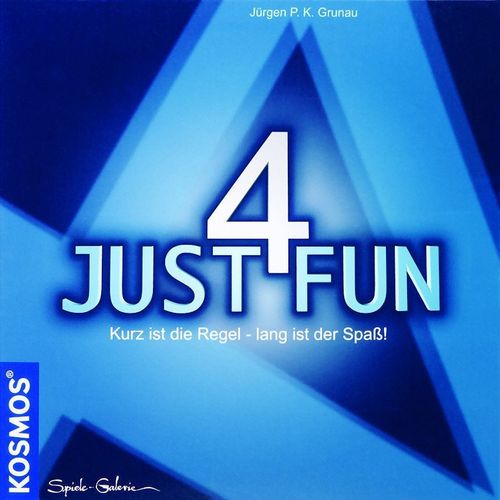
Just4Fun
Just4Fun Rulebook
Table of Contents
Table of Contents
Game Idea and Goal
The players play cards and thereby occupy number fields on the game board. As soon as a player owns four fields lying directly next to each other in a row (horizontally, vertically or diagonally), he has won. A field only counts, however, if one holds the majority of playing pieces there. If no player has reached the goal within 20 rounds, the player who occupies the most valuable fields with his pieces wins.
Examples: Three correct winning rows of fields lying next to each other. / No winning rows: the fields do lie "next to each other", but not in a row.
Game Material
- 1 game board
- 55 playing cards (of which four each of the values 1-12 and one each of the values 13-19)
- 80 stackable playing pieces (20 each in four colors)
Setup
- The game board, with its fields numbered 1 to 36, is placed on the table so that each player sits in front of one side of the board.
- Each player receives 20 playing pieces of one color, which he places in front of him.
- The playing cards are shuffled and each player receives 4 cards, which he takes in hand. The remaining cards are put ready next to the board as a face-down draw pile.
- The funniest player begins; the others follow clockwise.
Course of Play
The player whose turn it is must, if he can, play one or more cards and place a piece of his color on a square field that corresponds to the value of the card(s) played. Afterwards he draws as many cards as he has played.
1. Play one or more cards
- The player whose turn it is must play at least 1 card; it may also be 2, 3 or 4.
- If 2 or more cards are played, their values are added together.
- Played cards are laid down face up and form the discard pile.
2. Place a playing piece on the board
- Each player always places his pieces at the same position within the fields, namely on the circles that face his own side of the board.
Example for a four-player game: (illustration of each player's circles on the fields.)
- The player places a piece of his color on the field with the number played (or with the sum of the numbers played).
- Exactly 1 piece may be placed per turn.
Example: Player Red plays three cards with the values 5, 11 and 13. He places a piece on the field with the number 29 (= sum of 5 + 11 + 13).
Note: So that certain number fields can be found more easily and quickly, the square fields of the board are shaded in color. The darker the blue, the higher the number on the field.
- In principle, several or all players may place their pieces on one and the same field.
- If a player already has a piece standing on a field and later wants to place another piece on that field, it is simply stacked on the piece already there.
In theory, a player aiming for the majority can stack as many of his own pieces on one field as he likes over several turns.
3. Draw card(s)
- After a player has played cards, at the end of his turn he draws cards from the draw pile, exactly as many as needed for him to have four cards in hand again.
- Whenever all cards of the draw pile are used up, the cards of the discard pile are shuffled and form the new draw pile.
Then the next player clockwise is on turn.
Further Rules
Two pieces' lead creates safety
- One may not place one's own piece on a field if another player already has at least two pieces more there than one has oneself.
Example: Player Red has already placed two pieces on field 18; Player Yellow is represented with one piece; Player White is on turn and would now also like to place a piece on field 18. He may not do so, however, because Player Red already has two pieces more than White there. The only one who can still compete with Player Red on this field is Player Yellow.
-
As soon as a player has two pieces more than each other (!) player on a field, he becomes unassailable on that field and the following happens:
- The player moves his stacked pieces together into the middle of the field, where they remain until the end of the game and can no longer form an attackable majority on that field.
- All other pieces on the field concerned are removed from the game and put back into the box.
No Matching Cards
Should the extremely rare case occur that a player demonstrably cannot place a piece legally with any of his four cards, nor with a combination of several hand cards, he lays the four cards on the discard pile. Afterwards he draws four new cards from the draw pile. He may do nothing more in this turn.
End of the Game
The game ends when a player succeeds in having the majority of pieces on four fields lying next to each other in a row (horizontally, vertically or diagonally). This player has then won. - Majority means having on each of the four fields at least one piece more than each other player has on that field. (If no other player is represented on a field, a single piece naturally suffices for the majority!)
Should it exceptionally happen that no player manages to form a majority on four fields lying next to each other, the game ends when all players have placed their 20 pieces. - Now, from every field on which several colors are represented, the colors in the minority are removed. If there is a tie between two or more colors on a field, the whole field is cleared. - After the "clean-up work" is finished, each player adds up the point values of the fields still occupied by him. These do not have to lie next to each other. Whoever reaches the highest sum wins. In case of a tie, the player who owns the field with the highest number wins.
Example 1: On field 23, at the end of the game Yellow is represented with three pieces; Red with two pieces, White likewise with two pieces. - Red and White are in the minority and thus remove their pieces. Remaining on field 23 is Yellow. - For Yellow this field counts 23 points.
Example 2: On field 7, at the end of the game Red is represented with two pieces; White with two pieces and Yellow with one piece. - Yellow is in the minority and removes his piece. Red and White remain for now. Since these two have an equal number of pieces on the field, they cancel each other out and are likewise removed. On field 7 there are thus no points for any player.