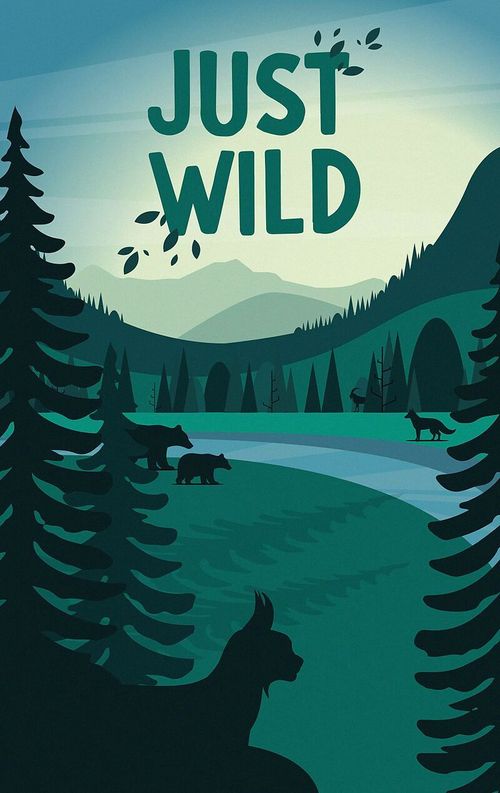
Just Wild
Just Wild Rulebook
Table of Contents
Table of Contents
Components
- 80 cards numbered 1 to 10
- 20 lynx cards
- 20 wolf cards
- 20 ibex cards
- 20 bear cards
- 24 animal tokens (6 of each species)
Setup
Each player chooses an animal, and takes the deck of cards and the five tokens corresponding to that species. Return any unused cards and tokens to the box. The last player to spot a wild animal starts the game.
Shuffle your deck of cards and draw the first card: place it face up in the middle of the table. The cards all need to be adjacent to each other and form a rectangle.
Next, prepare your hand by drawing the top three cards from your deck. Place the rest of your cards in front of you. This is your personal draw pile.
Turn overview
Players take turns playing in clockwise order. On your turn, you must place a card on the table. If you play a special card, you may place one of your tokens.
You may choose to:
a) Play a card face up by covering two half cards. The value of the card you play must be equal to the sum of the values on the covered cards. You are not allowed to cover a single card.
Example: Carla has a 6. She may cover a 2 and a 4. She's not allowed to entirely cover a 3.
b) Play a card face down: if you can't (or don't want to) cover any cards, you must play one card from your hand face down on the table. You must place it adjacent to a card that was played previously. These cards can be covered on future turns according to the normal rules.
Example: Leo can't cover any cards on the table. He plays a card from his hand (the 8) face down on the table.
Special situation
If you want to cover two half cards with a combined value higher than 10, you must play two cards: one face up, and one face down which will add 10 to the value of the first card you played.
Play the face-up card first, then play the top card from your draw pile face down on the table. A face-down card that was played this way has a value of 10.
On future turns, you may cover this card by keeping in mind the numbers shown in its corners. This card extends the play area and may be placed anywhere, but it has to be adjacent to a card that was played previously.
Note: if your draw pile is empty, you can no longer perform this action.
Example: Marco wants to cover an 8 and a 5. The sum of these two cards equals 13. Marco plays a 3 to cover the 8 and 5, then places the first card from his draw pile face down on the table.
Note: the backs of the cards are also numbered. The value on the front equals the sum of the two numbers on the back. This means the numbers on the back of the card (yours or an opponent's) tell you which value is on the front.
Special cards
The cards that show baby animals are special cards (10 cards per species, numbered 1 to 10). When you play one of these cards face up on the table, you can protect the terrain the baby is on. Place one of your tokens on the corresponding half card: for the rest of the game it can no longer be covered. Careful though, because you only have 5 tokens! Once you place a token, you're not allowed to move it or take it back.
Draw cards until your hand is refilled to three. Now, the player to your left takes their turn.
End of the game
The game doesn't end at the same time for all players. When you play your final card, calculate your points: each half card of your species that's still visible scores you one point. Write down your score immediately: this number is your final score, even if your cards are covered by other players later. Once all cards have been played, compare your scores. The player with the highest score wins the game.
Note: in case of a tie, the player with the most unused tokens wins. If there's still a tie, the victory is shared... You'll have to play another game!
Final scores example: Carla (ibex) 6 points, Leo (lynx) 5 points, Marco (wolf) 4 points.
Endangered species
An endangered species, also called a threatened species, is an animal or plant species that could completely disappear from the surface of the earth in the short or medium term.
The IUCN (International Union for Conservation of Nature) maintains a list of endangered species. Depending on their degree of endangerment, they are classified into one of three categories: "critically endangered", "endangered" or "vulnerable". The most recent version of the international Red List of threatened species lists 130,000 species, 37,000 of which are classified as endangered. 41% of amphibians, 14% of birds and 26% of mammals are threatened with extinction on a global level.
The threats that are causing these species to disappear are varied, but often they're linked to human behavior: disappearance of their environment, urbanization, hunting, deforestation, ... If nothing changes, these species will disappear forever. The 'threatened' status of these species is there to alert us.
The lynx
Lynxes are the biggest wild felines in Europe. They are also among the three largest predators in Europe, together with wolves and bears. Thanks to their big paws and enormous feet, they can easily travel across the snow and are therefore adapted to life in the mountains. That's where they hunt for deer, chamois and hares. They play a very important role in maintaining the balance between prey and predators.
History: In the 19th century, the Eurasian lynx completely disappeared from France, and its presence became restricted to the Jura and Alps in Switzerland. Today, populations have been reintroduced to the Vosges massif, allowing lynxes to return to the French Jura in a natural way.
The wolf
Wolves are also large predators. They live in packs and hunt for their prey (deer, wild boars and other mammals) by stalking them.
History: Once upon a time, wolves were very common in Europe, but they were hunted and forced to retreat to the last remaining wild territories: the mountains. Today, wolves are reclaiming Europe from the Italian Alps. They've now settled in the French and Swiss Alps and are starting to explore the rest of Europe little by little.
The bear
Bears are one of the most iconic species in the animal kingdom. They are a rare sight and live and hibernate in the mountains. They primarily live off plants and sometimes animals like deer.
History: These large predators almost entirely disappeared from Europe around 1930. They managed to survive in the Pyrenees and the Alps, but their populations were greatly reduced, and they were going to disappear if left ignored. New bears were introduced to these massifs, which allowed their species to reproduce and grow in numbers. However, bears remain endangered to this day.
The ibex
Ibexes are wild goats that have perfectly adapted to life in the mountains. They are outstanding climbers and feed on plants all year round.
History: Ibexes were hunted mercilessly and almost completely disappeared from the Alps in the 19th century. They owe their continued survival to the Italian kings, who prohibited hunting in the Gran Paradiso massif to protect the species from going extinct. Italian ibexes were reintroduced to the Swiss Alps, where they are now commonly present. They succeeded in naturally recolonizing the rest of the Alpine massif.