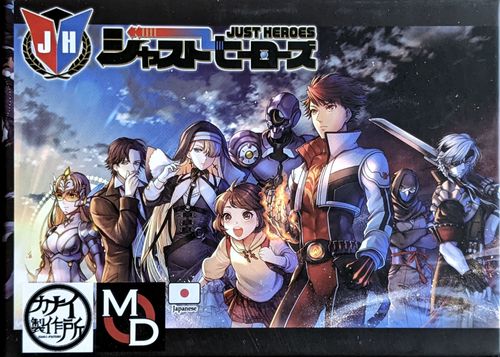
Just Heroes
Just Heroes Rulebook
Table of Contents
Table of Contents
Components
- 8 Hero Cards: These cards show the heroes who protect the city. They have (1) hero names and (2) special abilities. Some special abilities can be used during the game, while others are applied during game preparation. An ability marked with a yellow "1" icon can be used only once during the game.
- 8 Villain Cards: These cards show the villains who attack the city. They have (1) villain name and (2) special effects. The special effects of the villains are applied to all players. Some of the special effects are applied during game preparation. The cards have the corresponding (1) number of players and (2) resistance of the villain. There is also a (3) activity limit, which shows the limit for the number of times a player can win a trick (i.e., equal to the number of icons). The (4) Trick Management track shows the current number of tricks and the Fame multiplier to be won at the same time.
- 56 Battle Cards (14 cards in 4 suits): These cards show the various options that heroes have when attacking villains. There are four (1) suits: Hand Combat, Ranged Combat, Special Move, and Energy. Each card has a (2) strength, and there are 14 ranks from 1 to 7+ ("+" means stronger within the same number. When adding up the numbers, ignore the "+" when calculating). Special Moves are treated as trump cards (see below for details).
- 56 Support Cards: These cards show various items and groups that support the heroes. By using these, the heroes can adjust their attacks on the villains. They can also increase the amount of Fame earned when fighting with them. The cards have (1) a name and (2) a modifier to the number. Also, if the modification is written as "A/B", it means that either one of the values A or B can be used.
- 3 Trick Tracking Cards: These cards are used to manage the game's information. There is one card for each of the 3-5 players, so use only those cards that correspond to the number of players.
- 5 Fame Cards: These cards are used by players to manage their own Fame. The front shows 1-24. The back shows 25-48.
- 1 Trick Marker: A pawn placed on the Trick Tracking card to show the current number of tricks and Fame multiplier.
- 1 Fame Marker: Used to track Fame on each player's Fame card.
Preparation
Prepare the Heroes
Each player receives one Hero card and places it face down in front of themself. They may choose one at random or by preference. They also receive a Fame Card and a Fame Tracker Marker, and place a Fame Tracker Marker in the "10" space of the card.
Prepare the Table
Prepare management cards according to the number of players playing the game, and place them in the center of the playing area. Place a Trick Management marker in the upper left corner of the Trick Management Track at "x1".
Prepare the Villains
Shuffle the Villain cards face down and choose one card at random to be used in that game. The rest of the cards will not appear (be used) in that game. Remove them from the game.
Prepare the Battle Cards
If you have 3-4 players, adjust the number of Battle cards you use. If you are playing with 3 players, do not use 6, 6+, 7, or 7+ cards, and if you are playing with 4 players, do not use 7 or 7+ cards. Remove them from the game.
Shuffle the remaining Battle Cards face down, and deal 11 cards to each player to make a hand.
Place the remaining cards next to the Villain as "Shadows" (unused cards).
Prepare the Support
Shuffle the Support cards face down and deal 4 cards to each player (this number may change depending on the heroes/villains that appear). You can hold these cards with your hand or put them face down in front of you. As with your hand, keep these cards hidden from other players. The remaining Support cards are not used for the game, so please remove them.
After the above preparations are completed, decide the player who will play the first card (lead) by playing rock-paper-scissors or any other method you like.
Game Flow
The game is divided into "tricks". Each player plays one card of the same suit in clockwise order, starting with the lead player, who plays the first card. The leader player compares the total value of the cards played with the villain's resistance and gains or loses Fame accordingly. This is repeated a maximum of 11 times, with the goal of gaining as many Fames as possible.
How to Play Cards
First, the lead player chooses and plays a card from his or her hand that attacks the Villain. That attribute becomes the "Lead Suit".
Then, each player chooses a card in clockwise order and puts it in front of him/herself. At this time, please follow the rules below.
- There is a card of the lead suit in your hand: If there is a card of the same suit as the lead suit in your hand, you must choose a card of the same suit and play it face-up (must-follow).
- There are no cards of the lead suit in your hand: If you don't have any cards of the same suit as the lead suit in your hand, play a card of any suit. If it is not a "Special Move", play it face down and treat its strength as "0". If it is a "Special Move", play it face up. If it is a "trump card", it is treated as a "trump card" that is stronger than the lead suit.
When you play a card face-up, you should say the sum of the values of the current face-up cards to make the game go more smoothly.
Trick Decision
After each player has played his or her cards, a leader (i.e., the winner of the trick) is chosen among them. The leader will be the next lead player.
The leader is the player with the highest number in the "Special Move" (trump card) suit. If no one has played a "Special Move", then the player with the highest number in the "Lead Suit".
The leader player first turns over their cards to show that they are the leader (won the trick). Then, the numbers of the "face up" cards used in the trick (Lead Suit and Special Moves) are summed and compared to the villain's resistance.
Resistance is 3 players: 7 / 4 players: 12 / 5 players: 16.
- The total is out of the tolerance ±1 range (Lose): If the total is too high, the hero's attack will cause significant damage to the city in its efforts to defeat the villain. On the other hand, if the total is too small, the hero is unable to attack the villain effectively, and the hero is struck down. The number of Fames lost is calculated by multiplying the base value by the difference between the Resistance and the Fame multiplier that corresponds to the current number of tricks.
Example: The lead player played "Shooting", so the lead suit was "Shooting" for players C and D. Since they did not have "Shooting" in their hand, C played a Special Move and D played another card face down. The strength is "Special Move > Shooting > Other Suits", so Player C is the leader. The villain's resistance is 12, and the total value of the cards is 4+2+1+0=7. In this case, the difference is 12-7=5. Since the current Fame Multiplier is "x2", the representative player C loses the base value of 5 x Fame Multiplier 2 = 10 points of Fame. Note that the "+" in "2+" is not counted, and that face-down cards are counted as "0"! If the total value is too much or too little than the tolerance, you will lose the Fame factor. It is not always enough to be the leader!
Fame Decision
Depending on the sum of the cards played, the leader's Fame is gained or lost.
- The total of the Fame was the same as the resistance (Perfect Strike): The hero's attack has a stunning result. They gain a number of Fame equal to the base value of "2" multiplied by the Fame multiplier corresponding to the current number of tricks.
- The total was in the range of resistance plus or minus one (Good Strike): There was some collateral damage, but the results were mostly good. Gain a number of Fames equal to the base value of 1 multiplied by the Fame multiplier corresponding to the current number of tricks.
Example: If the villain's resistance is 12 and the total card value is 4+2+1+6=13, then the difference is 12-13=-1. Since it is in the range of 1, we have Good Strike and the current Fame Multiplier is "x2", so player D has a base value of 1 x Fame Multiplier of 2 = 2 points of Fame. Note that the "+" part of 1+ and 2+ is not calculated.
Example: The villain's resistance is 12, and the total value of the cards is 4+2+1+0=7. In this case, the difference is 12-7=5. Use one Support card to get +2. You still lose, but the difference is reduced to 3. Since the current Fame multiplier is "x2", Player C loses 6 Fame points (base value 3 x Fame multiplier 2 = 6). Note that when you lose, the number of Support cards you use is not added to the base value!
Using Support Cards
In order to adjust the result of the decision, the leader player may use any Support cards he or she has. Place the used Support card on top of the previously played card and modify the value. At this time, if a Support card has two positive and two negative modifiers, choose one of them.
If you have more than one Support card, you can use them combined. Also, be sure to apply the modifier to the Support card you used (you cannot use it only to gain additional Fame, as described below).
Gaining Additional Fame Through Support (Important)
Once you have used a Support card to gain Fame, you can gain more Fame. For each card you use, the base value is increased by 1. However, if you do not gain any Fame (i.e., you used a Support card to reduce the difference between your resistance and your total value and prevent the loss of Fame), it has no effect. Note that there is no further loss of Fame.
Example: If the leader uses three Support cards: -1+2-2=-1, there is no difference. Since the current Fame multiplier is "x2", Player D, as the leader, gets (base value 2 + number of Support cards used 3) x Fame multiplier 2 = 10 Fame points. However, they may use only one Support card with -1 to gain (2+1) x 2 = 6 points.
Next Trick
When the Fame increase/decrease is over, move one of the Trick Management Markers (starting from the top left, the markers move in the order 11222223334). After that, the player who became the leader this time becomes the new lead player, and plays a card in the same way. This continues until the end of the game is reached.
The cards played at each trick should be placed in order in front of you to count the number of tricks you have played as the leader.
Bust (Important)
If you become a leader with too many tricks, your hero will run out of stamina and will not be able to fight any more. This is called a "bust". The bust hero loses all their Fame, and the game ends.
Also, the number of tricks (stamina) until the "bust" will change depending on the number of players:
- 3 players: 5 tricks (6 cards bust)
- 4 players: 4 tricks (5 cards bust)
- 5 players: 3 tricks (4 cards bust)
The 4-player illustration in the booklet carries the caption: "When team leader, lay down your card. Bust because 5 tricks were won."
Game End
A fight against a villain ends when one of the following conditions is met.
- 11 tricks have been completed.
- Any player's Fame has dropped below zero.
- Any player busted.
In any case, the player with the most Fame at that time is the winner and is honored as the hero who defended the city from the villains. If there is more than one, the player who had more tricks won (more cards lying on their side) is the winner. If they are still equal, they share the victory.
Advanced Rules
If the normal game is not enough for you, you can add the following optional rules to your game.
Consecutive Games (Recommended)
Each game can be played as a "round," and a series of games can be played. At the end of the round, each player gets a score (with a different counter, such as a coin or a piece of paper) based on his or her Fame ranking (1st place: 2 points, 2nd place: 1 point, last place: -1 point, but never negative). Repeat the process, and the player who gets 4 points is the ultimate winner.
In each round, start with the game preparation, and re-prepare the heroes and villains. In each new round, the player who finished first in the previous round is the first player to lead (in case of a tie in Fame, the player with the highest number of tricks won is the winner. If the Fame is tied, the player with the highest number of representations is ranked higher; if it is the same, they are all equal, and there will be no points scored for the rank below them. If there is more than one first place winner, the player with the later trick won becomes the next lead player).
Multiple Villains
Have more than one Villain in the game. Apply all of their special effects. Heroes will have a hard time fighting them (recommended 2-3).
Characters
Sidekick Declaration
If you think the hand you have been dealt is too weak to win a trick, you may choose to support the other heroes and gain Fame. If you choose to do so, turn over your hero card and declare a sidekick before the game begins (clockwise from the first player to declare a sidekick).
The hero of the player who declared the sidekick loses his or her special ability, and all Support cards are returned to the box. Instead, the sidekick becomes a special scoring method.
A sidekick automatically gains a Fame "equal to the current Fame Multiplier" "when not represented by a trick". If the current Fame multiplier is x2, then you get 2 Fame points. On the other hand, if you are made leader (win a trick), you lose 5 points of Fame (regardless of the outcome or the current Fame multiplier).
Sidekick basically does not take into account the villain's special ability or the difference from the resistance (the effect of "Villain (Doom Witch)" is applied).
Cooperative Game
This is a game where the heroes cooperate with each other to avoid being defeated by the villain, rather than competing for points. In this game, all players win if no player has less than 0 Fame or has busted at the end of all tricks.
In a game with this option, the optional rule "Declare Sidekick" above cannot be used; if you are playing with 5 players, please exclude the villain "Doctor Spiral" from the game. You can also combine this optional rule with the "Multi-Villain" rule above to increase the difficulty of the game.
Cooperative Game: Betrayer
A "Betrayer" appears among the heroes to cooperate with the Villain. A Betrayer declaration is made in the same way as a Sidekick declaration.
If any hero's Fame drops below 0 or busts, the Betrayer wins. Conversely, if a Betrayer becomes a leader (wins a trick), the heroes win.
Strategic Game Preparation
If you have many players who are familiar with the game, you may want to change the order of Game Preparation to make the game more strategic and enjoyable for them. In such a case, "Prepare the Table", "Prepare the Villains", "Prepare the Battle Cards", "Prepare the Support", and "Determine the First Lead Player" should be done first, and "Prepare the Hero" should be done after checking your hand of cards and the Villain for the round. Choose your heroes in clockwise order starting with the first lead player, and start the game.
Character Cards
These characters are a work of fiction and are not representative of anyone.
Fire Barrel A boy who has just awakened as a hero. He has the ability to burst into flames. He has a strong sense of justice and is more determined than anyone else to protect those who are threatened by evil. ABILITY: Use when you become a leader. Adds +1 to fame multiplier for this trick.
Dominage The leader of the Global Order, an organization bent on world domination. He not only wreaks havoc on his own, but also manipulates many villains from behind the scenes. ABILITY: The base value for gaining Fame on a Good Strike becomes 0.
Sword Keeper An elementary school girl who became the hero "Arthur the 324th" after pulling out a mysterious holy sword stuck in the backyard of her house. She doesn't know what she's doing yet, but she's determined to slay any evil she sees. ABILITY: Gain an additional support card when preparing for the game.
Sid (Sealed Dragon) An evil dragon sealed in a holy sword. He was once a great dragon that plunged the world into chaos, but his power has been lost after being sealed for so long. He does not have a body of his own, and is staying in a human body at the Sword Keeper's house. ABILITY: Reduce the number of support cards dealt when preparing the game by one.
Shadow Blade A dark hero whose wife and child were murdered by the Mifune-kai, a Japanese yakuza organization, and who has returned to Japan with the power of Ninjutsu, an Eastern zen power. He transforms his hatred into power as he fights. ABILITY: Used when playing a card. If the current Lead suit is "Fighting", you win the trick with a "Good Strike" regardless of the card you played (Support cannot be used).
Grand Hatamoto Leader of the Mifune Kai. He is a terrifying evil samurai who has buried many of his enemies with his well-honed strength and the "Kendo" technique he unleashes with the weapon from his back. Despite his rugged appearance, he loves the special Eastern sweets "Daifuku". Ability: If the lead suit is "Shooting", resistance is increased by +3.
Silver Barrel One of the "Sisters," a special fighting group under the direct control of the Pope. Their mission is to pursue and destroy the demons that have appeared in the Mobius Ring, a supernatural singularity that connects the human world and the demon world. Ability: Used when playing a card. If the current Lead suit is "Shooting", you win the trick with a "Good Strike" regardless of the card you played (Support cannot be used).
Seven Crowns A demon who has come into the world through the Mobius Ring, a singularity that allows him to exercise the power of the seven deadly sins. After breaking through the siege of the Sisters by using a number of tricks, he has been hiding in the cities of humans, secretly increasing his followers and gaining power. ABILITY: If the lead suit is "Energy", resistance is increased by +3.
The Hound A detective in the First Investigation Division with the gift of "Truth Eye," which allows him to see facts beyond the obvious. He is currently investigating a series of art theft cases in the city. His daily routine is to quench his fatigue with a cup of joe at his favorite coffee shop. ABILITY: The range for a Good Strike is increased by 1 (Ex: for three players, the Good Strike range for The Hound is down to 5 and up to 9, instead of 6 and 8.)
The Cat A thief who specializes in stolen works of art. She has succeeded in stealing many things with her extraordinary physical abilities. On the outside, she is an ordinary college student who works as a waitress at a run-down coffee shop. ABILITY: After losing Fame upon winning a trick, an additional amount equal to the current Fame Multiplier will be lost. (Ex: on the third trick, if you lose Fame, you will lose an additional 2 Fame.)
Tireless A man-made soldier for the next generation of warfare, developed by the giant military industrial complex, Babylon. He was the first prototype, but his emotions were awakened in his memory, and he escaped in order to stop the conspiracy that Babylon was plotting. ABILITY: You have no stamina limits and no busts (you can be a leader as many times as you want).
Doctor Spiral He is the science and technology advisor of Babylon, and the creator of the Tireless. After deploying the same model to many countries, he plans to seize control of them and take over the world. ABILITY: The stamina limit is reduced by one.
Rayne A half-human, half-vampire hunter from Dhampyr. He makes a living hunting supernatural monsters on request. He's rough and foul-mouthed, but his motto is to give his all to the task at hand. ABILITY: Used when you win a trick. The trick is not included in the stamina limit (the card is not laid on its side) and you do not increase or decrease your Fame.
Doom Witch The Doom Witch is a powerful witch who has existed for who knows how long. Secretly dissolving into the human world, she is a horrible evil that enjoys seeing it disintegrate with the poison she has cast. Many fighters have tried to destroy her, but no one has ever succeeded. ABILITY: Each player who fails to win in each trick loses 1 Fame.
Regina Ray V One of the war maidens sent to this world by the Great God Odin to dispose of the flaming giant that escaped by breaking the seal. She wears a sacred armor that is a fusion of myths and modern technology, and uses the powerful energy of the divine disk called Gungnir. ABILITY: Used when playing a card. If the current Lead suit is "Energy", you win the trick with a "Good Strike" regardless of the card you played (Support cannot be used).
Surth A flame giant who escaped from the seal of the Great God Odin, which was damaged by the weakening of the mythical world, and fled from Asgard to the human world. He is usually contained in a human body, but once he reveals his true form, he can cause horrific damage. ABILITY: If the lead suit is "Fighting", resistance is increased by +3.
Questions
Q: If the lead is a suit other than "Special Move" and I cannot play that suit, must I play it if I have a "Special Move" card? A: No, you do not. If you don't have a card of the lead suit, you can play any other card you want.
Q: Can I play a card of "Special Move" face down? A: No, you cannot. You must play the Special Move card face-up.
Q: When I can use a Special Ability, can I not use it? A: Yes, you can. It is optional.
Q: Is it possible to make my card "lose" by using a Support card? A: It is not impossible, but there is no advantage.
Supplement to the Special Abilities
- Fire Barrel: Increases the fame multiplier. For example, if you use it when the fame multiplier is "x2", the fame multiplier becomes "x3".
- Silver Bullet / Shadow Blade / Legend Rave: You can play any card you want, as long as its suit corresponds to your ability. Even if you play a card face down, and no matter how much difference there is between it and your resistance, it will be treated as if it was determined a "Good Strike". However, you cannot use Support cards to increase the Fame's base value.
- Rain: Can be used not only on Loose Strikes, but also on Just-Strikes and Good-Strikes to prevent Busting.
- Dominage: The base Fame value is reduced from 1 to 0, but it can be increased by using Support cards.
- Cat: When you lose a Fame by a Loose Strike, you will lose additional Fame. If the difference between the Fame and Resistance is 3, and the Fame Multiplier is "x2", the Fame you lose is 3x2+2, or 8 points.
- Cid: When this Villain appears, only 3 Support cards are dealt (4 cards are dealt to the Sword Keeper player).