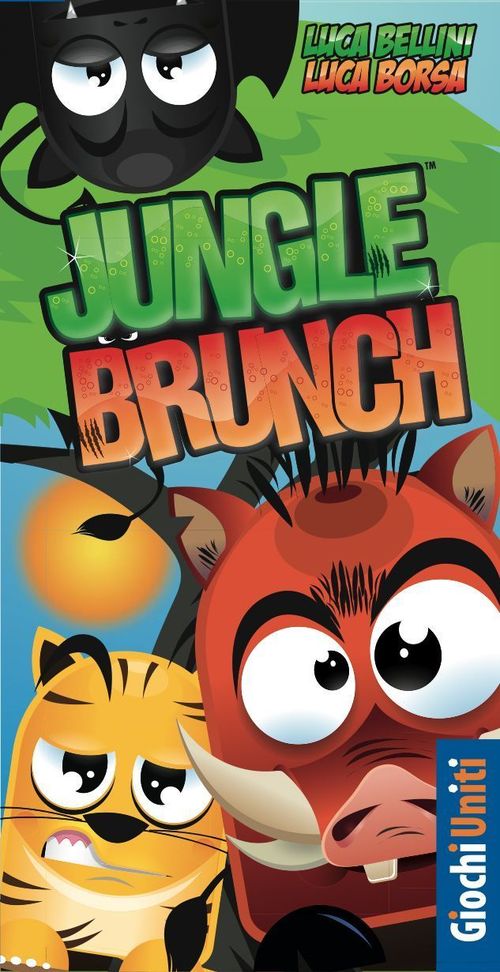
Jungle Brunch
Jungle Brunch Rulebook
Table of Contents
Table of Contents
Components
- 110 animal cards, divided into 5 decks of different colours (red, yellow, green, blue and purple). Each deck has 22 cards: 6 buffalo, 4 monkeys, 4 elephants, 3 tigers, 1 snake, 1 vulture, 1 warthog, 1 bat, 1 cub.
- 36 ordinary plant cards: 12 grass cards; 12 banana cards; 12 nut cards.
- 9 hunger cards: 3 grass cards; 3 banana cards; 3 nut cards.
- 6 abundance cards: 2 grass cards; 2 banana cards; 2 nut cards.
- Pack Leader card
- Fierce Hunter card
- Rulebook
Object of the Game
Time for a snack! Each player tries to eat more food (plants or animals) than the other players. The winner is the player who has gained the greatest number of food points.
Hint: to become a champion of the game, you need to learn the habits of the animals whose cards you have received. Each animal has its own advantages. Elephants are stronger than all the others, but they eat the food that gives the fewest points. Monkeys eat everything, but their turn to snack comes only after the stronger animals have eaten their fill. Buffalo chew fast, but they must always keep their ears pricked, because hungry tigers hunt them. And do not forget that there are also special animals...
Setup
Each player takes one shuffled deck of animals of one colour and places it face down in front of them. Then the players each take 6 animal cards from their decks, hold them in hand and show them to no one. Then the plant cards are shuffled and placed on the table face down.
At the start of each round, plant cards are turned over until at least one card of each kind (grass, bananas and nuts) has been revealed. In addition, a certain number of cards must be revealed, depending on the number of players:
- 2 players: at least 3 plant cards
- 3 players: 5 plant cards
- 4 players: 6 plant cards
- 5 players: 7 plant cards
Note: hunger cards turned over in the process of collecting food for the animals are always counted toward the total requirement, even though they have no food points. Abundance cards are laid out but are not counted when determining whether the required number of turned-over cards has been met - as if you had not noticed them!
When turning over plant cards, you must stack cards of the same type together. Hunger cards are also placed together with the plant cards of that type. Abundance cards are placed next to the cards of the corresponding plants, but separately from them.
The Fierce Hunter card is placed in the middle of the table.
The player who had breakfast earliest this morning starts the game and takes the Pack Leader card.
Example: in a 4-player game, at least 6 plant cards must be revealed, and each kind of plant must be represented by at least one card. A hunger card with the value "0" counts as a nut card, but an abundance card cannot count as a banana card. Thus, in the first round 7 plant cards are revealed.
Animal Cards
Herbivores (elephants, buffalo, monkeys and warthogs) eat only plants. On each animal's cards the plants are shown, starting with the most favoured. Each herbivore has a certain strength (power points). Buffalo and monkeys also have food points (because predators can eat them).
Predators (tigers and vultures) eat herbivores. On the predators' cards the animals they eat are shown, from the most preferred to the least preferred. Tigers have strength.
Special animals (snakes, bats and cubs) have special abilities with which they influence the behaviour of the other animals.
(Card layout: power points; favourite food, left to right; food points; special abilities.)
Plant Cards
(Card layout: plant type; number of points.)
First Round
The first player chooses two cards from those held in hand and puts them in the centre of the table: one card face down, the other face up. Then all players, clockwise, do the same. After each player has put two cards on the table, the face-down cards are turned face up simultaneously.
The jungle is calling! Now it is lunchtime: the animals begin to eat according to their tastes and abilities.
How Hungry Are You?
Check whether there are any snake or bat cards on the table. These animals can use their abilities before the other animals begin to eat.
Bat: If you played a bat card, place it on one herbivore card of your choice - for example, your own card. The strength of the chosen herbivore with the bat is reduced by 2 points (and strength determines when the animal can begin to eat). Note: if a herbivore's strength has been reduced to 0, the animal still stays in the game and can eat when its turn comes (the order is determined by strength). All animals eat before the warthog. You may not play two bat cards on the same herbivore card.
Snake: When you play a snake card, the strongest animal or animals (if several have equal strength) must run away. Put the cards of the animals that ran away into their owners' discard decks. If there are several snake cards on the table, this rule applies only once, regardless of the number of snakes played. Only the strongest animal(s) run away.
No snakes and bats, or you have finished playing out their abilities? Now the remaining animals proceed to the meal: the animals with the highest strength points eat first. Starting with the strongest animals, each eats its favourite food. If two animal cards have equal strength, the animal of the player who started the round, or of the player closest to them clockwise, feeds first. The same is used to determine which of the animals that have no strength feeds first.
Important: in each round, the player whose animal managed to feed first receives the Fierce Hunter card.
Elephants: to feed elephants, take a nut card or, if there are no nut cards, a banana card, and put it into your food points deck.
Tigers: take the buffalo or monkey card with the highest strength from any of the players. Put the chosen animal card into your food points deck. Keep in mind that a tiger can also eat your own animal! In that case, put the eaten animal not into the food points deck but into the discard deck.
Buffalo: to feed buffalo, take any grass card of your choice. If no grass cards remain, take a banana card. Put the chosen card into your food points deck.
Monkeys: to feed monkeys, take any banana card. If there are no more banana cards, nuts or grass will do. Put this card into your food points deck.
Warthogs: warthogs always eat after the other animals. To feed a warthog, take two banana or grass cards and put them into your food points deck.
Cubs: you may play these cards only together with cards of adult parent animals. A cub card may be played only together with elephant, monkey or buffalo cards. When the adult animal feeds, the cub feeds too (you take one additional plant card for this). If the parents ran away from a snake or were eaten, the cubs stay hungry.
Note: during a game round, abundance cards may be eaten like ordinary plant cards of that type.
Vultures eat buffalo and monkeys in turn, after the feeding of the animals ends, in the following cases:
- During feeding, buffalo and monkeys may be forced to eat a hunger card. Vultures eat such animals first. In this case the animal card and the hunger card are put into the food points deck.
- If any buffalo or monkeys stayed hungry in this round because there were no suitable plant cards, then each vulture participating in the game eats one of the unfed buffalo or monkeys.
- If two players are playing and a vulture has not eaten because no buffalo or monkeys stayed hungry, then the vulture eats the buffalo or monkey that fed last in this round. Both cards (the animal and the plant it ate) are in this case put into the food points deck.
After all animals that could feed have eaten, the remaining animal cards are put into the discard deck (even if they are cards of unfed animals).
Herd
If you play two cards of identical animals, they form a herd, whose members are protected from attack by predators. However, they eat more slowly. You cannot play a bat card on a herd, and, moreover, snakes are no threat to a herd. A herd can eat only when the turn comes for its weakest member to feed. A herd feeds before a lone animal of the same kind with equal strength. A herd of buffalo with strength 4 feeds before a lone buffalo with strength 4. The order of feeding relative to other animals of equal strength is determined by the usual rules. A herd feeds as a single animal: you may put only one food card into your food points deck.
New Round
At the end of the round, the player who first fed their animals (and received the Fierce Hunter card) becomes the player who plays first in the next round and receives the Pack Leader card. The Fierce Hunter card is again put in the centre of the table. Each player takes two new animal cards from their animal deck. Plant cards are laid out in the number needed to feed all the beasts in the jungle (see Setup).
End of the Game
When the cards in the animal decks run low, a last round is played in which each player has 4 cards left. After that the game ends. The game is also considered finished if at the start of a round there are not enough plant cards to feed all the beasts.
Determining the Winner
The winner is the player who has collected the greatest number of food points (counting eaten plants and animals). If the points are equal, the player who collected more food cards in their food points deck wins. If the number of cards is also equal, both players win.
Example of Play: First Round
(Players: Anya, Boris, Vova, Gena.)
Anya has the Pack Leader card, so she begins this round and lays out one face-down and one face-up animal card. Boris, Gena and Vova do the same during their turns. Then the face-down cards are turned over.
First, Boris's snake scares the strongest animal. Since Vova has made a herd of elephants, his elephant is safe, despite being the strongest animal of the round. Thus Anya must discard her tiger with strength 8. The strongest animal is now Gena's tiger, which eats Boris's buffalo with strength 5. This buffalo gives Gena 5 food points. Gena takes the Fierce Hunter card, since his tiger ate first.
Vova's herd also has strength 7 (he uses the lowest value) and eats next. Vova takes one nut card (the one worth 4 points). Two monkeys with strength 3 remain. Since they have equal strength, Anya's monkey eats first (Anya began the round and has the Pack Leader card). Anya takes a banana card. Since there are no more bananas, Gena takes the last nut card.
Scoring for the first round: Anya - 4 points, Boris - 0 points, Gena - 5 + 3 = 8 points, Vova - 4 points.
Example of Play: Second Round
Gena has the Fierce Hunter card, so he begins the second round. He takes the Pack Leader card and returns the Fierce Hunter card to the middle of the table. Gena puts one animal card face down and one animal card face up. Anya, Boris and Vova do the same in turn. Then the animal cards are simultaneously turned face up.
First, Boris's tiger with strength 8 eats Anya's buffalo (Boris receives the Fierce Hunter card). Unfortunately for Vova, his tiger must eat his own monkey (both cards are put into the discard deck).
Now Anya's monkey eats a banana (4 food points). Gena's monkey eats another banana. Since the "mother" has eaten, the cub also gets to satisfy its hunger and gets a nut (5 food points).
Finally, it is time for Boris's warthog to eat. He may choose between bananas or grass, and chooses the two most valuable grass cards.
Scoring for the second round: Anya - 4 points, Boris - 6 + 6 + 6 = 18 points (an excellent result!), Gena - 5 + 3 = 8 points, Vova - 0 points.
Example of Play: Third Round
Boris has the Fierce Hunter card, so he begins the third round. He takes the Pack Leader card and returns the Fierce Hunter card to the middle of the table. Each player in turn puts one animal card face down and one animal card face up. Then the cards are simultaneously turned face up.
First, Boris puts a bat card on any animal card of his choice: in this case, Vova's buffalo. The buffalo's strength is reduced by 2 and is now 4. Gena's elephant is first to eat, since it has 8 strength points. Gena chooses a nut card worth 4 points and takes the Fierce Hunter card. Now the strongest animal is Boris's buffalo (since Boris began this round). The buffalo eats grass (5 points). For his buffalo Vova also chooses a grass card worth 5 points.
Anya has the weakest buffalo, and it gets only the grass hunger card. Oh no! Gena's vulture appears on the horizon and eats Anya's buffalo and the hunger card. Then Anya's monkey gets a banana, and Vova's monkey the last nut card.
Scoring for the third round: Anya - 3 points, Boris - 5 points, Gena - 4 + 4 + 1 = 9 points, Vova - 5 + 2 = 7 points.