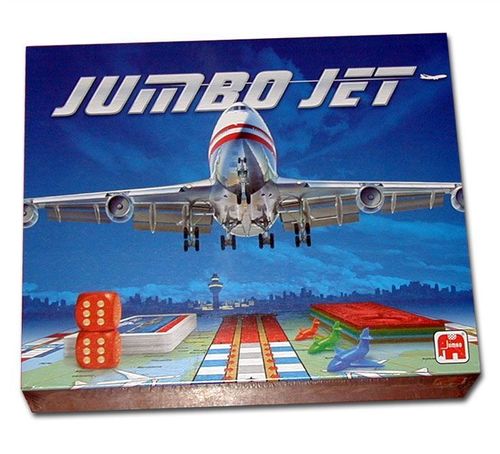
Jumbo Jet
Jumbo Jet Rulebook
Table of Contents
Table of Contents
Box Contents
- Game board
- Flight schedules (blue backs)
- Chance cards (red backs)
- 6 route arrows
- 48 landing rights
- 6 aircraft
- 2 dice
- Bank notes
Number of Players
Jumbo Jet can be played by three to six players, one of whom acts as the bank.
Aim of the Game
To earn as many Jumbos as possible by flying routes and collecting landing fees.
Preparations
Place the game board on the table. The players each select an airline. They each get a Jumbo Jet from the airline, a route arrow and eight landing rights. Each player also gets starting capital of 250,000 Jumbos (1 x 100,000; 1 x 50,000; 7 x 10,000; 2 x 5,000; 4 x 2,000; and 12 x 1,000).
The other money is taken care of by the bank, which also regulates bank payments. The flight schedules and the chance cards must be well shuffled and placed face down on the appropriate spaces on the game board. Each player takes a flight schedule card from the stack for free.
Start of the Game
The players decide who starts. The first player places his or her aircraft at the start of the runway. This player starts carrying out the first flight schedule. There are three options here:
1. Direct Flights
Place your route arrow on the destination. You fly directly to this city. See example 1.
2. Flights with Intermediate Stopovers
Place your route arrow on the final destination. You fly to this city via the city indicated on the arrow. See example 2.
3. World Trips
You do not use your route arrow for these flights. You take a World Trip departing in a direction of your choice. See example 3.
Flying
The aircraft's flight speed is determined by the figures thrown on the dice. Choose your departure direction in order to get to your destination and take off from the runway. If you throw a double, you can throw again after doing everything associated with the space on which you first landed.
Intermediate Stopovers
After you have arrived at (or flown over) the city where you are to make an intermediate stopover, you set course for your final destination via the shortest route (see example 2).
Final Destination
Once you arrive at (or fly over) the destination, you return to the runway via the shortest route (see example 1).
Runways
Example 4 explains how to land. Once you reach the landing runway after your flight, you immediately take another flight schedule. If you land on a blue space, you get this card for free. If you land on a white space, or fly straight on to the takeoff runway (example 7), you have to pay 10,000 Jumbos.
Payment
Once you have landed, you receive payment. The bank pays you the amount indicated on the middle of the flight schedule. After being paid, you place the card at the bottom of the stack of flight schedules.
Landing Rights
Instead of taking payment you can choose to keep the flight schedule card. You then place one of the landing right tokens next to the destination given on the flight schedule card (see example 5).
From this point on each player who lands on this space will have to pay you. You can never have more than eight landing rights in your possession at once. However, you can at all times sell off one of the landing rights you possess to another player or the bank. See also bankruptcy. World Trips do not generate landing rights, just money.
Landing Rights of Other Players
If, during the flight, you land on a space for which another player has landing rights you will be required to pay him or her. The more landing rights a player possesses on the same continent on which you land, the more you have to pay. You can see how much to pay at the bottom of the cards. You pay the first amount if the player possesses only those landing rights. You pay the second amount if the player possesses two sets of landing rights, etc.
Other Spaces That Appear on the Game Board
Red Spaces
If you land here, you take a chance card (red back) from the stack and carry out the associated actions.
Yellow Spaces with Fuel Pump
The amount you pay for fuel is determined by the figures thrown on the dice. Multiply the amount given here with the figures thrown on the dice and pay the bank this amount.
Clouds
If you land here you have to miss your next turn. Even if you have thrown a double your turn ends and you have to miss the next turn.
The Dice
If you land here you have a tailwind. You throw again, but only with one of the dice (even if you have landed here by throwing a double). Carry out the activities associated with the space on which you have landed. Your turn is then over.
Blue Spaces Without Dice
If you land here you can relax since nothing happens.
Arrows
Half way across the board between Sydney and Melbourne you will find a space filled with arrows. This is where you change lanes to make sure that your approach route corresponds with the landing runway. The spaces on which you land are not affected by the lane you are in. Possible landing rights apply to both lanes.
Bankruptcy
At the point you encounter financial obligations that you cannot fulfil, you are obliged to sell off one or more of your landing rights. The bank will pay you half of the amount stated in the middle of the card. When selling landing rights to the bank, the associated flight schedule card must be placed back under the stack. You take your landing rights card off the board and add it to your reserve. You can then use this card again when acquiring new landing rights.
You are at all times at liberty to sell off one or more of your landing rights (by auction if desired) to the other players. You may sell the landing rights to a player of your choice at a mutually agreed price.
If you cannot meet your financial obligations even after you have sold off all your landing rights, your airline is declared bankrupt and you are out of the game.
The Winner
Play continues until there is but a single airline in the game. The player at the helm of this airline wins the game.
If you want to shorten the game, you can choose to end it once the first player has gone bankrupt. This prevents anyone from being sidelined from the game. The player with the strongest airline at that point wins the game. All the players count their money. The landing rights are totalled according to the value of the amounts to be paid as landing fees when a player lands on that space (see landing rights example). The flight schedules in use at that point in the game count for the amount the player receives on landing (see landing example).
Tips
- Always try to get as many landing rights for the same continent. The landing rights that other players have to pay increase in line with the number of landing rights you possess on the same continent.
- You can trade landing rights as long as the players never have more than eight landing rights in their possession at the same time. By trading smartly you can try to gain control of an entire continent.
- You can buy landing rights in order to prevent another airline from gaining control of an entire continent or to sell them to another player at a profit later on in the game.
- If you get into financial difficulties, it could help to sell off one of your landing rights by auction. Your fellow players will probably pay less if you are really about to go bankrupt.