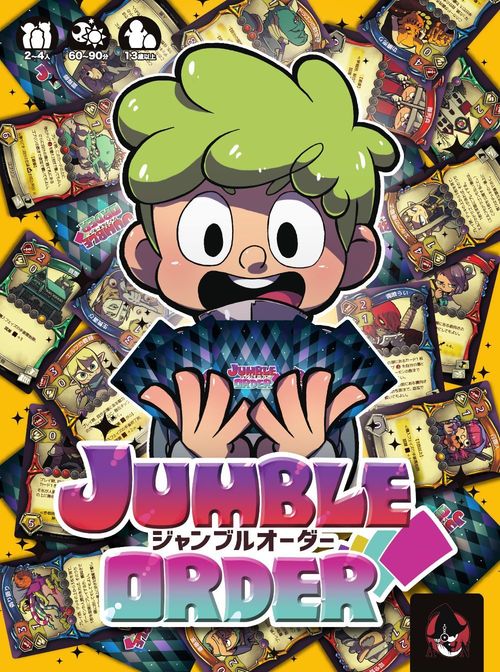
Jumble Order
Jumble Order Rulebook
Table of Contents
Table of Contents
Game Components
- Player components (non-card): 4 player boards (one per player), 16 player chips (4 per player), 4 deck placement tiles (one per player).
- Unit cards (153 total):
- Starting deck cards: 36. Marked in the lower right with a red, yellow, blue, or black player symbol.
- Basic unit cards: 32. Marked with the basic supply icon.
- Jumble unit cards (standard): 48. Marked with the standard Jumble icon.
- Jumble unit cards (additional): 18. Marked with the additional Jumble icon.
- Jumble unit cards (advanced): 18. Marked with the advanced Jumble icon.
- Other chips and tiles:
- Enhancement / discount chips (double-sided, red "+1" on one side and gold "−1" on the other): 12.
- Achievement chips (green, numbered "1"): 22.
- Withdrawal order tiles (numbered 1–4): 4.
- Purchase privilege tiles (red, yellow, blue): 3.
- Age tiles: 2. Stacked together, they serve as the start player marker.
- The player chips (4 per player, in four colours, star-shaped) are listed under player components above.
Unit Card Anatomy
- (A) Unit name, illustration and colour: The unit's name and illustration. The border colour is red, yellow, blue or green. Jumble unit cards also show one or more drop-shaped symbols giving the number of copies of that card used in the game (three drops means three copies).
- (B) Strength, gold and achievement: The unit's basic values. Strength (the red sword value) is used in the war phase. Gold (the yellow coin value) is used in the buy phase. Achievement (the green gem value, in the upper right) appears mainly on building cards and is used for end-of-game scoring.
- (C) Cost: The cost to buy this unit from the supply in the buy phase. There are two kinds: a cost paid in gold (shown with the gold icon) and a cost paid in territory (shown with the green gem icon).
- (D) Card type: The unit's type: race, or "building." The types are Human, Goblin, Elf, Demon, Dragon and Building, six in all, and they relate to card colour. Human and Dragon cards exist in red, yellow and blue. Goblin cards are red only, Elf cards yellow only, Demon cards blue only, and Building cards green only.
- (E) Special effect: The unit's own special effect.
- (F) Timing of the special effect: The timings at which a special effect fires are shown as icons. There are six: when the unit is played; when the unit is turned from face-down to face-up; when a war is joined; when a war is won; at the start of the buy phase turn; and at the end of the buy phase turn. The special effect fires at the timing whose icon is coloured rather than greyed out.
- (G) Card set icons: Icons that sort cards into sets for setup: the starting deck symbols (red, yellow, blue and black player symbols), the basic supply icon, and the standard, additional and advanced Jumble icons. Some cards also carry a front-half icon (a white paper-stack icon) or player-count icons. These are mainly used during setup. A card may carry more than one icon.
Setup
Table centre
Set up the cards, chips and tiles in the centre of the table as follows.
-
Remove cards by set icon. Check the set icons, and return to the box every card that carries one of the icons listed for the player count. If a card also carries other icons, it is still returned if it carries one of these.
- 2 players: return the cards with the two white paper-stack icons, the additional Jumble icon, and the advanced Jumble icon.
- 3 players: return the cards with one white paper-stack icon, the additional Jumble icon, and the advanced Jumble icon.
- 4 players: return the cards with the advanced Jumble icon only.
Once you are used to the game, choose freely between the additional and advanced Jumble sets, but never use both at once. In a 4-player game you may use the advanced Jumble cards in place of the additional ones; in a 2–3 player game you may pick one of the two sets as extra cards to add regardless of player count. (The advanced set contains cards that let players interfere with one another; use it only once you are well familiar with the game.)
As an example, one of the three Fort cards carries a white paper-stack icon: it is not used with 3 or fewer players, so it is returned to the box in every game except a 4-player game. The Spirit Medium card belongs to the additional Jumble set, so until you are used to the game it is used only in 4-player games. Spirited Away belongs to the advanced Jumble set, so do not use it until you are used to the game. In your first game, return all these cards to the box regardless of player count.
Cards you keep can be sorted by icon, which makes the rest of setup easier.
-
Basic unit cards (buildings). Place the four building cards Chapel, Trading House, Fort and Monument as four separate piles of identical cards.
- In a 3-player game: 4 Chapels, 3 Trading Houses, 2 Forts and 4 Monuments.
Each player
Sit around the centre of the table. Each player receives:
-
1 player board. Choose boards at random, or agree on them together. Place your board in front of you with either side up. For a first game, the Human board is recommended.
-
4 player chips, in the colour matching your board's unique icon (shown as A on the board). Place them on the four spots marked (a), (b), (c) and (d) on the board: (a) on the cross (×) of the lord effect, and (b), (c) and (d) on the ▷-marked number of each of the three resource tracks. (See the board diagram below.)
Your three resource tracks are kept on the board, and you change them by moving chips:
- Treasury (国庫), shown with a safe icon.
- Territory (領地), shown with a mountain icon.
- Lore (伝承), shown with a book icon.
In the board example shown in the diagram, treasury is 3, territory is 0 and lore is 1.
-
1 deck placement tile, in the colour matching your board's unique icon (A). Place it near the board (the diagram shows it at the upper right). This is where your deck goes.
-
9 starting deck cards, all showing the same player symbol as your board's unique icon (A): 3 Formation Soldiers, 3 Travelling Merchants and 3 Executioners. Different cards may share a name but differ in strength or gold. Shuffle them together face-down and place them on your deck placement tile. This is your deck.
Start of the game
When setup is finished, the oldest player takes both age tiles, places the one showing Age I face-up on top of the other, and places the stack in front of them. This player holds the age tiles and is the start player for each round. The face-up Age I tile also shows that the game begins in Age I.
Game Flow
The game is played over several rounds. Each round has four phases, played in order:
- I. Main phase
- II. War phase
- III. Buy phase
- IV. Clean-up phase
In the clean-up phase, if a specific end condition is met, the game ends, and the player with the highest total achievement wins. If the end condition is not met, the next round begins and play returns to the main phase.
I. Main Phase
In the main phase, turns are taken clockwise, starting with the player who holds the age tiles. However, a player who already has four or more cards in their play area is skipped on their turn. When every player is skipped, the main phase ends and the war phase begins.
On your turn, choose one of the following and carry it out:
- Play. Reveal the top card of your deck and place it face-up in your play area. (Think of it as turning over the top card of your deck.)
- Withdraw. Give up on winning a war this round, and carry out these steps in order:
- Place the top card of your deck face-down in your play area, adding cards one at a time until your play area has four cards. As a result, all of your later turns in this main phase are skipped.
- Take the lowest-numbered withdrawal order tile from the stock in the centre of the table.
- Check the withdrawal bonus on your board and resolve it. On the Human side it depends on the current age:
- Age I: +1 treasury.
- Age II: +2 treasury.
- Age III: +3 treasury.
- (Other board sides have their own withdrawal bonuses; see "Player Board Lord Effects" below.)
Repeating the Play action builds up your play area one card at a time. Normally it holds four cards, though in exceptional cases it can hold five or more.
Lord effect (player board)
Each player board has its own lord effect (領主効果). It can be used once per cycle of the deck (once while the deck goes round once). The lord effect is printed on your board: "Shuffle your discard pile and your deck together to form a new deck. (Lore does not increase during this, and the lord effect does not return to unused.) This effect can be used at any time during your main phase or buy phase turn."
- At setup, the (a) chip sits on the cross (×) of the lord effect spot. When you use the lord effect, move the (a) chip onto the circle (○). Whether the lord effect is unused (○ visible, so it can be used) or used (× visible, so it cannot be used) is shown by which symbol is uncovered.
- The upper limit of each track (treasury, territory and lore) is the highest value on the board, which is 9 on the example board. If a track would increase beyond 9, the chip stops at 9.
Example: withdrawal
Taro played a card on his first turn of the main phase, but on his second turn he gave up on winning the war and chose to withdraw. First, he places the three missing cards face-down in his play area. Then he takes the withdrawal order tile with the lowest number in the stock. (Because he was the first to withdraw this round, it is the "1" tile.) Last, he checks the withdrawal bonus and the current age. The age is I, so he gains +1 treasury. His treasury goes from 4 to 5, so he moves the corresponding chip.
Notes on playing and withdrawing
- In the main phase, you play one card at a time into your play area, keeping the upcoming war phase in mind. In the war phase, the strength of the cards in play is compared. If you have no chance of winning, it is a good idea to withdraw.
- The earlier you decide to withdraw, the sooner your turn comes around in the buy phase. If you prioritise the buy phase, you may withdraw without playing any cards at all. (Your play area then holds four face-down cards.)
- Withdrawal has a bonus and can be a valid choice. However, many cards have effects that trigger when played. Cards added face-down by withdrawal cannot trigger their "when played" effects, so be careful.
Shortage of cards in the deck
Sometimes, while playing, withdrawing, or resolving a card's special effect, the number of cards left in your deck is not enough. (For example, if you play with no cards in your deck, the deck is one card short. Also, if your play area has one card and your deck has two or fewer cards, withdrawing will still leave you short.)
When the deck is short, do the following in order:
- Increase your lore (伝承) by 1.
- If your lord effect chip is on the circle (○), move it back to the cross (×). The circle becomes visible again, which means the lord effect can be reused.
- Shuffle your discard pile face-down to form a face-down pile and add it to the bottom of your deck. (If your deck already has 0 cards, your discard pile becomes your new deck. Cards in your play area do not return to the deck in this case.)
II. War Phase
In the war phase, the players who have not withdrawn (that is, those who do not hold a withdrawal order tile) compare the total strength of the cards in their play areas, and the winner is decided.
Deciding the winner
- Each player who has not withdrawn in the main phase adds up the strength of the face-up cards in their play area to get their total strength.
- All players who have not withdrawn and who have the highest total strength win the war. A player whose total strength is 0 is treated as a loss even if they took part in the war.
Exception: 4-player game. In a 4-player game, each player compares only themselves and the two players on either side of them. Among these three players (including yourself), compare the total strength of those who have not withdrawn. If you are one of the players with the highest total strength, you win the war. Note that the group of three differs depending on the player.
Gaining territory
Every player who wins the war gains territory (領地) equal to the current age's value, and moves the territory chip up on their board. Specifically, in Age I a winner gains 1 territory, in Age II 2 territory, and in Age III 3 territory.
Example: resolving a war 1 (3-player game)
In the war phase, Taro, Jiro and Saburo have the following cards in their play areas. The current age is Age I.
- Taro's cards: Formation Soldier (strength 2), Blowgunner (strength 3), Blowgunner (strength 3), Travelling Merchant (strength 2).
- Jiro's cards: two Formation Soldiers (strength 2 each), a Chapel (strength 1), and a card with strength 0 carrying two enhancement chips (+1 each).
- Saburo has withdrawn (in his third main phase turn), so he does not take part in the war.
Taro's total strength is 2 + 3 + 3 + 2 = 10. Jiro's total strength is 2 + 2 + 1 + 2 = 7, the 2 coming from the card at strength 0 carrying two enhancement chips. Taro has the highest total, so Taro wins the war and gains 1 territory (the same value as the current age). Suppose instead that Jiro's total strength were 10: then Taro and Jiro would both win, and each would gain 1 territory.
Enhancement chips
In the war phase, the strengths of the cards in play are normally simply added up and compared. However, some special effects place enhancement chips on cards.
- A card carrying an enhancement chip gets +1 strength for each chip on it.
- Enhancement chips can only be placed on face-up cards in play. If a card with a chip is turned face-down, or leaves the play area, its enhancement chips return to the stock.
- When placing an enhancement chip, take an enhancement / discount chip from the stock and place it on the card with the +1 side up.
- If there are not enough chips to place, place as many as you can and leave the rest unplaced.
Example: resolving a war 2 (4-player game)
In the war phase, Taro, Jiro and Saburo have the same cards as in the previous example, and Shiro has the following cards in play. The current age is Age I.
- Shiro's cards: Travelling Merchant (strength 2), a face-down Jumble card (see the note below), Blowgunner (strength 3), Traitor (strength 4).
Shiro's total strength is 2 + 3 + 4 = 9. (One of the cards is face-down because of a special effect, but Shiro has not withdrawn.)
In a 4-player game, the players compared differ for each player. Seating is clockwise: Taro, Jiro, Saburo, Shiro.
- Taro looks only at the players on either side of him, Jiro and Shiro. Among these three, Taro's total strength is the highest, so Taro wins the war.
- Jiro's neighbours are Taro and Saburo. Saburo has withdrawn, so Jiro is compared only with Taro. Jiro's total of 7 does not reach Taro's 10, so Jiro loses.
- Saburo has withdrawn and did not take part in the war. Had he taken part, he would be compared with Jiro and Shiro.
- Shiro's neighbours are Taro and Saburo. As with Jiro, Shiro's total does not reach Taro's 10, so Shiro loses.
Note on face-down cards
As with Shiro above, a special effect can turn a card face-down even without withdrawal. A face-down card counts toward the four cards in the play area during the main phase, but during the war phase it is treated as if it does not exist. Note that it is not treated as a card of strength 0; it is ignored altogether.
III. Buy Phase
In the buy phase, each player adds one card from the centre of the table (the supply) to their discard pile. Follow these steps in order:
Turn them face-up
Before buying, each player turns face-up all of the cards in their play area that are face-down because of withdrawal or special effects. (Face-down cards can also be used for gold in the buy phase.)
Buy phase turn order
Turns in the buy phase follow the purchase order:
- First, the players holding withdrawal order tiles take their turns, in ascending order of the number on their tile.
- Then the other players take their turns, starting with the player holding the age tiles and proceeding clockwise. (If the player holding the age tiles has withdrawn, take turns clockwise starting from the nearest player in that direction.)
Buying a card
On your turn, choose one card from the basic supply or the Jumble supply in the centre of the table, and add it to your discard pile. You may not decline to buy.
- From the basic supply, you may buy the top card of each pile.
- From the Jumble supply, you may buy any of the revealed cards.
- You may buy a card only if you can pay its cost. Cards that you cannot afford cannot be bought.
Cards that need gold. The number at the bottom-left of a card is its cost. If the cost is shown with the gold icon, you must have at least that much gold. Add up the gold of every card in your play area to get your gold total. If your gold total is at least the cost, you can buy the card. If your gold total falls short, you may still buy the card by reducing your treasury on the board by the shortfall.
Cards that need territory. If the cost is shown with the territory (green gem) icon, you must have at least that much territory on your board. Building cards normally require territory, but unlike gold, there are no cards that hold territory. Instead, you pay by reducing the territory on your board by the cost. Territory is mainly gained by winning wars.
Example: buying (using the 3-player war example)
First, Saburo's face-down cards are turned face-up. Saburo's play area is now as follows: Formation Soldier (gold 1), Travelling Merchant (gold 1), Executioner (gold 1) and Chapel (gold 2). This means the gold on the face-down Travelling Merchant and Chapel can also be used for purchases.
The buy phase turn order starts with Saburo, who holds the withdrawal order tile "1". After Saburo, the remaining players, Taro and Jiro, take turns in order starting with the player who holds the age tiles. Taro holds the age tiles, so the order is Saburo, Taro, Jiro.
It is Saburo's turn. What matters for buying is the gold total of the cards in Saburo's play area. Saburo's gold total is 1 + 1 + 1 + 2 = 5.
- If Saburo wants to buy the Armed Elf, its cost is 5 gold. Saburo can add it to the discard pile without paying anything extra.
- If Saburo wants to buy the Traitor, its cost is 3 gold. Saburo can add it to the discard pile without paying anything extra, but the leftover gold cannot be used for anything else.
- If Saburo wants to buy the Elven Dragoon, its cost is 6 gold, so the gold total is 1 short. Saburo may reduce the treasury on the board by 1 to add the card to the discard pile. If Saburo cannot pay 1 treasury, he cannot buy it. However, even if the gold total were only 3, he could buy it by paying 3 treasury.
- If Saburo wants to buy the Chapel, its cost is 2 territory. The gold total does not matter. Saburo may reduce the territory on the board by 2 to add it to the discard pile. If he does not have enough territory, he cannot buy it. The leftover gold also cannot be used for anything.
Discount chips
Some cards in the Jumble supply carry a discount chip (the "−1" side up). When you buy a card carrying a discount chip, its cost is 1 less than its printed value.
Basic supply: Formation Soldier, Travelling Merchant and Executioner
-
Among the basic supply piles, the three kinds Formation Soldier, Travelling Merchant and Executioner have a cost of 0. You can buy one of these even if you have no gold, treasury or territory. (If no other card can be bought, you must buy one of these.)
-
When you buy one of these, if a purchase privilege tile sits on top of that pile, take the tile and resolve its privilege immediately:
- Red privilege (on the Formation Soldier pile): on acquisition, raise or lower your lore by 1 (your choice).
- Yellow privilege (on the Travelling Merchant pile): on acquisition, raise your treasury by an amount equal to your gold total. However, if your gold total is 1 or less, raise your treasury by at least 2.
- Blue privilege (on the Executioner pile): on acquisition, resolve Foresight (3) ("先読み(3)"). See the keyword effects on page 26 of the rulebook.
If there is no purchase privilege tile on the pile, you can still buy the card, but you do not receive a privilege.
Monument
The Monument may be bought for either 10 gold or 3 territory, whichever you prefer.
When a basic supply pile runs out
When the last card of a basic supply pile is bought, that pile is gone. Return the matching purchase privilege tile to the box. From then on, no one can buy cards from that pile.
It is very rare, but if the Formation Soldier, Travelling Merchant and Executioner piles all run out, a player may be unable to buy any card in the buy phase. In that case only, that player does not buy a card.
IV. Clean-up Phase
In the clean-up phase, prepare for the next round and check whether a new age has begun or the game has ended. Follow these steps in order:
Preparing the next round
- Each player returns their withdrawal order tile to the stock.
- Each player puts all the cards in their play area into their discard pile. Return every enhancement chip on those cards to the stock.
- Any player holding a purchase privilege tile returns it to the top of the matching basic supply pile.
- Place a discount chip on each leftmost card in each row of the Jumble supply. (A discount chip is an enhancement / discount chip with the "−1" side up.) If you need to place a second chip on a card that already carries one, instead of placing the chip, discard that card and return it to the box.
- Refill the Jumble supply. Turn over cards from the Jumble deck one at a time until the number of face-up cards returns to the initial count (6, or 8 if the additional or advanced set is in use). First, slide the remaining cards in each row to the left, then refill, row by row starting from the top left.
Example: clean-up phase (4-player game)
Saburo withdrew in the main phase, so he holds the withdrawal order tile "1." He returns it to its original position. He then puts all the cards in his play area into his discard pile. (The order of the cards in the discard pile may be changed freely.)
Saburo also holds the yellow purchase privilege tile, so he returns it to the top of the Travelling Merchant basic supply pile. Next, if there is a card in the leftmost position of each row of the Jumble supply, a discount chip is placed on that card. In the diagram, these are the Trainee Soldier and the Architect. (Rows with no cards get no chip.)
However, the Architect already carries a discount chip, so instead of placing one, that Architect is discarded. Then the Spirit Medium and the Traitor, which were not at the left edge, are slid to the left. The cards still missing are then refilled from the top of the Jumble deck in order: 5 in total, being the 4 that were originally missing plus the 1 Architect discarded.
New Age and End Check
Check the centre of the table, the stock, and each player's lore (伝承).
- Achievement chips. Check the stock for achievement chips. If there are no achievement chips left in the stock, the game ends regardless of the current age. Flip or rearrange the stacked age tiles so that the "end processing" side is showing.
- Lore and missing basic supply piles. Check each player's lore and the number of basic supply piles that are gone (a missing Fort pile counts as two piles):
- Age I: If at least one player has lore of 4 or more, OR at least one basic supply pile is gone, move to Age II. Flip or rearrange the stacked age tiles so that Age II shows.
- Age II: If at least one player has lore of 6 or more, OR at least two basic supply piles are gone, move to Age III. Flip or rearrange the stacked age tiles so that Age III shows.
- Age III: If at least three basic supply piles are gone, the game ends. Flip or rearrange the stacked age tiles so that "end processing" shows.
Ages never advance by more than one step at a time. For example, if someone's lore reaches 6 while the current age is Age I, the game only moves to Age II, not Age III. (It is likely to move to Age III in the next round.)
Passing the age tiles
The player with the lowest lore receives the age tiles, still stacked. If several players are tied for the lowest lore, the player who receives them is the one nearest clockwise from the current age-tile holder. (In a tie, the player to the left of the current holder, rather than the holder, has the highest priority.)
Example: clean-up and new age (continued)
The current age is Age II. The Formation Soldier and Chapel piles have run out, so the next round will be Age III. The player with the lowest lore receives the age tiles, with the Age III side showing.
Refill the Jumble supply by following the arrows in the diagram, from position A to position B, filling each empty space in order. (If the additional or advanced Jumble cards are not in use, the spaces marked "a" and "b" are not refilled.)
Game end
If the age tile shows "end processing," the game ends after the clean-up phase, once the following calculation is made. Each player checks all the cards in their deck and discard pile and adds up the achievement (功績, the green number in the upper right of each card). Then each player adds the value of any achievement chips they hold. The player with the highest total achievement wins!
If several players are tied, the winner is the player nearest clockwise from the holder of the age tiles. (The holder of the age tiles has the highest priority.)
Discarded cards. Cards may be discarded during the clean-up phase (for example, by the discount chip process, or by the effect of the Executioner). Discarded cards are removed from the game entirely: return them to the box. (Sorting the cards by icon makes setup easier next time.)
Jumble supply runs out. If the Jumble supply cannot be refilled because a pile runs out, stop refilling at that point. From then on in this game, the Jumble supply is not refilled.
Achievement chips run out. If the achievement chips in the stock run out, the game ends at the end of that round. Prepare a substitute (another token, etc.) for any missing achievement chips, so that the shortfall still counts toward achievement.
Example: scoring (end-game)
At game end, Taro's deck and discard pile contain two Chapels, a Fort, and two Monuments. Separately, there were 11 points' worth of achievement chips.
Two Chapels (2 + 2) + Fort (8) + Monument (11 ÷ 3 → 3) + Monument (11 ÷ 3 → 3) + 11 = 29. Taro's achievement for this game is therefore 29 points.
The example is printed as "Monument (11 ÷ 3 → 3)" for each Monument, and the result is taken as 3 points each, as printed. (See the Monument card text in the card effects section below.)
Card Special Effects
Every Jumble unit card has its own special effect. Most effects fire at one of the following timings. The detailed text for each card is in the card effects section at the end of this rulebook.
- When played (P). Fires when the card is played in the main phase.
- When joining a war (W1). Fires if the player did not withdraw in the war phase.
- If several cards fire at the same timing and the order matters, each player chooses the order of their own cards in their play area.
- The same applies to all timings below.
- When winning a war (W2). Fires if the player is a winner in the war phase.
- When turned from face-down to face-up (O). Fires when the card is turned face-up. This mostly happens at the start of the buy phase.
- At the start or end of a buy-phase turn (B1 / B2). Fires at the start of the player's buy-phase turn, or after they have finished buying.
- At game end (card's upper right). Achievement cards: their achievement is counted during the end-game scoring.
Keyword Notation
The following notation appears frequently in special effects. Detailed text for each card is in the card effects section.
(1) Number changes
- Treasury +X (国庫+X): move the chip on the board to increase your treasury by X.
- Territory +X (領地+X): move the chip on the board to increase your territory by X.
- Total strength +X (総合戦力+X): a special effect that fires when the card joins a war. The strengths of the cards in play are added up, then X is added to get the total strength.
- Achievement +X (功績+X): take X achievement chips from the centre of the table. Achievement is directly involved in deciding the winner.
(2) "Victory cry" (勝ちどき (X))
When you win a war, take X achievement chips. To use this effect, you must win the war while a card with "victory cry" is in your play area.
Example: if an Armed Elf is in your play area when you win a war, take 2 achievement chips from the stock.
(3) "Foresight" (先読み (x))
When played, look at the top X cards of your deck. Put any number of them, in any order, at the bottom of your deck, and return the rest, in any order, to the top of your deck. Any number from 0 up to X is allowed.
- If a timing is specified, as with the blue purchase privilege tile, the same procedure is carried out at that timing (when you acquire the tile), not when played.
- If your deck is short while looking at the cards, first resolve "If the deck runs out" (see the Shortage of cards in the deck section above).
Example: when Traitor is played, look at the top 2 cards of your deck. Put any number of them, in any order, at the bottom of your deck, and return the rest, in any order, to the top. For example, if you want to use both cards right away, you can put neither at the bottom and return both to the top in any order.
(4) Conditional text
Text in 【 】 followed by 《 》 means that the effect in 《 》 fires only when the condition in 【 】 is met. If the condition is not met, the text in 《 》 is ignored. In particular, 【N colours or more / or fewer】 and 【sequence】 are checked against the face-up cards in your play area.
- 【3 colours or more】: met when your play area has cards of three or more colours (red, yellow, blue and green). For example, Travelling Merchant has this condition: if your play area has red, yellow and blue cards, the condition is met, so at the start of the buy-phase turn you gain 1 treasury.
- 【Sequence】 (連番): met when the strengths of the cards in your play area form a consecutive run of numbers. The order in which the cards were played does not matter.
- Example: if the cards in play have strengths 1, 2, 3 and 4, the sequence is met, and the Formation Soldier's sequence condition is satisfied. If you join a war in this state, the two Formation Soldiers add +6 to your total strength and give you +2 treasury.
- In the war phase only face-up cards are looked at, and enhancement chips change card strength, so the sequence can be met in other arrangements as well. The rulebook gives printed examples of this, in which enhancement chips change the strengths so that a sequence is formed. A sequence formed this way does not fire its effect if the player has withdrawn.
- A sequence is not met if the player has withdrawn; the effect does not fire.
Short Game: Pre-built Decks
Jumble Order is a game in which winning comes from combining special effects skilfully. Until you are used to it, it may be hard to know what cards to buy. To get a feel for the game, you may play a short game with pre-built decks.
- Setup: Return cards to the box as if there were one fewer player. Specifically, in a 4-player game set up as for 3 players, and in a 3-player game set up as for 2 players. Use only the Jumble unit cards marked with the J icon. In a 2-player game, set up as for 2 players.
- Each player gains +2 lore on top of their normal starting value. (The Human board is recommended.)
- Change the starting deck according to your own player board. Take the cards to be added out of the Jumble unit piles. Whether or not they carry the front-half icon does not matter.
- All players: return one each of "Formation Soldier (strength 3)", "Travelling Merchant (strength 1)" and "Executioner (strength 1)" to the box.
- Black board: add "Architect", "Divine Wind Goblin" and "Ritual Hut" to your deck.
- Red board: add "Trainee Soldier", "Goblin King" and "Goblin Captain" to your deck.
- Yellow board: add "Pickpocket", "Armed Elf" and "Elven Dragoon" to your deck.
- Blue board: add "Traitor", "Sacrifice Chooser" and "False Tales" to your deck.
- Put all the Jumble unit cards that the players are not using, regardless of the front-half icon, together, shuffle them, and make a face-down deck.
Pre-built decks are very well-balanced and powerful. Try the basic combinations of cards and effective play.
Strategy Hints
Hint: aim for sequences and four colours
The sequence (連番) and four-colour conditions are very important to basic strategy. Many cards whose effects fire when a condition is met are very powerful, and meeting one can bring you much closer to victory. Some common ways to meet them:
Aiming for a sequence. Starting decks only contain cards of strength 1 to 3, so you cannot make a sequence of four cards with the starting deck. (Using the lord effect can make it possible, but it is not possible with the front side of the Human board.) First, buy a card of strength 4 (0 is fine) to make a sequence possible. You can also use a card that places enhancement chips, such as "Commander," to raise a strength 3 card to 4. Then aim for strength values spread out evenly across your deck.
Units that let you look at the top of your deck (Foresight) can also help you make a sequence without relying on luck. Turning cards face-down without withdrawing, through an effect like Traitor's, is also an effective method. A sequence of four is hard, but three or fewer cards makes a sequence easier to form. However, turning cards face-down works in the war phase. In the buy phase, all cards are turned face-up, so it does nothing there.
Example: turning cards face-down works for the war-joining effect of the Formation Soldier, but the "Elven Trader" checks the sequence in the buy phase, so this method does not work for it. All cards are face-up then, so you must truly have four cards in sequence.
Aiming for four colours. This is also impossible with the starting deck, but Travelling Merchant's three-colour condition is possible, so aim for it whenever you can. As with sequences, first buy the green units you are missing. The Chapel and Ritual Hut are easy choices. (The Ritual Hut is especially powerful when four colours are present.)
Hint: other strategy
Balanced buying and use of Foresight are the same as for sequences. However, unlike the sequence of Formation Soldiers, no strong card in the starting deck requires four colours from the outset. If you buy such cards and play them at the right time, achieving the condition is easier than achieving a sequence.
Also, if card effects let you play five or more cards into your play area, the bar for four colours is lower. (The bar for sequences goes up.)
Take care not to let your deck grow too large in order to meet conditions. Remember to discard unused cards through the effect of the Executioner.
Races
Races that appear in Jumble Order (bonus):
- Human (appears as red, yellow and blue): the race most numerous in the world of Jumble Order. Among humans, some are warlike and take up swords, some devote themselves to trade, and some wield charms, so they are very diverse.
- Goblin (appears as red): a very warlike race with sturdy bodies. Not especially good at trade or difficult talk, but in war they are different. They show a strong discipline and sharp tactics, with a knowledge not to be underestimated.
- Elf (appears as yellow): a race that has made its living by trade through its high intelligence. By controlling the flow of gold, it has strong ties with other races. Though devout, it has flexible thinking, and is not bad at war either.
- Demon (appears as blue): a race feared as the source of disasters and disease. Skilled at charms and the like, it can foresee the future and blur the boundary between life and death. A mysterious race whose true nature is hard to grasp.
- Dragon (appears as red, yellow and blue): a mysterious race with hard scales, fangs and overwhelming power. Proud, it seldom shows itself; but when history reaches a deadlock, it will surely appear as the agent of the gods.
Round Summary (bonus)
The printed summary page. Cards whose timing icon is coloured fire their effects in each phase.
I. Main phase (cards whose timing icon is coloured fire their effects)
The turn player chooses one of the following and carries it out.
- (1) Play: play the top card of your deck into your play area.
- (2) Withdraw: take a withdrawal order tile, and add cards face-down into your play area until it holds four cards.
Whether face-up or face-down, if a player has four or more cards in their play area, their turn is skipped. When every player has four or more cards, move on to II. War phase.
II. War phase (cards whose timing icon is coloured fire their effects)
Players who have not withdrawn compare the total strength of the cards in their play areas to decide the winner. Every player with the highest total strength gains territory according to the current age. (In a 4-player game, compare only with the players on your left and right.)
III. Buy phase (cards whose timing icon is coloured fire their effects)
After all face-down cards are turned face-up, each player, in the order of their withdrawal order tile numbers, buys one card from the supply and adds it to their discard pile. (This is the buy-phase turn.) A player with no withdrawal order tile buys after the holders, starting from the holder of the age tiles and going clockwise.
IV. Clean-up phase
- Each player puts their play-area cards into their discard pile, and returns their withdrawal order tiles and purchase privilege tiles to the stock.
- Place a discount chip on the leftmost card of each Jumble supply row, then refill the supply to its starting number. (If a card already has a chip when a chip is to be placed, discard that card.)
- Check the age and the game-end conditions, using the age tiles, each player's lore, the number of basic supply piles, and the achievement chips in the stock.
- The age tiles go to the player with the lowest lore. (In a tie, the player nearest clockwise from the current holder receives them.)
If the game has not ended at the end of the clean-up phase, return to I. Main phase. If it has ended, total the achievement of the cards in each player's deck and discard pile, and add the value of the achievement chips they hold. The player with the highest total achievement is the winner!
Use the card effects and the lord effects of your boards well, and aim for victory.
Card Effects (Effects Manual)
The following is transcribed from the official Japanese card effects manual (効果説明書, 16 pages), which accompanies the rulebook. Its own introduction reads: "This is not the Jumble Order manual. It explains the special effects of each unit card and the lord effects of the boards, and how they are resolved. Please read the separate manual first." Each card entry gives colour and type (e.g. "red, Human"), cost (gold icon = gold, gem icon = territory), and the card's effect text as printed. Strength, gold and achievement are shown on the card as in the rulebook's card anatomy.
Basic supply cards (7 piles)
The Formation Soldier, Travelling Merchant and Executioner also appear in each player's starting deck. Two of the starting deck cards of each name have different strength or gold values.
Formation Soldier (red, Human). Cost: 0 gold.
- 【Sequence】 ≪On joining a war: total strength +3, treasury +1≫
- Has a sequence condition. When it joins a war, your total strength increases, and you also gain treasury. If a sequence is met, the effect does nothing when you have withdrawn.
Travelling Merchant (yellow, Human). Cost: 0 gold.
- 【3 colours or more】 ≪At the start of the buy-phase turn: treasury +1≫
- If there are cards of three or more colours, you gain treasury at the start of the buy phase, that is, before buying a card. At the start of the buy phase all face-down cards are turned face-up, so the "3 colours or more" check can be made with four cards even after withdrawal.
Executioner (blue, Human). Cost: 0 gold.
- At the end of your buy-phase turn, you may discard one card in your play area other than this card. (If two or more Executioners are in play, only the effect of one of them may be used.)
- You may discard cards from your play area. This is an important card for building the deck you intend, by reducing the number of cards in it. Even if two or more are in play, only one of them can produce an effect, but the effect of an Executioner can discard other Executioners in play at the same time.
Chapel (green, Building). Cost: 2 territory.
- Foresight (3)
- All Buildings are green cards. It has foresight and lets you manipulate the order of your deck when played. Buying building cards is the most basic action for earning achievement.
Trading House (green, Building). Cost: 4 territory.
- At the start of the buy-phase turn: treasury +3
- A building with higher achievement than the Chapel, but it requires more territory as cost. You gain a large amount of treasury before buying.
Fort (green, Building). Cost: 6 territory.
- Victory cry (3)
- The building that brings the most achievement. It has victory cry, and gains achievement chips when you win a war. When the Fort basic supply pile runs out, it counts as two piles.
Monument (green, Building). Cost: 10 gold, or 3 territory.
- X is, at game end, "the number of your achievement chips held ÷ 3 (rounded up)."
- 【If your lore is 6 or more】 ≪When played: achievement +1≫
- The only card in the game that can be bought with either the gold total (treasury) or territory. At game end, it counts as achievement equal to "the achievement chips held ÷ 3 (rounded up)." By increasing lore you can gain achievement chips from the Monument itself when it is played, but also secure achievement chips through other units.
Translator's note: the card text says "÷3 (rounded up)," which for 11 chips would give 4. The printed example in the rulebook (page 24) shows "11 ÷ 3 → 3." The discrepancy is transcribed as printed. Check the official card before relying on the value.
Jumble cards: standard set (black J icon)
All cards except the Dragons are guaranteed to appear once each in the early to mid game. (They may appear more than once later.)
Trainee Soldier (red, Human). Cost: 3 gold. Strength 3, gold 0.
- 【Lore 4 or more】 ≪When played, place 1 enhancement chip on this card≫
- 【Lore 6 or more】 ≪When played, place 1 enhancement chip on this card≫
- When played, 0 to 2 enhancement chips are placed according to your lore. If there are no enhancement / discount chips in the stock, the shortfall cannot be placed. (This applies to all cards that place enhancement chips.)
Commander (red, Human). Cost: 4 gold. Strength 2, gold 1.
- When played, you may place 1 enhancement chip on 1 card in your play area.
- 【Sequence】 ≪Victory cry (2)≫
- When played, you may place an enhancement chip on any card already in play, including itself. Enhancement chips change the strength of a single card, so they can also help to form a sequence. If a sequence is formed, the Commander also has victory cry.
Goblin King (red, Goblin). Cost: 6 gold. Strength 0, gold 1.
- When played, you may place up to 2 enhancement chips on this card. You may also place additional chips, up to the number of Goblins in your play area and discard pile.
- 【Sequence】 ≪Victory cry (half of your lore, rounded up)≫
- When played, you may place enhancement chips up to the number of Goblins in your play area and discard pile, plus 2. Remember that the card itself counts as a Goblin. When a sequence is formed, it has victory cry, but the achievement chips it gives are half of your lore (rounded up).
Goblin Captain (red, Goblin). Cost: 6 gold. Strength 4, gold 0.
- When played, look at the top 3 cards of your deck. If there is a Goblin or a Building among them, immediately play one of them. Put the rest into the discard pile. (If there is none, discard all three.)
- This also fires when the Goblin Captain is played as the fourth card. As a result, five or more cards may line up in your play area. Cards played this way also trigger their "when played" effects.
Divine Wind Goblin (red, Goblin). Cost: 5 gold. Strength 6, gold 0.
- 【2 colours or fewer】 ≪When it wins, discard this card.≫
- 【4 colours】 ≪At the end of your buy-phase turn, place this card on top of your deck.≫
- This card is powerful, but if it wins while you have only two or fewer colours in your play area, it is discarded. If it is discarded this way, you may have only three or fewer cards in play during the buy phase. Conversely, if all four colours are present, it returns to the top of your deck. (Place it face-down on top of your deck.)
Elder Dragon (red, Dragon). Cost: 8 gold. Strength X, gold 1.
- X equals your lore.
- All Dragons do not appear in the opening setup.
- The Elder Dragon's strength depends on your own lore.
Red Dragon (red, Dragon). Cost: 8 gold. Strength 5, gold 0.
- When it wins, place this card on top of your deck.
- 【Total strength 18 or more】 ≪Victory cry (3)≫
- When it wins, it returns to the top of your deck, so it can join wars consecutively. (As with the Divine Wind Goblin, the number of cards in your play area decreases.) It also gets victory cry (3) if it wins with a total strength of 18 or more.
Queen Dragon (red, Dragon). Cost: 11 gold. Strength 5, gold 0. Achievement X.
- Victory cry (number of Dragons in your play area and discard pile).
- X is, at game end, "the number of Dragons in your deck and discard pile."
- At game end, it counts as achievement equal to the number of Dragons in your deck and discard pile. It is a rare card that gives achievement without being a building. Its victory cry refers to the number of Dragons in your deck and discard pile, so it becomes stronger as you collect Dragons.
Pickpocket (yellow, Human). Cost: 3 gold. Strength 2, gold 1.
- When played, you may turn this card face-down.
- When this card is turned from face-down to face-up: treasury +2.
- You gain treasury when the card is turned face-up. Normally a card is placed face-down in play by withdrawal or similar effects, but the Pickpocket can turn itself face-down when played. This is not a withdrawal. It is mainly turned face-up at the start of the buy phase.
Architect (yellow, Human). Cost: 4 gold. Strength 0, gold 2.
- When played, you may place enhancement chips on this card, up to the number of buildings in your play area and discard pile.
- You gain achievement chips equal to the number of enhancement chips placed this way.
- Note that if there are not enough enhancement chips in the stock, you cannot gain achievement chips for the chips that could not be placed.
Armed Elf (yellow, Elf). Cost: 5 gold. Strength 0, gold 1.
- Victory cry (2).
- When played, pay any amount of treasury and place the same number of enhancement chips on this card. Also place enhancement chips equal to the number of Elves in your play area and discard pile.
- This Elf behaves much like the Goblin King. When played, it carries enhancement chips equal to the number of Elves in your play area and discard pile, and by paying treasury you can add enhancement chips up to the amount paid. It has victory cry, and by investing large amounts of treasury you can convert it into achievement chips.
Elven Dragoon (yellow, Elf). Cost: 6 gold. Strength 4, gold 1.
- When played, look at the top 3 cards of your deck. If there is an Elf or a Dragon among them, immediately play one of them. (If there is neither an Elf nor a Dragon, reveal these three cards.) Put the rest on top of your deck in any order.
- This Elf behaves much like the Goblin Captain. If there is an Elf or a Dragon, it is played; if there is neither, reveal the cards. The rest are also returned to the top of your deck in any order.
Elven Trader (yellow, Elf). Cost: 5 gold. Strength 1, gold 3.
- When played, put one card in your play area other than this Elven Trader (or one face-down card) on the top or bottom of your deck.
- 【Sequence or 4 colours】 ≪At the start of the buy-phase turn: territory +2≫
- This card can return a card in your play area (other than itself) to the top or bottom of your deck. It may be face-down. If the only card in play is the Elven Trader, this effect does nothing. Since the buy-phase turn comes around until four cards are in play, this effect never reduces the number of cards in play in the main phase. "Sequence or 4 colours" means that either a sequence is formed or four colours are present. If it is met, you gain 2 territory. Because the main-phase turns keep coming around until four cards are in play, the number of cards in play is not reduced by this effect. Note also that all face-down cards are turned face-up at the start of the buy phase, so a sequence cannot be formed through an effect like the Traitor's that turns cards face-down.
- Translator's note: the card text says the territory is gained at the start of the buy-phase turn, while the explanatory note says "at the end of the buy-phase turn." Transcribed as printed; the card text is the 【】 ≪≫ effect shown on the card.
Dragon Merchant (yellow, Dragon). Cost: 8 gold. Strength X, gold 2.
- X equals your gold total.
- At the end of your buy-phase turn, place the card you bought this turn on top of your deck.
- Its strength depends on the gold total of your play area. (Face-down cards are not counted.) Also, a card bought in the buy phase is placed on top of your deck, not in the discard pile.
Dragon Treasure Guardian (yellow, Dragon). Cost: 8 gold. Strength 4, gold 1.
- 【Your treasury 4 or more】 ≪Victory cry (2)≫
- 【Your treasury 7 or more】 ≪Total strength +2≫
- A Dragon that grows stronger when you keep treasury. With 4 or more treasury it has victory cry; with 7 or more it strengthens your total strength.
Dragon Tax Collector (yellow, Dragon). Cost: 11 gold. Strength 5, gold 0. Achievement X.
- At the start of the buy-phase turn: gain treasury equal to the number of Dragons in your play area and discard pile.
- X is, at game end, "the number of cards in your deck and discard pile with gold 2 or more."
- At game end, it counts as achievement equal to "the number of cards with gold 2 or more in your deck and discard pile." Also, before buying, you gain treasury equal to the number of Dragons in your play area and discard pile.
Traitor (blue, Human). Cost: 3 gold. Strength 4, gold 1.
- Foresight (2).
- When played, turn one face-up card in your play area face-down.
- When played, foresight resolves first. After that, you must turn one face-up card in your play area face-down. (If the Traitor is the only card in play, it turns itself face-down.) At first glance it is a difficult card to use, but turning cards face-down can support a sequence, and turning a card from face-up to face-down can be the trigger for effects that fire then.
Oracle (blue, Human). Cost: 4 gold. Strength 1, gold 1.
- Foresight (4).
- When played, a strong foresight fires. Being able to manipulate your deck with foresight is a very important ability.
Soul Eater (blue, Demon). Cost: 5 gold. Strength 2, gold 1.
- When played, you may place enhancement chips on one card in your play area, up to the number of Demons in your play area and discard pile. You may also place additional chips, up to the total number of face-down cards in front of each player.
- This Demon behaves much like the Goblin King. When played, it carries enhancement chips equal to the number of Demons in your play area and discard pile, and in addition you may place enhancement chips equal to the number of face-down cards in play (including those of other players). These enhancement chips can be placed not only on the Soul Eater but on one card of your choice in your play area.
False Tales (blue, Demon). Cost: 6 gold. Strength 3, gold 1.
- When played, look at the top 3 cards of your deck. If there is a Demon or a Human among them, you may immediately play one of them, or put one of them into play face-down. Put the rest on top of your deck in any order.
- 【Sequence】 ≪Joining a war: total strength +3≫
- This Demon behaves much like the Elven Dragoon. False Tales can be played if there is a Demon or a Human (unlike the Elven Dragoon, you may choose not to play one even if one is there). You may put a card into play face-down instead of playing it. If a sequence is formed, its total strength rises.
Sacrifice Chooser (blue, Demon). Cost: 5 gold. Strength 3, gold 1.
- Victory cry (number of face-down cards in your play area).
- 【Sequence】 ≪Joining a war: total strength +2, and total strength +4 for each face-down card in your play area≫
- It has victory cry equal to the number of face-down cards in your play area. When a sequence is formed, its total strength rises, and the more face-down cards you have in play, the greater its effect. Since withdrawing to place cards face-down has no value, it becomes powerful when combined with support such as the Traitor, which turns cards face-down.
All-Calling Dragon (blue, Dragon). Cost: 8 gold. Strength 4, gold 1.
- 【Sequence or 4 colours】 ≪At the start of the buy-phase turn: look at all the cards in your deck and discard pile, choose 4, and put them into your deck in any order. The rest go to the discard pile.≫
- If a sequence or four colours is present at the start of the buy-phase turn, you can choose 4 cards from your deck and discard pile to build a new, carefully selected deck. Note that cards in play are not among the choices, and that a sequence cannot be formed through an effect like the Traitor's that turns cards face-down, because the check is made at the start of the buy-phase turn (when face-down cards have already been turned face-up).
Undying Dragon (blue, Dragon). Cost: 8 gold. Strength 4, gold 1.
- When joining a war, you may turn as many face-up cards in your play area face-down as you like.
- When this card is turned from face-down to face-up, put this card on top of your deck.
- This card can turn cards in your play area face-down as you like when joining a war. This makes a sequence easier, and because it returns to the top of your deck when it is turned face-up, it can be reused if you turn it over again. Note that if it returns to the top of your deck as a face-up card, you cannot use gold in the buy phase.
Underworld Dragon (blue, Dragon). Cost: 11 gold. Strength 5, gold 1. Achievement X.
- Foresight (the number of Dragons in your play area and discard pile).
- X is, at game end, "the number of Demons in your deck and discard pile."
- At game end, it counts as achievement equal to the number of Demons in your deck and discard pile. It also has foresight equal to the number of Dragons in your deck and discard pile.
Ritual Hut (green, Building). Cost: 5 gold. Strength 0, gold 1. Achievement 1.
- When played, place enhancement chips on this card equal to the current age.
- 【4 colours】 ≪At the start of the buy-phase turn: acquire one card from the Jumble supply and place it on top of your deck.≫
- This is a building card that appears in the Jumble supply. When played, enhancement chips equal to the current age are placed on it. Also, when four colours are present, at the start of the buy-phase turn you can place any card you choose from the Jumble supply on top of your deck, ignoring its cost. (Cards in the basic supply are not eligible.) Remember that you still buy cards under the normal rules.
Jumble cards: additional set (J icon with yellow lightning)
The additional Jumble set is used in 4-player games. It may also be included in 2- or 3-player games by choice.
Strategist (red, Human). Cost: 4 gold. Strength 1, gold 1.
- When played, you may turn one face-up card in your play area face-down.
- 【Sequence】 ≪Joining a war: total strength +4, territory +1≫
- Like the Traitor, this card turns a face-up card in your play area face-down when played, but unlike the Traitor you may choose not to make the effect fire (not to turn anything face-down). When a sequence is formed, its total strength rises and you also gain territory.
Goblin Explorer (red, Goblin). Cost: 4 gold. Strength 3, gold 1.
- 【Enhancement chips (+1) in the stock: 2 or fewer】 ≪A sequence is formed regardless of the strength of the cards in your play area.≫
- 【Sequence】 ≪Joining a war: total strength +2, victory cry (1)≫
- By checking the number of enhancement / discount chips in the stock, if there are 2 or fewer, the sequence state is met even if the play area is not a sequence. It supports sequences formed by other cards, and it also raises its own total strength and gains victory cry when a sequence is formed.
Earth Dragon (red, Dragon). Cost: 12 gold. Strength 5, gold 0.
- When played, territory +1.
- 【Lore 7 or more】 ≪When played, territory +2≫
- When played, you gain territory. If your lore has increased, you gain additional territory.
- Translator's note: the card text gives the condition as "lore 7 or more," while the explanatory note says "if your lore has increased." Both are transcribed as printed.
Phantom Thief (yellow, Human). Cost: 4 gold. Strength 3, gold 2.
- Foresight (2).
- 【Lore 2 or less】 ≪At the end of the buy-phase turn, discard this card.≫
- This card has balanced strength and gold, and also has foresight. Be careful: if your lore is low at the end of the buy phase, the card is discarded.
Elven Thief (yellow, Elf). Cost: 6 gold. Strength 3, gold 0.
- When played, place 3 enhancement chips on one card in your play area with strength 1 or less.
- 【Your treasury is 0】 ≪At the end of the buy-phase turn: treasury +2≫
- When played, 3 enhancement chips are placed on a weak card in your play area. (If there is no target, the effect does nothing.) Also, if your treasury is 0 after buying, you gain treasury.
Dragon Sorcerer (yellow, Dragon). Cost: 12 gold. Strength 4, gold 1.
- When played, choose 1 card from your discard pile and place it on top of your deck.
- When played, choose one card in your discard pile and place it on top of your deck. If there is no card in your discard pile, the effect does not fire.
Spirit Medium (blue, Human). Cost: 4 gold. Strength 2, gold 1.
- Foresight (2).
- When this card is turned from face-down to face-up: foresight (2). In a foresight made by this card's effect, you may, instead of returning the cards to the deck, discard any number of the cards you looked at.
- The foresight fires both when the card is played and when it is turned from face-down to face-up. Both times, you may discard any number of the cards you looked at.
Fame Seller (blue, Demon). Cost: 5 gold. Strength 4, gold 0.
- When this card is turned from face-down to face-up: gain achievement chips equal to half of your gold total (rounded up).
- 【Sequence or 4 colours】 ≪At the end of the buy-phase turn: gain achievement chips equal to half of your gold total (rounded up).≫
- When turned face-up, it gains achievement chips equal to half your gold total, rounded up. If a sequence or four colours is present, the same effect also fires at the end of the buy-phase turn. (If both conditions are met, the effect fires at both timings.)
Jumble cards: advanced set (J icon with red flame)
The advanced Jumble set may be used in place of the additional set in a 4-player game, and may also be included in 2- or 3-player games by choice. The advanced set contains tricky cards that can directly interfere with other players. Use it once you are used to the game.
Mercenary (red, Human). Cost: 5 gold. Strength 3, gold 0.
- When played, you may turn one face-up card in your play area face-down. If it is not a Human, you may place up to 2 enhancement chips (+1) on this card.
- 【Sequence】 ≪Joining a war: total strength +2, victory cry (1)≫
- This card behaves much like the Strategist. If the card you turned face-down is not a Human, it places enhancement chips on itself. When a sequence is formed, its total strength rises and it gains victory cry.
Goblin Raiders (red, Goblin). Cost: 5 gold. Strength 3, gold 1.
- When played, each player reveals the top card of their deck. If it is a Human or a Building, it is put into play face-down.
- 【Sequence】 ≪Joining a war: increase total strength by the number of Goblins in your play area and discard pile.≫
- When played, the top card of each player's deck is revealed, and a Human or Building is put into play face-down. This includes you. (Players who have withdrawn are also affected.) This effect can line up five or more cards in play. When a sequence is formed, total strength rises by the number of Goblins.
Rule-Breaking Dragon (blue, Dragon). Cost: 12 gold. Strength 5, gold 0.
- All the conditions (the text after 【 】, in ≪ ≫) of the other cards in your play area are treated as fully met.
- All conditions become met unconditionally. Sequences, four colours, lore of "N or more," and all others are satisfied. It is not always beneficial: for example, a Divine Wind Goblin must be discarded when it wins, and if it does not win it returns to the top of your deck.
Storm Dragon (red, Dragon and Goblin). Cost: 10 gold. Strength 8, gold 0.
- When it wins, you cannot gain achievement chips from your victory cry.
- 【Territory 4 or more】 ≪Joining a war: total strength −3≫
- It has strong strength, but your victory cry is nullified. Be careful, too: keeping territory makes it weaker. This card counts as both a Dragon and a Goblin.
Storyteller (yellow, Human). Cost: 5 gold. Strength 2, gold 1.
- Foresight (2).
- When it wins: if you gained achievement chips through victory cry, also gain 1 Monument.
- It has foresight, and when you gain achievement chips through victory cry, it also gives you an extra Monument. (Free of cost.) A Monument gained this way goes to the discard pile, just like one bought. If there are no Monuments left in the basic supply, you cannot gain one.
Elven Assassin (yellow, Elf). Cost: 6 gold. Strength 4, gold 0.
- When played, choose one card in the Jumble supply and place it at the bottom of the Jumble deck.
- 【4 colours】 ≪At the start of the buy-phase turn: gain treasury equal to the number of Elves in your play area and discard pile.≫
- When played, choose one Jumble supply card and send it to the bottom of the Jumble deck. If there is a discount chip on it, return the chip to the stock. When four colours are present, you gain treasury equal to the number of Elves at the start of the buy-phase turn.
Dragon Priest (yellow, Dragon and Elf). Cost: 10 gold. Strength 4, gold 1.
- When played, gain 1 Chapel.
- When played, it gains 1 Chapel. (Free of cost.) A Chapel gained this way goes to the discard pile, just like one bought. If there are no Chapels left in the basic supply, you cannot gain one. This card counts as both a Dragon and an Elf.
Jumble cards: advanced set (continued)
Operative (blue, Human). Cost: 5 gold. Strength 2, gold 1.
- Foresight (2).
- Joining a war: look at all the face-down cards in your play area, and you may turn one of them face-up. Place 2 enhancement chips (+1) on the card turned face-up this way.
- Besides foresight, this card can turn your face-down cards face-up when joining a war. Enhancement chips are placed on the card turned face-up this way. If this card causes a card that has an effect "when turned from face-up to face-down" to become face-up, that effect fires at this timing (the war phase).
Spirited Away (blue, Demon). Cost: 6 gold. Strength 4, gold 0.
- When played, each player turns one face-up card in their own play area face-down. This includes you.
- 【Sequence or 4 colours】 ≪At the end of the buy-phase turn: place one Demon from your play area or discard pile on top of your deck.≫
- If this card is the first card played, it turns itself face-down. Players who have not played any card are not affected by it. Also, if a sequence or four colours is formed, after buying you return one Demon from your play area or discard pile to the top of your deck.
Time-Devouring Dragon (blue, Dragon and Demon). Cost: 10 gold. Strength 4, gold 1.
- When played, immediately end the main phase.
- Each player adds to their own play area, face-down from the top of their deck, enough cards to make four.
- When played, each player adds cards face-down from their deck to their play area until it holds four cards. Then the war phase begins immediately. All players who have not withdrawn take part in the war. This card counts as both a Dragon and a Demon.
Player Board Lord Effects
Each player board tracks treasury, territory and lore, and each side has its own lord effect (領主効果), which can be used once per deck cycle (once while the deck goes round once). The Human side (front) is the same on every board. The other sides are the species: Goblin (red board), Elf (yellow board), Demon (blue board) and Dragon (black board). Each board also has a withdrawal bonus (撤退ボーナス) on its face.
Human (front side, common to all boards)
- Lord effect: Shuffle your deck together with your discard pile to rebuild a new deck. You may use this at any time on your turn: before or after playing or withdrawing in the main phase, before or after buying in the buy phase, and before resolving a card's special effect on your turn.
- By shuffling the whole discard pile into the deck, you can, for example, use a card you just bought right away. Unlike a normal rebuild, lore does not increase, and the lord effect does not return to unused. (This effect can be used again only when the deck is rebuilt in the normal way.)
- Withdrawal bonus: Age I: treasury +1. Age II: treasury +2. Age III: treasury +3.
Goblin (red board, back side)
- Lord effect: Place 1 enhancement chip on 1 card in your play area. This effect can be used before playing a card in the main phase. (It cannot be used after the fourth card has been played.)
- Withdrawal bonus (all ages): make your lord effect unused (○ visible), and treasury +1.
- Note: the goblin's lord effect is useful for adjusting sequences. Because it is used before playing, it cannot be used after the fourth card. Because withdrawal makes the lord effect unused, it can be used several times without waiting for the deck to go round. The goblin's withdrawal bonus does not change with the age; this is a feature of the Goblin board.
Elf (yellow board, back side)
- Lord effect: At the end of your buy-phase turn, place the card you bought this turn on top of your deck. This effect can be used in the buy phase.
- Withdrawal bonus: Age I: treasury +1. Age II: treasury +1. Age III: treasury +3.
- Note: you may place the purchased card on top of your deck as it is. Elves cannot keep a large amount of territory (maximum 6).
Demon (blue board, back side)
- Lord effect: Turn one face-up card in your play area face-down to perform Foresight (1). This effect can be used before playing a card in the main phase. (It cannot be used after the fourth card has been played.)
- Withdrawal bonus: Age I: treasury +1. Age II: Foresight (3). Age III: Foresight (4).
- Note: demons also cannot keep a large amount of treasury (maximum 7). From Age II onward, you cannot gain treasury when withdrawing, and performing foresight is a special feature, which makes this a tricky lord.
Dragon (black board, back side)
- Lord effect: While the lord effect is unused (○ visible), every face-up card in your play area with strength 5 or more gains victory cry (1).
- Withdrawal bonus: Age I: treasury +1. Age II: make the lord effect used (× visible), and treasury +2. Age III: make the lord effect used (× visible), and treasury +3.
- Note: this lord effect is always active and has no timing to use it. However, if you withdraw even once, it becomes used and is invalid until the deck goes round. You can also gain victory cry if an enhancement chip brings strength to 5 or more, or if the X value of a card such as the Elder Dragon is 5 or more.