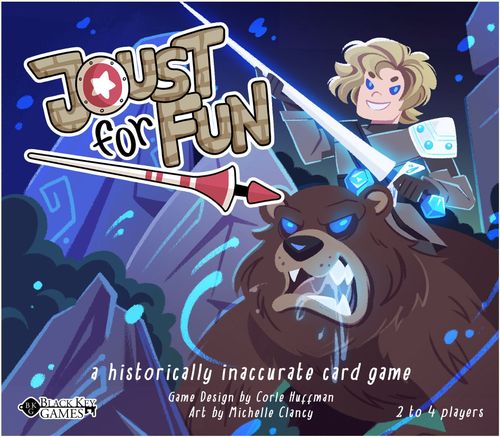
Joust for Fun
Joust for Fun Rulebook
Table of Contents
Table of Contents
Game Setup
- Shuffle the Knights into a deck. Shuffle the Court Cards into a deck. Place both decks between all players.
- Place Fan cards and Damage tokens between all players.
- Each player takes one set of Combat Cards (one each of values 1-5).
- Each player draws 2 Knights, looks at them, and places 1 Knight face down in their jousting region and 1 Knight face down in their stable (See picture p3). All players then reveal their Knights simultaneously.
- Randomly determine starting player.
- Get ready to Joust for Fun!
Knight Card Anatomy
Each Knight card has a Name, an Ability, and a Strength value.
Ability: If a card's ability contradicts this rulebook, the card takes precedence. If two abilities would trigger at the same time, the player whose turn it is chooses the order in which they resolve.
Strength: You may play Combat Cards up to your strength value. If an attacker accidentally plays an illegal value Combat Card, the attack is considered blocked.
How to Play: Turn Sequence
- Draw
- Choose a Jousting Knight
- Choose Combat Cards
- Striking and Blocking
- Resolve Combat
- End of Turn
Draw
Draw either 1 Court Card or 1 Knight. If a deck is empty, reshuffle and make a new deck before drawing.
Court Cards are immediately placed face up on the table. Choose which Knights are affected by your Court Card.
New Knights are placed in your stable. If you have no Knights, you must draw a Knight. If you already have 3 Knights, you may not draw a new Knight.
Choose a Jousting Knight
Place one Knight in front of your other Knights. This Knight is your jousting Knight. The rest of your Knights are placed behind your jousting Knight. The Knights behind your jousting Knight are considered your stabled Knights.
Your jousting Knight attacks the jousting Knight controlled by the player to your left. If that player does not have a jousting Knight, you may attack any of their Knights. If that player does not control any Knights, you may attack the next player.
Choose Combat Cards
Attacking player chooses a Combat Card (with a value less than or equal to the strength value of their jousting Knight) and plays it face down. Defender then chooses any value Combat Card and plays it face down. Both players then reveal their Combat Cards simultaneously.
Striking and Blocking
A strike occurs when the Combat Cards do not match. A block occurs when the Combat Cards match.
If you strike, the attacking Knight's strike ability triggers.
If blocked, the defending Knight's block ability triggers.
- Strike: Deal 1 damage to each Knight controlled by the defending player.
- Block: Deal damage to the attacker equal to your block value.
If a strike appears with a number, like Strike 3, you must strike with that specific number to trigger that ability.
Resolve Combat
If you strike, deal combat damage to the defending Knight equal to the numerical value of the attacker's Combat Card. For each point of damage a Knight is dealt, put one damage token on that Knight.
If you strike, gain a fan; if you were blocked, the defending player gains a fan. Then, return all Combat Cards to their owner's hand.
At any time, if a Knight has seven damage tokens, that Knight is knocked out. A player who knocks out an opposing Knight (at any time, for any reason) gains an additional 3 fans. Any excess damage is ignored.
End of Turn
Discard all Court Cards in play. Play then passes to the left.
Victory
The first player to acquire 12 fans wins!
Royal Decrees
Royal Decrees are advanced, alternate game modes. We recommend playing them after you are comfortable with the basic rules. To play a Royal Decree game, follow all normal setup rules, as well as the rules on that Royal Decree.
Royal Decree: A Knight's Tale
- Victory: Gain 2 trophies (by knocking out 2 opposing Knights).
- Fans: On your turn, spend 6 fans — deal 1 damage to any opposing Knight.
The Royal Decree illustration shows a Trophy card, depicted as a "#1" trophy.
Scenario Cards and Scenario Knights
Scenario Cards are advanced, alternate game modes — often recommended for a set number of players and often using special, scenario-only Knights. We recommend scenarios after you are comfortable with the basic rules. To play a Scenario game, follow all normal rules, as well as the rules on that Scenario Card.
Scenario Knights are only used when playing their Scenario. The back of each Scenario Knight says which scenario they are used for.
Scenario: Maiden Fair's Court Card Carousel
Recommended for 3 players.
- Knights: Each player gets 1 scenario copy Maiden Fair. No other Knights will be used.
- Court Cards: Remove Entice Them With Pie, Cosplay, and Lady in Waiting from the Court Card deck.
- Fans: Fans are not used in this scenario, you may return them to the box.
- Victory: Last Maiden standing.
Rules:
- Each Maiden Fair has 11 health.
- Whenever you would draw a Court Card, don't. Instead, do the following:
- Place the top card of the Court Card deck into the common area "Carousel." This Carousel is shared by all players.
- Whenever a 5th Court Card is added to the Carousel, immediately discard the oldest Court Card in the Carousel without effect.
- Activate each Court Card in the Carousel (including cards that say "when drawn").
- At the end of your turn, do not discard Court Cards as normal.
Maiden Fair (scenario Knight, strength 4): Block — Deal damage to the attacker equal to your block value.
Keywords
- Always: Always abilities are always in effect, regardless if a Knight is jousting or in the stable.
- Block: An unsuccessful attack. Specifically, when a defender plays a Combat Card that matches the attacker's Combat Card.
- Combat Damage: Damage that comes specifically from either a strike or from any source that says combat damage.
- Fan Support: During games with Fan Support rules, you may spend fans on your turn to trigger that game's Fan Support ability. If you have enough fans, you may trigger Fan Support multiple times during your turn.
- Healing: When a Knight heals a point of damage, remove 1 damage token from that Knight.
- Health: Knights begin each game with 7 health.
- Jousting Knight: Jousting Knights are the Knights currently in a player's front row (active region). Only jousting Knights may attack.
- Knocked Out: When a Knight has no remaining health (seven damage tokens) they are considered Knocked Out. Knocked out Knights are discarded.
- Stable: A stabled Knight refers to your Knights that are placed behind your front row.
- Strike: An attack that is not blocked. Specifically, when an attacker plays a Combat Card that doesn't match the defender's Combat Card. A strike also deals combat damage equal to the attacker's Combat Card value.
- Strike X: If a strike appears with a number, like Strike 2, you must strike with that specific number to trigger that ability.