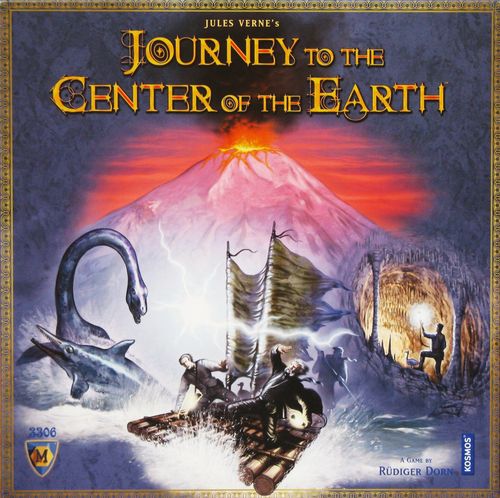
Journey to the Center of the Earth
Journey to the Center of the Earth Rulebook
Table of Contents
Table of Contents
Game Components
- 1 game board
- 3 explorer figures (Lidenbrock, Axel, Hans)
- 1 raft
- 20 water stones
- 10 sea adventure cards
- 2 bonus cards (Mushroom Forest and Ruined City)
- 63 explorer cards (21 each in blue, red, and yellow)
- 45 equipment cards (9 each of rope, pickaxe, compass, hardtack, and Ruhmkorff lamp)
- 64 fossil cards
- 16 event cards
Setup
- The game board is placed in the middle of the table.
- The three explorers are set up on the starting space below the snow crater. Any explorer can be moved by any player — there are no personal figures.
- The raft is placed on the starting space of the underground sea. It only comes into play during the second leg.
- The cards are sorted by their backs and each type is shuffled well. Each player receives 6 explorer cards and 3 equipment cards to their hand. Three more equipment cards are placed face up on the board to form the open display. The remaining cards from each deck are placed face down on the board, as are the fossil cards and the event cards.
- Each player receives 1 water stone and places it in front of them. The remaining water stones are placed next to the board.
- The bonus card "Mushroom Forest" is placed near the finish space of the first leg, and the bonus card "Ruined City" is placed near the finish space of the second leg.
- The sea adventure cards are shuffled and placed face down next to the board. They are not needed until the second leg.
Fossil Cards
During the game, players collect fossil cards, of which there are different kinds:
Various fossil finds: Snail, Bone, and Shell fossils are each worth 2 fame points.
Skull: A single piece of a dinosaur skull is worth 0-5 fame points. Two matching halves together are worth 5 points.
Skeleton: A piece of the skeleton is likewise worth 1 point; two different pieces are worth 3 points; and the complete skeleton of all pieces is worth 12 points.
Gold and Quartz: These become more valuable the more of them a player has: 1 gold is worth 1 point, 2 gold are worth 3 points, 3 gold are worth 6 points, and so on. If a player has 6 gold (worth 20 points), every additional gold card is worth 5 points. Quartz fame points are calculated the same way.
Sequence of Play
The journey runs over three legs. Somewhat different rules apply for each leg, so it is not necessary to read the whole rulebook at once. It is enough to read the rules for the first leg, play it (duration about 45 minutes), and then read the changes for the second leg and play it (about 20 minutes). Finally, read the rules for the short third leg and play it (about 5 minutes).
Leg 1: The Descent Into the Interior of the Earth
Cautiously they feel their way forward. It is dark, close, and hot. They would almost have died of thirst had Hans not discovered an underground stream, which Professor Lidenbrock immediately named "Hansbach." An incredible discovery awaits at the end of the descent.
The boldest player is the starting player and performs one of the following two actions:
a) draw 3 cards, or b) move 1 explorer
The player to their left is then next in turn, and likewise has the choice between the two options, and so on.
a) Draw 3 cards
- The player draws a total of three explorer and/or equipment cards in any combination. Example: 1 face-up equipment card from the display, 1 card from the face-down equipment deck, and 1 card from the face-down explorer deck.
- Important: observe the hand limit! Each player may hold at most 10 explorer cards and 5 equipment cards. If a player has already reached this limit and draws another card, they must immediately discard a card (this may also be the card just drawn).
- If a card is taken from the display, the display is refilled back to three only at the end of the turn.
- If a face-down explorer or equipment deck is used up, the corresponding discard pile is shuffled and becomes the new face-down deck.
b) Move 1 explorer
- The player may move one of the three explorers by playing explorer cards of matching color — but at most 5 explorer cards of one color.
- Moving an explorer from one space to an adjacent space normally costs 1 card.
- An explorer is moved horizontally or vertically (not diagonally) and may change direction freely during the move. At least one space must be moved forward (that is, downward). Moving backward or purely sideways is not allowed.
- No more than one explorer may stand on a single space. It is, however, permitted to move past other explorers.
- On their turn, a player may play as many equipment cards as they like.
- After the move, the player places the played explorer and equipment cards face up next to the respective face-down decks. This creates a separate discard pile for each card type.
- The rules for the different board spaces must be observed during movement.
See also the two movement examples below.
Board Spaces
Granite: Cannot be entered.
Chasm: Can only be crossed with a "rope" equipment card. An explorer may not remain standing on the chasm space.
Rocks: Costs 1 card per rock pictured on the space (so 2 or 3 cards). Exception: the "pickaxe" equipment card.
Hansbach (stream): If an explorer's move ends on such a space, or the explorer passes over one, the player receives a water stone from the supply and places it in front of them. Water stones are important so that discovered fossil cards are not lost at the end of the leg.
Discovery: If an explorer's move ends on a fossil space, the player may make a discovery. To do so, they must discard from their hand the equipment cards pictured on the space (matching quantity, matching symbols). If a star is pictured on the space, the player may discard any equipment cards for the star. The player then takes the same number of cards (that is, 1 to 3 depending on the space) from the fossil card deck. Found fossils are sorted face up by card type in front of the player. The value in fame points of a fossil card depends on the type of fossil (as described on page 1 [above]).
Event: If an explorer's move ends on such a space, or the explorer passes over one during the move, the player draws the top card of the event card deck at the end of their turn. There are only positive events. Cards showing a lightning bolt are read aloud and resolved immediately. The remaining cards are picked up by the player and may be used later, once.
Equipment Cards
The following equipment cards exist:
Rope: Allows the crossing of a chasm space. It is not permitted to remain standing on the chasm space. Entering the chasm space still costs a normal explorer card.
Compass: The explorer may move 1 space diagonally. This move also costs an explorer card as usual.
Hardtack: This card counts as two additional cards of the chosen color. The player may not, however, move using only hardtack — they must also play at least one explorer card. With one or more hardtack cards, it is possible to move more than five spaces.
Pickaxe: All spaces on which rocks are pictured cost only 1 card for the rest of the turn.
Ruhmkorff lamp: The player may draw two more fossil cards than the number of equipment cards they discarded. They may choose which of all the drawn fossil cards to keep. The fossil cards they do not choose to keep are pushed back into the middle of the card deck.
Movement Examples
Example 1: The player wants to reach the circled discovery space. To do this, they play 3 red explorer cards and may thus move the red explorer 3 spaces. In addition, they play 1 rope to cross the chasm. With the help of a compass card, they may move diagonally, thereby bypassing the difficult-to-cross space with 3 rocks. On the discovery space, they play 1 more rope and 1 pickaxe and receive 2 fossil cards.
Example 2: The player wants to finish the first leg but only has 1 blue explorer card in hand. So they play this card plus 2 hardtack cards. This lets them move 5 normal spaces. In addition, they play a pickaxe so that each rocky space costs them only 1 card. They also play a compass to move 1 space diagonally. The player receives 1 water stone and the "Mushroom Forest" bonus card. To finish their turn, they also draw an event card.
End of the First Leg
As soon as a player moves an explorer onto the finish space of the first leg, that player receives the "Mushroom Forest" bonus card. The three explorers are then placed onto the raft, which is on the starting space of the Lidenbrock Sea.
- At the end of the leg, each player checks whether they have enough water stones to keep the fossil cards they have collected. The rule is: 1 water stone "supplies" 3 fossil cards.
- If a player does not have enough water stones, they must discard fossil cards until the supply is sufficient. Example: a player has 11 fossil cards and 3 water stones. These "supply" 9 fossil cards; the player must discard 2 fossil cards.
- The water stones needed for the supply are then returned to the box.
- Any player who still has water stones left over scores 1 point per stone at the end of the game.
Leg 2: The Voyage on the Lidenbrock Sea
Professor Lidenbrock names the underground sea after its swift discoverer. A raft has been built from the trunks of giant mushroom trees, and the journey continues. There is much to discover: Axel Island, a geyser, and — could it be? — a battle between two prehistoric sea creatures!
The same rules as for the first leg apply, with the following exceptions:
- Since this is a freshwater sea, the fossil cards do not need to be supplied with water stones at the end of the leg.
- With the "rope" equipment card, a whirlpool can be crossed, just as with the chasm in the first leg.
- Instead of moving one explorer, the players move the raft with all three explorers. To do this, up to five explorer cards of any one color may be played.
- When the raft is moved, it must move at least one space toward the finish space on the opposite side. Moving backward or purely sideways is not allowed.
Whenever a player moves the raft onto a discovery space, every other player, in turn order starting to the active player's left, may also discard the equipment cards required on the discovery space (matching quantity, matching symbols) and draw the corresponding cards from the fossil card deck. This applies even if the active player themselves cannot or does not want to make a discovery on that space. Only the active player, however, may use the "Ruhmkorff lamp."
Sea Adventures
After the raft has been moved (and any discoveries have been made), the active player reveals the top sea adventure card at the end of their turn. There are positive and negative sea adventures. The positive ones are the fossil find, the sighting of a geyser, Axel Island, or the battle of two sea saurians. The negative one is the ball lightning.
To successfully complete a positive adventure, the active player must discard the explorer card(s) requested on the left side of the card. In return, they receive the reward pictured on the right side of the card. For a fossil find, they may draw one fossil card and then put the sea adventure card back in the box. For a sighting, they receive the card, which brings the fame points printed on it.
If the active player cannot or does not want to discard the required explorer cards, then in turn order, each other player in turn gets the chance to discard the cards for the reward. As soon as one player discards the cards, the adventure is completed. The other players then no longer have this chance. If every player has had a turn and no one could or wanted to discard the required explorer cards, the card is put back in the box unused.
Example: Playing with three players. The active player has moved the raft and, at the end of their turn, reveals a fossil find. To make this find, they must discard a yellow explorer card. Since they do not have one, the next player clockwise now has this chance. They also cannot discard a yellow explorer card. Since the last player finally also does not have the required card, the sea adventure card is removed from the game.
Ball lightning: The ball lightning goes around the table once until it strikes someone or everyone has protected themselves against it. To protect themselves, the active player must discard the explorer cards requested on the left side of the card (two of one color or two of any colors, depending on the card). If a player can or will not do this, the ball lightning strikes them and they lose one fossil card of their choice. The turn then ends and the ball lightning is removed from the game.
If, however, the player does discard the explorer cards, the ball lightning moves on in clockwise order to the next player, who must now likewise protect themselves, and so on. If every player has had a turn and could protect themselves against the ball lightning, the card is removed from the game with no losses.
End of the Second Leg
If a player moves the raft onto the finish space, they receive the "Ruined City" bonus card. The raft is then placed at the start of the lava stream for the final leg (onto the pictured brown raft).
Leg 3: The Lava Stream
Faster than expected, the end of the journey has come. On a stream of glowing lava, the adventurers are carried out of the volcano. But what is this? This is no longer Iceland. In Italy, they surface again, to present their finds to the scientific world and report on their experiences.
- A player reveals the top explorer card and moves the raft to the next space showing a raft of the same color.
- If the raft lands on a space with one or two crossed-out fossil cards, every player loses that many fossil cards of their choice.
- This loss can sometimes be prevented: before it takes effect, the top card of the face-down equipment card deck is revealed. Every player who holds the equipment card pictured on it may discard that card instead of losing fossils.
- Afterward, the next explorer card is revealed and the raft is moved again, and so on.
- Once the raft reaches the last space of the lava stream, or moves past it because the revealed color no longer has a raft ahead of it, the game ends.
Example for the Lava Stream Leg
- A yellow explorer card is revealed. The raft is moved onto the next space showing a yellow raft. Then the top equipment card is revealed: a rope. Any player who can now discard a "rope" is protected. All other players lose one fossil card of their choice.
- The next player likewise reveals a yellow explorer card and moves the raft accordingly. Since no card can be lost on this space, no equipment card is revealed.
- The next player draws a red explorer card. The raft is moved forward, and again nothing happens.
- The following player draws a blue explorer card. Bad luck — everyone loses 2 fossil cards, unless they can discard the correct equipment card instead. A "pickaxe" is revealed. Whoever still holds it is protected. Everyone else must give up two fossil cards.
Since there is no further space on the lava stream, the leg — and therefore the game — ends here. Had a red card been drawn last instead of a blue one, the game would have ended immediately, since there is no red space left on the route.
Game End and Scoring
- The players total the fame points of their collected fossil cards and add the points from their collected bonus cards for the finish spaces and for successful sea adventure sightings.
- For any water stones remaining from the first leg, each is worth 1 point.
- Explorer and equipment cards still held in hand score no points.
- The player with the highest total wins. In case of a tie, the tied player with the most fossil cards wins. If this is also equal, there are multiple winners.
Scoring example:
At the end of the game, a player has the following in front of them:
| Cards | Fame points |
|---|---|
| Snail, Bone, Shell, Skull, Skull | 8 points |
| 2 Skulls (0-5 each) | 5 points |
| 3 Skeleton pieces (complete set) | 3 points |
| 1 Skull (0-5) | 0 points |
| 3 Gold | 10 points |
| 1 Quartz | 1 point |
| Mushroom Forest bonus card | 4 points |
| Geysir sighting card | 3 points |
| 1 water stone | 1 point |
The player has thus scored 35 fame points.