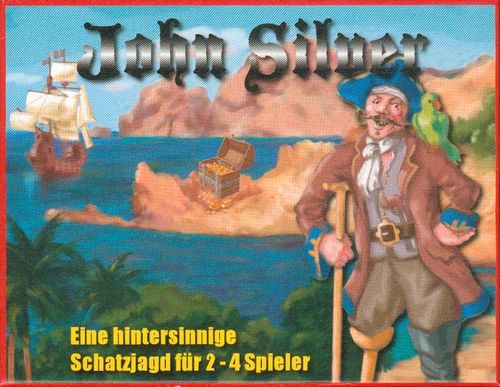
John Silver
John Silver Rulebook
Table of Contents
Table of Contents
Equipment
The game comes with 3 sets of 13 cards each. One contains treasure chests, one sailors, and the third ships. In addition, there are 5 Joker cards. They show numbers from 5 1/2 to 9 1/2.
Each of these 3 card sets has one neutral card without a number; its front differs from the other cards.
Finally, there are 4 Character cards (2 of each): a pirate, a ship's boy, a captain and a merchant.
Setup
Choosing roles and taking cards
Each player chooses a role. They place the corresponding Character card in front of them so as to see the rules summary and, at the same time, each player knows who is who. With two players, each takes 2 roles. Regardless of the number of players, the second Character cards are placed side by side in the center of the table. With 3 players, the 4 cards are placed in the center of the table; one of them is not assigned to a player.
The 3 symbol cards (ship, sailor and treasure chest) are placed one below the other, each forming the start of a row. The Character cards and the symbols form a matrix of 4 columns by 3 rows; each column is assigned to a player, in any order.
Shuffle the 44 cards and deal 6 to each player. The rest is placed to the side, face down. If a player has no Apple card among their 6 cards, they may put them back and draw 6 new ones. This exchange is allowed only at this moment of the game, not during the game.
Goal of the Game
Apples and gold coins
The player who collects the most points wins. However, the points are not the numbers on the cards. Instead:
- each gold coin earns 1 point
- each Apple earns 1 point, but for the neighbor to the player's left
- black spots reduce the points owned.
Course of the Game
A difficult road to victory
The player who looks most like a Pirate starts the game. Then play proceeds clockwise.
On their turn, the player places one card. Cards are played below one of the 4 Character cards and in one of the 3 rows: one row for sailors, one row for ships, and one for treasure chests (see Example 1). The result is a 3x4 matrix of cards which will be built in the center of the table. The following rules apply:
- there can be only one row of each type of card. If a row with treasure chests exists, the next chest must be placed in that row.
- players may place their card on any free space. They are not restricted to playing under their own Character card.
- in each column, there can be only one card of each type.
- the Joker can be used as a treasure chest, a sailor or a ship. Several Jokers may be placed in the same row.
Example 1: If player 1 wants to place a treasure chest in the game, they must place it in the 1st row. They cannot start a second row of treasure chests. Since players 2 and 4 have already placed a treasure chest, player 1 cannot place their treasure chest in those columns; they can only place it in player 3's column or in their own column.
A player may start a row with a Joker. It takes the symbol of the card to its left.
After their turn, the player takes a new card from the pile, and again has 6 cards in hand. If the player placed a card with an Apple, they may choose:
- to draw a new card from the pile, as usual
- to take one of the cards already in play, but not one with Apples
Example 2: In the sailor row, player 4 is in a bad position. They are in danger with their 1 and their 5 1/2, which means 4 black spots (you will understand shortly). The only solution is an Apple card. They place it in any row, remove the card from the sailor row and clear the situation. Now they take that card into their hand and do not draw a new one from the pile.
If the pile is empty, the only way to complete one's hand is to play an Apple card. The player must take a card from the table. This means that players' hands can empty at any time. It may happen that a player is the only one who still has cards. In general, this is an advantage.
If a player has no more cards in their hand, they can still receive points if other players play cards in their column.
The game continues until all the cards are placed. Incomplete rows are not scored.
Distribution
Collecting treasures
At the end of each turn, check whether a row is filled with 4 cards. If so, this quartet is distributed:
The card with the second highest value is paired with the card of highest value. The second lowest card is paired with the lowest card. The cards are given to the owners of the columns where the pairs of cards are located.
It does not matter how the cards got there; what matters is where they are at that moment. With 3 or 4 players, cards showing black spots are revealed so that every player sees where they are.
Example 3: There are 4 cards in the Ship row, so there is a distribution. Player 1 has the highest card, 9 1/2. The 9 1/2 and the 9 are given to them. Player 3 has the lowest card. They receive that card and the 7.
What would the distribution have been if a 7 had been placed in the Ship row? That 7 shows Apples and, as explained earlier, when an Apple is played, a card must be taken from the table. Could it be a card from the Ship row? Yes! If the player does so, there will be no distribution, because after their turn there will be only 3 cards in that row.
With 3 players, there is a dummy player who belongs to no one. If this player wins cards, they are removed from the game. In the 2-player variant, it is possible for a player to take all the cards.
End of the Game
The black spots come into play!
If no more distributions are possible, the game is over. The cards of the incomplete rows are discarded. Each player takes the cards they won during the game and sorts them as follows:
- the cards with Apples;
- the cards with gold coins;
- the cards with black spots.
The Apple cards are given to the player on the left, who will gain those points. In a 2-player game, a player gives all their Apple cards to their opponent. Now, the count:
- each gold coin and each Apple earns 1 point.
- each player counts their black spots, and:
- with 2 players, each black spot removes 1 point.
- with 3 or 4 players, the one with the most black spots loses 8 points, the second loses 4 points. If players are tied for the most black spots, they each lose 6 points; if there is a tie for second place, they each lose 2 points.
Variant
A way to become rich
In the basic game, each column can contain only one card of the same type. That is why, in Example 1, the treasure chest must be placed in position 1 or 3.
In the variant, more than one card of the same symbol may be placed in each column, by placing them one above the other, up to 4.
But it is not allowed to place cards with different symbols in the same row. A distribution always takes place when a row is filled.