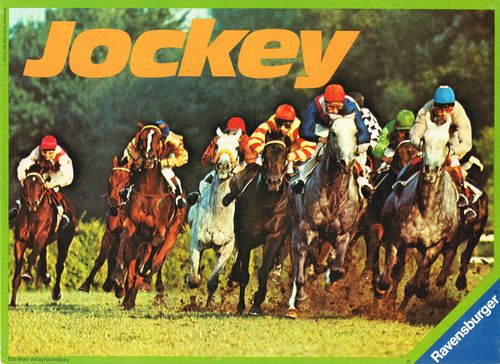
Jockey
Jockey Rulebook
Table of Contents
Table of Contents
Components
- 1 Felt Game Board
- 54 Jockey Cards
- 4 Horse Figures
- 6x3 Marker Pieces
- Betting Pad
Each player receives several "Jockey Cards" as well as starting capital, with which they can place bets. Once the "Jockey Cards" have been dealt, each player estimates their chances and bets on particular horses. In turn, each participant plays a Jockey Card. Following the instructions on the cards, the horses are moved, with any player able to move any horse. Through sharp observation, clever use of one's own cards, and by taking advantage of the other players' moves, each player tries to bring the horses they have bet on to victory and win their bet.
The goal of the game is to have the highest betting capital after three races.
Preparation
The four horses are placed on the starting squares of the unrolled game board.
Each player receives a betting slip and three round marker pieces bearing the same number. This number, as well as the player's name, are noted on the betting slip.
Each player receives 1000 as starting capital. This balance is recorded by placing a marker piece on square 1 of the 1000s row of the scoring table in the middle of the game board.
The Jockey Cards are shuffled thoroughly and dealt:
- 15 cards each with 2 players
- 12 cards each with 5 players
- 10 cards each with 4 players
- 9 cards each with 5 and 6 players
The remaining cards are set aside face down as a reserve pile.
Jockey Cards
After a Jockey Card is played, a horse is moved according to the information on the card.
The following card types move only horses of a specific color:
-
There are two versions of this card: "+7" and "+10". The horse of this color is moved forward by the indicated number of squares.
-
If the horse of this color is in the lead, its lead is tripled (x5). Example: Red is six squares ahead of the next horse. Red advances twelve squares and extends its lead to 18 squares.
-
This horse is moved forward 50 squares (+50 max.), but no further than 5 squares behind the leading horse. Remaining squares are forfeited.
Neutral Jockey Cards can be used for any horse.
-
There are two cards of this type: "No. 2 +15" and "No. 4 +20". The horses in second and fourth position are moved forward by the indicated number of squares.
-
The horse in third position moves forward 18 squares (+18 max.), but no further than one square ahead of the leading horse. Remaining squares are forfeited.
Course of Play
A game consists of three races. Before each race, the players sort their cards by color cards and neutral cards. According to the 4 types of bets, they estimate the winning chances these cards offer them. Each player then places their bet secretly. The finishing order and bet amount are noted on the betting slip in the "1st Race" section. The betting slips are collected and set aside until the end of each race.
The oldest participant begins. They play the first Jockey Card, lay it face up next to the game board, and move a horse on its track according to the information on the card. In turn, each participant then plays a card, lays it on top of the already-played card, and moves the corresponding horse.
A card must always be played; passing is not allowed. If a player does not want to change a situation for tactical reasons, they may "discard" a card. This is possible when two or more horses are on the same square. In this case, the placement of these horses cannot be determined.
Only the placements marked with "No." can be determined; the others cannot. The cards for the positions that cannot be determined (depending on the game situation, cards 2, 3, 4, 5) may be played, but no horse is moved. See illustration.
If the cards are not sufficient to finish a race, players each receive two more cards from the pile that was set aside, or the bottom cards from the pile of played cards. If not all cards were needed for a race, each player may keep up to two cards of their choice for the next race, and receives correspondingly fewer cards when the cards are redealt.
End of Game
A race is finished when two horses have passed the finish after square 80. The betting slips are revealed, profit or loss is determined, and the new account balance is recorded by placing the three marker pieces on the scoring table.
For the second and third races, the cards are reshuffled each time and the bets are noted on the betting slip in the "2nd Race" and "3rd Race" sections.
Bets
Bets are only placed on the winner and on second place. The stake for a lost bet is always deducted from the balance. Only one bet may be placed per race.
Win Bet
Example
A bet is placed only on the winning horse. If the bet is correct, the player wins three times their stake. Example: A stake of 500 on the yellow horse to win; if yellow wins, 900 is credited to the player; if another horse wins, 500 is deducted from the balance.
If several players have placed a win bet on the same horse, or set that horse as No. 1 of their finishing-order bet, only double the stake is won on the win bet.
Double Bet
Example
The bet is placed on the win of two horses. If one of the two horses wins, the player is credited the stake amount.
Place Bet
Example
Unlike the Double Bet, where two horses are bet on for first place, here a bet is placed on one horse, and the stake amount is won if this horse finishes in first or second place.
Finishing-Order Bet
A bet is placed on two horses that must pass the finish in the specified order.
Example
On the betting slip, the first and second horse are marked and an amount is staked for each horse. If the two horses pass the finish in this order, the player receives four times both stakes. Example: Stake for No. 1 = 400, stake for No. 2 = 500, 5600 is credited.
If the horse set as No. 1 was also staked by other players as No. 1 of a finishing-order bet or as the winning horse of a win bet, only three times both stakes is won on the finishing-order bet. If only the horse set as No. 1 finishes as the winner, payment is calculated as for a win bet; if only the second place of No. 2 is correct, payment is calculated as for a place bet. The stake for the other horse is deducted in each case.
Recording Winnings
The minimum stake on a horse is 100, the maximum stake is the current account balance. Exception: if the balance is less than 1000, a credit can still be taken so that up to 1000 can be staked. A credit of up to 1000 is granted for each race.
The scoring table in the middle of the game board has five columns: three columns for balance, 10000, 1000, 100, as well as two columns for credit, -100, -1000. The current account balance is recorded by the three marker pieces of matching digit, one figure each for the columns 100 (-100), 1000 (-1000), 10000.
In the illustration, player 1 has a balance of 52,500, player 6 has taken a credit of 1400.
Advanced Tips
Keep your opponents in the dark for as long as possible about which horse you have bet on. Your opponents can help you bring your horse to victory.
Play the Jockey Cards that bring your horse far into the lead only near the end of each race.
Card types 4 and 5 deserve special attention, since the placements of the horses, and thus the usability of these cards, change with almost every move. With good tactics, you can bring all of these color-neutral cards into play for the color you have bet on.
The Win Bet is recommended when a player has many good cards of one color.
If you have good cards for two horses, choose the Double Bet and stake a correspondingly high amount.
The Place Bet is usually chosen when you mostly have cards of one color but are not certain whether they will be enough for the win.
Since the Finishing-Order Bet requires attention to the order in which two horses finish, it should only be chosen once players are already somewhat familiar with the game.