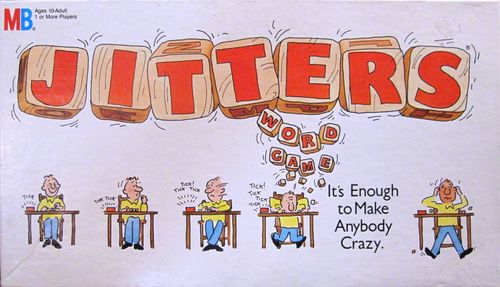
Jitters
Jitters Rulebook
Table of Contents
Table of Contents
Number of Players
Jitters is a game for any number of players. In a solitaire game, play for practice as you try to beat your previous scores.
Object
Play a series of rounds, until one or more players reach a total of 250 points or more at the end of a round. The player with the highest total score of 250 points or more wins the game.
NOTE: The winning score can be adjusted upwards or downwards, to accommodate number of players and desired playtime.
Contents
- 12 letter dice
- 1 timer
- 1 dice cup
- 20 cards
Game Setup
- Shuffle the cards and place them facedown in a drawpile, next to the timer.
- One player acts as the scorekeeper. The scorekeeper takes a paper and pencil (not provided), to write down the score after each player's turn and the scores at the end of each round of play.
- Keep a dictionary nearby as a definitive reference source, in case of challenges.
Game Play
Choose a player to go first. After each player's turn, play continues to the left.
Basic Turn
To begin your turn, follow the steps below:
- GET THE DICE AND TIMER READY. First, place all 12 dice in the dice cup. Then press STOP on the timer switch, and wind the timer dial clockwise as far as it will go.
- START THE TIMER. Press START on the timer switch. The timer will immediately begin ticking--and the rest of your turn will be a race against time!
- DRAW A CARD. Quickly take a card from the top of the pile, and place it faceup in front of you.
- ROLL ALL 12 DICE. Then quickly try to form words on your card as described in the rules below.
Earning Points On Your Turn
Your object on each turn is to earn points by completing one or more cards drawn from the deck. Complete as many cards as possible, one at a time, by placing the dice you roll on the colored circles to form words. Each time you complete a card, you have two options:
- You can stop the timer to end your turn, then total your points; or...
- You can draw a new card, and try to complete it to add points to your score.
Here's the real challenge: To earn points on your turn, you must complete your last card and stop the timer! If you complete your last card and stop the timer, you earn the point total of all the cards you completed on that turn. However, if time runs out before you stop the timer--whether you've completed your last card or not--you earn no points at all for that turn!
The Cards
Each card in the deck shows a letter pattern and a point score: the more difficult the pattern, the higher the point score. See Figure 1 for an example of each.
FIGURE 1 -- Point scores range from 10 points (for the easiest pattern) to 25 points (for the most difficult pattern). (The figure shows four cards, scoring 10, 15, 20 and 25 points, each with a pattern of colored circles.)
RULES FOR FORMING WORDS. To form a word or words on your card, place one letter die on each of the colored circles. Rules for forming words are as follows:
- Use only the top letters on the dice to form words on your card. EXCEPTION: See Sideswiping, on page 4.
- You cannot use the same word more than once per card. But you can reroll the dice if you get a bad letter mix (see Rerolling, on page 4.)
- On some cards, you must form one or more separate words; on others, you must form two or more connected words (words that connect to other words by common letters). Figure 1 (above) shows an example of each of these two types of cards.
- The words you form must be legal, or you may be challenged (see the list of illegal words under CHALLENGES).
- While forming your words, you can rearrange the dice on the card as often as you like--or take dice off the card and replace them with dice on the playing area. But remember to use only the top letters of the dice rolled.
Completing Your Card
Once you've formed all the words a card pattern calls for, you've completed that card. (Figure 2, on page 4, shows a complete card.) You now have the option of stopping the timer to end your turn, or starting a new card. The rules for each option are described on page 4.
STOPPING THE TIMER. Stop the timer by pressing STOP on the timer switch. This ends your turn. Then follow the rules under To Score, Or Not To Score?, on page 5.
STARTING A NEW CARD. To start a new card, quickly do the following:
- Move your completed card aside, then draw a new card from the top of the pile, and place it faceup in front of you.
- Roll all 12 of the dice again, and follow the rules for forming a word or words to complete your new card.
You may start any number of new cards on your turn, as long as you've completed your previous card.
FIGURE 2 -- "If you draw this card..." (a 20-point card) "...and roll this letter mix..." (letter dice shown scattered) "...you can complete your card by forming these words" (the card shown with letter dice F, L, Y, E, T, I, P placed on its circles).
Dice Rules
REROLLING. If you get stuck with a bad letter mix, you may reroll the dice to try for better letters. You can reroll as many times per card as you like--but you must reroll all 12 dice each time. This means you may have to remove one or more already-formed words from your card!
SIDESWIPING. On any roll of the dice, you may "swipe" one letter from the side (not the bottom) of one die. For example, you may need an "E," and discover that no "E's" are showing on the dice tops. Instead of rerolling all of the dice, you may turn the dice you haven't used, to look for an "E" on the side of one of them. If you find it, just flip the die over so that the "E" is on top, and place it on your card.
Whenever you sideswipe, announce it to the other players. You can only sideswipe once per dice roll.
Ending Your Turn
Your turn is over: 1) When you stop the timer after finishing a card; 2) When the timer runs out; or 3) When you lose a challenge (see CHALLENGES).
To Score, Or Not To Score?
WHEN AND HOW YOU SCORE POINTS. If you completed your present card and stopped the timer before time ran out, read the point score on that card aloud to the scorekeeper. Also read aloud the point scores on any additional cards you completed during your turn. The scorekeeper adds up the points and records your total. This is your score for the current round of play.
WHEN YOU CAN'T SCORE POINTS. If you did not complete your present card and stop the timer before time ran out, you receive no score at all for your turn! Even if you completed your present card, you receive no score if you didn't stop the timer.
Place the cards you drew during your turn in a faceup discard pile, next to the drawpile. Play now continues with the player to your left.
CREATING A NEW DRAWPILE. To make sure the next player has enough cards to draw during his or her turn, reshuffle the discard pile to form a new drawpile when there are five or six cards left in the drawpile you're using.
Challenges
As a player forms words on a card, any other player can challenge the spelling or legality of a word formed. A word is considered illegal if it falls into the categories listed below.
ILLEGAL WORDS
- Words which are always capitalized (Utah, August).
- Words requiring a hyphen (one-way, co-op).
- Words requiring an apostrophe (you're, don't).
- Abbreviations and symbols (RCA, AG).
- Prefixes and suffixes unable to stand alone (un, ing).
- Foreign words that don't appear in your dictionary (moi, der).
ISSUING A CHALLENGE. The challenger must issue the challenge before the challenged player removes the dice from a completed card, or stops the timer to end his or her turn. Then the challenger must announce which word is being challenged. For example, the challenger says "I challenge the word ______." NOTE: Once a challenge is issued, it cannot be taken back!
When challenged, a player has two options: he or she can either remove the word in question and form a different word; or stop the timer and resolve the challenge before continuing.
RESOLVING A CHALLENGE. To resolve a challenge, a neutral player consults the dictionary.
The challenger wins if the challenged word does not appear in your dictionary, or appears in your dictionary but is spelled incorrectly or is illegal (see Illegal Words, on page 5). When the challenger wins, the challenged player's turn ends, and he or she receives a "0" score for his or her present turn.
The challenged player wins if the challenged word appears in your dictionary, is spelled correctly, and is not illegal (see Illegal Words, on page 5). The challenged player can then press START on the timer switch and continue playing, using the successfully defended word if desired. NOTE: If the challenged player has completed his or her present card, he or she may choose to leave the timer off and end his or her turn.
The unsuccessful challenger must skip his or her next turn and take a "0" score for that turn. Each time a challenger loses a challenge, he or she loses a turn!
Ending A Round
A game consists of several rounds of play. The scorekeeper keeps a running total of each player's score. After the last player in a round has taken his or her turn, the scorekeeper announces the running total scores to the players.
How to Win the Game
Continue rounds of play until one or more players reach a total of 250 or more points when a round ends. The player with the highest total (of 250 points or more) wins the game!
RESOLVING A TIE: Players tying for first place must play a tiebreaker round. Winner of the tiebreaker round wins the game!