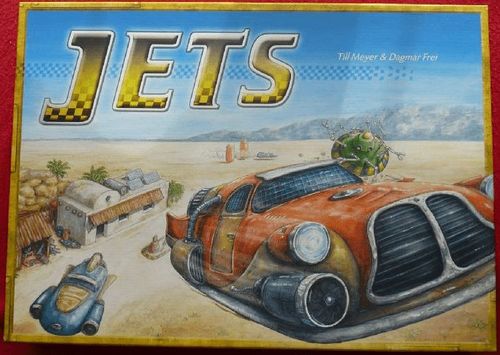
Jets
Jets Rulebook
Table of Contents
Table of Contents
Overview
Three to six players try to steer their jets through a number of gates as quickly as possible. All gates must be flown through in ascending order.
It is not only about planning your own flight path well, but also about defending yourself against the nasty tricks of the competition. Jet races are fought with hard bandages. When the first jet has passed the start gate again, the race is over. The player who manages this wins.
The players may also agree to fly two laps. Through energy consumption, the demands on tactics change considerably. As a rule, the pilot who has best managed his energy consumption will win.
Beginners and advanced players
To learn the finer points of a jet race step by step, prospective pilots may start in four stages. (The quick overviews of the variants are at the end of the rulebook.)
- First race (simple): All jets start with 15 energy units but receive no equipment cards. Such a race is not very spectacular, but you do learn to fly a jet.
- Second race (for more experienced pilots): All jets start with 15 energy points. Each jet may receive three red or green equipment cards and one blue one. Only the projectors Kupferwurm HaZ IV, Sticky Fingers and Butt Kick are in play.
- Third race (for experts): All equipment cards are in play, and each jet may receive 7 equipment items.
- Fourth race (for cracks): Equipment cards that were not installed at the start also stay in play. A description is at the end of the rulebook (see "Races with all the trimmings for cracks").
Components
- 6 jets (each: a hexagonal base plate and a rectangular handle piece)
- 5 lifts and 1 projector lift
- 45 equipment cards
- 100 round energy chips
- 6 dice in 6 colours
- 30 square damage chips
- 18 gate buoys (Torbojen)
- 1 rulebook
Setup
It is generally recommended to play on a carpet or a tablecloth, as the playing materials then slip less easily. Playing on shag pile or similar long-pile flooring is strongly discouraged.
Before the first game, the jets, consisting of a hexagonal base plate and a rectangular handle piece, must be assembled. It is recommended to glue these parts together.
-
Lay out the 5 to 9 target gates on the table or the floor. Each target gate consists of two buoys that carry numbers and belong together by colour. A target gate is laid out by placing the Lift 4 indicator somewhere and somehow on the playing area. One of the two buoys of the same colour is placed in each of the two angles of the indicator. Then the indicator is removed and the target gate is finished.
How large the distance between the target gates is, is up to the players. The more gates and the greater the distance between them, the longer the race takes, but the faster it also becomes.
For a nice little beginners' afternoon race, 5 gates should be set up about 20 cm apart from each other, forming roughly an oval circuit together.
More experienced pilots may set up all 9 gates and construct courses with bends and loops.
Pilots who have already received the higher honours of the desert race may agree to place some or all target gates with smaller lifts. Narrower gates require much more skill in flying.
The race course should be laid out before the equipment phase, since some equipment is sensibly useful or quite useless depending on the course.
-
Gate 1 is the starting line. All jets start behind this line. After the start, the gate counts as a target gate. Whoever first flies through it again wins the race.
-
Each player receives a jet, which he initially places in front of himself.
-
Each player receives a die in his player colour. It is turned with the 0 facing up, showing that the jet is standing still, i.e. has a lift of zero.
-
The 6 lift indicators (5 lifts and one projector lift) are set aside.
-
The damage chips are set aside.
-
(Not in the simple race.) All equipment cards are laid out face up. There are navigation aids that improve flight behaviour (blue cards), equipment with which one can hinder the competition (red cards), and other equipment (green cards). A description of the equipment is on each card; a detailed explanation is in the back part of the rulebook.
Race
Turn sequence
As soon as a player starts, he places his jet behind the finish line, which is the imagined line between the gate buoys marked "1". Since every jet stands still at the start of the game (the die showing lift indicator 0 facing up), the first turn is flown with Lift 1. The player places Lift 1 at the front of his jet, aligns it, and moves his jet to the front end of the lift. The coloured die is used to mark the speed flown in this round.
If no additional equipment is used, the turn is over and the next player is on turn.
Players may use a Booster, a Hyper Booster or a Take Five Booster to make a really rapid start, but must then also pay the energy consumption stated on the card.
Each time an additional equipment item is used, the player must hand in the number of energy chips stated on the card.
End of the race
As soon as a player has flown through gate 1 after having passed all the other gates in ascending order, he is the winner of the race. The competition may still contest the next places.
Flying
Jets fly at 5 different speeds, colloquially called "Lift". The faster the lift, the greater the distance the jet covers. But the higher the speed, the smaller the ability to change direction. Truly tight curves are only possible at small lifts. However, there are additional equipment items that can significantly improve cornering behaviour.
When a player is on turn, he must first decide whether to accelerate, to brake, or to keep the lift of the last turn. Accelerating and braking are only possible by one lift level. So a pilot who flew with Lift 3 may do this again, brake to Lift 2, or accelerate to Lift 4.
The speed chosen for this round is marked with the die in the player's colour.
When the player has decided, he places the corresponding lift exactly at the front of his jet. He may align the lift as far to the left or right as the angle of the lift allows. Then the jet is taken from the back end of the lift and placed again exactly at the front. Here too, the direction of the jet may be changed within the possible angle.
Once a player has taken a lift in his hand, it must be used. It is not allowed to try several lifts and only then decide. (Source footnote 4: if the pilots agree, lifts may be tried out, but this then applies to all participants of a race.)
Overtaking
When a pilot flies a course in which the lift touches another jet, the jet standing in the path of the arriving jet is briefly tipped over an edge, and the lift for the other, crossing jet is laid as usual.
If a collision is nevertheless unavoidable, built-in safety modules ensure that the jet coming from behind "slips" and thereby evades.
Slipping
Each pilot should fly so that he does not collide with another jet; that is, two jets may not touch at the end of a turn.
However, flight paths may cross. In this case, the lift with which the arriving jet flies is placed at the front of the supposedly rammed jet, and at the front of that lift the arriving jet. Slipping can therefore be used very nicely for overtaking, but it is a clear violation of the RsVO.
If several jets fly one behind the other, it can happen that a jet coming from behind slips several times.
Slipping because of an avoided collision costs the slipping jet one unit of energy; with repeated slipping, one unit of energy for each slip.
If a jet has no energy left, it cannot slip, and it must in any case fly so that a collision is avoided. If this is not possible, the jet must miss a turn.
Sideways slipping
If there is a danger of collision from the side, the lift for the slipping jet must likewise be placed at the front of the slipped jet. The change of direction for the slipping jet is therefore dramatic and often not what the pilot had imagined for a targeted flight.
If the pilot does not accept the resulting change of direction, a course must be chosen in which slipping is avoided.
In the rare cases where this is not possible, the automatic system places the slipping jet in a stasis field for one turn. So: either slip, or evade, or miss a turn.
Head-on slipping
(Source footnote 6: the "Geisterfahrer" ("wrong-way driver") expansion offers further tactical options. It is not part of this rulebook.)
In rare cases, two jets fly towards each other more or less head-on. In this case, the lift for the slipping jet is placed at the back of the slipped jet.
If that does not give a sensible course, the same applies as for sideways slipping.
Refuelling
Each time a jet flies through a gate, two units of energy are teleported on board. The player takes two round chips and adds them to his supply. This need not be the gate through which the pilot has to fly next.
Two units of energy are also teleported on board when a gate buoy is rammed.
In contrast to refuelling at the start of the game, a jet may during the race well have more than 15 units of energy on board.
Distance
In some situations, the distance between jets, or between jets and other objects, must be measured. For this, the indicated lift is placed between the two things. If at any position the material of the lift touches both things, they have the disputed distance.
Drift
Most deserts are still largely unexplored, and nobody can say why the position of gate buoys or even jets sometimes changes. Pilots speak of the "sleeve of God wiping across the table of reality". If such a thing happens, one may try to reconstruct the position of the buoys or jets from memory. If that is not possible, the new situation must simply be taken as it is.
Damage
Unfortunately, jets are repeatedly damaged, some of which, to put it kindly, comes from external interference. A damaged jet receives damage points, which are placed on one or more cards. Depending on how the damage came about, either the pilot or the perpetrator places the damage chips.
A damage total of more than three damage chips may well lie on one card.
Equipment on which a chip still lies at the start of a turn cannot be used.
| Cause of damage | Damage placed |
|---|---|
| Ramming a gate buoy | Three damage chips, placed by the pilot himself |
| Hit by a Ziehdröhn (name as printed; not explained in this rulebook) | Three damage chips, placed by the shooter |
| Use of the Sidestepgenerator | Three damage chips on this card |
| Use of the Take Five Booster | Three damage chips on this card |
Each pilot may, as the last action of his turn, remove one damage chip, even if the damage occurred in the turn just ended.
The equipment "Robert" repairs all damage immediately when activated.
A jet can never be destroyed. Even if the energy has fallen to zero and all equipment is temporarily damaged, there always remains the possibility to accelerate by one lift level, to brake, or to keep the current lift and creep on to the next gate in order to refuel.
Additional equipment
There are three categories of additional equipment:
- Blue cards are boosters and steering aids.
- Red cards are nasty things with which one can hinder the competition. To use these, the projector lift is used.
- Green cards are aids for energy supply, for repairs and for upgrading the jet. They do sometimes disturb the competition, though.
When a player is on turn, he may activate one or more of his equipment items.
Each time additional equipment is used, the player must hand in energy chips according to the statement on the card.
If there are no chips or too few chips available, an equipment item cannot be used for the time being.
It may also happen that an equipment item cannot be used for the time being, because it is currently damaged, or because the current speed is too high.
A player may carry out several actions during his turn, but may use each equipment item only once. So it is not possible, in one turn, to activate two Kupferwurm HaZ IVs, to use the Abstauber twice or a Photonenpaddel, or anything similar. Apart from that, during a race each equipment item may be used as often as desired, always provided the necessary energy is available.
It should also be borne in mind that certain equipment is a sensible response to the competition's equipment: owners of a Sidestepgenerator can only smile wearily at the danger of Höllenböller, to name just one example.
Equipment descriptions
Boosters and steering aids (blue cards)
Booster: The normal Booster, which can be bought in every department store, allows accelerating by 2 lift levels instead of one. For this, one unit of propulsion energy must be handed in.
Retro Booster: The Retro Booster is directed forwards, not backwards. The name does not come from the direction of thrust, but from the fact that the design of the Retro Booster resembles that of the golden 1950s of the 20th century. It works exactly like the Booster, only for braking. It also requires one unit of propulsion energy.
Hyper Booster: Works similarly to the Booster, but allows a double move with the same lift. At Lift 4 or 5 one covers a decent distance. The Hyper Booster consumes three units of energy (one can visibly see the swirl in the battery). It is nevertheless a good argument when it comes to showing the competition the nozzles. The Hyper Booster may not be used in the same turn as the Take Five Booster.
Take Five Booster: This Booster accelerates the jet to Lift 5 for one round. The lift indicator must be raised by only one level. This means that for a jet that flew with Lift 2 and uses the Take Five Booster, the lift indicator is set to 3. The Booster is enormously efficient and quickly brings a pilot out of a dangerous situation, but it also needs three units of propulsion energy. In addition, the Take Five Booster receives three damage points after use.
If the Photonenpaddel is used after a flight with Take Five, steering is done with Lift 5, not with the lift the lift indicator shows.
The Booster may not be used in the same turn as the Hyper Booster.
Sometimes pilots complain of neck pain after using the Booster, especially when Take Five is used at Lift 1. Wearers of dentures are not recommended the Take Five Booster.
Photonenpaddel: To improve cornering ability, the Photonenpaddel were developed. When using the normal paddle, the jet is placed as usual at the front of the lift. Now the jet is held and the lift used is aligned once more. Finally, the jet is aligned again.
The Photonenpaddel is very efficient at low speeds and requires one unit of energy.
Paddel de Luxe: At high speeds the Photonenpaddel de Luxe is considerably better suited. At the end of the turn, the jet is placed on the lift as usual and held. Now the lift is exchanged for Lift 2 and the jet is aligned accordingly. This does not mean, however, that the jet must start again with Lift 2 in the next round; the lift according to the lift indicator still applies.
It is obvious that very tight curves are possible at high speeds too.
Since the abrupt changes of direction sometimes overwhelm a pilot's stomach, the Paddel de Luxe from Singapore come with sick bags, and the paddles of German manufacture come with only a roll of kitchen towel.
The Paddel de Luxe swallows an exorbitant two units of energy.
Sidestepgenerator: The theory behind the Sidestepgenerator is understood worldwide by only three people, and not even they correctly. Accordingly, the name of this device is complicated, and it is commonly referred to only as the Sidestepgenerator.
When the generator is used, before or after flying, Lift 1, 2 or 3 is placed at a right angle to the jet, and then the jet is placed at the end of the lift, so the jet takes a step to the side, as it were.
After use, the Sidestepgenerator receives three damage points.
The Sidestepgenerator is simple to handle, trouble-free and often a convenient way to compensate for steering errors or to escape the competition. Sidestepgenerators also prove to be a proper response to Höllenböller.
In rare cases, side effects such as coprolalia or the conviction that hair and ears are located next to the head can occur when it is used.
The Sidestepgenerator requires two units of energy.
(Source footnote 7: further exciting equipment is in the player expansion "Geräte und Glitter". It is not part of this rulebook.)
Projectors (red cards)
All projectors are activated with the special projector lift, which is placed at the front of the jet. If the target is touched by the material of the lift, the projector has hit. Some projectors can also be directed backwards. A miss has no effect.
As soon as a pilot has announced the use of a projector, he must carry it out, even if it then turns out, when the projector lift is placed, that the shot misses owing to a colossally poor sense of distance. Regardless of the result, the corresponding energy chips must be handed in.
Kupferwurm HaZ IV: The projector from the firm Kupferwurm, whose designation is actually "Kupferwurm halbautomatisch zielsuchend Baureihe 4" ("Kupferwurm semi-automatic homing series 4"), is the latest word in simple, uncomplicated projectors. However well and lovingly one equips one's jet, an HaZ IV will undo much of the work.
On a hit, the shooter places, on one to three equipment cards of the victim, a total of three damage chips, which may also be three chips on one card.
An advantage of the HaZ IV is that it can be directed forwards and backwards.
A cheap, unproblematic projector and, with a consumption of one unit of energy, fairly efficient.
Sticky Fingers: This projector, also called "Leimschleuder" ("glue slinger"), immediately brakes the hit jet. Its lift indicator is set to zero, and it must accelerate from Lift 0 again in the next turn.
Sticky Fingers brings relatively little when the jets, because of a small or narrow course, do not reach high lifts anyway. In high speed races, on the other hand, Sticky Fingers can permanently push the favourite off the winners' podium.
Butt Kick: This projector resembles a monstrous firecracker with targeted effect. It immediately accelerates the hit jet forwards with Lift 3. The direction of this unplanned push is determined by the shooter. The lift indicator of the hit jet, however, remains at its previous setting. When the pilot is next on turn, he flies normally, even if he does not like the area he now finds himself in.
With tight curves and low speeds, the use of a Butt Kick may well lead to physical altercations after the race. In high speed races the effect is rather subdued.
Traumatorpedo: The Traumatorpedo leads the pilot of the hit jet into states that one would rather not describe as "mental health". The on-board computer of the hit jet immediately registers the pilot's incapacity and sends an emergency signal. This is picked up by the shooter who, as helpful people exist everywhere, carries out the victim's next turn and steers, accelerates or brakes according to his own judgement. Additional equipment of any kind may not be used during this.
Most shooters act as the victim would have acted had he been himself, but some shooters understand "helpful" not equally as "kind".
A thoroughly nasty projector that can quickly put the competition out of the running. It does cost four units of energy, though. Its effect is dramatic or hardly worth mentioning, depending on the flight situation.
Stasisfeld: This projector erects a temporary stasis field around the hit jet, inside which absolutely nothing moves for one turn.
To the outside world it looks as though the hit jet did not fly for one turn. For the pilot of the hit jet nothing seems to have happened at all, except that he had the competition in his rear-view mirror a moment ago and now they are suddenly on the horizon ahead of him.
Pilots report an incomprehensible hunger for celery with mustard after one of these projector hits.
Überhirn: This projector logs into the control system of the hit jet and allows the shooter to activate one projector of the hit jet. The required units of projector energy are deducted from the hit jet.
If the projector fired is a Traumatorpedo, the shooter of the Überhirn carries out the victim's next turn, not the pilot from whose jet the torpedo was activated.
The Überhirn projector is also known under the name "Ich war's nicht!" ("It wasn't me!").
There are said to be pilots who activate an Überhirn not because they want to hit something with a projector of the victim, but only because they enjoy the energy loss in the hit jet.
Other equipment (green cards)
Accessory dealers offer a rich catalogue of sensible accessories that are not subject to a firearms licence. This accessory is switched on or off at the start or end of the turn and pleases the pilot. When switched on, this equipment naturally consumes energy.
Warpfeld: A further possibility of compensating for steering errors is to warp the gates. For this, Lift 4 (or another lift, if the gate previously had that distance) is placed between the buoys, and then one buoy is turned around the other.
To be able to use the Warpfeld, the warping pilot may have a distance of at most Lift 4 to one of the two gate buoys. He may, however, warp the gate, as it were, from out of his reach.
It is said that ill-disposed pilots do not use the Warpfeld to compensate for their own steering errors, but to spoil the passage of the gate for other pilots. If this should ever really have happened, these are certainly isolated cases.
The Warpfeld swallows an absurd four units of energy.
Robert: A maintenance robot is the best friend of man when everything has gone wrong again. Robert independently repairs all damage. Alternatively, Robert can also restore three units of energy.
In the first case the pilot may remove all damage points from his equipment; in the second case the jet receives three units of energy.
Unfortunately, Robert only works during a turn with Lift 1. It is not possible to activate Robert and then accelerate in the same round.
And unfortunately Robert is not able to repair himself, and so is often the preferred target of Kupferwurm HaZ IVs.
Abstauber: The Abstauber is offered as an "aid for cleaning one's own and other people's jets", whereby the unspoken emphasis is on "other people's jets". The Abstauber allows a pilot to remove two units of energy from another jet within a distance of at most Lift 1, and to teleport them onto his own ship.
Despite this impressive performance, the use of the Abstauber is not welcomed, especially not by those affected.
Höllenböller: Höllenböller are sold as high-end sound systems, but their use is regarded throughout the entire solar system as warlike aggression.
Höllenböller are large-volume loudspeakers mounted on the outside of the jet (a Höllenböller mounted inside the jet would not be survived by any pilot), through which a song by the currently fashionable boy group (Höllenböller of British production) or a "Heimatschlager" (Höllenböller of Japanese production) is played.
The noise is so dreadful that all jets within a distance of Lift 1 or less are immediately displaced sideways with Lift 3. It is therefore good to keep well away from an active Höllenböller.
Jets equipped with Sidestepgenerators can, of course, simply step back again.
Races with all the trimmings for cracks
Anyone who can steer his jet blind through the narrowest gates, and repair a Traumatorpedo with a nail file even when drunk, will probably only smile wearily at normal races. Moreover, one of the most common sentences said during a race is: "Oh, if only I had taken (this or that)…!"
Before the start of the game, the players may agree to build in a further option:
Then gate buoy number 4 (if 8 or 9 gate buoys are in play) or gate buoy number 3 (if 5, 6 or 7 gate buoys are in play) counts as an equipment station.
Each pilot who considers it sensible may have a stasis field built around himself as soon as he is within a distance of at most Lift 4 of the equipment station. While he misses a turn, he may a) exchange any number of equipment cards for 3 energy chips each, or vice versa, and/or b) exchange any number of equipment cards for others still in the supply.
However, no jet may still have more than 7 equipment items on board; fewer may well make sense.
Even though one loses a turn, stopping at the equipment station may be sensible if one finds that one had equipped one's jet rather suboptimally at the start, or if one desperately needs energy.
After the stasis field has dissolved again at the end of the round, the jet starts the following turn again with the lift with which it had flown into the stasis field.
If the equipment station is located at a central point of the race course, it can of course be visited several times.
Life's big questions
Jet pilots are human beings like you and me, and it is inevitable that they too sometimes ask the big "W" questions: "Where do I come from, where am I going?", "Where do I get new energy from?", "When did I last have breakfast?"
The more complicated life becomes, the more complex the answers become, if there are any at all. While the first questions are still relatively easy to answer, even if one has the spirituality of a red slug ("You come from gate buoy 1 and go to gate buoy 7! And there is new energy there too."), questions such as "What happens if a Butt Kick makes me bump over a gate buoy? Is that even possible? Is it allowed? Is it foreseen in the Great Plan?!" are more difficult.
(Source footnote 8, the ruling on this question: naturally the jet is damaged as usual, and as usual the pilot must place the damage on his cards, even though he cannot really help it.)
But jet pilots are resourceful people and should be quite capable of clarifying all the questions that existence raises, alone or together with others.
Quick reference
Quick guide (simple race)
Whoever is on turn carries out his turn in the order stated:
- Fly. A speed one higher, lower or the same as shown by the lift indicator may be chosen. Place the chosen lift exactly at the front of the jet and align it in the desired direction. Hold the lift and move the jet to the front end of the lift. Align it again in the desired direction.
- If the jet would end its turn on another jet, evade or slip. To slip, do not place the lift at your own jet, but at the slipped one. If that would then hit yet another jet, evade or slip again.
- For each slipped jet, hand in one unit of energy.
- If the jet has flown through a gate, take two units of energy from the supply.
- Set the lift indicator to the speed flown.
- Remove one damage chip.
The turn is then over, and the next player clockwise is on turn.
Quick guide (for experienced pilots, experts and cracks)
Whoever is on turn carries out his turn in the order stated:
- Possibly use equipment before flying and hand in the corresponding energy.
- Possibly place damage points on the equipment card (Sidestepgenerator).
- Fly. A speed one higher, lower or the same as shown by the lift indicator may be chosen, unless a Booster is used. Place the chosen lift exactly at the front of the jet and align it in the desired direction. Hold the lift and move the jet to the front end of the lift. Align it again in the desired direction.
- If the jet would end its turn on another jet, evade or slip. To slip, do not place the lift at your own jet, but at the slipped one. If that would then hit yet another jet, evade or slip again.
- For each slipped jet, hand in one unit of energy.
- If the jet has flown through a gate, take two units of energy from the supply.
- Possibly use further equipment and hand in the corresponding energy.
- Possibly place damage points on the equipment card (Sidestepgenerator or Take Five Booster).
- Set the lift indicator to the speed flown (when using the Take Five Booster, raise the lift indicator by one level).
- Remove one damage chip.
The turn is then over, and the next player clockwise is on turn.