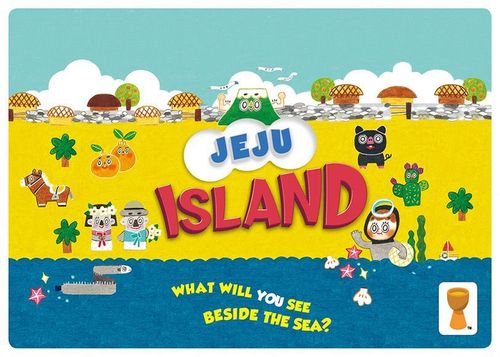
Jeju Island
Jeju Island Rulebook
Table of Contents
Table of Contents
Winning the Game
The game is over when the deck of Point cards is emptied or once all the stacks of Jeju tiles are gone. All players count up the points showing on the Point cards, and also add up their unused Jeju tiles (1 point per two tiles). The player with the most overall points wins.
Contents
32 Point Cards — each card shows a point value, the Jeju tiles needed to claim it, and (sometimes) a special effect.
80 Jeju tiles, in 7 different types:
- Hallabong orange: 11 tiles
- Jeju cactus: 11 tiles
- Hallasan mountain: 11 tiles
- Cutlass fish: 11 tiles
- Jeju pony: 11 tiles
- Jeju black pig: 11 tiles
- Haenyeo diver: 14 tiles
1 set of tokens:
- 6 Neutral tokens
- 2 sets of Player tokens (8 total)
Apply the included stickers to the matching colored tokens.
4 Player Indicator tokens
1 Harubang statue
Game Setup
-
Layout the board in the center play area.
-
Each player takes two Player tokens of the same color, other than the black tokens.
-
Each player takes the Player Indicator token of their color.
-
Shuffle the Jeju tiles and place them in equal stacks on the 6 locations shown on the board.
Note: if a Haenyeo diver token is on the top of any stack, shuffle it lower in that stack.
-
Place the 6 black Neutral tokens on the circled spaces of the board, one on each space.
-
Choose a player order. The first player takes two of their tokens and places them on top of any two different spots occupied by the Neutral tokens. The next players do the same, in turn order.
Note: During setup only, no spot can have more than 3 tokens on it. But during the game the number of tokens in a stack doesn't matter.
-
The last player to play also takes the Harubang statue and places it near any one of the 6 spots.
-
Shuffle the Point cards and place the deck face-down nearby. Draw 5 cards, flip them over and place them above the board.
Play
On a player's turn they may choose and perform one of the two play options below.
1. Travel and Jeju Tile Collecting
Travel
- Choose a stack on the board that includes one of your pieces.
- Pick up the entire stack and choose the left or right direction.
- Starting with the next space in the chosen direction, drop the bottom-most piece of your stack on top of the stack in that space. Continue to the next stack and on, dropping pieces until none are left.
As you're moving the stack from space to space, drop the bottom-most token on each space in that direction until the stack is gone.
Jeju Tile Collecting
-
All players perform Jeju tile Collecting together.
-
For each of the stacks on the board, the player whose token is on top of the stack takes the top Jeju tile next to it. If the top token is Neutral, nobody collects for that stack.
Note: if there are no tiles left in a stack, the player doesn't receive one.
-
If the Harubang statue is next to the tile that a player picks up, it's bonus time! The player may either leave the statue in that spot, or move it to any of the other locations on the board. Either way the player takes the top Jeju tile next to where the statue is placed, as a bonus.
2. Taking Point Cards
-
Using the Jeju tiles that they've collected, a player may spend them to pick up Point cards.
-
Each card shows the tiles that are needed to pick it up. The player must discard those tiles in order to gain the card.
Note: the Haenyeo diver tile counts as a joker. It can be used in place of any other tile.
-
If a player takes a Point card, then another is drawn from the deck to replace it.
Point Card Anatomy
Each Point card shows the type and number of tiles needed for the card, a point value, and (on some cards) a special effect. A question mark on a tile space means any tile can be used for that space.
Special Effect Explanation
- Instant Harubang: as soon as this card is picked up, the player completes the Harubang bonus exactly as it happens during the Jeju tile Collecting phase.
- Card Refresh: as soon as this card is picked up, the rest of the Point cards are discarded from the game, and 5 new cards are put in their place.
- Everlasting tile: for the rest of the game, the player who owns this card can purchase Point cards without having to give up one of this particular tile.
End of the Game
As soon as the stack of Jeju tiles is depleted, or when the Point card deck is exhausted, the game is over.
Counting Up Your Score
-
Count up the point values on all your Point cards.
-
Count up the number of tiles you have left over. Every 2 tiles are worth 1 point.
Note: The Haenyeo diver tiles are NOT counted. They are not worth points in this phase.
Combine your score for the above steps. The player who scored the most overall points wins! In case of a tie, the player with the most point cards wins.