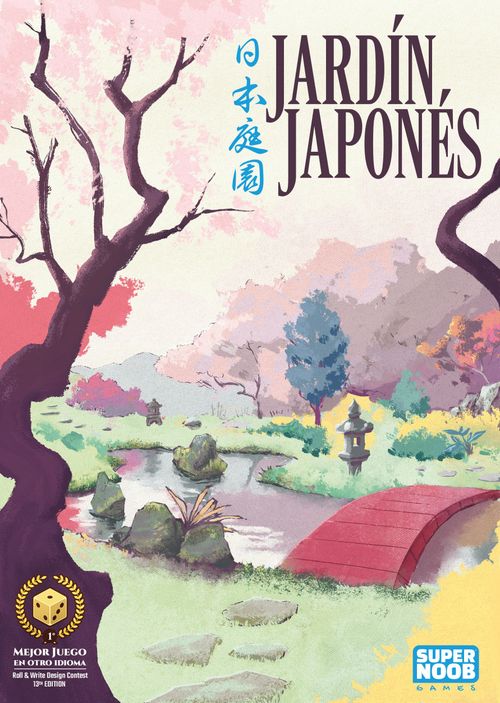
Jardín Japonés
Jardín Japonés Rulebook
Table of Contents
Table of Contents
Components
- Game pad (100 double-sided sheets)
- 3 Dice
- 4 Pencils
Overview
In Jardín Japonés you will try to score the most points by drawing decorations and tracing ponds on a grid during the 4 seasons of the year.
At the end of each season you may trace a pond, boosting the scoring of certain decorations, as well as avoiding negative points for undecorated earth spaces.
Each season is divided into 3 turns: at the start of each turn the dice are rolled and everyone decides what to do with the same roll, taking the scoring criteria into account.
Whoever scores the most points when the year ends wins!
Game Sheet
The sheet shows: the Bonsai, the Turn boxes (one row per season: Autumn, Winter, Spring, Summer), the Garden (a grid with Rows and Columns), the Pond icons with Pond Points, the Scoring Zone, and a Summary of Scoring Criteria.
Decorations and Basic Concepts
Your garden is defined by a 6x6 grid on which you will draw decorations and trace ponds. The rows and columns correspond to the numbers of the 6 faces of the dice, which will indicate the location (row/column) where decorations are drawn.
Each die face shows a decoration icon and a number. The icon represents a decoration. The number indicates a location on the grid.
You must decide, for each die, whether you use the decoration or the location. They never work together.
Location
Some decorations must be on earth spaces to score, while others are boosted by being on water spaces.
Other location concepts: Adjacent (orthogonally next to a space), Diagonal, Around (all the spaces surrounding a space).
Decorations
Stone lantern, Moss, Bamboo, Rock, Tree, Bridge.
How to Play
Give a game sheet and a pencil to each participant and place the 3 dice in the center of the table. Before starting, make sure everyone understands the Scoring Criteria.
1. Start of Turn
Throw the 3 dice (any participant may do it). Everyone will use the same result.
2. Drawing Phase
Each participant decides what to do with the result of the dice, choosing between A or B:
A. Draw 2 decorations. Choose two of the available decorations. The remaining die determines the location in which you have to draw them. There can only be one decoration per space. Example: Lantern and Bamboo in row or column 5. The chosen decorations must be drawn in any of the empty spaces of row 5 or of column 5.
B. Prune the bonsai (max. 3 times). Choose only one decoration to draw it in any space with no location restriction, and mark one of the bonsai's leaves to indicate a pruning (maximum 3 prunings per game). Example: Bonsai pruning to place the Lantern at 6. The remaining dice are ignored.
If you cannot draw the chosen decorations for lack of space, choose another combination of dice or prune the bonsai.
Prune the bonsai wisely! You can only do it 3 times in the whole game.
3. End of Turn
After drawing, write down the dice used in the corresponding turn box (A). If you pruned the Bonsai, write down only the die used for the decoration and the chosen location (B).
Example A: first season, Autumn: decoration numbers 1-2, location number 5. Example B: decoration number 1, location 6.
It is mandatory to end the drawing phase having fulfilled one of the two options. If this is impossible because the uses of the bonsai have been exhausted and because there are no empty spaces in the available locations, skip the drawing phase and write an X in the corresponding turn box.
4. End of Season and Tracing Ponds
At the end of each season, if you wish, you may trace a pond to obtain more points. Ponds allow certain decorations (moss and bridges) to score, and boost others (rocks). You can also use them strategically to fill empty earth spaces, thus avoiding negative points.
To trace a pond, outline one or more adjacent spaces, making a closed figure. If you do, mark the pond icon corresponding to the season that has just ended.
You may only trace one pond per season (there will be at most 4 ponds in each garden at the end of the game). Its shape and size are free but it cannot have another pond around it, nor contain earth spaces.
You may draw decorations in a previously traced pond, or else trace a new pond that contains decorations you drew in earlier turns.
Example: During autumn we place rocks and plant moss in the garden. We know water will soon arrive! At the end of autumn we trace our first pond: now the rock is submerged and the moss is nourished by the moisture at the water's edge. Points assured! Starting winter, we roll the dice and have the opportunity to place a bridge and a bamboo. It is time to take advantage of our first pond!
Watch out! Don't risk too much because decorations can end up out of place. Who wants to see a wet lantern or a bridge without water underneath?
At the end of the game you will get negative points if:
- Bridges are left outside of a pond.
- Lanterns, bamboo, trees or moss are left inside of a pond.
5. End of the Game and Scoring
When summer (the last season) ends, you will contemplate the gardens to count the points. Add up the points obtained with each decoration and each pond following the scoring criteria, and then subtract the empty earth spaces and the out-of-place decorations to get your final result.
Whoever achieves the highest score will obtain the title of Sakuteiki for the best Japanese Garden!
In case of a tie, whoever has more unpruned leaves on their bonsai wins. If the tie persists, whoever has watered a plant more recently wins.
Scoring Criteria
Each decoration has a specific way of scoring and it is essential to be clear on how they work.
Stone Lantern (3 pts.)
The lantern gives 3 points if it is on an earth space and is separated by at least 3 spaces from any other lantern on the grid (counting spaces orthogonally). Ponds or other decorations do not affect the count of spaces between lanterns.
Examples: This lantern at the end of the game gives 3 points. Good! As there are 3 or more spaces separating both lanterns, the new one also scores 3 points. This third lantern does not score points and also cancels those of the previous one... by one space!
Bamboo (2 pts.)
The bamboo gives 2 points if it is on earth and adjacent to another bamboo.
Examples: This bamboo by itself gives no points. By drawing another bamboo adjacent to the first, we get 2 points for each of them. The third bamboo is not adjacent to the previous ones, so it does not score points. With this fourth bamboo we join a whole group of bamboo in adjacency, getting 8 points.
Tree (1 / 2 pts.)
- The tree gives 1 point if it is on earth and is drawn during autumn or winter.
- The tree gives 2 points if it is on earth and is drawn during spring or summer.
To identify the trees drawn in spring and/or summer, make a mark in the space at the moment you draw them. It is also recommended to check the turn record boxes when scoring, to avoid mistakes.
Rock (3 pts.)
- The rock gives 1 point if it is on an earth space and has no other rock around it.
- The rock gives 2 points if it is on a water space and has no other rock around it.
Examples: This rock gives 1 point for being on earth. This second rock on earth meets the distance condition, so it gives 1 point. A pond contains the first rock! Now it gives 2 points. Now we draw a rock but it has another rock around it! Neither of the two gives points.
Moss (1+ pts.)
The moss must be on an earth space and have at least one pond adjacent in order to score. It gives 1 point for each adjacent water space.
Examples: 0 - gives no points as it is not adjacent to any water space. 1 - gives 1 point because it is adjacent to one water space. 2 - gives 2 points because it is adjacent to two water spaces. 3 - gives 3 points because it is adjacent to three water spaces.
Bridge (15 pts.)
To score, the bridge must meet the following criteria:
- It must be on a water space (it may be drawn before or after the pond that contains it).
- It must connect two earth spaces in a straight line.
- It must not have another bridge adjacent.
The score it gives will depend on the number of bridges in your garden at the end of the game, according to the scale 1/4/9/15 points for 1/2/3/4 bridges respectively. Drawing more bridges does not give extra points.
The orientation of the bridge is for aesthetic purposes only and totally optional.
Examples: A - connects two earth spaces in a line. B - connects two earth spaces in a line (the rotation of the bridge is aesthetic). C - does not connect two earth spaces in a line. D - connects two earth spaces in a line, but is adjacent to another bridge. E - does not connect two earth spaces in a line.
Pond (3 pts.)
Each pond gives 3 points. Remember that it is not allowed to have another pond around it.
Penalties
- 1 negative point for each earth space without decoration.
- 1 negative point for each out-of-place decoration (lantern, bamboo, tree or moss on a water space; or bridge on an earth space).
Final Scoring Example
At the end of the year, our garden has a total of 23 decorations, which indicates that the bonsai was pruned only once.
- All the lanterns respect their distance.
- Only one bamboo was left alone.
- One tree was planted in autumn/winter and two others in spring/summer.
- All the moss enjoys the moisture at the water's edge.
- Three bridges facilitate the route through the garden.
- Two rocks are submerged in the ponds while another stands on the earth.
- Four ponds hydrate the garden.
- A bridge on the earth and 6 undecorated spaces add up to 7 negative points. The void is inevitable.
Solo Game
Serve yourself a cup of coffee or tea and immerse yourself in the tranquility of your own garden with a solo game. Follow all the rules already explained and try to surpass yourself as a Niwashi game after game, discovering new strategies while you design and beautify your space of philosophical introspection. Use the following score table to take note of your progress.
| Points | Rank |
|---|---|
| -19 (printed; i.e. up to 19) | Mushin |
| 20 - 30 | A journey of a thousand kilometers begins with a single step. |
| 31 - 40 | Even dust, piled up, can be a mountain. |
| 41 - 50 | Do you hear the wind in the pine tree? |
| 51 - 60 | Contemplate the cherry blossoms. |
| 61+ | Yugen |