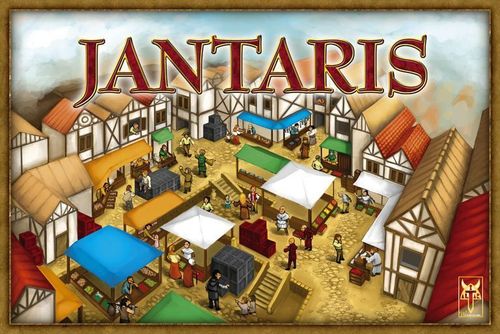
Jantaris
Jantaris Rulebook
Table of Contents
Table of Contents
Game Components
- 1 Game Board with City Map and Prestige Track
- 60 Merchant Pawns (colored wooden pawns, 15 pawns in each of 4 colors)
- 1 Active Player Token
- 2 Merchant Guild Tokens (1 red, 1 black)
- 20 Item Cards (with brown frames)
- 8 Market Control Cards (with black frames)
- 6 Great Fair Cards (with red frames)
- 16 Voting Cards (4 types in 4 colors)
- 48 Goods (colored wooden cubes, 24 red, 24 black)
- 4 Action Description Cards
- 4 Overview Cards
Game Setup
- Place the game board on the table. The board contains the City Map with round City Center in the middle of the city and eight Districts arranged around it. (The City Center doesn't count as a District.) Along the sides of the board, there is a Prestige Track for scoring Prestige Points.
- Place both Merchant Guild Tokens in the City Center in the middle of the City Map.
- Shuffle all the Item Cards to create the Bazaar Deck. Set it face down near the game board. Turn up the top 2 cards of the Bazaar Deck and place them face up next to the Bazaar Deck.
- Shuffle the Great Fair Deck and set it face down near the face up Item Cards.
- Sort the Goods cubes by color and place them near the game board.
- Shuffle the Market Control Deck and set it face down near the game board. Turn up as many cards as there are players and place them face up next to the Market Control Deck, so that each player can see them.
- Each player chooses a different guild (one of the four colors) and takes all Merchant Pawns (also called Merchants), the Action Description Card, the Overview Card, and the 4 Voting Cards ("Strengthen Position", "Deal", "Recruitment" and "Black Market") of his color.
- Each player places one of his pawns on the starting light green space of the Prestige Track and the rest of his Merchants in the empty space in front of him.
Setup figure for 3 players (blue player has all his game requisites).
- Market Control Cards
- Item Cards
- Great Fair Cards
- Game Board
- Merchant Guild Tokens
- Goods
- Merchants
- Action Description Card
- Voting Cards
- Active Player Token
Game Start
The youngest player takes two of his Merchants and places them into two different Districts of his choice. Then each of other players, proceeding clockwise, also places two of his Merchants to two different Districts. Players may place Merchants into Districts where other players have placed Merchants. After each player has placed two Merchants, the youngest player takes the Active Player Token.
The player with the Active Player Token becomes the Active Player and conducts the game for this turn. When his turn ends, he gives the Active Player Token to the player to his left.
General Rules
Each turn has four phases. The following rules apply to all four of these phases.
Amount of Goods
A player may never own more than 6 Goods of each color. When he reaches this limit, he may not gain any more Goods of this color until he has fewer than 6 Goods of this color.
Merchant Guild Tokens
New Merchants may never be placed into a District or into the City Center that is occupied by a Merchant Guild Token.
If it isn't explicitly permitted, Merchants may not be removed from, or moved to or from a District or the City Center if a Merchant Guild Token occupies it.
Once a Merchant Guild Token is moved from the City Center to a District, it can never return to the City Center. A Merchant Guild Token cannot be placed in the District occupied by the other Merchant Guild Token.
Figure: placing new Merchants on the City Map during the Guild House action.
The Active Player's Turn
The Active Player's turn consists of four phases. Their sequence may not be changed.
The 1st Phase – City
In the first phase, the Active Player must choose one of three actions: he can visit the Marketplace, the Guild House, or the Bazaar.
Marketplace
The Active Player may take up to two Goods of the same color from the supply. Since there is a general rule that he is not allowed to own more than 6 Goods of each color, he may not exceed this limit through use of the Marketplace.
Guild House
The Active Player chooses between two actions involving Merchants:
-
Take one of his Merchants from his supply and places it on the City Map (into any District or into the City Center) that does not have a Merchant Guild Token in it.
or
-
Remove up to 2 of his Merchants from areas of the City Map that do not have Merchant Guild Tokens and place them in his supply on the table in front of him.
Bazaar
The Active Player must start the auction for one of the two face-up Items next to the Bazaar Deck. To start the bidding, the Active Player must possess at least the Goods needed for payment of the starting price stated on the card, including the specified color combination of Goods. [If he cannot afford either of the two face up Items, the first phase ends without an auction.] The starting bid must be at least the number of Goods required to buy the Item being auctioned.
After the opening bid by the Active Player, each player (clockwise from the Active Player) may either increase the number of Goods bid or drop out of the auction. To increase the bid price, the player must possess the number and color combination of Goods stated on the Item Card as the starting price, and enough extra Goods to fulfill his bid. Once a player drops out of the auction, he may not rejoin it. When it comes back around to the Active Player, he may match the highest bid, rather than having to bid higher. It is then up to the other bidders to bid higher. If the Active Player doesn't win the first Item auctioned and he has the necessary Goods to open the bidding for the second item, he may start the auction of the second face-up Item on the table. A new face up Item Card is not drawn from the Bazaar Deck until after the entire phase is over.
Other rules for the auction
- If the player doesn't have enough Goods to exceed the highest bid, he must drop out of the auction.
- The Goods that the player offers above the starting price may be of any color combination.
- The Active Player has an advantage – when he wants to be successful in the auction, he needs only bid equal to the highest offer of other players. The other bidders will still have the chance to raise their bids.
- The player who offered the highest price pays the Goods to the supply and becomes a happy owner of the sold Item. He places this Item in front of him and moves his Merchant forward on the Prestige Track. He moves the number of spaces equal to the Prestige Points stated on the Item Card.
- The Active Player may buy only one Item in his turn. If he buys the first Item, he may not auction the second Item.
When the Active Player cannot or does not want to start another auction, he turns up new Item Cards from the Bazaar Deck so that two Items are face-up on the table again. Then the first phase ends.
Description of the Item Card
(Figure: Royal Cape example card, with callouts a–e.)
a. Name of the Item b. Prestige Points acquired by buying the Item c. Supplemental symbol d. Starting price of the Item e. Special effect of the Item
Royal Cape card text: "At the beginning of your turn, each player possessing an Item with the crown symbol may remove one of his Merchants that is not in the same District as a Merchant Guild Token from the City Map."
Crown symbol
When the Item Card has a crown symbol on it, it means its effect affects not only its owner, but also all the other players who own at least 1 Item Card with a crown symbol. If the Active Player owns more than one Item Card with a crown symbol, he determines the order of their effects.
Using the Items
Each Item Card text contains information about when the Item effect occurs. Items are retained for the remainder of the game unless the card explicitly states that it is discarded. Some cards that are retained can be used multiple times. The effect can occur:
- immediately after it is bought, in which case this is the only time the benefit is gained
- at the very beginning of each of the Item owner's turns, i.e. before this player chooses where to go for phase one
- when the specific situation described on the card occurs; the card takes effect immediately once the stated situation occurs
Note
Each of the three actions can benefit the Active Player, but remember that an action might not benefit the player if completing that action would violate a general rule. For example, the Active Player should not visit the Marketplace when he already has 6 red and 6 black Goods, because he cannot gain any more goods.
The 2nd Phase – Diplomacy
The Active Player chooses one of the two Merchant Guild Tokens and moves it to a District not already occupied by a Merchant Guild Token. This District is called the Active District for this phase. Each District adjacent to the Active District is called the Nearby District for this phase. Each player then chooses one of his Voting Cards and places it face down on the table in front of him. When all players have chosen their Voting Cards, they all turn them face up, so the other players can see them. After the showing of Voting Cards, the Active Player takes his action, followed by other players, proceeding clockwise.
The effect of the Voting Card depends on the number of the votes of the same type. It is described on the Action Description Card.
Action Description Card. The printed grid has no row labels; the row labels below are taken from the Diplomacy text ("[2 "Deal"]", "[3+ "Deal"]") and the Black Market and Recruitment descriptions, indicating how many players chose that card.
| Deal | Black Market | Strengthen Position | Recruitment | |
|---|---|---|---|---|
| 1 vote | Gain 2 Goods of the same color as Merchant Guild Token in the Active District. | Take 1 Good from one of your opponents. | Banish one player's Merchants from the Active District. | Place 1 Merchant from your supply into any District that not occupied by a Merchant Guild Token. |
| 2 votes | Gain as many Goods as you have Merchants in the Active District. The color of the Goods is the same as Merchant Guild Token in the Active District. | Gain 2 Goods from the supply. They may be the same or different colors. | Move up to 2 of your Merchants from one of the Nearby Districts not occupied by a Merchant Guild Token to the Active District. | Place 1 Merchant from your supply into the City Center, if a Merchant Guild Token doesn't occupy it. |
| 3 or more votes | Gain as many Goods as you have Merchants in the City Center. The color of the Goods is the same as Merchant Guild Token in the Active District. | Lose all your Goods. All your Merchants are banished from the Active District. |
Example: During the voting Peter plays "Black Market", Jane plays "Deal" and Richard plays "Black Market". Thus Jane gains 2 Goods of the same color as the Merchant Guild Token in the Active District. Peter and Richard each gain 2 Goods; they may choose the color of their Goods.
To clarify the Voting Card effects, you can use the following summary of their functions and the influence upon the game. The exact description of their functions is on the Action Description Card that players have.
Deal – allows the player to gain Goods that he can use to buy Items or trade at the Great Fair. If you vote for this action alone, you gain two Goods of the same color as the Merchant Guild token in the Active District. When more than one player chooses "Deal", the number of Goods gained is determined by the number of Merchants that player has in the Active District or in the City Center (i.e. the more Merchants he has in the Active District or in the City Center, the more Goods he gains). When he has no Merchants in the Active District or in the City Center, he gains no Goods.
Black Market – also allows the player to gain Goods. He takes the Goods from another player or from the supply; in both cases, it could be one or both colors. But there is a danger that you should not underestimate – when more than two players choose the "Black Market", all the players who chose it lose all their Goods and their Merchants are banished from the Active District.
Strengthen Position – helps the Strengthen Position player move Merchants between Districts or banish other players' Merchants from the Active District, thereby changing the dominant position in that District. "Strengthen Position" is often a key action when trying to claim a Market Control Card in the fourth phase of the Active Player's turn, thus you should plan on using it carefully. You may banish your own Merchants or select a player who has no Merchants in the Active District.
Recruitment – brings new Merchants into the City from your supply. According to the number of players choosing for this action, the new Merchants are placed to any District, the City Center, or one of the Nearby Districts.
Banish
The term "banish" is used in certain action descriptions and on a few Item cards. Each player whose Merchants are banished must follow these steps:
- He moves one Merchant from the Active District to each Nearby District (if he has only one Merchant in the Active District, he may choose which one to move it to). He may not move the Merchant to a Nearby District occupied by a Merchant Guild Token. In this case, he can only move one Merchant to the other Nearby District.
- He removes all his Merchants remaining in the Active District and places them in the supply in front of him.
Example of banishing 4 Merchants from the District Taira (figure).
The 3rd Phase – Great Fair
When fewer than 5 Merchants are in the City Center at the end of the second phase, the third phase is skipped and the Active Player proceeds to the fourth phase. If there are five or more Merchants in the City Center, the Active Player turns up the top Great Fair Card and then proceeds according to the following rules:
If the Active Player has at least one Merchant in the City Center and has at least as many Goods of any color as is stated on the Great Fair Card, he must pay this amount of Goods (any color combination). This brings him the number of Prestige Points stated on the Great Fair Card (he moves forward his Merchant on the Prestige Track by this number of spaces). After this exchange of Goods to Prestige Points he moves one of his Merchants from the City Center to any District not occupied by a Merchant Guild Token. Whether he made this exchange or not, the player to his left takes the same action. This continues until no one can trade Goods for Prestige Points (i.e. he has no more Merchants in the City Center or he does not have enough Goods to make the exchange). At this point, the third phase ends and the Active Player places the face up Great Fair Card on the bottom of the Great Fair Deck.
(Figure: Great Fair card example, showing three Goods above a red arrow and two Prestige-point Goods below it.)
The 4th Phase – Market Control
Any player can gain Prestige Points by meeting the conditions of the Market Control Card. To gain the Prestige Points, he needs to dominate the three Districts named together on one of the exposed Market Control Cards.
To achieve the dominance in a District, the player must have at least two Merchants there and more Merchants than any other player in the District.
If a player meets the conditions for claiming a Market Control Card in this phase, he has the option of announcing it to the other players and taking that card. Every Market Control Card earns its holder 3 Prestige Points (which the player immediately scores in the Prestige Track). He places the claimed Market Control Card on the table in front of him and turns up a new Market Control Card (if there is still a card in that deck). A player may claim the newly turned up Market Control Card before the phase ends.
(Figure: Market Control card example – Rajan, Chamarat, Taira.)
The End of Player's Turn
At the end of the fourth phase, the Active Player's turn ends. The Active Player gives the Active Player Token to the player on his left. This player becomes the new Active Player and starts his turn with the first phase.
The End of the Game
The game ends when at the beginning of the turn of the player who started the game, one or more players have 12 or more Prestige Points. At that point, the player who has the most Prestige Points wins. If there are two or more players tied for the most Prestige Points, the player who possesses more Goods wins. If they also have the same number of Goods, the players win together.
Sample Game
For a better understanding of the rules, here is a sample game, in which we will observe one game turn through one player's (Peter) eyes. Three Peter's friends – Jane, Mark, and Linda – are playing the game with him.
After opening the game box, Peter helps the others with game setup. He places the game board in the middle of the table. Then he spills out all wooden components from the bag. He selects the two Merchant Guild Tokens and places them in the City Center on the City Map. He then takes all the blue (his favorite color) Merchant Pawns, the blue Action Description Card, the blue Overview Card, and the four blue Voting Cards. After this, he shuffles the Market Control Deck, turns up four cards from it and places them next to the deck. Meanwhile, the other players finish the rest of game setup. At last, each player places two Merchants into two different Districts. Peter is the youngest player, so he places his Merchants first. As the District Shakara is named on only one face up Market Control Card, he decides to place his first Merchant there, avoiding the competition for Districts named on two or three of the Market Control Cards. Then he places his second Merchant into Likaran. The other players also place two of their Merchants into two different Districts of their own choice. As Peter is the youngest player, he takes the Active Player Token and starts the game.
First, Peter chooses which of the three options he will use during the first phase. After a short hesitation, he chooses the Guild House and places one of his Merchants from his supply into Shakara. As he now has two of his Merchants in this District, all other players have fewer Merchants than Peter here. Peter has temporarily achieved market dominance in Shakara. It will be useful in the future. Now Peter's first phase ends and the second phase starts.
As both Merchant Guild Tokens occupy the City Center, Peter can choose any District. He chooses Shakara (where his Merchants dominate) and moves the black Merchant Guild Token to it. At this moment, each player chooses one of his Voting Cards and places it face down on the table. Peter chooses the "Deal" Card.
When all players have chosen their Voting Cards, they turn them face up. Jane, who sits next to Peter clockwise, has also chosen the "Deal". Mark, sitting next to Jane clockwise, has chosen "Black Market". Linda, the last player, decides to play "Recruitment". Peter takes his action first. As two "Deal" Cards have been played (Peter's and Jane's), Peter has to take the second action described on the Action Description Card, which says: "Gain as many Goods as you have Merchants in the Active District. The color of the Goods is the same as Merchant Guild Token in the Active District." Peter has two Merchants in the Active District, so he gains two black Goods from the supply. Then Jane also does the action for when two players choose "Deal", but she has no Merchants in the Active District, so she doesn't gain any Goods. Mark takes one Good from Peter. Finally, Linda takes one Merchant from the supply in front of her and places it into Likaran.
Since all the players have taken their second phase actions, the second phase ends and the third phase, Great Fair, starts. There are no Merchants in the City Center, so the Great Fair doesn't proceed and we move on to the fourth phase. As no player meets conditions of any of the Market Control Cards, the fourth phase ends too. Peter gives the Active Player Token to Jane. She becomes the Active Player and starts her turn with the first phase.
(Figure: game layout for the sample game.)
Hints for the Beginners
- At the start of the game, when the Merchant Guild Tokens are still on the City Center, you should consider the risk of playing the "Recruitment" Card. If one of the other players votes for "Recruitment" too, both of you will not benefit from the action.
- If only one player chooses "Strengthen Position", he may use it on his own Merchants. This action can help you move your Merchants effectively across the City Map (for example, after claiming a Market Control Card, you may wish to migrate your Merchants to Nearby Districts listed on another Market Control Card).
- You can achieve dominance in Districts by using the Great Fair, as you get to choose where your Merchants are moved when they leave the City Center for the surrounding Districts after trading.
- When you like an offered Item in the Bazaar and start to save up the required Goods to claim it in the auction, you should think twice before playing the "Recruitment" Card in the Diplomacy phase. It may lead to you having to place your Merchant into the City Center, leading to the Great Fair before you have the chance to auction the desired Item. This brings valuable Prestige Points to you, but it prevents you from having the Goods needed to buy the Item.
Appendix
This Appendix solves specific problems and uncertainties when using some Items. If the use of an Item is unclear to you, check here for the solution.
Historic Book
The effect of this card proceeds just after entering the bazaar, i.e. before the auction starts.
Picks
When the three Items each bring you the same number of Prestige Points, you cannot claim any of them.
Old Coins
Of course, you may use this Item only when the conditions for the Great Fair are fulfilled, i.e. there are at least 5 Merchants on the City Center.